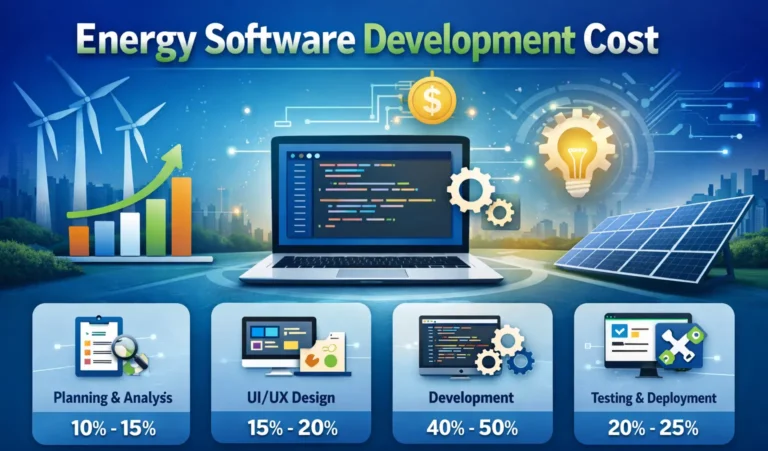
Energy software development plays a crucial role in optimizing power generation, monitoring consumption, and improving sustainability across industries.
Typically, the cost of energy software development ranges from $8,000 to $70,000+, depending on project scope, complexity, features, and technology stack.
Basic applications with limited functionality fall on the lower end, while advanced systems with AI integration, real-time analytics, and IoT capabilities can significantly increase expenses.
Understanding the pricing structure helps businesses allocate budgets effectively, avoid unexpected costs, and ensure long-term scalability, performance, and compliance with energy regulations in a competitive digital landscape.
What Factors Affect the Cost of Energy Software Development?
Several key factors influence energy software development costs, including complexity, features, technology choices, and team expertise, all directly impacting the final project budget and timeline.
1. Project Complexity
Complexity significantly impacts cost, as simple dashboards cost less while advanced systems with AI, IoT, or predictive analytics increase expenses.
A highly complex energy app development company may approach $70,000 due to development time, integrations, and specialized expertise required for accurate data processing.
2. Features and Functionality
The number and type of features, such as real-time monitoring, reporting tools, and automation, influence cost.
Basic features keep costs near $8,000, while advanced capabilities like AI-driven insights and forecasting increase development time and overall pricing significantly.
3. Technology Stack
The choice of programming languages, frameworks, and infrastructure affects costs. Modern and scalable technologies may require skilled developers, increasing expenses.
Cloud-based or IoT-integrated systems also raise costs due to additional configuration, licensing, and long-term scalability requirements.
4. Development Team Location
Hiring developers from different regions affects pricing. Teams in North America or Europe charge higher rates compared to Asia.
Offshore development can reduce costs while maintaining quality, helping businesses stay within budget without compromising functionality or performance.
5. Integration Requirements
Energy software often needs integration with third-party systems, sensors, or APIs.
The more integrations required, the higher the cost due to additional development, testing, and compatibility checks, especially when dealing with real-time energy data systems.
6. Compliance and Security
Energy software must comply with industry regulations and data security standards.
Implementing secure data handling and compliance features adds to development time and cost, particularly for enterprise-level applications requiring strict regulatory adherence and audit capabilities.
What Is the Cost Breakdown of Energy Software Development?
Breaking down energy software development costs helps businesses understand where budgets are allocated, from design and development to testing, deployment, and ongoing maintenance expenses.
1. Basic Development ($8,000 – $15,000)
Basic energy software includes simple dashboards, monitoring tools, and limited integrations.
Costs remain low due to minimal features, shorter development timelines, and reduced technical complexity, making it ideal for startups or small-scale energy tracking solutions.
2. Medium-Level Development ($15,000 – $40,000)
Medium-level software includes real-time analytics, reporting, and moderate integrations. Costs increase due to enhanced UI/UX, improved functionality, and scalability.
These solutions suit growing businesses requiring more advanced energy monitoring and performance optimization tools.
3. Advanced Development ($40,000 – $70,000+)
Advanced solutions include AI, IoT integration, predictive analytics, and automation. High costs result from complex architecture, longer timelines, and specialized expertise.
These systems are ideal for enterprises managing large-scale energy operations and smart grid systems.
4. UI/UX Design Costs
Design costs typically range from $2,000 to $10,000, depending on complexity.
A well-designed interface improves usability and user engagement, which is crucial for energy dashboards requiring clear visualization of data and real-time insights.
5. Testing and Quality Assurance
Testing ensures reliability and performance, costing around $2,000 to $8,000.
Energy software requires rigorous testing due to real-time data handling, ensuring accuracy, stability, and security across multiple devices and systems.
6. Maintenance Costs ($1,000 – $10,000/year)
Ongoing maintenance includes updates, bug fixes, and performance optimization.
Costs vary based on system complexity, ensuring the software remains secure, scalable, and aligned with evolving energy regulations and technological advancements.
How Does App Complexity Impact the Total Development Cost?
App complexity directly influences development cost by determining required features, integrations, development time, and expertise, ultimately shaping the total budget for energy software solutions.
1. Simple Applications ($8,000 – $15,000)
Simple apps include basic monitoring and reporting features with minimal integrations.
They require less development time and fewer resources, making them cost-effective and suitable for small businesses or initial energy management solutions.
2. Moderate Complexity Apps ($15,000 – $40,000)
These apps include dashboards, analytics, and integrations with external systems.
Increased functionality requires more development effort, resulting in higher costs while offering better scalability and performance for mid-sized energy operations.
3. Highly Complex Apps ($40,000 – $70,000+)
Advanced apps feature AI, IoT connectivity, and predictive analytics.
These systems require extensive development, testing, and expertise, significantly increasing costs but delivering powerful capabilities for large-scale energy management and automation.
4. Data Processing Requirements
Handling large volumes of real-time energy data increases complexity and cost.
Systems requiring high-speed processing and storage solutions demand robust infrastructure, raising development expenses closer to the higher price range.
5. Customization Needs
Highly customized solutions require additional development time and expertise.
Tailored features for specific industries or workflows increase complexity and costs, especially when compared to standard or template-based solutions.
6. Scalability Requirements
Applications designed for future growth require scalable architecture.
Building such systems increases initial costs but ensures long-term efficiency and reduces the need for expensive redevelopment as user demand and data volume grow.
What Are the Hidden and Ongoing Costs of Energy Software Development?
Beyond initial development, hidden and ongoing costs can impact budgets, including maintenance, updates, infrastructure, and compliance expenses that businesses must plan for effectively.
1. Maintenance and Updates (Starting $1,000+)
Regular updates and bug fixes ensure smooth performance.
Costs begin around $1,000 annually but increase depending on complexity, helping maintain system reliability, security, and compatibility with evolving technologies.
2. Cloud Hosting and Infrastructure
Cloud services and server costs are ongoing expenses.
Depending on usage and data volume, businesses may spend thousands annually to maintain system performance, especially for real-time energy monitoring platforms.
3. Third-Party Integrations
APIs and external services may require subscription fees.
These hidden costs accumulate over time, particularly for advanced energy software relying on multiple integrations for data collection and analysis.
4. Security Enhancements
Cybersecurity measures require continuous investment.
Protecting sensitive energy data involves regular updates, monitoring tools, and compliance checks, increasing long-term operational costs beyond initial development.
5. Compliance Costs
Meeting regulatory standards involves audits, certifications, and updates.
These costs are often overlooked but are essential for operating legally in the energy sector, especially in regulated markets.
6. Scaling Costs (From $8,000+)
As user demand grows, scaling infrastructure and features increases costs.
Businesses may need additional development investment to upgrade systems, ensuring performance and reliability under higher workloads.
How Can You Reduce Energy Software Development Costs?
Reducing development costs requires strategic planning, efficient resource allocation, and smart technology choices to balance affordability with performance and scalability in energy software projects.
1. Start with MVP (Save $10,000–$30,000)
Building a Minimum Viable Product reduces initial costs by focusing on core features. This approach allows businesses to launch early and expand later, keeping development within the $8,000–$20,000 range initially.
2. Use Pre-Built Solutions (Save $5,000–$15,000)
Leveraging existing frameworks and tools reduces development time and cost. Pre-built modules eliminate the need for building features from scratch, lowering overall expenses significantly.
3. Outsource Development (Save $10,000–$25,000)
Hiring offshore developers reduces hourly rates while maintaining quality. This approach helps businesses achieve high-quality results within a lower budget compared to hiring in high-cost regions.
4. Limit Customization (Save $5,000–$20,000)
Avoiding unnecessary custom features reduces development time and costs. Standard solutions often meet most requirements, minimizing the need for expensive tailored functionalities.
5. Optimize Feature Set (Save $8,000–$25,000)
Focusing only on essential features prevents overspending. Eliminating non-critical functionalities ensures efficient resource use and keeps development within budget constraints.
6. Plan for Scalability Early (Save $10,000+)
Investing in scalable architecture early prevents costly redesigns later. Proper planning reduces long-term expenses while ensuring the software can grow efficiently with business needs.
Conclusion
Energy software development is a strategic investment that varies widely in cost, typically ranging from $8,000 to $70,000+, depending on complexity, features, and scalability requirements.
While basic solutions offer affordable entry points, advanced systems deliver powerful capabilities for large-scale energy management.
Understanding cost factors, breakdowns, and hidden expenses helps businesses plan effectively and avoid budget overruns.
As the energy sector continues to evolve with digital transformation, investing in the right software solution ensures improved efficiency, sustainability, and long-term growth, making it a valuable asset for businesses aiming to stay competitive.
Frequently Asked Questions ( FAQs )
1. What is the average cost of energy software development?
Energy software development typically costs between $8,000 and $70,000+, depending on complexity, features, integrations, and scalability requirements for businesses.
2. How much does basic energy software cost?
Basic energy software costs around $8,000 to $15,000, offering simple dashboards, monitoring tools, and limited integrations suitable for small businesses.
3. What is the cost of advanced energy software?
Advanced energy software ranges from $40,000 to $70,000+, including AI, IoT, real-time analytics, automation, and complex integrations for enterprises.
4. How much does maintenance cost annually?
Maintenance costs range from $1,000 to $10,000 annually, covering updates, bug fixes, security improvements, and system optimization for performance.
5. What factors increase development costs the most?
Complex features, AI integration, customization, third-party integrations, and strict security requirements significantly increase development costs, reaching up to $70,000+.
6. Can I reduce development costs?
Yes, using the MVP approach, outsourcing, limiting features, and pre-built tools can reduce costs by $5,000 to $30,000 effectively.
7. How long does development take?
Energy software development usually takes 2 to 6 months, depending on complexity, features, integrations, and team expertise involved in project execution.
8. Are there hidden costs involved?
Yes, hidden costs start from $1,000+, including hosting, APIs, maintenance, compliance, security upgrades, and scaling expenses over time.
9. Is outsourcing a cost-effective option?
Outsourcing can save $10,000 to $25,000, providing access to skilled developers, lower rates, and efficient project execution with proper management.
10. What is the best budget for starting a project?
A budget of $8,000 to $20,000 is ideal for MVP development, allowing testing, early launch, and future scalability planning efficiently.

CrinPro
CrinPro Solutions is a leading IT company that helps startups and enterprises build innovative digital products. From intuitive mobile applications and high-performance websites to AI-powered solutions and enterprise software, our team delivers scalable, secure, and user-focused products tailored to unique business needs. With expertise across multiple industries, we transform ideas into digital experiences that drive growth, improve efficiency, and create long-term business value.