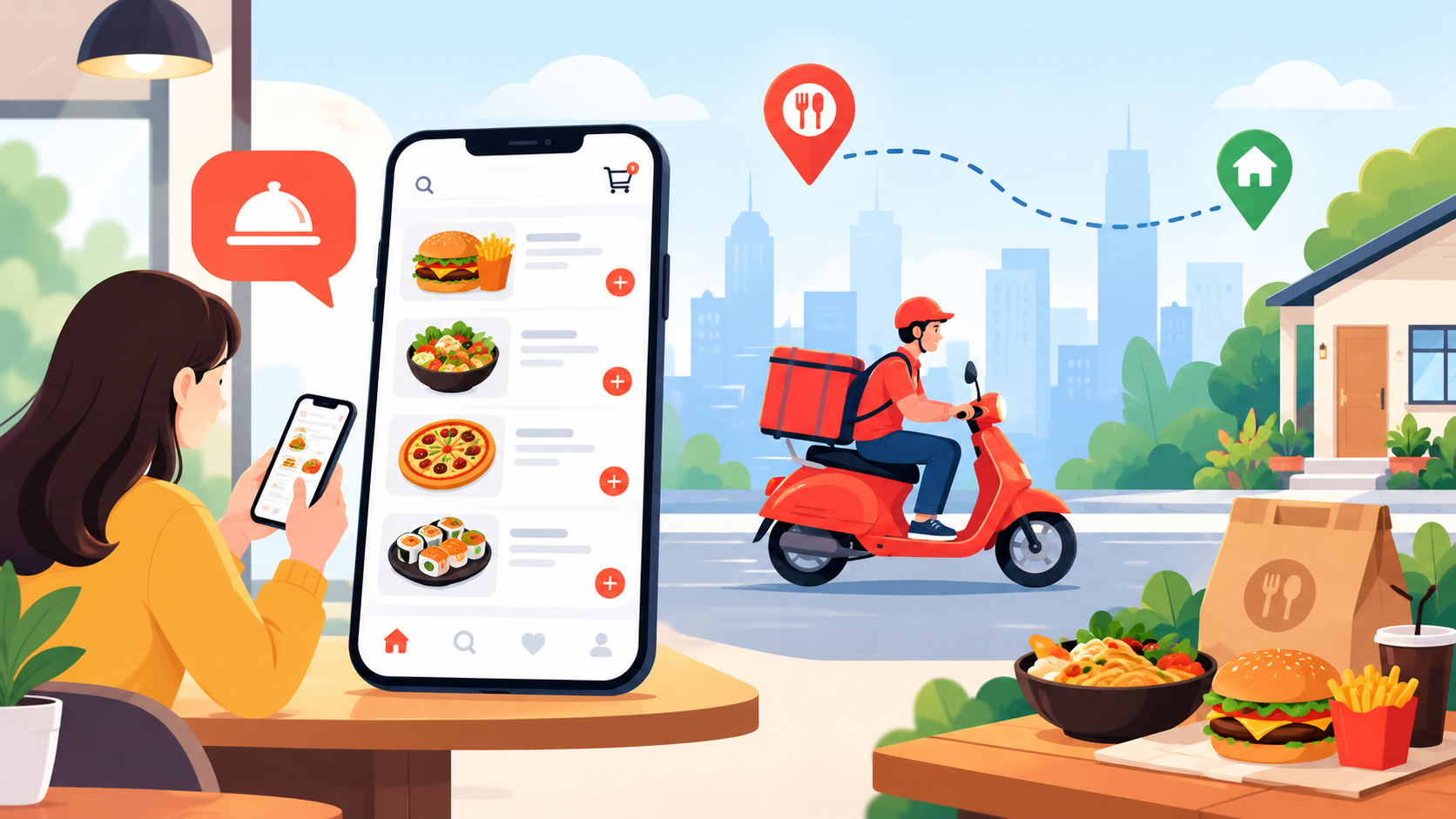
Key Takeaways:
- Food delivery app development requires careful planning, scalable technology, and user-focused features.
- Development costs can range from $8,000 to $70,000 based on project requirements.
- Security, GPS tracking, integrations, and scalability are important development considerations.
- A strong launch strategy can improve customer adoption and platform performance.
- Choosing an experienced development partner can simplify development and ongoing maintenance.
Learning how to build a food delivery app has become essential knowledge for entrepreneurs looking to capture the booming on-demand food market, where consumers increasingly expect fast, convenient, and reliable ordering experiences from their smartphones.
Turning a promising idea into a fully functional, market ready platform involves far more than just writing code; it requires careful planning around business models, core features, technology choices, and a clear understanding of how customers, restaurants, and delivery riders will interact within the app.
Whether you're launching a single restaurant ordering system or a multi-vendor marketplace competing with established players, the journey from concept to successful launch follows a defined path.
This guide walks through everything you need to know, covering ideation, essential features, development steps, and practical strategies for a successful market launch.
Understanding the Food Delivery App Market Opportunity
The food delivery industry continues expanding as consumers prioritize convenience, variety, and faster ordering experiences.
Food delivery app development gives restaurants and entrepreneurs opportunities to reach wider audiences, streamline operations, personalize experiences, and build scalable digital food businesses.
1. Growing Consumer Demand
Convenience remains a major driver of online food ordering. Consumers increasingly use smartphones to browse menus, compare restaurants, place orders, and track deliveries.
This shift creates strong opportunities for businesses offering simple, reliable, and engaging digital ordering experiences.
2. Strong Market Growth
The global online food delivery market was valued at $288.8 billion in 2024 and is projected to reach $505.5 billion by 2030, growing at a 9.4% CAGR from 2025 to 2030.
3. Rising On-Demand Ordering
Mobile-first consumers increasingly expect quick access to meals, live delivery tracking, digital payments, and personalized recommendations.
On-demand food delivery app development helps businesses meet these expectations while connecting customers, restaurants, and delivery partners through one convenient digital ecosystem.
4. Expanding Digital User Base
Statista projects the worldwide online food delivery market to generate approximately $1.51 trillion in 2026, with meal delivery expected to reach 2.6 billion users by 2031. This expanding user base supports opportunities for innovative platforms.
Types of Food Delivery App Models to Choose From
Choosing the right food delivery model depends on your target customers, business goals, restaurant partnerships, and delivery operations.
Understanding different models helps businesses select a scalable approach that supports customer convenience, efficient ordering, and sustainable revenue growth.
1. Restaurant Aggregator App
A restaurant aggregator connects customers with multiple restaurants through one platform.
Online food ordering app development for this model typically includes restaurant listings, menus, reviews, search, payments, order tracking, promotions, and delivery management for convenient food discovery.
2. Restaurant-Owned Delivery App
A restaurant-owned app focuses on managing orders and deliveries for one restaurant or brand.
Restaurant delivery app development can include digital menus, table reservations, loyalty programs, online payments, delivery tracking, customer profiles, and promotional offers.
3. Multi-Restaurant Marketplace App
A multi-restaurant marketplace allows customers to order from numerous restaurants within one application.
Custom food delivery app development can support restaurant dashboards, delivery partners, customer accounts, real-time tracking, promotions, reviews, payments, and centralized order management.
4. Cloud Kitchen Delivery App
Cloud kitchen apps focus on restaurants operating without traditional dine-in spaces.
The platform can showcase multiple virtual food brands, accept digital orders, manage kitchen workflows, coordinate deliveries, and provide customers with convenient ordering and real-time delivery updates.
5. Grocery and Food Delivery App
This model combines prepared meals with grocery and essential food deliveries.
Customers can order restaurant meals, packaged foods, beverages, and household essentials from one platform, creating broader revenue opportunities through multiple product categories and convenient doorstep delivery.
6. Subscription-Based Food Delivery App
Subscription-based platforms offer recurring meal deliveries or membership benefits for regular customers.
Businesses can provide weekly meal plans, discounted deliveries, exclusive offers, scheduled orders, and loyalty rewards, encouraging repeat purchases while creating predictable and recurring revenue streams.
Must-Have Features for a Successful Food Delivery App
A successful food delivery platform needs intuitive functionality that makes ordering simple for customers and management efficient for businesses.
These food delivery app features can improve convenience, streamline operations, strengthen customer engagement, and support long-term business growth.
1. Easy Restaurant and Menu Discovery
Customers should quickly find restaurants, cuisines, dishes, and offers using search and filters.
When considering how to build a food delivery app, businesses should include location-based discovery, categories, ratings, menus, pricing, and availability for smoother ordering experiences.
2. Seamless Order Management
Efficient order management helps customers place, modify, and track their orders without confusion.
During food delivery app development, businesses should provide order confirmations, preparation updates, delivery status, estimated arrival times, and notifications to keep customers informed throughout the process.
3. Multiple Payment Options
Offering flexible payment methods makes checkout convenient and reduces abandoned orders.
The food delivery app business model can support credit and debit cards, digital wallets, UPI, cash on delivery, and other secure payment methods according to the target market.
4. Real-Time Delivery Tracking
Real-time tracking allows customers to follow their orders from restaurant preparation through delivery.
GPS integration can display delivery partner locations, estimated arrival times, route updates, and status notifications, giving users greater visibility and confidence throughout the delivery process.
5. Ratings and Reviews
Ratings and reviews help customers make informed restaurant choices while giving businesses valuable feedback.
Users should be able to rate food quality, delivery experience, restaurant service, and delivery partners, helping platforms maintain quality standards and improve customer satisfaction.
6. Personalized Recommendations
Personalized recommendations can make food discovery more engaging by suggesting restaurants and dishes based on previous orders, preferences, location, and browsing behavior.
Businesses can also use personalized offers, loyalty rewards, and notifications to encourage repeat purchases and increase engagement.
Best Tech Stack for Building a Scalable Food Delivery App
Choosing the right food delivery app technology stack helps businesses build applications that remain fast, secure, and scalable.
The right combination of frontend, backend, databases, cloud services, APIs, and payment tools supports seamless operations as users and orders increase.
1. Frontend Technologies
React Native, Flutter, or React.js can create responsive customer and delivery interfaces.
Businesses should consider these technologies during their food delivery app launch strategy to support smooth navigation, restaurant discovery, ordering, tracking, and consistent experiences across multiple devices.
2. Backend Technologies
Node.js, Python, Java, or PHP can power reliable backend systems for food delivery platforms.
During Uber eats clone app development, backend technologies manage user accounts, restaurant operations, order processing, delivery assignments, payments, notifications, and communication between different application components.
3. Database Technologies
PostgreSQL, MySQL, MongoDB, and Redis can handle different types of application data.
Relational databases manage structured information such as users and orders, while NoSQL databases and caching solutions support flexible data handling and faster access to frequently requested information.
4. Cloud Infrastructure
AWS, Microsoft Azure, and Google Cloud provide scalable infrastructure for food delivery platforms.
Cloud services support secure hosting, automated backups, load balancing, database management, monitoring, and storage, helping applications maintain reliable performance during traffic spikes and high-order periods.
5. GPS and Mapping APIs
Google Maps Platform, Mapbox, or similar mapping services can enable location-based restaurant discovery and delivery tracking.
These APIs support route optimization, distance calculations, geolocation, estimated arrival times, and real-time driver tracking, creating a smoother experience for customers and delivery partners.
6. Payment Gateway Integration
Payment gateways such as Stripe, PayPal, or regional payment providers enable secure digital transactions.
Integration should support multiple payment methods, transaction verification, refunds, payment status updates, and secure processing while ensuring customers can complete orders conveniently across supported devices.
7. Push Notification Services
Firebase Cloud Messaging and Apple Push Notification Service can deliver timely updates to users.
Notifications can inform customers about order confirmations, preparation progress, delivery assignments, discounts, and arrival updates, while restaurants and drivers receive important operational alerts.
8. Security Technologies
Security technologies such as SSL/TLS encryption, OAuth, multi-factor authentication, and secure API practices help protect sensitive information.
Implementing proper access controls, encrypted data storage, fraud monitoring, and regular security testing can reduce risks and strengthen trust across the platform.
Step-by-Step Development Process: From Idea to Launch
A structured food delivery app development process helps transform an idea into a reliable digital platform.
From market research and planning to design, development, testing, and launch, each stage ensures the app meets customer and business expectations.
1. Conduct Market Research
Start by researching competitors, target customers, food preferences, pricing, and delivery expectations.
During restaurant app development, identify market gaps, define your audience, study existing platforms, and determine the features that can give your application a competitive advantage.
2. Define App Requirements
Clearly define how the platform will work for customers, restaurants, delivery partners, and administrators.
Understanding how to build a food delivery app involves identifying user journeys, essential features, payment options, delivery workflows, integrations, and business requirements before development begins.
3. Create a Project Plan
Establish the development scope, technology requirements, project milestones, team responsibilities, and estimated budget.
Understanding the food delivery app development cost at this stage helps businesses allocate resources effectively, prioritize features, and avoid unexpected expenses during later development stages.
4. Design the UI/UX
Create wireframes, prototypes, and final interfaces for every application component. The design should make restaurant discovery, menu browsing, checkout, order tracking, and account management simple.
A user-friendly interface improves navigation and creates a more engaging overall ordering experience.
5. Select the Technology Stack
Choose suitable frontend, backend, database, cloud, payment, mapping, and notification technologies based on project requirements.
Understanding the on-demand app development cost helps businesses balance technology choices with scalability, functionality, performance, maintenance requirements, and available development budgets.
6. Develop Core Features
Develop customer, restaurant, delivery partner, and admin functionalities according to the approved specifications.
On-demand food delivery app development typically includes registration, restaurant listings, menus, ordering, payments, delivery assignment, GPS tracking, notifications, ratings, and administrative management.
7. Integrate Essential APIs
Integrate services required for payments, maps, notifications, authentication, analytics, and real-time tracking.
Online food ordering app development becomes more effective when APIs are carefully selected, securely configured, thoroughly tested, and optimized for reliable communication between application components.
8. Build Custom Functionality
Add specialized features that differentiate the platform from competitors.
Custom food delivery app development may include loyalty programs, subscription plans, personalized recommendations, promotional tools, advanced analytics, multiple delivery options, restaurant management features, or unique ordering experiences based on business needs.
9. Test the Application
Perform functional, usability, security, compatibility, and performance testing across supported devices and platforms.
Restaurant delivery app development requires thorough testing of menus, orders, payments, delivery assignments, tracking, notifications, and restaurant workflows to identify and resolve issues before launch.
10. Launch and Monitor
Deploy the application to relevant app stores and production environments after completing testing and approvals.
Monitor performance, user feedback, crashes, orders, and engagement after launch. Regular updates and improvements help maintain reliability, enhance customer satisfaction, and support long-term growth.
Cost to Build a Food Delivery App
The food delivery app development cost typically ranges from $8,000 to $70,000, depending on features, platforms, design, integrations, security, and customization.
A basic app costs less, while advanced platforms with multiple user panels require higher investments overall.
|
Cost Element |
Estimated Cost |
Description |
|
Market Research & Planning |
$500–$600 |
Defines target users, competitors, features, and overall project requirements. |
|
UI/UX Design |
$700–$800 |
Creates intuitive interfaces for customers, restaurants, and delivery partners. |
|
Customer App Development |
$900–$1,000 |
Builds browsing, ordering, payment, tracking, and account management features. |
|
Restaurant Panel |
$1,200–$1,500 |
Enables restaurants to manage menus, orders, offers, and business information. |
|
Delivery Partner App |
$1,500–$2,000 |
Supports delivery assignments, navigation, status updates, and earnings management. |
|
Backend Development |
$1,500–$2,000 |
Handles users, orders, payments, APIs, databases, and application logic. |
|
Payment Integration |
$700–$800 |
Enables secure online payments, refunds, transaction processing, and payment verification. |
|
GPS & Map Integration |
$900–$1,000 |
Provides location services, route mapping, delivery tracking, and distance calculations. |
|
Testing & Quality Assurance |
$700–$800 |
Identifies functional, security, performance, and compatibility issues before launch. |
|
Maintenance & Support |
$900–$1,000 |
Covers updates, bug fixes, optimization, monitoring, and ongoing technical assistance. |
Common Challenges in Food Delivery App Development (and How to Solve Them)
Food delivery platforms face challenges involving logistics, technology, customer expectations, and restaurant coordination.
Working with experienced mobile app development companies can help businesses identify risks, build systems, improve operational efficiency, and create smoother experiences for customers, restaurants, and delivery partners.
1. Handling High Order Volumes
Managing high order volumes can strain servers, databases, and APIs, causing slow performance or downtime.
Growing platforms need infrastructure that can handle traffic spikes without affecting ordering, payments, or tracking. Poor scalability can quickly damage customer satisfaction and business revenue.
How to solve it:
Use scalable cloud infrastructure, load balancing, caching, and optimized databases. Conduct stress testing before launch to understand how the application performs during peak ordering periods.
2. Ensuring Accurate Delivery Tracking
Accurate delivery tracking becomes difficult when GPS signals fluctuate, routes change, or location data updates slowly.
Customers expect precise arrival information, while delivery partners need reliable navigation. Inaccurate tracking can create confusion, delayed deliveries, support requests, and negative customer experiences.
How to solve it:
Integrate reliable mapping and GPS APIs with real-time location updates. Use route optimization and fallback mechanisms to maintain accurate tracking even when connectivity or GPS signals become unstable.
3. Managing Restaurant and Delivery Coordination
Coordinating restaurants, customers, and delivery partners requires efficient communication and synchronized workflows.
Delays can occur when restaurants miss orders, drivers receive late assignments, or customers receive outdated updates. Without effective coordination, operational errors increase and deliveries become harder to manage
How to solve it:
Create centralized order management with automated notifications and real-time status updates. Clear dashboards for restaurants and delivery partners can help everyone receive orders, updates, and delivery instructions promptly.
4. Maintaining Strong App Security
Food delivery apps process sensitive customer information and financial transactions, making security a major concern.
Weak authentication, insecure APIs, or inadequate data protection can expose users to fraud and breaches. Security issues can also reduce trust and create business consequences.
How to solve it:
Implement encryption, secure authentication, role-based access, protected APIs, and regular security testing. Businesses should also monitor suspicious activities and keep security systems updated after launch.
5. Integrating Third-Party Services
Integrating payment gateways, maps, notifications, restaurant systems, and third-party services can create technical complications.
Different APIs may have varying requirements, limitations, or reliability issues. Managing these dependencies incorrectly can affect compatibility, security, application performance, and overall functionality.
How to solve it:
Choose reliable APIs and thoroughly test every integration before deployment. Maintain proper documentation, error-handling systems, and backup solutions to minimize disruptions caused by third-party service failures.
6. Managing Complex Integrations
Integrating payment gateways, maps, notifications, restaurant systems, and third-party services can create technical complications.
Different APIs may have varying requirements, limitations, or reliability issues. An experienced food delivery app development company can manage integrations while maintaining compatibility, security, and performance.
How to solve it:
Plan integrations during the architecture stage and select APIs based on scalability, documentation, security, and reliability. Regularly monitor third-party services and update integrations when their platforms change.
7. Keeping Customers Engaged
Keeping customers engaged is challenging because users have many food ordering choices. Poor navigation, limited personalization, complicated checkout, or irrelevant promotions can encourage users to switch platforms.
Businesses need continuous improvements that make ordering convenient, personalized, and rewarding for customers efficiently.
How to solve it:
Use personalized recommendations, loyalty programs, targeted offers, push notifications, and a simple checkout process. Analyze customer behavior regularly to improve features and deliver more relevant experiences.
8. Supporting Restaurant and Delivery Partners
Restaurants and delivery partners need simple tools to manage orders, availability, menus, deliveries, and earnings.
Complicated interfaces can increase mistakes and slow operations. Poor partner experiences eventually affect customers through incorrect orders, longer wait times, and inconsistent delivery service.
How to solve it:
Build dedicated dashboards with simple navigation, clear order statuses, automated alerts, and easy management tools. Provide training resources and ongoing support to help partners use the platform effectively.
Tips to Choose the Right Development Partner
Choosing the right development partner can influence your app’s quality, security, scalability, and long-term success.
Look for teams with relevant experience, strong communication, transparent pricing, and technical expertise, including AI development services, to build a reliable food delivery platform.
1. Check Relevant Industry Experience
Review the company’s experience developing food delivery platforms, marketplace apps, or similar on-demand solutions.
Previous projects can show how well the team understands restaurant operations, delivery workflows, customer expectations, payment systems, and real-time tracking requirements before development begins.
2. Understand Their Business Approach
Your development partner should understand your target audience, revenue strategy, and operational requirements.
Discuss the food delivery app business model with potential partners to ensure they can recommend suitable features, integrations, monetization options, and workflows for your platform.
3. Review Their Technical Expertise
Evaluate the team’s knowledge of frontend frameworks, backend technologies, databases, cloud infrastructure, APIs, payment gateways, GPS services, and security.
A technically capable partner can recommend appropriate technologies while ensuring your application remains scalable, secure, responsive, and easy to maintain.
4. Examine Their Portfolio
Study the company’s previous projects and case studies to understand its capabilities. Look for applications with similar functionality, user volumes, integrations, or business requirements.
A strong portfolio provides useful evidence of development quality, creativity, technical expertise, and problem-solving abilities.
5. Evaluate Communication and Transparency
Clear communication helps prevent misunderstandings throughout development. Ask how frequently the team provides updates, handles feedback, documents requirements, and reports progress.
Transparent communication makes it easier to track milestones, discuss changes, resolve issues, and maintain alignment with project objectives.
6. Consider Their Launch Support
Your partner should assist beyond development and testing. During your food delivery app launch strategy, confirm whether they provide deployment assistance, app store support, performance monitoring, bug fixing, and post-launch improvements.
Continued support can make the launch smoother and more reliable.
7. Compare Pricing Carefully
Do not select a partner based only on the lowest quotation.
Compare pricing according to development scope, features, technology, team expertise, integrations, testing, and maintenance. A detailed quotation helps you understand where your investment goes and prevents unexpected expenses later.
8. Check Post-Launch Maintenance
Food delivery platforms require continuous updates as technologies, operating systems, APIs, and customer expectations change.
Choose a partner offering dependable maintenance, security updates, performance optimization, technical support, and feature enhancements to keep your application stable and competitive after launch.
Final Thoughts
Building a food delivery app requires careful planning, reliable technology, and a strong understanding of customer and business needs.
From choosing the right business model and essential features to selecting a scalable technology stack, every decision can influence the platform’s performance and growth.
Businesses should also prepare for challenges such as high order volumes, delivery coordination, third-party integrations, security, and customer retention.
The right development partner can simplify these complexities by providing technical expertise, transparent communication, quality testing, and ongoing support.
The overall food delivery app development cost can vary based on features, platforms, integrations, customization, and development requirements.
With a clear strategy and experienced team, businesses can build a secure, scalable, and user-friendly platform that supports long-term success effectively.
FAQ's
The food delivery app development cost typically ranges from $8,000 to $70,000, depending on features, platforms, integrations, customization, and overall development complexity.
Development can take several months, depending on the number of features, platforms, integrations, testing requirements, customization, and development team size.
Important features include restaurant discovery, digital menus, search and filters, online payments, order tracking, push notifications, ratings, reviews, customer profiles, and personalized recommendations.
Common technologies include React Native, Flutter, Node.js, Python, PostgreSQL, MongoDB, Redis, cloud platforms, payment gateways, mapping APIs, and notification services.
Businesses can start with an MVP, prioritize essential features, choose cross-platform development, use necessary third-party integrations, and introduce advanced functionality gradually.
Common challenges include scalability, GPS accuracy, restaurant coordination, security, third-party integrations, customer engagement, high order volumes, and delivery partner management.
Yes. A multi-restaurant platform can connect customers with different restaurants while providing restaurant dashboards, menus, order management, payments, reviews, and delivery tracking
GPS and mapping APIs track delivery partners, calculate routes, estimate arrival times, and provide customers with real-time delivery updates.
Security protects customer information, payment details, accounts, and transaction data. Encryption, secure authentication, protected APIs, and regular security testing help reduce potential risks.
Evaluate the company’s industry experience, technical expertise, portfolio, communication, pricing transparency, customization capabilities, development methodology, and post-launch maintenance services.

CrinPro
CrinPro Solutions is a leading IT company that helps startups and enterprises build innovative digital products. From intuitive mobile applications and high-performance websites to AI-powered solutions and enterprise software, our team delivers scalable, secure, and user-focused products tailored to unique business needs. With expertise across multiple industries, we transform ideas into digital experiences that drive growth, improve efficiency, and create long-term business value.