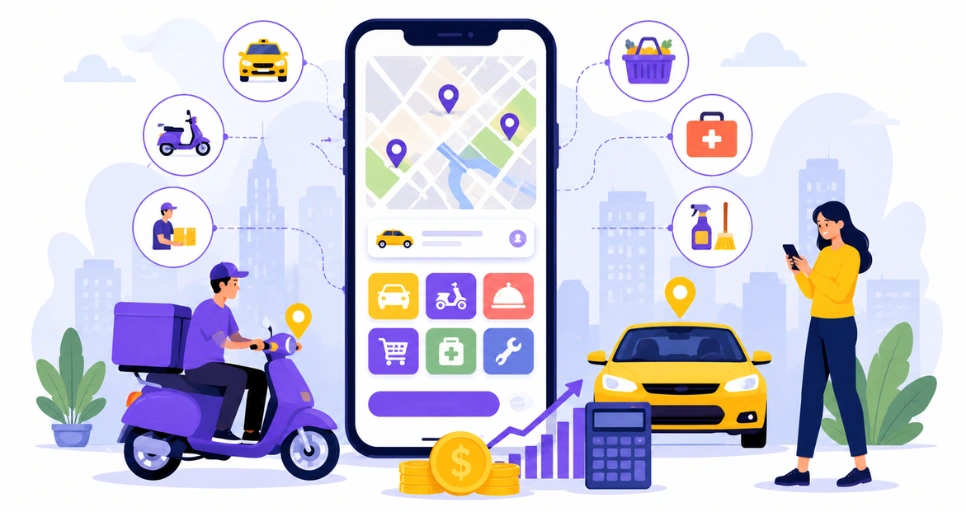
Key Takeaways:
- On-demand app development costs typically range from $8,000 to $80,000, depending on features, service complexity, and platform choice.
- Real-time booking, GPS tracking, and secure payments are core, non-negotiable features for a competitive on-demand platform.
- Most builds take 4-8 months, covering planning, core development, real-time features, provider tools, and thorough testing.
- Starting with a single service vertical and a lean MVP helps validate demand before expanding into multi-service support.
- Partnering with an experienced on-demand development team reduces costly rework and speeds up time to a competitive launch.
From food delivery to home services, on-demand apps have reshaped how customers expect to access nearly everything, instantly, from their phones.
For businesses looking to enter this space, one question comes up before anything else: what's the real on-demand app development cost in 2026?
Pricing varies significantly based on features, industry vertical, and the development team you hire.
A basic booking tool costs far less than a full-scale platform with real-time tracking, provider matching, and payment processing built in, and these differences directly shape your final budget.
This guide breaks down realistic pricing estimates, the features that drive those numbers, the variables that explain why costs vary so widely, and practical ways to control your budget.
What Is On-Demand App Development, and Why Does Pricing Vary So Much?
On-demand app development involves building platforms that connect customers with instant services, from delivery to home repairs and beyond.
Understanding the real cost to develop an on-demand app starts with recognizing just how broad this category has become.
1. Service Complexity Varies Dramatically Across Verticals
A simple booking app for a single service type costs far less than a multi-vendor platform supporting real-time tracking, provider matching, and complex logistics. This range in complexity explains most of the pricing gap between projects.
2. Strong, Sustained Global Market Growth Through 2026
The global on-demand services market is projected to reach $216 billion in 2026, growing to $346 billion by 2035 at a 5.4% CAGR, reflecting sustained demand across transportation, delivery, and home services.
3. Continued Expansion Through 2027 Driven by AI and Gig Economy Growth
The online on-demand services market is projected to grow steadily, driven by rising smartphone adoption, AI-powered logistics, and expanding gig economy participation, with sectors like food delivery already processing billions of transactions annually.
Must-Have Features That Shape On-Demand App Development Cost
The right on-demand app features directly influence both budget and user experience across any service vertical.
From real-time tracking to secure payments, each functionality adds complexity, cost, and long-term value to your platform.
1. Real-Time Booking and Scheduling
Users need instant visibility into service availability, whether that's a delivery slot, a service provider, or a rental item.
Fast, accurate scheduling forms the foundation of any successful on-demand app development project, significantly reducing booking friction.
2. Live GPS Tracking and Status Updates
Customers expect real-time visibility into the progress of orders or services, whether tracking a delivery driver or a technician's arrival.
Reliable on-demand mobile app development requires accurate location data and timely status notifications throughout the entire process.
3. Provider-Customer Matching Algorithms
Smart algorithms that instantly connect customers with nearby available providers are central to efficient operations.
Any serious custom on-demand app development project treats fast, accurate matching as essential for minimizing wait times and improving satisfaction.
4. Secure Payment and Multiple Payment Methods
Supporting cards, digital wallets, and cash options through encrypted gateways builds customer trust and reduces checkout friction.
Reliable on-demand service app development treats payment flexibility as a baseline expectation, not an optional add-on.
5. Multi-Service Category Support
Platforms expanding beyond a single service type into a broader super app development model require flexible architecture supporting multiple categories, providers, and pricing structures within one unified customer experience.
6. Provider Dashboard and Management Tools
A dedicated interface lets service providers manage availability, track earnings, and communicate with customers efficiently.
Comprehensive on-demand business app development treats this provider-facing functionality as equally important as the customer-facing app.
On-Demand App Development Cost Breakdown by Stage
Understanding costs stage by stage reveals exactly where your budget goes throughout the project.
Pricing typically ranges from $8,000 to $80,000, and knowing baseline mobile app development cost benchmarks helps you plan realistically before development begins.
1. UI/UX Design and Wireframing
Design costs cover wireframes, prototypes, and interface layouts tailored to both customers and service providers.
Understanding the full on-demand app development cost at this stage helps you decide between simple templates and fully custom design.
|
Element |
Description |
Cost |
|
Wireframing |
Basic layout structure and flow |
$500-$900 |
|
UI Design |
Custom screens and branding |
$1,300-$2,600 |
|
Prototyping |
Interactive clickable prototype |
$800-$1,500 |
2. Real-Time Booking and Scheduling System
Building instant booking, service selection, and scheduling logic requires structured backend architecture.
Understanding the full cost to develop an on-demand app at this stage helps you plan for scalable, real-time scheduling functionality.
|
Element |
Description |
Cost |
|
Booking Interface |
Service selection and scheduling flow |
$1,800-$3,300 |
|
Availability Management |
Real-time slot tracking system |
$1,400-$2,600 |
|
Order Confirmation |
Automated booking confirmations |
$700-$1,300 |
3. GPS Tracking and Provider Matching
Live tracking combined with smart matching algorithms minimizes wait times and keeps customers informed throughout service delivery.
This stage often accounts for a meaningful share of overall software development cost, given the technical demands of real-time data.
|
Element |
Description |
Cost |
|
GPS Tracking |
Live location updates and ETAs |
$2,000-$3,800 |
|
Matching Algorithm |
Automated provider-customer pairing |
$2,400-$4,500 |
|
Route Optimization |
Efficient routing for providers |
$1,600-$3,000 |
4. Backend and Database Architecture
A scalable backend handles user data, bookings, and concurrent users across potentially thousands of transactions.
This foundation supports every feature added throughout the rest of on-demand app development, keeping the platform stable as it scales.
|
Element |
Description |
Cost |
|
Database Design |
Scalable schema architecture |
$1,600-$2,900 |
|
Server Configuration |
Cloud or on-premises setup |
$1,200-$2,300 |
|
API Development |
Backend-to-frontend connectivity |
$1,500-$2,700 |
5. Payment Gateway and Provider Payouts
Building encrypted payment gateways alongside automated provider payouts streamlines transactions for both customers and service providers.
Any experienced on-demand app development company treats this secure infrastructure as essential for building trust during checkout.
|
Element |
Description |
Cost |
|
Payment Gateway Integration |
Multi-method payment processing |
$1,300-$2,600 |
|
Provider Payout System |
Automated earnings distribution |
$1,100-$2,200 |
|
Transaction Security |
Encryption and fraud prevention |
$700-$1,400 |
6. Provider App and Dashboard
A dedicated interface lets service providers manage availability, track earnings, and communicate with customers.
Solid booking app development principles ensure this companion app improves service quality and operational efficiency compared to a single shared app.
|
Element |
Description |
Cost |
|
Provider Dashboard |
Availability and earnings management |
$1,900-$3,600 |
|
In-App Navigation |
Turn-by-turn service directions |
$900-$1,700 |
|
Provider Communication Tools |
Messaging with customers |
$800-$1,500 |
7. Ratings, Reviews, and Trust Features
Two-way rating systems between customers and providers maintain service quality and accountability across the platform.
Reliable on-demand mobile app development treats this transparency as essential for helping customers make confident provider decisions.
|
Element |
Description |
Cost |
|
Rating & Review System |
Two-way feedback functionality |
$900-$1,700 |
|
Provider Verification |
Background checks and credentials |
$1,200-$2,300 |
|
Trust & Safety Badges |
Verified status indicators |
$500-$1,000 |
8. Admin Panel and Analytics
A robust admin dashboard lets platform owners manage bookings, providers, and reporting from one place.
Any serious custom on-demand app development project treats detailed analytics as essential for identifying trends and optimizing pricing over time.
|
Element |
Description |
Cost |
|
Order Management |
Centralized booking oversight |
$1,300-$2,500 |
|
Provider & User Controls |
Account management and verification |
$1,000-$1,900 |
|
Analytics & Reporting |
Revenue and performance insights |
$900-$1,700 |
9. Cross-Platform Development
Building for both iOS and Android simultaneously increases developer hours and testing requirements.
Understanding realistic MVP development cost at this stage helps businesses plan a lean initial launch before expanding to full platform coverage.
|
Element |
Description |
Cost |
|
iOS Development |
Native build and optimization |
$3,200-$6,000 |
|
Android Development |
Native build and optimization |
$3,200-$6,000 |
|
Cross-Platform Testing |
Device and OS compatibility |
$900-$1,700 |
10. QA Testing and Post-Launch Support
Thorough testing across booking flows, payment processing, and provider matching prevents costly post-launch issues.
Reliable on-demand app development services provide ongoing maintenance to keep the platform stable and running smoothly after deployment.
|
Element |
Description |
Cost |
|
Manual & Automated Testing |
Functional and regression testing |
$1,400-$2,600 |
|
Bug Fixing |
Pre-launch issue resolution |
$700-$1,300 |
|
Ongoing Maintenance |
Annual updates and support |
$2,500-$5,500 |
Factors That Can Increase or Reduce Your Development Budget
Several variables shape the final price of any on-demand platform, from service complexity to platform choice.
Understanding what drives on-demand app development cost upfront helps businesses plan realistic budgets and avoid unexpected expenses partway through development.
1. App Complexity and Feature Scope
A basic booking platform costs far less than one packed with real-time tracking, matching algorithms, and advanced analytics.
Where you hire also matters, since mobile app development companies in different regions charge significantly different rates for similar work.
2. Single-Service vs. Multi-Service Model
Choosing a focused, single-category on-demand service app development approach keeps costs manageable, while supporting multiple service types demands more complex backend logic and significantly increases overall project cost.
3. Number of Service Categories Supported
Platforms designed for multi-service on-demand app development, supporting everything from delivery to home repairs within one app, require more configurable pricing, provider management, and category-specific workflows than single-service tools.
4. Provider Onboarding and Verification Depth
Building thorough background checks, document verification, and screening processes adds development time to any on-demand business app development project but significantly improves platform trust and customer safety over time.
5. Real-Time Tracking and Matching Sophistication
Building precise GPS tracking and intelligent matching algorithms requires robust mapping integration and backend systems capable of handling multiple simultaneous requests without performance issues or delays.
6. Third-Party Integrations and Scalability Needs
Payment gateways, mapping APIs, and cloud infrastructure all add licensing fees that factor into overall costs.
Planning for future scalability prevents expensive rebuilds as your platform grows and adds more service categories.
How to Reduce Costs Without Compromising Quality?
Controlling development costs doesn't mean cutting corners on reliability or performance.
Understanding realistic on-demand app development cost benchmarks alongside smart planning helps businesses stay within budget while still delivering a genuinely solid product.
1. Start With a Clear MVP Scope
Defining core features first, like booking and basic tracking, rather than building every module at once, keeps initial costs manageable.
Partnering with experienced AI app development companies later, once demand is validated, adds smart features without upfront risk.
2. Focus on a Single Service Vertical First
Launching a focused on-demand delivery app development project, rather than a broad multi-service platform, reduces initial complexity and lets you validate demand before expanding into additional service categories.
3. Reuse Existing Components and Templates
Leveraging pre-built modules, authentication systems, and design templates reduces development time significantly.
Skilled teams know which components can be reused versus which require custom building from scratch for your specific service.
4. Compare Multiple Development Partners
Requesting detailed quotes from several providers offering on-demand app development services helps you understand realistic market rates and avoid overpaying for standard, commonly available functionality.
5. Leverage Cloud Infrastructure Strategically
Cloud-based hosting reduces upfront infrastructure costs compared to on-premise servers.
Flexible, usage-based pricing models scale with actual usage rather than requiring businesses to overpay for unused server capacity from day one.
6. Automate Testing and Quality Assurance
Automated testing tools catch bugs faster and reduce manual QA hours over time. This efficiency lowers testing costs while actually improving accuracy compared to relying solely on manual testing processes throughout development.
7. Phase Advanced Features After Launch
Releasing features like AI-powered matching or predictive analytics after initial launch spreads costs over time and allows for feedback-driven adjustments before committing to a full, expanded feature set.
8. Choose Partners With Post-Launch Support Included
Selecting mobile app development services that bundle initial maintenance and support into their pricing prevents unexpected costs immediately after launch, when stabilization work is often most needed.
Conclusion
Building a successful on-demand app in 2026 requires balancing genuinely useful features with realistic budget planning from the very start.
As this guide shows, development costs typically range from $8,000 to $80,000, depending on service complexity, integrations, and platform choice.
Prioritize reliable booking functionality, real-time tracking, and secure payments before investing in advanced extras like multi-service support or AI-driven matching.
Starting with a lean MVP focused on a single service vertical helps validate demand before expanding further.
Choosing the right development partner and planning for scalability from day one significantly reduces both financial risk and costly rework.
With careful planning, businesses can launch a competitive on-demand platform positioned for sustainable growth in this rapidly expanding market.
FAQ's
Development costs typically range from $8,000 to $80,000, depending on features, service complexity, platform choice, and the development team you hire.
Most on-demand apps take 4-8 months to develop, factoring in planning, core development, real-time features, and thorough testing before launch.
Starting with one service vertical keeps initial costs lower and lets you validate demand before expanding into a broader, multi-service platform
Yes, most successful platforms build dedicated provider apps for managing availability, navigation, and earnings, improving efficiency compared to a single shared app.
Real-time GPS tracking, provider matching algorithms, and multi-service category support typically add the most to your overall development budget.
Yes, launching on either iOS or Android alone reduces development and testing costs significantly compared to building both simultaneously.
Plan for server maintenance, security updates, and feature enhancements, which typically add $2,500-$5,500 annually depending on your app's scale.
Yes, starting with a basic MVP focused on booking and payments keeps initial costs closer to $8,000-$20,000.
Yes, background checks and verification build essential trust and safety, making this a worthwhile early investment rather than a later addition.
Yes, a specialized company understands real-time matching, provider logistics, and payment complexity, reducing costly errors compared to a generalist team.

CrinPro
CrinPro Solutions is a leading IT company that helps startups and enterprises build innovative digital products. From intuitive mobile applications and high-performance websites to AI-powered solutions and enterprise software, our team delivers scalable, secure, and user-focused products tailored to unique business needs. With expertise across multiple industries, we transform ideas into digital experiences that drive growth, improve efficiency, and create long-term business value.