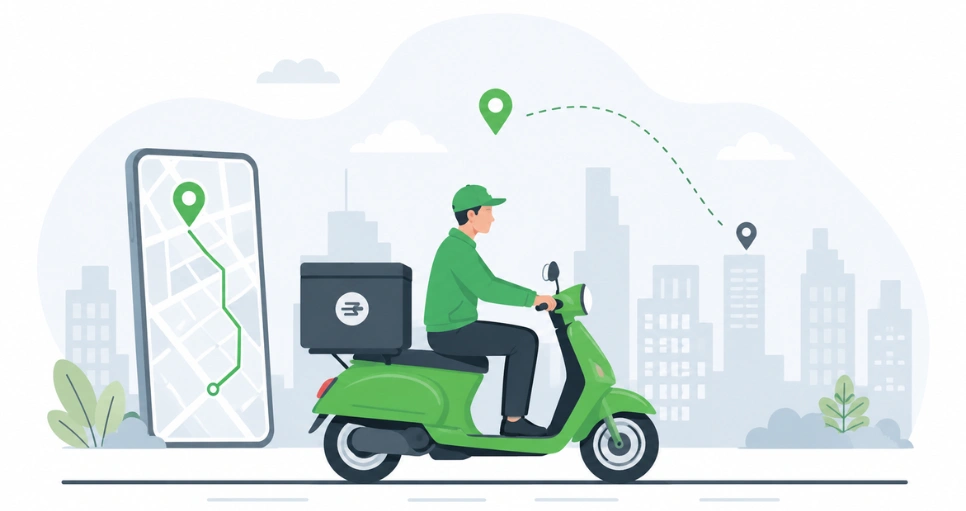
Food delivery has become one of the most competitive spaces in tech, with platforms like Uber Eats setting the standard for speed, convenience, and seamless restaurant partnerships.
For entrepreneurs looking to enter this space, the smartest path rarely starts with building every feature at once.
Instead, most successful businesses begin with Uber Eats clone app development focused on a lean, functional MVP, then expand strategically as real users and revenue validate the model.
This approach reduces risk, controls upfront costs, and lets you learn what your specific market actually wants before investing in advanced features like AI-driven recommendations or multi-vendor logistics.
This guide walks through that entire journey, from launching a lean MVP to scaling into a full-featured, competitive food delivery platform.
What Is an Uber Eats Clone App, and Why Start With an MVP?
An Uber Eats clone app connects customers, restaurants, and drivers through real-time ordering, tracking, and delivery management.
Understanding Uber Eats-like app development as an MVP-first process helps entrepreneurs enter this space without overspending on unproven features.
1. Full-Scale Platforms Are Expensive and Risky to Build First
Building every feature at once, from AI recommendations to multi-vendor logistics, risks significant investment before knowing if your specific market will actually adopt the app. An MVP validates demand first.
2. Strong, Sustained Global Market Growth Through 2026
The global online food delivery market was valued at $319.99 billion in 2025 and grew to $350.63 billion in 2026, with projections pointing to $728.83 billion by 2034 at a 9.58% CAGR.
3. Continued Expansion Through 2027 Driven by Repeat Ordering Behavior
79% of delivery orders come from restaurants customers have ordered from before, and 73% of consumers stick with the same app for delivery, showing that even a lean MVP can build lasting customer loyalty as it scales through 2027 and beyond.
What Are the Must-Have Features in an Uber Eats Clone App?
The right Uber Eats clone app features determine whether your MVP validates real demand or falls flat with early users. From ordering to delivery tracking, each functionality directly shapes customer trust and repeat usage.
1. Restaurant Browsing and Menu Display
Customers need intuitive menu browsing, category filters, and search functionality to find restaurants and dishes quickly.
Clean navigation and clear pricing directly impact conversion rates during a customer's very first ordering experience.
2. Real-Time Order Placement and Tracking
Reliable food delivery app development requires seamless order placement alongside live tracking showing preparation status and delivery progress.
Customers expect accurate ETAs and notifications throughout the entire process from checkout to doorstep.
3. Secure Payment Processing
Multiple payment options, including cards, digital wallets, and cash on delivery, must be processed through encrypted, PCI-compliant gateways.
Fast, reliable transactions build customer trust and reduce cart abandonment during checkout.
4. Restaurant Partner Dashboard
A dedicated interface lets restaurants manage menus, track incoming orders, and update availability in real time.
Any serious food delivery platform development project treats this dashboard as essential, since restaurant adoption directly determines platform success.
5. Driver App for Delivery Management
A companion app for drivers handles order assignments, navigation, and delivery confirmation.
This dedicated tool improves delivery speed and accuracy compared to relying solely on the customer-facing app for logistics.
6. Ratings, Reviews, and Order History
Transparent rating systems for restaurants and drivers build trust and improve service quality over time.
Accessible order history also encourages repeat purchases by making it quick and effortless to reorder favorite meals.
Step-by-Step Process to Scale From MVP to Full Platform
Scaling successfully requires a structured approach that builds on your validated MVP rather than starting over.
Here's exactly how booking app development moves through each stage as you expand toward a full-featured platform.
1. Validate Your MVP With Real User Data
Before adding new features, analyze order volume, repeat customer rates, and restaurant feedback from your initial launch.
This data confirms which parts of your Uber Eats clone app development foundation are working and which need refinement.
2. Expand Restaurant Partnerships and Coverage
Growing your network of partner restaurants increases customer choice and order volume simultaneously.
Strong restaurant delivery app development at this stage requires streamlined onboarding tools that make joining the platform easy for new partners
3. Add Multi-Vendor Order Support
Allowing customers to order from multiple restaurants in a single checkout increases average order value.
Understanding related Zomato clone app development cost benchmarks helps teams budget for similar multi-vendor cart functionality.
4. Introduce Loyalty Programs and Promotions
Building points systems, discount codes, and referral incentives encourages repeat usage and customer acquisition.
Reliable food ordering app development treats these retention tools as essential once your customer base reaches meaningful scale.
5. Build Advanced Restaurant Management Tools
Adding inventory syncing, sales analytics, and promotional tools for restaurant partners strengthens their commitment to the platform.
Comprehensive multi-restaurant delivery app development at this stage improves partner retention and satisfaction significantly.
6. Integrate AI-Powered Recommendations
Partnering with experienced AI app development companies enables personalized restaurant suggestions, smart reordering prompts, and demand forecasting.
These intelligent features improve engagement as your platform gathers more user behavior data over time.
7. Add Route Optimization for Drivers
Implementing smart routing algorithms that minimize delivery time across multiple simultaneous orders becomes essential at scale.
Any serious custom food delivery app development project prioritizes this efficiency as order volume grows significantly.
8. Expand Payment and Currency Options
Supporting additional payment methods, split payments, and multi-currency support accommodates a growing, more diverse customer base.
Mature food delivery app development platforms treat payment flexibility as a competitive necessity, not a luxury.
9. Strengthen Backend Infrastructure for Scale
Upgrading server capacity, database architecture, and load balancing ensures performance remains reliable during peak ordering periods.
Reliable mobile app development services help teams plan this infrastructure growth proactively rather than reactively.
10. Continuously Test and Iterate Based on Growth Data
Ongoing testing across new features, order volume spikes, and expanding markets prevents costly performance issues.
Mature Uber Eats-like app development treats this continuous refinement as an ongoing process, not a one-time project milestone.
Uber Eats Clone App Development Cost: MVP vs. Full-Scale
Understanding realistic mobile app development cost benchmarks at each stage helps businesses budget accurately for growth.
Pricing typically ranges from $8,000 for a lean MVP to $70,000 for a full-scale platform, depending on features and complexity.
|
Feature |
Description |
MVP Cost |
Full-Scale Cost |
|
UI/UX Design |
Wireframes and basic interface vs. fully custom, polished design |
$600-$700 |
$1,800-$2,600 |
|
Restaurant Browsing & Menu Display |
Simple listing view vs. advanced search, filters, and categorization |
$900-$1,300 |
$2,200-$3,300 |
|
Order Placement & Tracking |
Basic order status vs. live GPS tracking with real-time updates |
$1,200-$1,900 |
$3,200-$4,800 |
|
Payment Gateway Integration |
Single payment method vs. multiple gateways with multi-currency support |
$800-$1,250 |
$2,000-$2,900 |
|
Restaurant Partner Dashboard |
Basic order notifications vs. full menu, inventory, and analytics tools |
$1,000-$1,600 |
$2,600-$3,900 |
|
Driver App & Delivery Management |
Manual assignment vs. automated dispatch with route optimization |
$1,300-$2,000 |
$3,000-$4,500 |
|
Backend & Database Architecture |
Single-server setup vs. scalable, high-availability cloud infrastructure |
$1,400-$2,100 |
$3,500-$5,200 |
|
AI-Powered Recommendations |
Not included at MVP stage |
Not included |
$2,900-$4,200 |
|
Multi-Vendor & Loyalty Features |
Not included at MVP stage |
Not included |
$2,600-$3,900 |
|
QA Testing & Post-Launch Support |
Basic functional testing vs. continuous testing and dedicated maintenance |
$900-$1,400 |
$2,200-$3,300 |
How to Choose the Best App Development Partner for Uber Eats Clone App?
Choosing the right partner directly affects your project's cost, quality, and long-term scalability.
Understanding realistic MVP development cost benchmarks alongside partner selection criteria helps businesses avoid costly missteps at every stage of growth.
1. Evaluate Their Food Delivery Industry Experience
Review case studies and completed projects specifically within food delivery, rather than generic app development.
A strong portfolio demonstrating Uber Eats clone app development experience signals relevant expertise and reduces development risk significantly.
2. Confirm Their MVP-to-Scale Approach
Ensure the team understands how to build a lean MVP first, then expand thoughtfully as demand grows.
Experienced food delivery app development partners plan architecture that supports scaling without requiring a complete rebuild.
3. Compare Pricing Models and Transparency
Different providers offer fixed-price, hourly, or milestone-based billing structures.
Comparing multiple quotes and requesting detailed cost breakdowns helps you understand realistic market rates and avoid overpaying for standard features.
4. Assess Their Multi-Restaurant Integration Expertise
Confirm the team has genuine experience connecting multiple restaurant partners within one platform.
Skilled restaurant delivery app development requires structured onboarding tools and backend architecture that handles growing partner networks smoothly.
5. Check Their Payment and Logistics Integration Skills
Ensure the team has handled secure payment processing and delivery logistics for similar platforms before.
Reliable food ordering app development depends on this integration expertise to avoid costly payment or dispatch issues later.
6. Review Their Driver App Development Experience
Confirm the team has built companion driver apps handling navigation, order assignment, and delivery confirmation.
A genuine on-demand food delivery app requires this dual-app expertise, not just customer-facing development skills alone.
7. Read Client Reviews and References
Genuine feedback from other food delivery clients reveals a team's reliability, communication style, and ability to deliver projects on time and within budget expectations.
8. Confirm Post-Launch Support and Scaling Plans
Ask what ongoing support is included after launch, including feature additions and infrastructure upgrades. Understanding long-term software development cost helps you plan for continuous growth beyond the initial MVP launch.
Conclusion
Building an Uber Eats clone app in 2026 works best as a journey, not a single launch, starting lean with a validated MVP before scaling into a full-featured platform.
As this guide shows, MVP development starts around $8,000, while a full-scale build can reach $70,000, depending on features like AI recommendations, multi-vendor support, and advanced logistics.
Prioritize core ordering, tracking, and payment functionality first, then expand based on real user data and restaurant partner growth.
Choosing a development partner experienced in both MVP validation and long-term scaling significantly reduces the risk of costly rebuilds down the line.
With careful planning, businesses can grow from a lean starting point into a genuinely competitive food delivery platform.
FAQ's
An MVP typically costs around $8,000 to $20,000, depending on core features like ordering, tracking, and payment processing
A full-featured platform typically ranges from $40,000 to $70,000, depending on AI features, multi-vendor support, and advanced logistics.
Most MVPs take 2-4 months to develop, focusing on core ordering, tracking, and payment functionality before expanding further.
Scale once your MVP shows consistent order volume, repeat customers, and positive restaurant feedback validating genuine market demand.
Expanding restaurant partnerships, adding loyalty programs, and improving driver logistics are typically the highest-value early scaling investments.
No, AI-powered recommendations and demand forecasting are best added once you have enough user data to make them effective.
Yes, if your MVP was built with scalable architecture in mind, most features can be added incrementally without a full rebuild.
Plan for server maintenance, security updates, and feature enhancements, which typically increase as your platform scales and adds more users.
Not necessarily. Many successful MVPs start with a single restaurant or small network before expanding to multi-vendor support later.
Yes, a specialized company understands MVP validation and scaling challenges, reducing costly errors compared to a generalist development team.

CrinPro
CrinPro Solutions is a leading IT company that helps startups and enterprises build innovative digital products. From intuitive mobile applications and high-performance websites to AI-powered solutions and enterprise software, our team delivers scalable, secure, and user-focused products tailored to unique business needs. With expertise across multiple industries, we transform ideas into digital experiences that drive growth, improve efficiency, and create long-term business value.