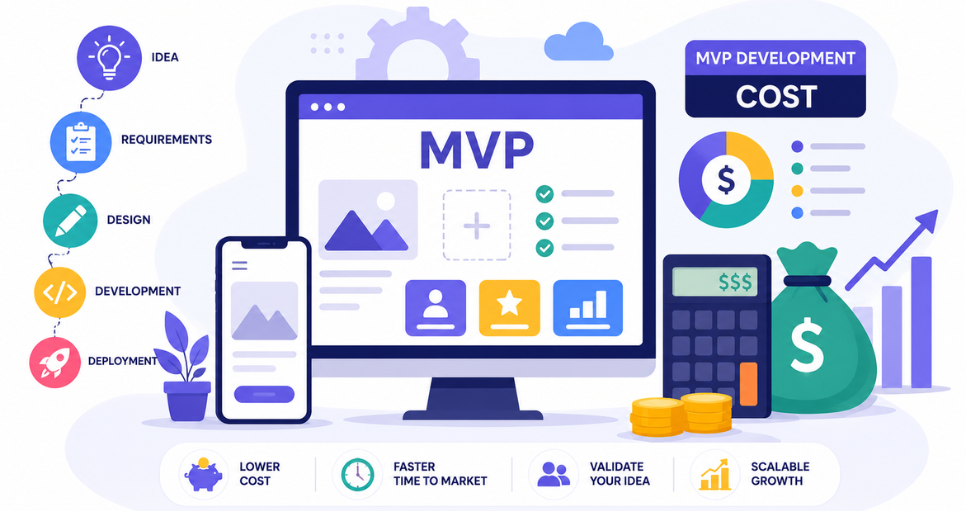
Launching a new product often starts with one critical question: How much will it actually cost to build a minimum viable product?
Understanding MVP development cost upfront helps founders and startups plan realistic budgets before committing time, resources, and investor funding to a project.
Pricing varies significantly based on features, platform choice, design complexity, and the development team you hire.
Unlike a fully-featured app, an MVP focuses on core functionality only, testing your idea in the market before scaling further.
This approach reduces risk, but costs can still range widely depending on your specific requirements and technical scope.
This guide breaks down realistic pricing estimates, the key factors driving costs up or down, and practical ways to keep your MVP budget lean without sacrificing quality.
What Is an MVP, and Why Does Getting the Pricing Right Matter?
A Minimum Viable Product is a stripped-down version of your app, built with only core features to test market demand. Getting the minimum viable product development cost right upfront prevents overspending before you've validated real user interest.
1. Overspending Early Kills Startups Before They Launch
Many founders pour funds into unnecessary features before confirming customer demand. Pricing an MVP correctly protects a limited runway, allowing startups to validate assumptions and pivot quickly without burning through capital intended for post-launch growth and scaling.
2. Strong, Rising Investment in Custom Software Development
The global custom software development market is projected to grow from $53.95 billion in 2025 to $65.85 billion in 2026, reflecting rising demand for tailored digital products.
3. Accelerating Long-Term Growth Through 2030
The same market is expected to reach $141.13 billion by 2030, showing sustained investment in custom-built software solutions, including startup MVPs, over the next several years.
Key Factors That Influence MVP Development Cost
Several variables determine your final MVP price, from feature complexity to platform choice. Understanding these factors before starting mobile app development helps founders budget realistically and avoid unexpected costs partway through the project.
1. Feature Scope and Core Functionality
The number and complexity of features you include directly impact cost. A simple MVP with basic functionality costs far less than one requiring real-time data processing, complex integrations, or advanced user permission systems from launch.
2. Level of Customization Required
Choosing custom MVP development over template-based solutions increases upfront costs but delivers better scalability and brand differentiation. Fully tailored builds require more design and development hours than pre-built, generic starter frameworks and templates.
3. Platform Choice: Web, iOS, Android, or All Three
Building for a single platform keeps costs lower, while launching simultaneously across web and mobile increases development hours, testing requirements, and overall project timeline significantly, especially for resource-constrained early-stage startups.
4. Development Team Location and Expertise
Where you hire matters significantly for pricing. Agencies in North America and Western Europe typically charge more per hour than teams in South Asia or Eastern Europe, though the quality of experience varies accordingly.
5. Backend Complexity and Third-Party Integrations
Payment gateways, APIs, cloud hosting, and database architecture all add development time and licensing costs. More sophisticated backend requirements, especially for data-heavy products, increase both budget and development timeline substantially.
6. Design Quality and User Experience Investment
Basic wireframes cost less than polished, research-backed UI/UX design tailored to your target audience. Investing in stronger design early can improve user retention and investor confidence during early fundraising stages.
MVP Development Cost Breakdown by Stage
Building an MVP is the smartest way to validate your product idea before committing to a full-scale development budget.
Understanding your mobile app development cost at the MVP stage keeps expectations realistic and planning sharp.
Costs typically range between $8,000 and $70,000 depending on complexity, feature scope, and your development team. Here is a transparent, stage-by-stage breakdown of exactly where your MVP budget goes in 2026.
1.Discovery and Requirements Planning
Understanding the real cost to build an MVP starts with recognizing that discovery is not an optional expense but a budget-protecting investment.
Skipping this stage is one of the most expensive mistakes any founder can make because undefined requirements during planning consistently become the most costly problems to solve once active development is already underway and gaining momentum.
|
Discovery Component |
What It Covers |
Estimated Cost |
|
Business Requirements Documentation |
Feature prioritization, user story mapping, and detailed product requirement documentation |
$800 – $1,200 |
|
Technical Architecture Planning |
Technology stack selection, system design, database schema planning, and integration mapping |
$500 – $900 |
|
Project Roadmap and Timeline |
Sprint planning, milestone definition, resource allocation, and delivery timeline documentation |
$300 – $600 |
2. Market Research and Competitor Analysis
Understanding your MVP app development cost accurately requires understanding your market thoroughly before a single feature gets designed or built.
Thorough competitor analysis, target audience research, and user pain point validation give your development team the clarity needed to make every feature decision with genuine confidence and strategic precision from the very beginning.
|
Research Component |
What It Covers |
Estimated Cost |
|
Competitor Feature Analysis |
Detailed analysis of competing products, feature gaps, and market positioning opportunities |
$600 – $1,000 |
|
Target Audience Research |
User interviews, survey design, persona development, and pain point validation documentation |
$400 – $700 |
|
Market Opportunity Assessment |
Market size analysis, growth potential evaluation, and competitive differentiation strategy |
$300 – $500 |
3. UI/UX Design
MVP design investment represents one of the most impactful decisions in your total software development cost allocation. Every design decision during this stage should serve user validation goals rather than aesthetic ambitions.
A focused MVP design investment delivers an interface that tests your core value proposition effectively without burning budget on unnecessary visual complexity or premature polish.
|
Design Component |
What It Covers |
Estimated Cost |
|
Wireframing and User Flows |
Core screen wireframes, user journey mapping, and navigation flow documentation |
$700 – $1,100 |
|
Visual UI Design |
Essential screen designs, basic design system, and brand-aligned visual identity |
$900 – $1,400 |
|
Interactive Prototype |
Clickable prototype for user testing, stakeholder review, and investor demonstration purposes |
$400 – $700 |
4. Core Feature Development
Your MVP software development cost is most directly shaped by how disciplined you are about what goes into the core feature set.
The temptation to add features beyond the validated core is where most MVP budgets spiral out of control, and timelines stretch beyond what early-stage funding can sustainably support through the full development cycle.
|
Core Feature Component |
What It Covers |
Estimated Cost |
|
User Authentication and Onboarding |
Registration, login, social sign-in, and guided first-session onboarding flow development |
$800 – $1,300 |
|
Primary Feature Set Development |
The one to three core features that define and deliver your MVP's central value proposition |
$2,500 – $4,000 |
|
Basic User Profile and Settings |
Profile creation, preference management, notification settings, and account management screens |
$500 – $800 |
5. Backend Infrastructure
Reputable MVP development services providers consistently emphasize that a lean but scalable backend architecture is what separates an MVP that grows gracefully from one that requires a complete rebuild the moment it gains real traction.
Building the right backend foundation during the MVP stage saves significantly more in avoided rebuild costs later than it costs upfront.
|
Backend Component |
What It Covers |
Estimated Cost |
|
API Development and Architecture |
Core RESTful API setup for all MVP features with proper documentation and versioning |
$1,500 – $2,500 |
|
Database Setup and Configuration |
Initial database architecture, schema design, and data management infrastructure setup |
$700 – $1,100 |
|
Cloud Hosting and DevOps Setup |
Server configuration, deployment pipeline, environment setup, and basic monitoring tools |
$400 – $700 |
6. Third-Party Integrations
Experienced mobile app development companies know that most MVPs require at least a few critical third-party integrations to deliver their core value proposition reliably.
Payment processing, authentication providers, email services, and analytics platforms all need to be connected and tested during the MVP stage because they often sit at the center of the core user experience being validated.
|
Integration Component |
What It Covers |
Estimated Cost |
|
Payment Gateway Integration |
Stripe or similar payment processor setup for basic transaction processing capability |
$600 – $1,000 |
|
Communication Services Setup |
Email, SMS, and push notification service integration for core user communication flows |
$300 – $500 |
|
Analytics and Tracking Setup |
User behavior tracking, funnel analytics, and basic business intelligence dashboard configuration |
$200 – $400 |
7. Security and Data Protection
Understanding your MVP product development cost means accepting that security cannot be treated as a post-MVP concern, regardless of how early-stage your product currently is.
User data collected during MVP validation carries real legal obligations and real security risks that must be addressed from the first version to protect both your users and your business from day one.
|
Security Component |
What It Covers |
Estimated Cost |
|
Data Encryption Implementation |
Basic encryption for sensitive user data storage and API communication security |
$500 – $800 |
|
Authentication Security Setup |
Secure session management, password hashing, and basic vulnerability protection implementation |
$300 – $500 |
|
Privacy Compliance Basics |
GDPR and CCPA basic compliance implementation, including consent management and data handling |
$200 – $350 |
8. Quality Assurance and Testing
A clear MVP cost breakdown always includes QA as a non-negotiable line item rather than an optional expense that gets cut when budgets feel tight.
Bugs that crash the onboarding flow or break the primary feature completely undermine the value of every insight your MVP validation process attempts to collect from early adopters during the critical first weeks after launch.
|
QA Component |
What It Covers |
Estimated Cost |
|
Functional Testing |
Core user flow testing across primary features, edge cases, and critical error scenarios |
$600 – $1,000 |
|
Device and Browser Compatibility |
Testing across target devices, screen sizes, operating systems, and browser versions |
$300 – $500 |
|
Performance and Load Testing |
Basic load testing to ensure stability under expected early user volume scenarios |
$200 – $350 |
9. Launch Preparation and App Store Submission
Successful minimum viable product development always includes a structured launch preparation phase that most founders underestimate in both time and cost requirements.
App store submission, compliance review, listing optimization, and pre-launch setup all take meaningful preparation time that needs explicit budget allocation rather than last-minute scrambling right before your intended launch date arrives.
|
Launch Component |
What It Covers |
Estimated Cost |
|
App Store Submission and Setup |
iOS App Store and Google Play listing creation, screenshots, and compliance review |
$400 – $700 |
|
App Store Optimization |
Keyword research, description optimization, and category selection for maximum organic visibility |
$200 – $400 |
|
Pre-Launch Marketing Setup |
Landing page creation, email list setup, and basic social media presence establishment |
$300 – $500 |
10. Post-Launch Monitoring and Iteration Support
Transparent MVP development pricing always accounts for post-launch monitoring and iteration support as part of the total investment rather than treating it as an unexpected additional expense after delivery.
The most critical phase of any MVP is the post-launch period when real user behavior data reveals what works, what fails, and what needs immediate attention before your next development cycle begins.
|
Post-Launch Component |
What It Covers |
Estimated Cost |
|
Performance Monitoring Setup |
Crash reporting, uptime monitoring, error tracking, and real-time performance alert configuration |
$400 – $700 |
|
User Feedback Collection System |
In-app feedback tools, user interview scheduling, and early adopter survey implementation |
$200 – $400 |
|
Bug Fixes and Critical Updates |
Rapid response bug fixing and critical issue resolution during the first 30 post-launch days |
$500 – $800 |
How to Reduce MVP Costs Without Cutting Characteristics?
Reducing your MVP development cost is not about building less. It is about building smarter. The right decisions made early in the process protect quality while keeping your investment firmly under control.
1. Start With a Ruthlessly Prioritized Feature List
Experienced MVP app development companies consistently identify feature scope as the single most controllable cost variable in any early-stage product build.
Every feature that does not directly validate your core value proposition adds cost without adding clarity. Cut everything that does not answer a specific product question your target users actually care about.
2. Validate With User Research Before Writing a Single Line of Code
Investing in startup MVP development research before development begins prevents the most expensive mistake any founder makes, which is building the wrong thing with real money.
User interviews, landing page tests, and prototype validation reveal what features actually matter before your development budget gets committed to building anything at all.
3. Choose Cross-Platform Development to Cut Frontend Costs
Understanding the real cost to build an MVP means recognizing that separate native iOS and Android builds nearly double your frontend investment for no meaningful user experience benefit at the early validation stage.
React Native or Flutter delivers strong cross-platform performance at a fraction of what two separate native codebases require from your budget.
4. Work With a Team That Has Done This Before
A skilled mobile app development company with genuine MVP experience moves faster, makes fewer costly architectural mistakes, and requires significantly less handholding through early-stage product decisions.
Paying slightly more per hour for a team that has built and launched MVPs before consistently costs less in total than a cheaper team learning on your project.
5. Use Proven Third-Party Tools Instead of Building From Scratch
Cutting your MVP development cost through strategic use of existing solutions is one of the smartest decisions any founder can make.
Authentication, payments, notifications, and analytics all have mature, affordable third-party solutions that take days to integrate rather than weeks to build custom, freeing your budget for the features that genuinely differentiate your product.
6. Launch on One Platform First and Expand Later
Reducing your MVP app development cost by launching on a single platform first is a decision that pays back immediately and compounds over time.
iOS or Android alone cuts frontend development cost nearly in half, focuses your testing resources on one environment, and still gives you enough real user data to validate your core product assumptions completely.
7. Partner With Experienced Full-Stack Teams for Efficiency
Working with full-stack development companies that handle frontend, backend, and DevOps under one roof eliminates the coordination overhead and communication gaps that multiply costs when separate specialized teams are stitched together to cover different parts of the same early-stage product build across multiple vendors with competing priorities and timelines.
8. Negotiate Phased Development Contracts With Clear Milestones
The best startup app development companies offer phased engagement models where you commit to one development stage at a time rather than the entire project upfront.
This approach keeps your financial risk controlled at every stage, gives you natural decision points to adjust scope based on what you learn, and protects your budget from runaway cost overruns that fixed contracts rarely prevent effectively.
Final Thoughts
Building an MVP is not merely an expense; it is a strategic investment in the future of your product.
By focusing on core functionality, you gain the clarity needed to test your value proposition without exhausting your runway on unverified assumptions.
Whether you are navigating platform choices or managing backend complexity, the key to a successful launch lies in disciplined planning and prioritizing features that truly serve your users.
Remember, a leaner, well-executed MVP provides far more actionable data than an over-featured, expensive build.
Use the budgeting and development strategies outlined here to control your costs, mitigate risk, and lay a robust foundation that allows your startup to pivot, scale, and thrive in an increasingly competitive market.
FAQ's
A Minimum Viable Product is a stripped-down, initial version of your application containing only the most essential core features necessary to solve a specific problem and test market demand with early adopters before committing to full-scale development.
Accurate MVP pricing is crucial because it helps founders avoid overspending on unnecessary features, effectively protecting their limited financial runway and ensuring that capital remains available to pivot or scale based on validated user feedback after launch.
While costs vary significantly based on your specific requirements, technical scope, and team expertise, you can typically expect an MVP development budget to range between $8,000 and $70,000 for a functional, market-ready initial release.
Several critical factors increase total costs, including the complexity of desired features, the need for custom integrations, platform requirements, your choice of development team location, and the intricacy of the backend architecture required to support your app.
Skipping the discovery phase is a major mistake; this stage is a vital, budget-protecting investment that helps you map requirements, plan architecture, and avoid the much higher costs associated with fixing undefined or poorly planned technical problems later.
You can effectively manage and reduce costs by ruthlessly prioritizing your feature list, conducting thorough user research before development starts, adopting efficient cross-platform development frameworks, and leveraging proven, existing third-party tools instead of building every component from scratch.
Opting for cross-platform development is a smart financial strategy because it allows you to maintain a single codebase for both iOS and Android, avoiding the significantly higher costs and extended timelines required to build and maintain two entirely separate native applications.
Launching on a single platform initially is often the most cost-effective approach for early-stage startups; it reduces development, testing, and maintenance requirements, allowing you to gather sufficient real-world user data to validate your assumptions before deciding to expand to other platforms.
Partnering with a full-stack team is highly efficient because they manage the entire technical ecosystem, including frontend, backend, and DevOps, eliminating the coordination friction, communication gaps, and overhead costs that frequently occur when hiring and managing separate, specialized vendors for different project components.
Yes, planning for post-launch monitoring should absolutely be part of your total budget; this phase is essential for collecting real user behavior data, tracking performance metrics, and implementing rapid bug fixes, all of which directly inform your product's next development cycle.

CrinPro
CrinPro Solutions is a leading IT company that helps startups and enterprises build innovative digital products. From intuitive mobile applications and high-performance websites to AI-powered solutions and enterprise software, our team delivers scalable, secure, and user-focused products tailored to unique business needs. With expertise across multiple industries, we transform ideas into digital experiences that drive growth, improve efficiency, and create long-term business value.