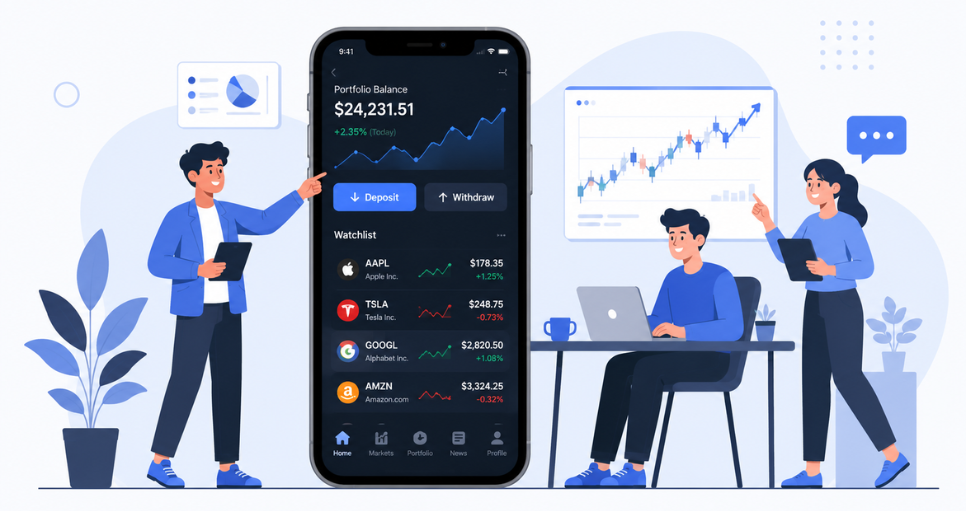
Key Takeaways:
- Stock trading app development costs typically range from $8,000 to $70,000, depending on features, platform selection, security requirements, and overall project complexity.
- Core features such as real-time market data, portfolio management, KYC verification, secure payments, and analytics play a major role in determining the development budget.
- Launching with an MVP is a cost-effective strategy that allows businesses to validate their idea, attract early users, and add advanced features over time.
- Security, regulatory compliance, and AI integration are essential investments for building a trustworthy, scalable, and competitive fintech application.
- Partnering with an experienced stock trading app development company helps ensure high-quality development, faster delivery, reliable post-launch support, and long-term business success.
The rise of retail investing has transformed how people buy, sell, and manage assets, with millions now trading stocks directly from their smartphones instead of relying on traditional brokers.
As this shift accelerates, businesses and fintech startups are increasingly exploring stock trading app development as a way to capture a growing, engaged user base.
Building a successful trading app requires far more than basic buy-and-sell functionality. Modern users expect real-time market data, secure transactions, portfolio tracking, and regulatory compliance, all while maintaining fast, reliable performance across devices.
These technical and legal requirements directly shape your development timeline and budget.
This guide breaks down the core features, realistic development costs, and key business benefits of launching a competitive stock trading app in 2026.
What Is a Stock Trading App, and Why Are Businesses Building One in 2026?
A stock trading app lets users buy, sell, and monitor stocks directly from their smartphones, replacing traditional broker-dependent processes.
Rising retail investor participation is fueling growing interest in trading app development across fintech startups and established brokerages alike.
1. Retail Investors Now Expect Mobile-First Trading
More investors prefer managing portfolios through smartphones rather than desktop platforms or phone calls with brokers.
This shift toward on-demand, app-based trading is pushing financial businesses to prioritize mobile experiences over legacy systems.
2. Steady Global Market Growth Through 2026 and 2027
The global online trading platform market is projected to grow from $22,880.78 million in 2026 to $24,217.02 million in 2027, reflecting continued digital adoption.
3. Rising Demand for AI-Driven Trading Tools
The same report highlights growing integration of artificial intelligence for predictive analytics and personalized trading recommendations, showing where investor expectations are heading through 2027 and beyond.
Must-Have Features for a Competitive Stock Trading App
The right stock trading app features determine whether your platform attracts and retains serious investors.
From real-time data to secure transactions, each functionality directly shapes user trust and long-term engagement.
1. Real-Time Market Data and Charting Tools
Investors need live stock prices, interactive charts, and technical indicators to make informed decisions quickly.
Fast, accurate data feeds are non-negotiable, since delays or inaccuracies can directly impact trading outcomes and user trust.
2. Secure Account Verification and KYC Compliance
Robust identity verification, including document upload and background checks, ensures regulatory compliance before users can trade.
This feature protects both the platform and investors from fraud while meeting financial industry legal requirements.
3. AI-Powered Market Insights and Recommendations
Modern AI stock trading app development increasingly includes predictive analytics, personalized stock suggestions, and risk assessment tools.
These intelligent features help users make smarter decisions without requiring extensive financial expertise or research time.
4. Portfolio Tracking and Performance Analytics
Users expect clear dashboards showing portfolio value, gains, losses, and asset allocation over time.
Detailed performance analytics help investors evaluate strategy effectiveness and make adjustments based on historical trading data.
5. Secure Payment and Withdrawal Processing
Fast, encrypted deposit and withdrawal systems supporting multiple payment methods build investor confidence.
Reliable transaction processing reduces friction and ensures users can access their funds without unnecessary delays or complications.
6. Order Types and Trade Execution Speed
Supporting market, limit, and stop-loss orders gives investors flexibility in executing trades strategically.
Fast, reliable online trading app development ensures orders execute quickly, minimizing slippage during volatile market conditions.
Step-by-Step to Develop a Stock Trading App in 2026
Building a successful stock trading app requires a structured process that balances compliance, security, and user experience.
Here's exactly how mobile app development moves from initial concept to a fully functional, market-ready trading platform.
1. Define Your Business Model and Target Market
Decide whether you're building a full-service brokerage, a simplified investing app, or a specialized trading tool.
Clarifying this focus early shapes every decision throughout stock market app development, from features to regulatory requirements.
2. Secure Licensing and Regulatory Compliance
Legal stock trading app development requires jurisdiction-specific financial licenses and compliance with securities regulations before launch.
This step often takes months, so businesses should begin the process early alongside experienced legal counsel.
3. Choose the Right Development Partner
Selecting experienced mobile app development companies familiar with financial regulations and security standards reduces project risk significantly.
Their expertise in handling sensitive financial data speeds up development while ensuring compliance requirements are met.
4. Design Wireframes and User Interface
Creating intuitive, data-rich wireframes ensures smooth navigation for both novice and experienced investors.
Any successful stock brokerage app development project prioritizes clear dashboards that simplify complex trading data without overwhelming users.
5. Select the Right Technology Stack
Choosing appropriate programming languages, real-time data APIs, and cloud infrastructure depends on your app's trading volume needs.
Reliable fintech app development requires robust architecture capable of handling high-frequency data updates securely.
6. Build Core Trading and Account Features
This stage involves developing account registration, KYC verification, and basic buy-sell functionality.
Solid custom trading app development at this phase establishes the technical foundation before adding advanced analytics and AI tools.
7. Integrate Real-Time Market Data Feeds
Connecting reliable financial data providers ensures accurate, low-latency stock prices and charting information.
An experienced mobile app development company ensures this integration handles high-volume data streams without performance degradation or delays.
8. Add Portfolio Tracking and Analytics Tools
Building detailed dashboards showing gains, losses, and asset allocation helps users evaluate their strategies effectively.
Comprehensive investment app development at this stage focuses on clear, actionable performance insights for everyday investors.
9. Implement AI-Powered Insights and Security Features
Partnering with specialized AI app development companies enables predictive analytics, personalized recommendations, and fraud detection systems.
These intelligent tools improve decision-making while protecting user accounts from suspicious trading activity.
10. Test, Launch, and Monitor Performance
Rigorous testing across trading scenarios, security protocols, and compliance requirements prevents costly post-launch issues.
Ongoing trading app development monitoring after launch helps teams refine features based on real user trading behavior and feedback.
Stock Trading App Development Cost Breakdown
Understanding the mobile app development cost of a stock trading platform helps businesses plan budgets effectively.
Development expenses vary depending on features, security, integrations, compliance, platform selection, and overall application complexity, making accurate cost estimation essential before starting the project.
|
Development Component |
Estimated Cost (USD) |
Description |
|
Market Research & Planning |
$600–$700 |
Business analysis, competitor research, and project planning. |
|
UI/UX Design |
$800–$950 |
Wireframes, prototypes, responsive layouts, and user experience design. |
|
User Registration & Authentication |
$700–$900 |
Secure login, KYC integration, OTP verification, and user profiles. |
|
Trading Dashboard Development |
$1,200–$1,500 |
Portfolio management, watchlists, stock tracking, and dashboards. |
|
Real-Time Market Data Integration |
$900–$1,200 |
Live stock prices, charts, APIs, and financial market data integration. |
|
Payment Gateway & Wallet Integration |
$700–$900 |
Secure deposits, withdrawals, and transaction management. |
|
Admin Panel Development |
$800–$1,000 |
User management, analytics, reporting, and platform administration. |
|
Security & Compliance |
$700–$900 |
Data encryption, secure APIs, authentication, and regulatory compliance. |
|
Testing & Quality Assurance |
$700–$850 |
Functional, performance, security, and compatibility testing. |
|
Deployment & Initial Maintenance |
$900–$1,100 |
App Store/Play Store deployment, bug fixes, and launch support. |
Factors That Can Increase or Reduce Your Development Budget
Understanding the fintech app development cost requires evaluating several technical and business factors.
Your feature requirements, technology choices, security standards, and development approach all influence the overall budget, timeline, and long-term maintenance expenses for a stock trading application.
1. Feature Complexity
Advanced features like real-time trading, portfolio management, watchlists, push notifications, and secure payment integration require additional development effort.
The more complex your feature set becomes, the higher your overall project budget and development timeline will be.
2. Platform Selection
Choosing Android, iOS, web, or cross-platform deployment significantly affects stock market app development costs.
Supporting multiple platforms requires additional design, coding, testing, and maintenance, increasing both the initial investment and long-term development expenses.
3. AI Integration
Implementing AI stock trading app development features such as predictive analytics, intelligent recommendations, automated trading insights, and personalized alerts improves user experiences.
However, advanced AI capabilities also require specialized expertise, increasing overall development complexity and project costs.
4. Custom Design and Development
Investing in custom trading app development allows businesses to create unique user experiences tailored to their audience.
Personalized interfaces, advanced workflows, and exclusive features require additional design and engineering resources, increasing development time and budget.
5. Regulatory Compliance
Secure stock brokerage app development requires compliance with financial regulations, data protection laws, encrypted transactions, and identity verification.
Meeting these regulatory standards increases development effort but protects users while strengthening platform credibility and long-term business success.
6. MVP vs Full-Scale Product
Launching with an MVP helps reduce MVP development cost by focusing only on essential features.
Businesses can validate their ideas, gather user feedback, and gradually introduce advanced functionality without making a large upfront investment.
7. Development Team Expertise
Partnering with an experienced stock trading app development company may require a higher initial investment.
But skilled professionals deliver better code quality, stronger security, faster development, and reliable post-launch support that reduces long-term technical challenges.
8. Maintenance and Future Upgrades
Successful fintech app development extends beyond launch.
Regular security updates, performance optimization, feature enhancements, compliance updates, and technical support require continuous investment to keep the application secure, competitive, and aligned with evolving customer expectations.
Final Thoughts
Developing a stock trading app requires careful planning, the right technology, and a clear understanding of your business goals.
The overall budget depends on factors such as feature complexity, platform selection, security requirements, AI integration, regulatory compliance, and ongoing maintenance.
While a basic solution can be built with a lower investment, advanced trading platforms require additional resources to deliver a secure and seamless user experience.
Starting with an MVP is a practical way to validate your idea before expanding with premium features.
Partnering with an experienced development team also helps reduce technical risks and ensures your application is scalable, compliant, and future-ready.
By planning your budget strategically and focusing on long-term value, you can build a competitive stock trading app that meets user expectations and supports sustainable business growth.
FAQ's
The cost of developing a stock trading app typically ranges from $8,000 to $70,000. The final price depends on factors such as feature complexity, platform selection, UI/UX design, security requirements, third-party integrations, and regulatory compliance.
A basic MVP usually takes 3–5 months to develop, while a feature-rich stock trading app with AI, real-time analytics, and advanced trading tools may require 6–12 months or more.
Core features include user registration, KYC verification, real-time stock market data, watchlists, portfolio management, secure payments, push notifications, trading dashboards, analytics, and an admin panel.
The overall cost depends on app complexity, supported platforms, UI/UX design, AI integration, third-party APIs, cloud infrastructure, security measures, regulatory compliance, and post-launch maintenance.
AI is not mandatory, but it enhances the user experience through personalized recommendations, predictive market insights, risk analysis, automated alerts, fraud detection, and intelligent customer support.
Stock trading apps handle sensitive financial and personal information. Strong security measures such as encryption, multi-factor authentication, secure APIs, and compliance with financial regulations help protect user data and transactions.
Yes. Building an MVP allows you to launch with essential features, validate your business idea, gather user feedback, and gradually add advanced functionality while keeping initial development costs under control.
The choice depends on your target audience and budget. Many businesses start with Android or iOS, while others choose cross-platform development to reach more users with a single codebase
Popular technologies include Flutter, React Native, Swift, Kotlin, Node.js, React, cloud platforms, AI frameworks, secure payment gateways, and real-time market data APIs.
An experienced development company can build a secure, scalable, and high-performing trading platform while ensuring regulatory compliance, seamless integrations, quality assurance, and long-term technical support, helping your app succeed in a competitive fintech market.

CrinPro
CrinPro Solutions is a leading IT company that helps startups and enterprises build innovative digital products. From intuitive mobile applications and high-performance websites to AI-powered solutions and enterprise software, our team delivers scalable, secure, and user-focused products tailored to unique business needs. With expertise across multiple industries, we transform ideas into digital experiences that drive growth, improve efficiency, and create long-term business value.