Key Takeaways:
- Medicine delivery apps connect customers, pharmacies, and couriers through digital ordering workflows.
- Prescription verification and pharmacy compliance are essential for safe dispensing.
- GPS tracking improves delivery visibility and customer communication.
- AI can support demand forecasting, data extraction, and operational efficiency.
- Development costs may range from $8,000 to $90,000+, depending on scope.
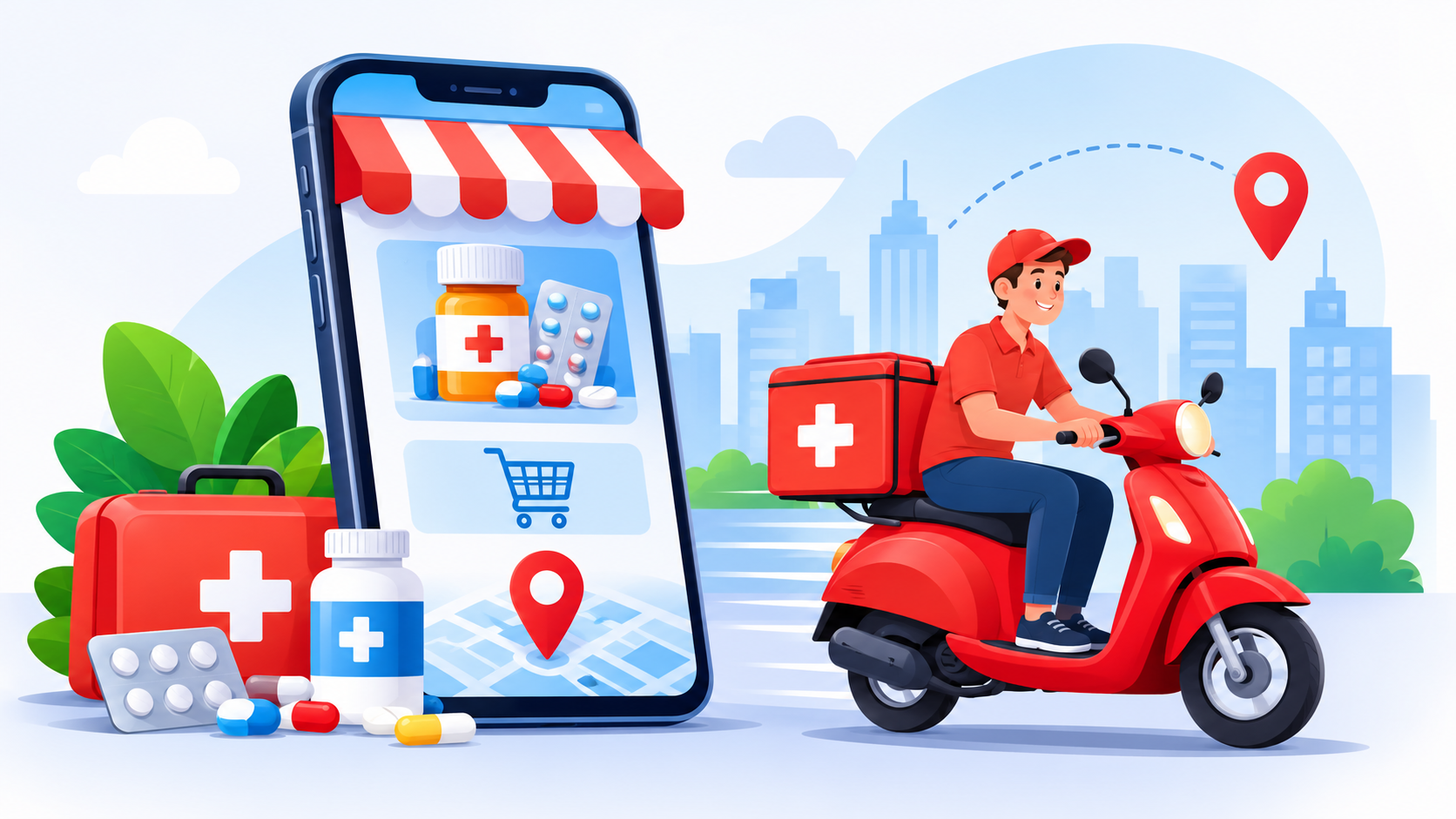
Medicine delivery apps help customers order medicines, upload prescriptions, check product availability, and track deliveries from their smartphones. These platforms connect patients, pharmacies, and delivery partners through a coordinated digital system.
In 2027, medicine delivery app development increasingly focuses on prescription verification, real-time inventory updates, secure payments, GPS tracking, and AI-assisted workflows. These capabilities can improve order accuracy, streamline pharmacy operations, and make medicine access more convenient.
Businesses planning a healthcare platform should prioritise patient safety, data privacy, and compliance with applicable pharmaceutical regulations. Working with a provider that offers healthcare app development services can help you build a reliable foundation for these requirements.
How Modern Medicine Delivery Apps Work From Ordering to Delivery
A medicine delivery app coordinates customers, pharmacies, payment providers, and delivery partners to fulfil orders securely and efficiently.
- Medicine Search: Customers search for medicines, check availability, and review product details.
- Prescription Submission: For prescription-required medicines, customers upload a valid prescription for verification.
- Pharmacy Review: The pharmacy reviews the prescription and confirms whether it can fulfil the order.
- Inventory Confirmation: The system verifies stock availability and updates order status.
- Payment and Confirmation: Customers complete payment using supported methods and receive order confirmation.
- Order Preparation: Pharmacy staff prepare the approved order for dispatch.
- Delivery Assignment: The platform assigns an eligible delivery partner.
- Order Tracking: Customers receive status updates and tracking information until delivery is completed.
A well-designed platform connects these steps through reliable APIs and automated notifications. Businesses evaluating the healthcare app development cost should consider the complexity of prescription workflows, pharmacy integrations, and delivery operations when planning the initial budget.
Prescription Verification and Pharmacy Compliance in Medicine Delivery Apps
Prescription verification is a critical part of medicine delivery app development. The platform must help pharmacies validate prescriptions, protect patient information, and ensure that medicines are supplied according to applicable laws and professional requirements.
1. Prescription Upload and Validation
Customers should be able to upload prescriptions as images or PDFs. The app can check file quality, capture relevant details, and flag incomplete submissions for manual review.
2. Pharmacist Review and Approval
Qualified pharmacy staff should verify prescription validity, medicine details, dosage instructions, and other required information before approving an order. AI-based text extraction can assist with data entry but should not replace professional verification.
3. Prescription Records and Access Control
Store prescription records securely, restrict access to authorised personnel, and apply appropriate retention policies. Audit logs can help track reviews, approvals, and changes.
4. Compliance and Restricted Medicines
Prescription requirements, dispensing rules, and restrictions vary by jurisdiction and medicine category. The platform should enforce applicable requirements and prevent restricted products from being supplied through unauthorised workflows.
Essential Features of a Medicine Delivery App for a Seamless User Experience
A medicine delivery app needs features that support convenient ordering, accurate pharmacy operations, secure payments, and reliable delivery. The functionality should meet the needs of customers, pharmacists, delivery partners, and administrators.
|
Feature |
Purpose |
|
User Registration and Profiles |
Manages customer accounts, addresses, and preferences. |
|
Medicine Search and Filters |
Helps users find medicines by name, category, or availability. |
|
Prescription Upload |
Supports prescription submission for required medicines |
|
Pharmacy Dashboard |
Manages orders, prescriptions, stock, and fulfilment. |
|
Inventory Management |
Tracks available quantities and stock changes |
|
Secure Payments |
Supports approved payment methods, refunds, and receipts. |
|
Order Status Updates |
Notifies customers about confirmation, preparation, and dispatch |
|
GPS Tracking |
Displays delivery progress and estimated arrival times. |
|
Notifications |
Sends order updates, reminders, and delivery alerts. |
|
Admin Dashboard |
Manages users, pharmacies, orders, and platform reports. |
|
Ratings and Feedback |
Collects feedback about delivery and service quality |
|
AI-Assisted Support |
Helps answer routine questions and route complex queries to staff. |
The app should also apply role-based permissions so customers, pharmacists, delivery partners, and administrators can access only the functions they need. Prioritising these features helps businesses launch a practical first version before adding more advanced capabilities.
Inventory Management and Order Fulfilment in Medicine Delivery Apps
Accurate inventory management helps medicine delivery platforms prevent stock mismatches, reduce order cancellations, and coordinate pharmacy fulfilment. The system should synchronise product availability with incoming orders and stock changes.
1. Real-Time Stock Updates
Update inventory when medicines are received, reserved, dispensed, or returned. Where multiple pharmacies operate on the platform, availability should be tracked separately for each location.
2. Batch and Expiry Management
Store batch numbers, expiry dates, and relevant product details. Alerts can help pharmacy staff identify approaching expiry dates and prioritise suitable stock rotation.
3. Order Processing and Fulfilment
A central workflow should track each order from confirmation to dispatch. Pharmacy staff need clear views of pending prescriptions, approved orders, stock shortages, and orders awaiting preparation.
4. Low-Stock Alerts and Replenishment
Automated alerts can notify pharmacy teams when stock falls below predefined thresholds. Demand forecasts may also help estimate future requirements, although replenishment decisions should account for actual sales and supply conditions.
5. Handling Substitutions and Out-of-Stock Items
If a medicine is unavailable, the platform should notify the customer and route the issue to authorised pharmacy staff. Any substitution must follow applicable rules and receive appropriate professional approval.
GPS Tracking and Last-Mile Delivery in Medicine Delivery Apps
GPS tracking helps medicine delivery platforms provide visibility into dispatch progress, estimated arrival times, and delivery status. A reliable last-mile workflow connects pharmacy preparation, courier assignment, route planning, and customer notifications.
1. Live Location Tracking
Delivery applications can share location updates while a delivery is active, allowing customers to view progress on a map. Location collection should be limited to what is necessary and handled with appropriate permissions.
2. Route Planning and Delivery Estimates
Mapping services can help couriers navigate routes and estimate arrival times. Route planning may consider distance, traffic conditions, delivery windows, and multiple assigned orders.
3. Courier Assignment and Status Updates
The platform should support delivery assignment, pickup confirmation, in-transit updates, and delivery completion. Notifications can keep customers informed when an order is dispatched or delayed.
4. Proof of Delivery
Depending on local requirements and the type of medicine, delivery confirmation may use a one-time code, recipient confirmation, or another approved method. Sensitive prescription details should not be exposed unnecessarily.
5. Tracking Costs and Integrations
Businesses should account for mapping API usage, location permissions, background tracking, and device compatibility. Reviewing the GPS tracking app development cost can help when estimating these components within the wider medicine delivery platform budget.
AI Applications in Medicine Delivery Platforms for Smarter Pharmacy Operations
AI can help medicine delivery platforms improve operational efficiency, personalise customer experiences, and anticipate supply needs. Its role should focus on supporting pharmacy staff and automating appropriate workflows without compromising patient safety.
1. Demand Forecasting
AI models can analyse historical orders, seasonal patterns, and local demand to estimate future medicine requirements. These insights can help pharmacies plan inventory and reduce avoidable shortages.
2. Intelligent Search and Recommendations
AI-powered search can interpret product queries and help users find relevant catalogue information. Recommendations should respect clinical boundaries and must not independently prescribe medicines or suggest unsafe substitutions.
3. Prescription Data Extraction
Optical character recognition and AI can extract text from uploaded prescriptions to reduce manual data entry. Pharmacists must verify the extracted information before dispensing prescription-required medicines.
4. Customer Support Automation
AI assistants can answer routine questions about order status, delivery updates, and platform features. Medical questions and uncertain or high-risk requests should be escalated to qualified professionals.
5. Delivery and Operational Optimisation
AI can help estimate delivery times, identify potential delays, and support courier assignment using relevant operational data.
Businesses should evaluate the AI app development cost alongside model usage, data security, validation, monitoring, and human oversight. AI outputs must be tested carefully, especially when they influence prescription handling or other safety-critical workflows.
Technology Stack for Medicine Delivery App Development
The right technology stack helps a medicine delivery platform manage customer accounts, prescription workflows, inventory, payments, and delivery tracking securely. Technology choices should reflect the platform's scale, integration needs, and regulatory requirements.
|
Technology Layer |
Common Technologies |
Purpose |
|
Frontend |
React, Next.js |
Customer and pharmacy web interfaces |
|
Mobile Apps |
Flutter, React Native, Swift, Kotlin |
Customer and courier applications |
|
Backend |
Node.js, Python, Java |
APIs, orders, inventory, and business logic |
|
Database |
PostgreSQL, MySQL, MongoDB |
Customer, medicine, prescription, and order records |
|
Cloud Infrastructure |
AWS, Microsoft Azure, Google Cloud |
Hosting, backups, and scalability |
|
Maps and GPS |
Google Maps Platform, Mapbox |
Navigation, location updates, and delivery estimates |
|
Payments |
Stripe, Razorpay, regional payment gateways |
Checkout, refunds, and transaction processing |
|
Notifications |
Firebase Cloud Messaging, Twilio, SendGrid |
Push notifications, SMS, and email |
|
AI and Machine Learning |
Python, PyTorch, managed AI APIs |
Demand forecasting and workflow assistance |
|
Security |
OAuth 2.0, OpenID Connect, MFA |
Authentication and access management |
|
Monitoring |
OpenTelemetry, Prometheus, Grafana |
Performance monitoring and troubleshooting |
Choosing the Right Stack
- For an MVP: Focus on ordering, prescription review, inventory, and basic delivery tracking.
- For growing platforms: Add multi-pharmacy support, automated notifications, and stronger integration capabilities.
- For enterprise systems: Prioritise audit trails, access controls, resilience, and interoperability.
A modular architecture allows businesses to expand functionality without replacing the entire system. A suitable healthcare app development services provider can help align technology decisions with clinical workflows, security needs, and future growth.
Medicine Delivery App Development Process: 8 Key Stages
Developing a medicine delivery app requires careful planning, secure integrations, and thorough testing. A structured process helps businesses create a reliable platform that supports customers, pharmacies, and delivery partners.
1. Market Research and Requirement Analysis
Research competitors, customer needs, pharmacy workflows, and applicable regulations. Define the target audience, business model, essential features, and project objectives.
2. Feature Planning and Scope Definition
Prioritise core functions such as medicine search, prescription uploads, inventory management, payments, and order tracking. Separate MVP requirements from future enhancements.
3. UI/UX Design and Prototyping
Design intuitive interfaces for customers, pharmacists, couriers, and administrators. Create wireframes and prototypes to validate navigation and ordering workflows.
4. Technology and Architecture Planning
Select the frontend, backend, database, cloud infrastructure, and integration approach. Plan security controls and data flows before implementation begins.
5. Frontend and Backend Development
Build user interfaces, APIs, account management, order processing, pharmacy dashboards, and administrative tools. Implement role-based access controls from the beginning.
6. Prescription, Inventory, and Payment Integration
Develop prescription review workflows, synchronise pharmacy inventory, and integrate approved payment providers. Ensure that prescription-required orders follow the appropriate verification process.
7. Testing and Security Validation
Test ordering workflows, prescription handling, payment processing, inventory accuracy, device compatibility, and delivery tracking. Conduct security and performance testing before launch.
8. Deployment, Monitoring, and Maintenance
Release the application, monitor performance, resolve issues, and introduce updates based on user feedback. Maintain integrations, security controls, and infrastructure as the platform grows.
A separate courier workflow may also require capabilities associated with courier delivery app development, including delivery assignment, navigation, status updates, and proof of delivery.
Integrating Pharmacies, Payments, and Delivery Partners
A medicine delivery platform depends on reliable integrations to coordinate pharmacies, payment providers, inventory systems, and courier services. These connections help maintain consistent order information and reduce manual work.
1. Pharmacy and Inventory Integration
APIs can synchronise medicine catalogues, stock availability, order status, and prescription-review workflows. Multi-branch platforms should track inventory by pharmacy location to avoid inaccurate availability information.
2. Payment Gateway Integration
Payment providers support checkout, transaction confirmation, refunds, and payment-status updates. Webhooks can notify the platform when transactions succeed or fail, while sensitive payment data should be handled according to applicable security requirements.
3. Courier and Logistics Integration
Delivery APIs can support courier assignment, shipment creation, tracking updates, and delivery confirmation. Where external courier services are unavailable, the platform may require its own courier application and dispatch system.
4. Notifications and Customer Communication
Push notifications, SMS, and email can communicate order confirmation, prescription-review outcomes, dispatch updates, and delivery completion. Messages should avoid exposing unnecessary prescription or health information.
5. Third-Party Healthcare Systems
Depending on the use case, integrations may include laboratory systems, electronic health records, or pharmacy management software. Each connection should use authorised access, secure data exchange, and appropriate consent.
A well-planned integration layer makes it easier to add pharmacies and delivery partners while maintaining reliable workflows across the platform.
Security, Patient Privacy, and Regulatory Considerations
Medicine delivery apps handle personal information, prescription records, and payment details. Security and regulatory compliance should therefore be built into the platform from the start.
1. Protecting Patient Information
Use encryption, secure storage, access controls, and appropriate data-retention policies. Restrict prescription access to authorised personnel and avoid exposing sensitive information in notifications or delivery dashboards.
2. Authentication and Permissions
Implement secure login, multifactor authentication where appropriate, and role-based permissions for customers, pharmacists, couriers, and administrators.
3. Prescription and Dispensing Compliance
Follow applicable rules for prescription validation, pharmacist review, medicine dispensing, and restricted products. AI tools may assist with data extraction but should not independently approve prescriptions.
4. Payment and Transaction Security
Use reputable payment providers, secure API connections, transaction monitoring, and appropriate controls for refunds and payment disputes.
5. Audit Logs and Monitoring
Record important actions, including prescription reviews, order changes, and administrative access. Monitor suspicious activity and establish incident-response procedures.
6. Regulatory Requirements
Requirements vary by country and jurisdiction. Businesses should review applicable pharmaceutical, privacy, consumer-protection, and electronic transaction rules before launch.
Working with a medicine delivery app development company experienced in secure healthcare workflows can help businesses address these requirements and establish a more dependable platform.
Medicine Delivery App Development Cost and Timeline in 2027
The medicine delivery app development cost depends on the platform's features, prescription workflows, pharmacy integrations, delivery tracking, security requirements, and supported devices. A basic app requires less investment than a multi-pharmacy platform with advanced automation and AI capabilities.
|
App Type |
Estimated Development Cost |
Timeline |
|
Basic Medicine Delivery App |
8,000–20,000 |
2–3 months |
|
Mid-Level Pharmacy App |
20,000–40,000 |
3–5 months |
|
Advanced Medicine Delivery Platform |
40,000–70,000 |
5–7 months |
|
Enterprise Healthcare Delivery Platform |
70,000–90,000+ |
7–10+ months |
What Influences Development Costs?
- Features: Prescription uploads, pharmacist dashboards, inventory controls, and delivery tracking affect development effort.
- Integrations: Pharmacy systems, payment gateways, and courier APIs add implementation and testing work.
- AI capabilities: Demand forecasting and workflow automation can increase both development and operating costs.
- Security and compliance: Data protection, access controls, audit logs, and security testing require dedicated resources.
- Platform choice: Supporting web, Android, and iOS can increase design, development, and testing requirements.
Additional Costs to Budget For
The initial estimate may exclude cloud hosting, mapping API usage, payment-processing fees, SMS notifications, security audits, and ongoing maintenance.
Businesses should also consider the wider healthcare app development cost if the platform will expand into telemedicine, patient records, or other healthcare services.
A phased launch can help control spending: begin with essential ordering and pharmacy workflows, validate demand, and add advanced features as the business grows.
Business Models and Revenue Streams for Sustainable Growth
Medicine delivery platforms can generate revenue through product sales, pharmacy partnerships, delivery services, and subscription offerings. The right model depends on the business structure, target market, and applicable pharmaceutical regulations.
1. Medicine Sales and Pharmacy Commissions
Platforms that partner with pharmacies may earn commissions or service fees on eligible orders, subject to local rules and commercial agreements.
2. Delivery Fees
Customers may pay standard or express delivery charges based on distance, delivery speed, or order requirements. Pricing should remain transparent.
3. Subscription Plans
Memberships can offer benefits such as discounted delivery, eligible recurring-order services, or priority support.
4. Pharmacy Software and SaaS
A platform can charge pharmacies for inventory management, order processing, analytics, and other business tools through monthly or annual plans.
5. Business Partnerships
Partnerships with healthcare providers, laboratories, or approved service providers may create additional revenue opportunities where legally permitted.
6. Responsible Monetisation
Businesses should disclose fees clearly, protect patient privacy, and avoid incentives that compromise appropriate medicine use or professional pharmacy decisions.
A sustainable revenue model balances customer convenience, pharmacy value, operational expenses, and compliance requirements.
Conclusion
Medicine delivery apps are making it easier for customers to order medicines and access pharmacy services digitally. Successful platforms combine prescription verification, accurate inventory management, secure payments, and reliable delivery tracking.
Businesses planning medicine delivery app development in 2027 should prioritise patient safety, pharmacy compliance, data privacy, and dependable integrations. AI can support inventory forecasting and operational workflows, but prescription approval and other clinical responsibilities must remain with qualified professionals.
A phased development strategy helps businesses launch essential features first, validate demand, and expand as operational requirements grow. With the right architecture and safeguards, a medicine delivery platform can support convenient ordering while maintaining reliable pharmacy and delivery workflows.
FAQ's
A custom app may cost approximately 8,000–90,000+, depending on features and complexity.
Development typically takes 2–10 months or longer, depending on scope and integrations.
Core features include medicine search, prescription uploads, inventory management, payments, and delivery tracking.
Customers upload prescriptions, which authorised pharmacy professionals review before dispensing applicable medicines.
Yes. AI can support demand forecasting, prescription data extraction, customer support, and delivery optimisation.
GPS tracking provides delivery progress, location updates, and estimated arrival times.
It can be secure with encryption, access controls, audit logs, and appropriate privacy safeguards.
Yes. APIs can connect the platform with pharmacy software, inventory systems, payment providers, and courier services.

CrinPro
CrinPro Solutions is a leading IT company that helps startups and enterprises build innovative digital products. From intuitive mobile applications and high-performance websites to AI-powered solutions and enterprise software, our team delivers scalable, secure, and user-focused products tailored to unique business needs. With expertise across multiple industries, we transform ideas into digital experiences that drive growth, improve efficiency, and create long-term business value.