Key Takeaways:
- Start with a clear business model and validate your target customers, delivery area, florist network, and demand before development.
- Build an MVP with essential features including product browsing, customization, payments, scheduling, tracking, florist management, and driver operations.
- Choose technology based on your app's scale, integration needs, budget, and future requirements rather than following popular technology trends.
- Plan for flower-specific challenges, including perishable inventory, substitutions, seasonal demand, delivery failures, and same-day delivery expectations.
- Launch in one market first, measure customer behavior and delivery performance, then scale features, vendors, drivers, and geographic coverage.
Running a flower shop on phone calls and walk-in orders sounds simple. It is not.
Customers want fast answers, live updates, and easy payments, and most small florists cannot keep up alone.
That gap is exactly why so many florists lose orders every single day. The good news is that this problem has a clear fix.
Learning how to build a flower delivery app gives you one system that handles orders, payments, delivery, and customers together.
In this blog, we will walk through business models, must-have features, the full development process, technology choices, cost, timeline, monetization, common challenges, and how to launch the right way.
What Is a Flower Delivery App, and How Does It Work?
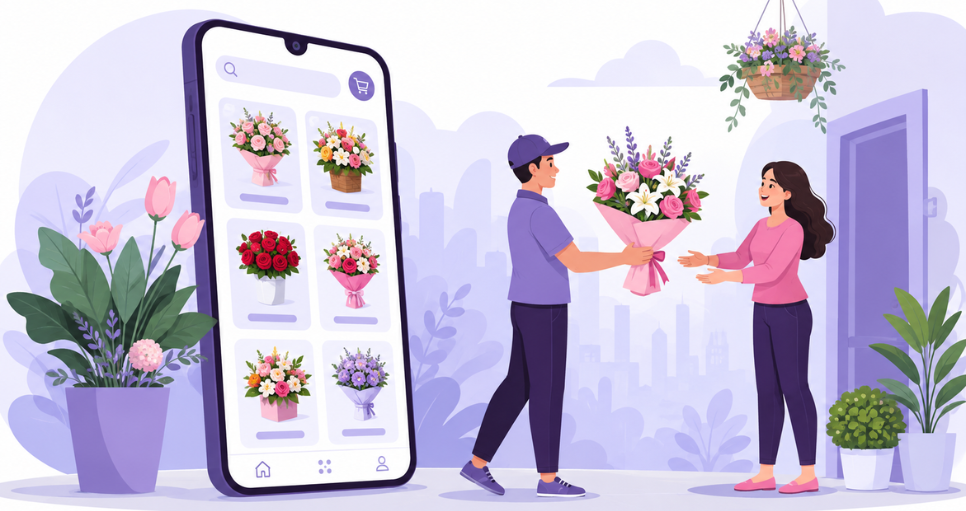
A flower delivery app is a mobile platform where customers browse bouquets, customize gifts, pay online, and track delivery to a recipient in real time, connecting shoppers with local florists.
The global flower delivery service market is projected to reach USD 8.6 billion in 2026, growing to USD 13.8 billion by 2033 at a 7.0% CAGR. Europe led with a 33.7% share in 2025, while the UK held Europe’s largest share.
Here is the basic flow, and honestly, once you see it laid out, it feels pretty simple.
- The customer opens the app and picks flowers or a gift.
- The order goes to a nearby florist for preparation.
- A driver is assigned and picks up the order.
- Customer and recipient get live tracking until drop-off.
This entire loop is what people mean when they talk about flower delivery app development. It sounds technical, but really it is just connecting people who want flowers with people who can deliver them, fast and without confusion.
Why Should You Build a Flower Delivery App?
Flowers are emotional purchases, and an app captures gifting moments that phone orders simply miss while building loyalty and repeat sales.
- Same-day delivery keeps customers happy during birthdays, anniversaries, and last-minute sympathy orders, which builds trust fast.
- Digital payments and order tracking reduce phone call chaos and give florists a cleaner, more organized daily workflow.
- Personalized bouquets and gift notes turn a simple purchase into an emotional experience that customers remember and repeat.
- A florist marketplace model lets you scale across cities without owning every flower shop or delivery fleet yourself.
- Subscription flowers and corporate gifting create steady recurring revenue instead of relying only on occasion based spikes.
Choose the Right Flower Delivery App Business Model
Your business model shapes everything else, from your app features to your delivery costs, so pick it before writing a single line of code.
1. Dedicated florist model
You run your own flower shop and app together. You control inventory, quality, and branding fully. This model needs more upfront investment but gives you the tightest grip on customer experience and delivery timing.
2. Aggregator marketplace model
You connect multiple local florists on one platform without owning inventory. This is closer to how custom software development teams often build multi-vendor apps. It scales faster but demands strong vendor management tools.
3. Hybrid model
Some businesses run their own core inventory while also onboarding partner florists for extra coverage. It balances control with reach, though it does need a slightly more complex backend to manage both sides properly.
4. Subscription flower model
Customers pay monthly for recurring bouquets. This model, popularized by brands like The Bouqs Company and UrbanStems, works well for predictable revenue and lower marketing spend once customers are locked in.
5. On-demand gifting model
This focuses purely on same-day and instant gifting occasions. Big global names like 1800Flowers, FTD, Teleflora, and Interflora built massive trust in this space, and studying their delivery promise is worth your time. A mobile app development company can help you decide which structure fits your budget and target city.
Best Flower Delivery App Features for a Seamless User Experience
Every flower delivery app needs four connected sides working together; the customer, the florist, the driver, and the admin, or the whole system, breaks down fast.
1. Browse and search flowers
Customers filter by occasion, color, price, or flower type. A good search reduces drop-off and helps first-time users find gifts quickly without frustration.
2. Bouquet customization
Letting shoppers pick flower types, add greeting cards, or choose vase styles turns a basic order into something personal, which matters a lot in gifting.
3. Scheduled and same-day delivery
Customers pick exact delivery windows. This single feature, tied closely to on-demand app development, often decides whether someone trusts your app for urgent gifting.
4. Multiple payment options
Cards, wallets, and local payment gateways reduce checkout friction. Fewer payment steps almost always means fewer abandoned carts, which every founder learns the hard way eventually.
5. Florist inventory dashboard
Vendors manage stock, pricing, and order acceptance from one screen. Real-time inventory prevents the awkward moment when a bouquet sells out mid-order.
6. Driver navigation and status updates
Delivery partners get optimized routes and simple status buttons. This overlaps heavily with gift delivery app development, since timing accuracy really is the whole product here.
7. Admin analytics dashboard
Owners track orders, vendor performance, and revenue in one place. Without this, scaling past one city becomes guesswork instead of strategy.
8. Ratings, reviews, and loyalty rewards
Trust signals and repeat purchase incentives keep customers coming back. This same structure is common in cake delivery app development, and it works just as well for flowers.
Flower Delivery App Development Process: From Idea to Launch
Building a flower app is not just coding, it is a sequence of decisions that either support your business or quietly work against it later.
Step 1. Validate the business idea
Before anything else, study your target city, customer demand, competitor florists, delivery zones, average order value, and peak occasions like Valentine season.
One mistake I see in app projects is treating development as the first step. It is not. The first step is proving that customers, suppliers, and delivery operations can actually support the business model you picked.
Step 2. Define your target audience.
Your users are not one group. Individual gift buyers, busy professionals, families, corporate buyers, event planners, and home subscribers all behave differently.
|
Audience |
What They Usually Want |
|
Individual gift buyers |
Fast, emotional, occasion-based orders |
|
Busy professionals |
Quick checkout, saved addresses, reminders |
|
Corporate buyers |
Bulk orders, invoicing, recurring schedules |
|
Event planners |
Large orders, custom arrangements, delivery timing |
|
Home subscribers |
Recurring bouquets, predictable pricing |
Step 3. Choose your business model.
We covered this earlier, so I will not repeat it here. Just remember, this decision directly affects your architecture, your feature list, your revenue structure, and how your delivery operations run day to day.
Step 4. Define the MVP.
A practical flower delivery app development company can help turn these requirements into a focused MVP by separating essential workflows from features that can wait until later.
|
MVP Area |
Essential Functionality |
|
Customer |
Browse, customize, order, pay, track |
|
Florist |
Products, inventory, orders |
|
Driver |
Assignment, navigation, delivery status |
|
Admin |
Orders, users, vendors, payments |
|
Backend |
APIs, authentication, notifications, database |
Do not build these on day one; they can wait. AI recommendations, advanced loyalty programs, AR try-on features, complex subscriptions, multi-country support, and deep analytics.
This is a powerful differentiator once you add it later, but not before you prove the basics work.
Step 5. Design the customer journey.
Map out discovery, product selection, customization, recipient details, delivery slot picking, checkout, tracking, review, and reorder. A customer journey diagram would work beautifully here, honestly; it is the single clearest way to catch gaps before development starts.
Step 6. Design UI and UX
Focus on visual product discovery, fast checkout, high-quality imagery, simple navigation, accessibility, trust signals, delivery visibility, and minimal checkout friction.
A strong mobile app development strategy should prioritize the gifting journey rather than simply reproducing a desktop store on a smaller screen.
Step 7. Plan the backend architecture.
This is where you show real technical depth. Cover authentication, product catalog, inventory, orders, payments, delivery, notifications, users, vendors, analytics, and APIs.
The customer app flows into the API layer, which connects to business logic, order management, inventory, the florist system, dispatch, and finally the driver app, supported by payments, maps, notifications, and analytics services running alongside.
Step 8. Choose the technology stack.
No single stack is universally best here. The right pick depends on your scale, your team's expertise, target geography, integration needs, and budget.
If you plan to add personalized recommendations, demand forecasting, or AI powered customer support later, working with an AI development company can help you design those capabilities without rebuilding the core platform.
|
Layer |
Possible Technologies |
|
Mobile |
Flutter, React Native, Swift, Kotlin |
|
Web dashboard |
React, Next.js |
|
Backend |
Node.js, NestJS, Python, Laravel |
|
Database |
PostgreSQL, MySQL |
|
Cache |
Redis |
|
Cloud |
AWS, Azure, Google Cloud |
|
Maps |
Google Maps Platform, Mapbox |
|
Notifications |
Firebase Cloud Messaging, APNs |
|
Payments |
Stripe or regional gateways |
|
Analytics |
Firebase Analytics, Mixpanel, Amplitude |
Step 9. Develop and integrate the platform.
The frontend, backend, APIs, payment gateways, maps, notifications, inventory syncing, florist portal, driver app, and admin panel all come together in this phase.
At this stage, choosing the right flower delivery app development company matters because the team needs experience across mobile development, payment integration, real-time tracking, APIs, and delivery workflows.
Step 10. Test the complete order lifecycle.
Do not just say perform QA; that tells nobody anything useful. Test the real path. The customer places an order, payment succeeds, the florist accepts, inventory changes, the driver gets assigned, the customer tracks, the driver arrives, delivery is confirmed, and the review gets submitted.
Then test the failures too, because they happen more than people admit. Payment fails, flowers become unavailable, the florist rejects the order, the driver cancels, the customer changes address, or the recipient is simply not home.
Step 11. Launch in a controlled market
Start with one city, limited delivery zones, a small florist network, a core catalog, simple pricing, and a small driver team. Then measure results before expanding; patience here really does pay off.
Step 12. Monitor and scale
Watch performance, order volume, retention, delivery success rate, inventory accuracy, vendor performance, customer acquisition cost, server capacity, and peak season readiness before pushing into new cities.
How to Estimate Flower Delivery App Development Cost
Cost depends heavily on features, platforms, and team location, and it usually falls somewhere in a fairly wide range depending on how complex your app gets.
|
Package |
Cost Range |
Timeline |
Best For |
|
Basic MVP |
8,000 to 20,000 |
6 to 10 weeks |
Single city, core ordering and delivery only |
|
Standard |
20,000 to 45,000 |
3 to 5 months |
Florist portal, driver app, admin dashboard |
|
Advanced |
45,000 to 90,000 |
5 to 8 months |
Multi-city, subscriptions, loyalty, analytics |
|
Enterprise |
90,000 plus |
8 months and up |
Multi-country, AI recommendations, custom logistics |
Biggest Challenges in Flower Delivery App Development
Flowers are perishable and emotional purchases, which creates operational problems that a normal e-commerce app simply never has to deal with.
1. Perishable inventory
Flowers wilt fast, so unsold stock becomes a real loss quickly. Real time inventory syncing and smaller, frequent restocking cycles help reduce waste significantly.
2. Flower substitutions
Popular blooms sell out during peak occasions like Valentine week. Clear substitution policies and upfront customer notifications keep trust intact instead of losing it.
3. Seasonal demand spikes
Mother's Day and Valentine's Day can multiply orders overnight. Scalable cloud infrastructure and temporary driver partnerships absorb this pressure without crashing your system.
4. Same-day delivery pressure
Customers expect flowers within hours, not days. Smart route optimization, real-time driver assignment, delivery tracking, and a dense local florist network make tight delivery windows more realistic.
If your platform needs advanced dispatching, route planning, driver management, and fleet visibility, logistics app development can provide the foundation for handling these operations at scale.
5. Delivery failure and address issues
Wrong addresses or unavailable recipients cause failed deliveries often. Address verification tools and proactive driver communication cut this problem down noticeably over time.
6. Florist availability and quality control
Not every partner florist maintains the same quality standard. Regular vendor audits and customer review scores help you catch quality drops before they hurt your brand.
Security and Compliance for an On-Demand Flower Delivery App
Security cannot be an afterthought here. You are handling payments, home addresses, and personal gift messages.
Secure authentication, encryption, and role-based access protect sensitive data properly. Payment security through PCI-compliant gateways keeps transactions safe.
Location privacy matters too, since delivery tracking reveals real-time recipient location. Keep data retention limited, publish a clear privacy policy, and follow GDPR where it applies to your customer base.
Secure APIs and regular vulnerability testing round out a trustworthy On-demand flower delivery app, and honestly, this section alone builds more buyer confidence than any feature list ever will.
How Does a Flower Delivery App Make Money?
Revenue in this space usually comes from a mix of sources rather than one single stream, which actually makes the business more stable over time.
- Commission fees from partner florists on every completed order, usually ranging between ten and thirty per cent depending on the market.
- Delivery charges are added at checkout and sometimes adjusted for distance, urgency, or peak season demand during holidays.
- Product margins on flowers and gift add-ons sold directly through your own dedicated inventory.
- Subscription plans for recurring bouquets, which create predictable monthly revenue instead of relying only on occasion spikes.
- Featured florist listings and premium placement fees, similar to sponsored spots on food delivery platforms.
- Corporate accounts with bulk pricing and recurring gifting schedules for offices, hotels, and event businesses.
Conclusion
Learning how to build a flower delivery app really comes down to a handful of connected decisions.
Pick the right business model, define a lean MVP, cover the features each stakeholder actually needs, choose technology that fits your scale, plan operations around real delivery challenges, and budget honestly for both cost and growth.
None of this needs to happen perfectly on day one. It needs to happen in the right order.
If you are serious about turning this idea into a working product, start with a validated MVP in one city, and grow from a foundation that actually holds up under real customer demand.
FAQ's
Cost ranges from 8,000 for a basic MVP to 90,000 plus for an enterprise-level platform with AI features, multi-city support, and advanced logistics tools.
A basic MVP takes about 6 to 10 weeks. Standard builds take 3 to 5 months, while advanced multi-city platforms can take 5 to 8 months or longer.
It depends on your resources. Dedicated models give more control, while aggregator marketplace models scale faster without owning inventory or delivery fleets yourself.
At minimum, browsing, customization, checkout, payments, delivery scheduling, tracking, a florist dashboard, and a driver app for order fulfillment are essential.
They rely on dense local florist networks, route optimization tools, and real-time driver assignment to keep delivery windows tight and reliable.
Yes, this is the aggregator marketplace model, where multiple partner florists list products and manage their own inventory through a shared platform.
Perishable inventory combined with unpredictable seasonal demand spikes is usually the hardest operational problem to manage consistently well.
No. AI recommendations and predictive tools are valuable later, but a lean MVP should focus on core ordering, payment, and delivery functionality first.

CrinPro
CrinPro Solutions is a leading IT company that helps startups and enterprises build innovative digital products. From intuitive mobile applications and high-performance websites to AI-powered solutions and enterprise software, our team delivers scalable, secure, and user-focused products tailored to unique business needs. With expertise across multiple industries, we transform ideas into digital experiences that drive growth, improve efficiency, and create long-term business value.