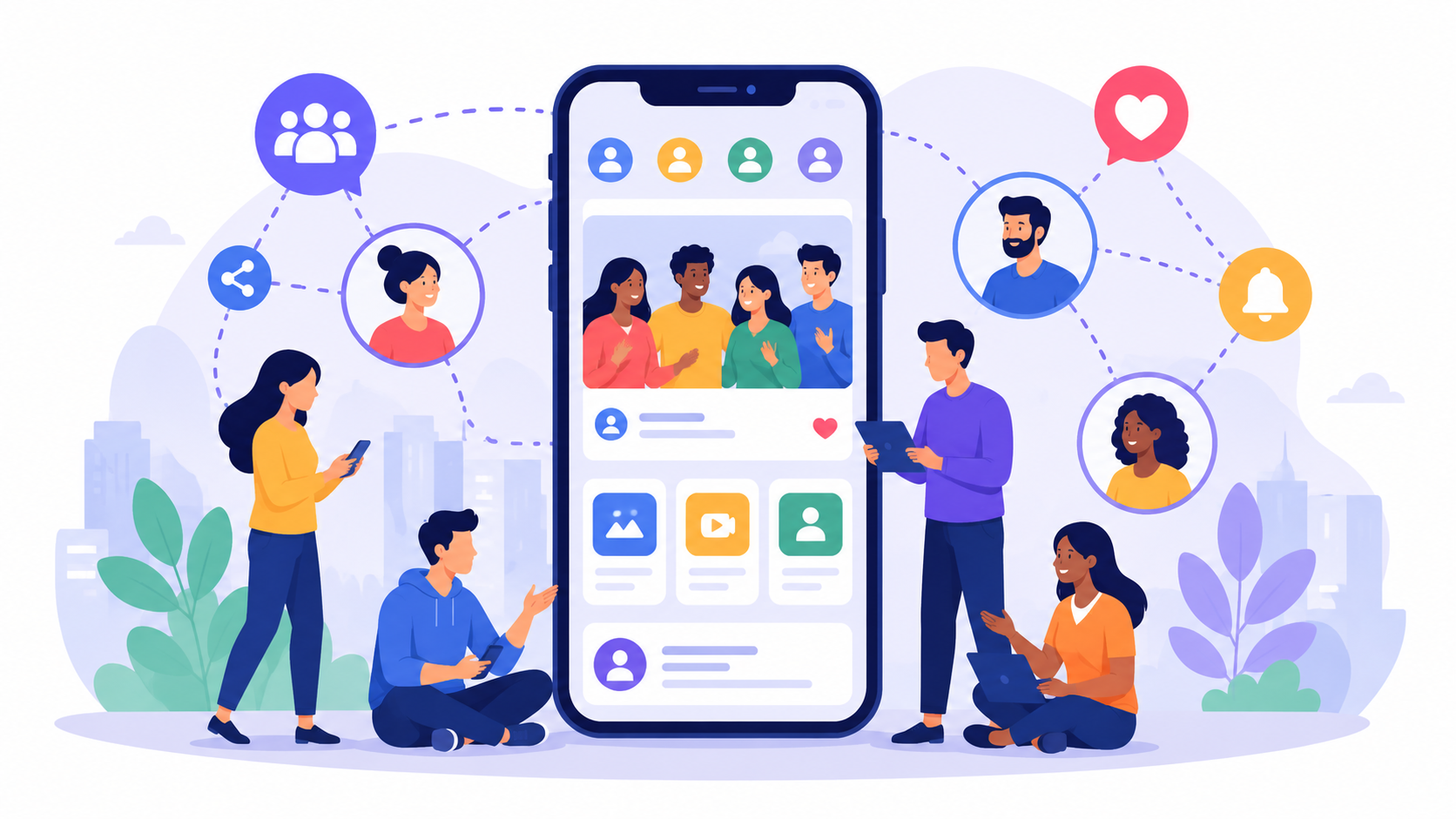
Key Takeaways:
- Community app development costs typically range from $8,000 to $60,000, depending on features, design complexity, integrations, technology, and customization.
- Essential features include user profiles, community feeds, groups, messaging, notifications, search, content moderation, and admin dashboards.
- Starting with an MVP can help businesses control initial costs, validate their concept, and gather valuable feedback before adding advanced features.
- Choosing the right development partner requires evaluating technical expertise, industry experience, security practices, scalability, communication, pricing, and post-launch support.
- Ongoing maintenance, security updates, performance optimization, and feature enhancements are important for keeping the community app reliable, secure, and engaging as the user base grows.
Every thriving online community starts the same way, with a group of people who share something in common and no reliable place to connect around it.
Turning that shared interest into an actual product, one people genuinely want to use daily, is where community app development becomes essential, transforming a good idea into a real, functioning platform.
Building a successful community app requires more than group chats and a feed. Modern users expect meaningful discovery, genuine moderation, and features that encourage real connection rather than passive scrolling, all while keeping the platform sustainable to run and grow over time.
This guide walks through the entire journey, from defining your app's core purpose to must-have features, the development process, and realistic costs for launching in 2026.
What Is Community App Development, and Why Are Businesses Investing in It?
A community app is a digital platform that lets people connect, share, and engage around a shared interest, brand, or goal.
Growing enterprise interest in community mobile app development reflects how businesses increasingly view community as a genuine competitive advantage.
1. Community-Led Growth Is Replacing Traditional Marketing Alone
Businesses increasingly recognize community-led growth as a sustainable competitive advantage over relying purely on paid advertising.
Building genuine spaces for engagement helps brands retain customers and reduce acquisition costs over time.
2. Strong, Sustained Global Market Growth Through 2026
The global online community platform market is projected to grow from $819.67 million in 2025 to over $1 billion by 2026, reaching $2.67 billion by 2033 at a 15.9% CAGR.
3. Accelerating Enterprise Adoption Through 2027
Approximately 80% of organizations plan to expand digital workplace and community initiatives by 2027, with internal communities already improving cross-department collaboration by 28% and reducing email dependency by 40%.
Must-Have Features for a Thriving Community App
Before writing a single line of code, clarifying what your community actually needs matters more than deciding on community app features. A vague idea rarely translates into a thriving platform without a clear purpose guiding every decision.
1. Identify the Specific Problem Your Community Solves
Every successful community app addresses a genuine gap, whether that's connecting niche hobbyists, supporting a professional network, or building brand loyalty. Clarifying this problem early prevents building generic features that don't genuinely serve your target audience.
2. Define Your Target Audience Precisely
Understanding exactly who your community serves shapes tone, features, and moderation approach throughout social community app development. A broad, undefined audience often leads to a diluted, less engaging platform than one built for a specific group.
3. Decide Between Open, Private, or Hybrid Access
Choosing whether your online community app development project supports fully open membership, invite-only access, or a hybrid model significantly shapes both technical architecture and the overall community culture that develops over time.
4. Map Out Core Engagement Mechanics
Deciding how members will interact, through discussions, events, direct messaging, or content sharing, forms the foundation of your community platform development strategy. These mechanics should align directly with why people are joining in the first place.
5. Plan for Sustainable Moderation From Day One
Any serious custom community app development project accounts for moderation strategy early, whether through community guidelines, volunteer moderators, or automated tools. Waiting until problems arise often leads to reactive, poorly implemented solutions later.
6. Clarify Your Monetization or Sustainability Model
Deciding how the platform will sustain itself, whether through subscriptions, sponsorships, or free community-building tied to a broader business goal, should be settled before development begins to avoid costly pivots later.
Step-by-Step Development Process From Build to Launch
Building a successful community platform requires a structured process that borrows from proven social media app development practices while addressing community-specific needs.
Here's exactly how this journey moves from initial concept through a fully functional, engaged platform.
1. Define Your Business Requirements and Scope
Start by identifying core features, target audience, and access model based on your earlier blueprint work.
Clarifying this scope early shapes every decision throughout community app development, from technical architecture to moderation strategy.
2. Conduct Market and Competitor Research
Studying existing platforms helps identify feature gaps and engagement strategies relevant to your niche.
Understanding successful community mobile app development approaches gives useful context for positioning your platform competitively within a crowded market.
3. Plan Your Budget and Development Timeline
Understanding realistic mobile app development cost upfront helps set expectations for design, core features, and moderation tools.
Most community apps require several months of development depending on feature complexity and scale.
4. Design Wireframes and User Interface
Creating intuitive wireframes for profiles, discussions, and content feeds ensures smooth navigation before development begins.
Solid membership app development principles prioritize easy onboarding and clear engagement pathways for new members.
5. Choose the Right Technology Stack
Selecting appropriate programming languages, cloud infrastructure, and real-time messaging frameworks depends on your platform's scale.
Any serious community networking app development project requires infrastructure capable of handling concurrent user interactions reliably.
6. Build a Lean MVP First
Understanding realistic MVP development cost helps teams launch core functionality first, like profiles, posting, and basic discussions, before investing in advanced features that may not resonate with early users.
7. Build Core Engagement Features
This stage involves developing discussion threads, direct messaging, and content sharing tools central to any community app development services project. Reliable engagement mechanics keep members returning and actively participating.
8. Add Moderation and Safety Tools
Building reporting systems, content flagging, and moderator dashboards protects community quality as the platform grows.
Strong social community app development treats these tools as essential, not optional, for long-term health.
9. Integrate Personalization and Recommendations
Partnering with experienced AI app development companies helps surface relevant discussions, groups, or connections based on member interests, improving engagement without requiring members to search extensively for relevant content.
10. Conduct Rigorous Testing and Quality Assurance
Testing across user flows, moderation scenarios, and scalability prevents costly post-launch issues.
This stage is especially critical for online community app development, since poor moderation tools can quickly damage community trust.
11. Launch With a Core Group of Early Members
Rather than launching broadly, seeding your community engagement app with an initial group of genuinely interested members helps establish culture and activity before opening registration to a wider audience.
12. Monitor, Iterate, and Scale Based on Feedback
After launch, continuous monitoring identifies engagement patterns and member feedback.
Partnering with experienced mobile app development companies helps refine features over time, ensuring the platform evolves alongside its growing community.
Community App Development Cost Breakdown
The social media app development cost for a community platform can vary based on features, design, integrations, and technical complexity. A typical community app may cost between $8,000 and $60,000, depending on business requirements.
|
Development Element |
Estimated Cost |
Details |
|
Business Analysis & Planning |
$600–$700 |
Requirements, research, planning, and feature documentation |
|
UI/UX Design |
$800–$950 |
User interface, navigation, wireframes, and visual design |
|
User Registration & Profiles |
$700–$900 |
Sign-up, login, profiles, verification, and account settings |
|
Community Feed |
$1,000–$1,500 |
Posts, comments, reactions, sharing, and content interactions |
|
Messaging & Chat |
$1,200–$1,800 |
Private messaging, group chats, media sharing, and notifications |
|
Groups & Communities |
$1,000–$1,600 |
Group creation, membership management, moderation, and discussions |
|
Push Notifications |
$500–$800 |
Alerts for messages, activities, comments, and community updates |
|
Search & Content Discovery |
$700–$1,200 |
User, group, post, and content search functionality |
|
Admin Dashboard |
$1,500–$2,500 |
User management, moderation, analytics, reports, and content controls |
|
Testing & Deployment |
$1,000–$1,500 |
Functional testing, security checks, performance testing, and deployment |
How to Choose the Right Community App Development Partner?
Choosing the right development partner requires evaluating technical expertise, relevant experience, communication, security practices, scalability, and support.
Reliable mobile app development services can help businesses build community platforms that are secure, engaging, scalable, and user-friendly.
1. Review Industry Experience
Look for a development partner with experience building community, social networking, or engagement-focused applications.
Relevant expertise helps developers understand user interactions, content management, moderation requirements, and the technical challenges associated with community-driven platforms.
2. Check Their Technical Expertise
Evaluate their knowledge of mobile frameworks, backend technologies, databases, cloud infrastructure, APIs, and third-party integrations.
Strong technical expertise ensures your community application can support essential functionality while maintaining reliable performance across different devices and operating systems.
3. Examine Previous Projects
Review portfolios, case studies, client testimonials, and previously developed applications.
This helps you understand the partner's design quality, development capabilities, problem-solving approach, and experience delivering platforms with features similar to your community app requirements.
4. Evaluate Communication
Clear communication is essential throughout development.
Choose a partner that provides regular updates, explains technical decisions clearly, responds promptly to questions, and maintains transparent communication channels throughout planning, development, testing, deployment, and post-launch support.
5. Assess Security Practices
Community apps handle user profiles, messages, media, and potentially sensitive information.
Ensure your development partner follows secure coding practices, implements authentication, protects databases, conducts security testing, and regularly addresses vulnerabilities to safeguard user information effectively.
6. Compare Development Costs
Don't choose a partner based solely on the lowest quotation. Compare pricing, included features, development timelines, support, and maintenance requirements.
Understanding the software development cost helps you evaluate value and avoid unexpected expenses during development.
7. Consider Scalability
Choose a partner capable of developing an architecture that can accommodate increasing users, content, communities, and interactions.
A scalable platform makes it easier to introduce new features, support growing traffic, and expand your community app without major redevelopment.
8. Check Post-Launch Support
Development should not end after deployment. Confirm that the partner provides ongoing maintenance, bug fixes, security updates, performance optimization, technical support, and feature enhancements to keep your community application reliable and competitive as user expectations evolve.
Conclusion
Choosing the right community app development partner can significantly influence your platform's performance, scalability, security, and long-term success.
Businesses should evaluate a partner's industry experience, technical expertise, previous projects, communication, security practices, pricing, and post-launch support before making a decision.
A reliable development team can transform your concept into an engaging platform with features such as user profiles, community feeds, messaging, groups, notifications, and content moderation.
Starting with an MVP can also help control initial expenses while allowing businesses to validate their ideas and gather valuable user feedback.
As the community grows, the right partner should provide ongoing maintenance, performance optimization, security updates, and feature enhancements.
With careful planning and the right technology partner, businesses can build a scalable community platform that supports sustainable growth and stronger user engagement.
FAQ's
Community app development can cost approximately $8,000 to $60,000, depending on features, design complexity, integrations, technology stack, platform requirements, and overall customization
A basic community app may take around 2–4 months, while advanced platforms with messaging, groups, personalized feeds, moderation, and complex integrations may require additional development time.
Essential features include user profiles, community feeds, posts, comments, reactions, groups, private messaging, notifications, search, content moderation, reporting, and an administrative dashboard.
Yes. An MVP allows businesses to launch essential features, test the concept with real users, collect feedback, and control initial development expenses before investing in advanced functionality.
Yes. Developers can integrate private chats, group conversations, media sharing, message notifications, and other communication features based on the platform's community requirements.
Common monetization options include subscriptions, premium memberships, advertisements, sponsored content, paid communities, in-app purchases, and transaction-based fees.
Evaluate the partner's industry experience, technical expertise, portfolio, communication, security practices, pricing transparency, scalability capabilities, and post-launch maintenance and support.
Security is essential because community platforms manage user profiles, messages, media, and other personal information. Strong authentication, encryption, secure databases, access controls, and regular security updates help protect users.
Yes. A scalable architecture, cloud infrastructure, optimized databases, and efficient backend systems can help the application handle increasing users, content, communities, and interactions.
Yes. Regular maintenance helps address bugs, security vulnerabilities, compatibility issues, performance problems, third-party integration changes, and new user requirements while keeping the platform reliable and competitive.

CrinPro
CrinPro Solutions is a leading IT company that helps startups and enterprises build innovative digital products. From intuitive mobile applications and high-performance websites to AI-powered solutions and enterprise software, our team delivers scalable, secure, and user-focused products tailored to unique business needs. With expertise across multiple industries, we transform ideas into digital experiences that drive growth, improve efficiency, and create long-term business value.