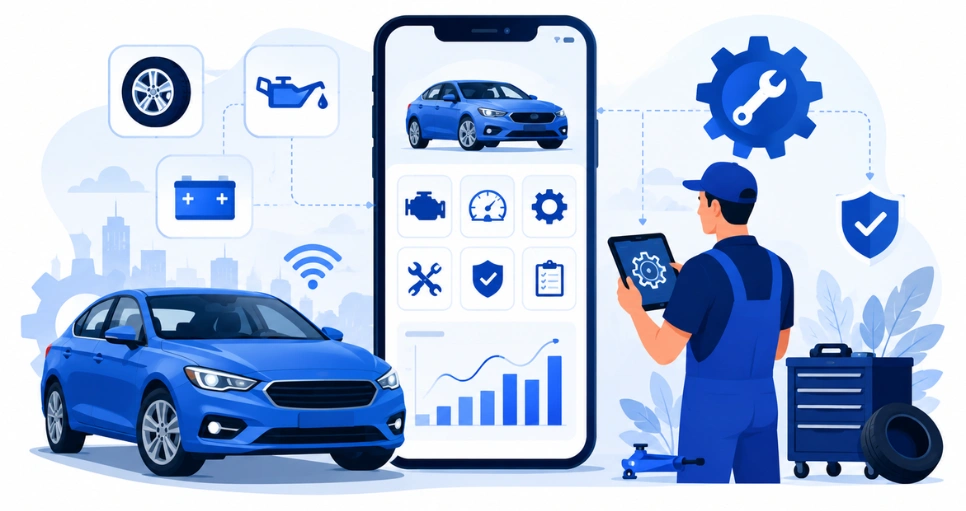
Key Takeaways:
- Automotive app maintenance can cost approximately $3,000 to $20,000 per year, depending on app complexity, features, integrations, and support requirements.
- Regular maintenance helps improve app performance, security, compatibility, and reliability while reducing the risk of unexpected technical issues.
- Essential maintenance activities include bug fixes, security patches, performance optimization, API updates, compatibility testing, and third-party integration support.
- Choosing the right maintenance partner requires evaluating automotive expertise, technical capabilities, security practices, support availability, scalability, and previous project experience.
- A proactive maintenance strategy helps extend the app's lifecycle, improve user satisfaction, support future features, and keep automotive applications ready for evolving technologies.
Automotive apps play an important role in connected mobility, vehicle management, navigation, maintenance, and customer engagement.
However, launching an app is only the beginning. Regular maintenance is essential to keep automotive applications secure, reliable, compatible, and responsive as technologies and user expectations evolve.
Automotive app maintenance covers software updates, bug fixes, performance optimization, security monitoring, third-party integrations, and ongoing technical support.
Businesses must also plan maintenance costs carefully, as expenses can vary depending on app complexity, platform requirements, feature updates, and security needs.
A proactive maintenance strategy helps prevent technical issues, protect sensitive user and vehicle data, improve application performance, and support long-term scalability.
This guide explores automotive app maintenance costs, essential updates, security practices, and support strategies businesses should consider after launch.
Why Automotive Apps Need Regular Maintenance and Support?
Regular maintenance keeps automotive apps secure, compatible, and reliable as technologies evolve.
Professional automotive app support services help businesses resolve issues quickly, improve performance, protect user data, and maintain seamless experiences across devices, platforms, connected vehicles, and services.
1. Prevents Technical Issues
Regular updates prevent bugs, compatibility problems, and performance issues from affecting users.
Timely automotive software maintenance keeps applications stable, supports newer operating systems, improves functionality, and reduces technical risks that could otherwise create costly disruptions for businesses.
2. Maintains Connected Features
Effective vehicle app maintenance ensures connected features remain functional, responsive, and secure.
Monitoring integrations, fixing bugs, updating APIs, and optimizing performance help maintain dependable communication between vehicles, mobile applications, cloud platforms, and supporting digital services for users.
3. Supports Technology Evolution
Strong automotive software development should include maintenance planning from the beginning.
Developers can build scalable architectures, secure integrations, and flexible systems that simplify future updates, reduce technical debt, and make ongoing improvements easier as automotive technologies continue evolving.
4. Strengthens Application Security
Regular security updates protect automotive applications from vulnerabilities, unauthorized access, and data breaches.
Businesses should monitor threats, update dependencies, strengthen authentication, and conduct security testing regularly to safeguard sensitive customer information and connected vehicle systems effectively.
5. Improves App Performance
Ongoing monitoring helps businesses identify crashes, slow performance, integration failures, and user experience issues before they become widespread.
Support teams can analyze application data, resolve problems quickly, and continuously improve functionality, reliability, and customer satisfaction over time.
What Does Automotive App Maintenance Include?
Understanding the automotive app maintenance cost requires looking beyond bug fixes.
Maintenance includes security checks, platform compatibility, performance optimization, feature updates, integrations, and ongoing support that keep applications reliable, scalable, and ready for evolving mobility needs as businesses grow.
1. Automotive App Security
Protecting sensitive vehicle and customer information requires strong automotive app security practices.
Maintenance teams regularly patch vulnerabilities, update authentication systems, monitor threats, test integrations, and strengthen data protection measures to reduce risks across connected automotive applications across platforms and devices.
2. Automotive App Updates
Regular automotive app updates keep applications compatible with newer operating systems, devices, APIs, and connected vehicle technologies.
Teams introduce improvements, fix bugs, optimize performance, and refresh functionality to maintain smooth experiences while addressing changing customer expectations effectively for users today.
3. Automotive Application Support
Reliable automotive application support helps businesses resolve technical issues, monitor performance, manage incidents, and assist users after launch.
Support teams provide troubleshooting, system monitoring, integration assistance, and fixes that reduce downtime and maintain dependable application operations without prolonged disruption effectively.
4. Software Development Cost
Maintenance budgets should account for the software development cost alongside ongoing technical requirements.
Businesses should plan expenses for updates, testing, infrastructure, security, integrations, and optimization to control spending and maintain consistent application performance throughout its lifecycle and future expansion needs.
5. Connected Car App Maintenance
Connected car app maintenance involves monitoring vehicle connectivity, APIs, cloud services, GPS functions, notifications, and device compatibility.
Continuous maintenance ensures connected features remain responsive, secure, and reliable while supporting new vehicle technologies and evolving mobility requirements across evolving transportation ecosystems.
6. Automotive Software Support
Effective automotive software support assists with deployment.
Teams monitor application health, resolve technical problems, manage updates, assist users, and recommend improvements, helping businesses maintain reliability, security, and performance.
Customer satisfaction as requirements evolve over time throughout ongoing product operations.
Automotive App Maintenance Cost: Key Factors and Breakdown
Once an automotive app launches, ongoing maintenance keeps it secure, compatible, and running smoothly as vehicles and mobile operating systems evolve.
Understanding realistic automotive software development cost alongside maintenance helps businesses budget for the full product lifecycle, not just the initial build.
1. Bug Fixes and Performance Monitoring
Ongoing monitoring identifies crashes, connectivity issues, and unexpected errors that could affect vehicle-related functionality.
Consistent automotive app maintenance prevents small issues from compounding into larger, more expensive problems that could disrupt real-time vehicle data or controls.
|
Element |
Description |
Cost |
|
Crash Monitoring |
Real-time error tracking and alerts |
$300-$600/year |
|
Bug Resolution |
Identifying and fixing reported issues |
$400-$900/year |
|
Performance Audits |
Load time and responsiveness checks |
$250-$500/year |
2. iOS and Device Compatibility Updates
Each new iOS and Android release requires testing and adjustments to ensure the app continues functioning correctly across devices.
Understanding realistic automotive app maintenance cost at this stage helps teams budget for compatibility checks against updated in-car infotainment systems.
|
Element |
Description |
Cost |
|
iOS/Android Compatibility Testing |
Testing across new OS releases |
$350-$700/year |
|
Infotainment System Compatibility |
Testing against updated vehicle systems |
$400-$900/year |
|
Device Fragmentation Testing |
Checks across smartphone models |
$300-$600/year |
3. Vehicle Connectivity and Telematics Maintenance
Apps connecting to vehicle sensors, GPS, or onboard diagnostics require ongoing maintenance to ensure data syncs accurately.
This stage often represents a meaningful share of overall mobile app development cost, given the technical demands of real-time vehicle data.
|
Element |
Description |
Cost |
|
Telematics Data Sync |
Ensuring accurate vehicle data flow |
$500-$1,100/year |
|
Sensor Integration Updates |
Maintaining sensor compatibility |
$400-$900/year |
|
Connectivity Protocol Updates |
Bluetooth and IoT protocol maintenance |
$350-$700/year |
4. Security Patches and Vulnerability Management
Regular security updates protect user data and vehicle systems as new threats emerge.
Strong automotive app performance optimization practices ensure these patches don't compromise speed or responsiveness, which matters significantly for apps handling remote vehicle access.
|
Element |
Description |
Cost |
|
Vulnerability Scanning |
Identifying security weaknesses |
$350-$700/year |
|
Security Patch Deployment |
Applying fixes for known threats |
$400-$800/year |
|
Data Encryption Maintenance |
Keeping encryption protocols current |
$300-$600/year |
5. Feature Enhancements and New Functionality
Beyond fixes, maintenance often includes adding requested features or refining existing ones based on user feedback.
Reliable automotive app maintenance services treat this ongoing evolution as essential for staying competitive as vehicle technology advances.
|
Element |
Description |
Cost |
|
Feature Requests |
Adding new user-requested functionality |
$500-$1,200/year |
|
UX Refinements |
Improving existing feature usability |
$350-$800/year |
|
A/B Testing |
Testing feature variations for improvement |
$250-$500/year |
6. Server and Cloud Infrastructure Management
Monitoring cloud hosting, database performance, and server uptime ensures the app remains fast and reliable as vehicle data volume grows.
Partnering with experienced AI app development companies can further optimize this infrastructure for predictive scaling.
|
Element |
Description |
Cost |
|
Server Uptime Monitoring |
Continuous infrastructure health checks |
$300-$700/year |
|
Database Performance Tuning |
Optimizing data storage and retrieval |
$400-$800/year |
|
Scalability Adjustments |
Adapting infrastructure to growing usage |
$350-$700/year |
7. Third-Party API and Integration Maintenance
Apps relying on mapping services, payment gateways, or manufacturer APIs require ongoing monitoring for changes or deprecations from those providers.
Reliable automotive software maintenance treats these integrations as potential points of failure requiring regular attention.
|
Element |
Description |
Cost |
|
Mapping API Maintenance |
Keeping navigation features functional |
$300-$600/year |
|
Payment Gateway Updates |
Ensuring secure transaction processing |
$350-$700/year |
|
Manufacturer API Sync |
Maintaining vehicle brand-specific integrations |
$400-$900/year |
8. Compliance and Regulatory Updates
Automotive apps handling location or personal data must maintain compliance with evolving data protection regulations.
Any thorough vehicle app maintenance plan factors in these ongoing legal requirements to avoid penalties across different markets.
|
Element |
Description |
Cost |
|
Data Privacy Compliance |
Consent management and policy updates |
$300-$700/year |
|
Regional Regulatory Adjustments |
Adapting to location-specific laws |
$350-$800/year |
|
Compliance Documentation |
Maintaining audit-ready records |
$250-$500/year |
9. Analytics Review and Performance Reporting
Regular reporting on crash rates, user engagement, and app performance helps identify trends and prioritize future updates.
Many mobile app development companies now include this reporting as a standard part of their retainer packages.
|
Element |
Description |
Cost |
|
Usage Analytics Reporting |
Tracking engagement and feature usage |
$250-$500/year |
|
Crash Rate Reporting |
Monitoring stability trends over time |
$200-$450/year |
|
Performance Dashboards |
Visualizing key app health metrics |
$300-$600/year |
10. Customer Support and Emergency Response
Maintaining in-app support tools and having a rapid response plan for critical issues, like connectivity outages or vehicle control failures, protects both user trust and safety.
Reliable connected car app maintenance treats emergency response as a non-negotiable priority.
|
Element |
Description |
Cost |
|
Support Ticket Management |
Maintaining in-app help and chat tools |
$300-$600/year |
|
Emergency Issue Response |
Priority handling of critical failures |
$400-$900/year |
|
Downtime Communication Systems |
Alerting users during outages |
$250-$500/year |
Essential Updates for Better App Performance and User Experience
Regular updates keep automotive apps fast, secure, and user-friendly as technologies evolve.
Prioritizing automotive app security alongside functionality helps businesses prevent vulnerabilities, improve reliability, support new devices, and deliver consistent digital experiences that meet changing driver and customer expectations effectively.
1. Optimize App Performance
Automotive app performance optimization helps reduce crashes, loading delays, battery consumption, and resource usage.
Teams should monitor application behavior, identify bottlenecks, optimize code, improve database queries, and refine network requests to deliver faster, smoother experiences for users across supported devices.
2. Maintain Compatibility
Regular automotive app updates maintain compatibility with operating systems, APIs, devices, and connected vehicle technologies.
Businesses should release improvements, bug fixes, security patches, and feature enhancements regularly, ensuring applications remain functional, reliable, relevant, and convenient for customers over time.
3. Provide Ongoing Support
Professional automotive app maintenance services help businesses monitor application health, resolve technical issues, manage integrations, and maintain stability after launch.
Continuous support also identifies emerging problems early, reducing downtime and ensuring important features continue working reliably across changing platforms and environments.
4. Improve Application Architecture
Modern mobile app development services should prioritize scalable architecture, intuitive interfaces, efficient databases, and reliable integrations.
These foundations make future improvements easier, support performance enhancements, and help automotive applications adapt smoothly to emerging technologies, user needs, and connected mobility ecosystems.
5. Conduct Regular Testing
Regular testing is essential for maintaining quality across automotive applications.
Businesses should evaluate functionality, compatibility, usability, security, and performance after major changes, while gathering customer feedback to identify improvements that make navigation simpler, features more useful, and experiences more satisfying.
6. Strengthen Security Measures
Security updates should address vulnerabilities, outdated dependencies, authentication weaknesses, and data protection concerns.
Businesses should conduct regular security assessments, apply patches promptly, monitor suspicious activity, and strengthen access controls to protect customer information and connected automotive systems from emerging threats.
How to Choose the Right Automotive App Maintenance Partner?
Choosing the right maintenance partner requires evaluating technical expertise, industry experience, communication, security practices, and support capabilities.
An enterprise web application development guide can help businesses understand essential evaluation criteria before selecting a reliable long-term technology partner.
1. Evaluate Automotive Experience
Choose a partner with relevant automotive technology experience and knowledge of connected mobility systems.
Industry expertise helps teams understand vehicle integrations, customer expectations, security requirements, and technical challenges, leading to more effective maintenance strategies and solutions.
2. Check Technical Expertise
Review the partner's expertise across mobile platforms, cloud infrastructure, APIs, databases, cybersecurity, and connected vehicle technologies.
Strong technical capabilities ensure the team can troubleshoot complex issues, maintain integrations, optimize performance, and implement future application improvements efficiently.
3. Review Previous Projects
Examine previous automotive applications and maintenance projects to understand the partner's capabilities.
Case studies, portfolios, client feedback, and measurable outcomes can reveal their experience with similar applications, technical challenges, project scopes, and long-term maintenance requirements.
4. Assess Security Practices
Security should remain a priority when selecting an automotive maintenance partner.
Evaluate their vulnerability management, authentication practices, data protection methods, security testing, compliance awareness, and incident response procedures to ensure sensitive customer and vehicle information remains protected.
5. Understand Support Availability
Confirm the partner's support model, response times, communication channels, and issue-resolution processes.
Reliable support availability helps businesses address critical bugs, application failures, integration problems, and performance issues quickly, minimizing downtime and protecting customer experiences.
6. Compare Maintenance Services
Understand exactly what the maintenance package includes before signing an agreement.
Services may cover bug fixes, security updates, performance optimization, compatibility improvements, monitoring, third-party integrations, backups, and technical support, depending on your application's requirements and complexity.
7. Consider Scalability
Select a partner capable of supporting your application's future growth.
As users, vehicles, features, and integrations increase, the maintenance team should provide scalable infrastructure recommendations, performance improvements, and technical solutions that accommodate expanding business requirements effectively.
8. Compare Pricing and Contracts
Compare pricing structures, service-level agreements, response commitments, included services, and additional charges before making a decision.
Transparent contracts help businesses understand maintenance expenses, avoid unexpected costs, and establish clear expectations for long-term technical support and application management.
Final Thoughts
Choosing the right automotive app maintenance partner is essential for keeping your application secure, reliable, and competitive after launch.
A capable partner can handle regular updates, bug fixes, performance optimization, security monitoring, compatibility improvements, integrations, and ongoing technical support.
Businesses should evaluate automotive industry experience, technical expertise, previous projects, security practices, response times, scalability, service coverage, and pricing before making a decision.
A reliable maintenance strategy can prevent costly disruptions, improve user satisfaction, and extend the application's lifecycle. It also ensures that connected vehicle features and digital services continue functioning as technologies evolve.
By selecting a partner that offers transparent communication, proactive monitoring, and flexible support, automotive businesses can maintain strong application performance while preparing their platforms for future features, users, integrations, and changing mobility expectations.
FAQ's
Automotive app maintenance involves ongoing bug fixes, security updates, performance optimization, compatibility improvements, integration management, monitoring, and technical support to keep automotive applications reliable and functional.
Regular maintenance helps prevent technical issues, improve performance, protect sensitive data, maintain compatibility with newer technologies, and provide users with a consistent and reliable application experience.
It typically includes bug fixing, security monitoring, software updates, performance optimization, API maintenance, compatibility testing, database management, third-party integration support, and ongoing technical assistance.
Updates should be released whenever security vulnerabilities, compatibility issues, critical bugs, or necessary improvements arise. Businesses should also schedule regular performance and security reviews to identify potential issues proactively.
Automotive app maintenance costs vary based on application complexity, features, platforms, integrations, support requirements, and update frequency. Businesses should evaluate their specific requirements before establishing a maintenance budget.
Maintenance teams apply security patches, update dependencies, monitor vulnerabilities, strengthen authentication, conduct security testing, and implement data protection measures to reduce potential security risks.
Yes. Performance maintenance can reduce crashes, improve loading speeds, optimize databases and APIs, minimize resource usage, and ensure smoother functionality across supported devices and connected automotive systems.
Businesses should evaluate automotive experience, technical expertise, security practices, previous projects, support availability, scalability, communication, service coverage, pricing, and contract terms before selecting a maintenance partner.
Yes. An experienced partner can help introduce new features, update integrations, improve architecture, support additional platforms, and scale infrastructure as business requirements and automotive technologies evolve.
Yes. Post-launch support helps businesses resolve unexpected issues, monitor application health, maintain security, manage updates, improve performance, and ensure connected features continue working reliably after deployment.

CrinPro
CrinPro Solutions is a leading IT company that helps startups and enterprises build innovative digital products. From intuitive mobile applications and high-performance websites to AI-powered solutions and enterprise software, our team delivers scalable, secure, and user-focused products tailored to unique business needs. With expertise across multiple industries, we transform ideas into digital experiences that drive growth, improve efficiency, and create long-term business value.