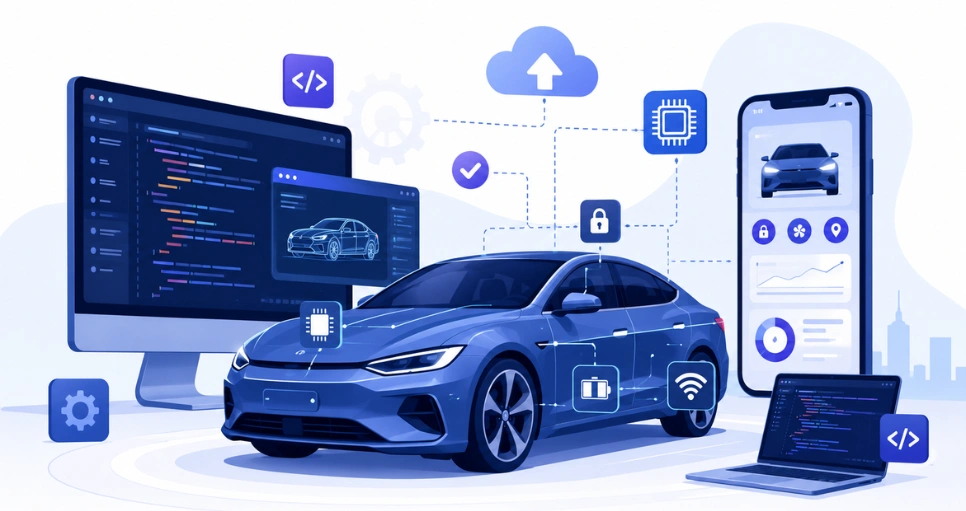
Key Takeaways:
- Automotive software has become the core driver of modern vehicle innovation, not just a supporting feature.
- Success depends on balancing ADAS, OTA updates, cybersecurity, and regulatory compliance from day one.
- Development costs typically range from $7,000 to $80,000, depending on complexity and integration needs.
- Trends like AI personalization, 5G connectivity, and software-defined architecture are reshaping the industry fast.
- Manufacturers who invest in scalable, secure software now will lead the next generation of vehicles.
The automotive industry is undergoing a fundamental shift, with vehicles increasingly defined by code rather than mechanical components alone.
Modern cars now rely on complex systems for navigation, safety, connectivity, and autonomous capabilities, making software the backbone of vehicle performance.
As this transformation accelerates, understanding automotive software development has become essential for manufacturers, suppliers, and tech companies entering the space.
From infotainment systems to advanced driver-assistance technology, software now determines how vehicles function, communicate, and evolve.
This guide explores the core features, key technologies, and emerging trends shaping automotive software today, along with the practical realities of building it.
The Rise of Software-Defined Vehicles: Why Automotive Software Matters Now
Vehicles are shifting from mechanical systems to software-driven platforms, redefining how cars are designed, updated, and experienced.
This transformation is fueling growing demand for custom automotive software development across manufacturers, suppliers, and mobility startups alike.
1. Vehicles Are Becoming Continuously Upgradable Platforms
Over-the-air updates now let automakers improve performance, safety, and features long after a vehicle leaves the factory.
This shift mirrors developments in consumer electronics, turning cars into evolving products rather than static, one-time purchases.
2. Explosive Growth in the Software-Defined Vehicle Market
The software-defined vehicle market is projected to grow from $447.55 billion in 2026 to $1,707.36 billion by 2035, at a 16.0% CAGR.
3. Strong Near-Term Momentum Through 2027
The global software-defined vehicles market is expected to register significant revenue growth during 2026 and 2027, supported by expanding connected vehicle platforms and stricter cybersecurity mandates for OTA-capable systems.
Must-Have Features in Modern Automotive Software Systems
Modern vehicles rely on sophisticated software to function safely and intelligently.
Successful automotive app development requires specific core features that enhance safety, connectivity, and the overall driving experience for today's tech-savvy consumers.
1. Advanced Driver-Assistance Systems (ADAS)
Comprehensive automotive software solutions now include lane-keeping assistance, collision detection, and adaptive cruise control as standard safety features.
These systems rely on real-time sensor data processing to prevent accidents and support increasingly autonomous driving capabilities.
2. Over-the-Air (OTA) Update Capability
Vehicles must support remote software updates without requiring dealership visits.
This functionality lets automakers fix bugs, improve performance, and introduce new features throughout a vehicle's lifecycle, similar to smartphone software updates.
3. Infotainment and Connectivity Integration
Seamless smartphone integration, voice commands, and navigation systems keep drivers connected and informed.
Modern infotainment platforms must support multiple device ecosystems while maintaining intuitive, distraction-free interfaces for safe in-vehicle interaction.
4. Companion Mobile App Integration
Reliable mobile app development lets owners remotely lock doors, check battery status, or locate their vehicle from a smartphone.
This connected experience extends vehicle functionality beyond the dashboard into everyday digital convenience.
5. Vehicle Cybersecurity Protocols
Robust encryption and intrusion detection systems protect connected vehicles from hacking attempts and data breaches.
As cars become more software-dependent, strong cybersecurity architecture is essential for protecting both vehicle systems and driver privacy.
6. Predictive Maintenance and Diagnostics
AI-powered diagnostic tools analyze vehicle data to predict component failures before they occur.
This proactive approach reduces downtime, improves safety, and helps drivers schedule maintenance based on the vehicle's actual condition rather than fixed intervals.
How to Build an Automotive Software App: Development Process?
Building a successful automotive software development project requires a structured approach that balances safety, compliance, and user experience.
Here's a step-by-step breakdown of how manufacturers and developers move from concept to a fully functional, market-ready platform.
1. Define Objectives and Target Vehicle Systems
Start by identifying whether you're building infotainment, ADAS, telematics, or a companion mobile app.
Partnering with experienced AI app development companies early helps clarify your core objective and shapes the technical architecture needed for integration.
2. Conduct Market and Regulatory Research
Automotive software must comply with strict safety standards like ISO 26262 and regional data privacy laws.
Reputable vehicle software development teams research applicable regulations early, ensuring your automotive technology solutions meet industry-specific compliance requirements from the start.
3. Choose the Right Technology Stack
Selecting appropriate programming languages, real-time operating systems, and hardware platforms depends on your app's function and directly affects overall software development cost.
ADAS and safety-critical systems often require different technical foundations than infotainment applications.
4. Design the System Architecture
Planning how software components communicate across vehicle systems, whether centralized or zonal, determines scalability and performance.
Strong architecture decisions matter most in connected car software development, preventing integration issues as more sensors get added later.
5. Develop Core Functionality and Sensor Integration
This stage involves building the actual software logic and connecting sensors, cameras, and control units.
Robust automotive management software ensures developers can process real-time data accurately, delivering reliable performance across varying driving conditions.
6. Build the User Interface and Experience
Whether designing a dashboard display or companion app, interfaces must remain intuitive and distraction-free.
Factoring in web app development cost early helps teams balance clear visual hierarchy and voice command support within budget.
7. Implement Cybersecurity Measures
Connected vehicles are vulnerable to hacking, making encryption, secure boot processes, and intrusion detection critical.
Any serious custom automotive software development project builds security into the architecture from the beginning, not as an afterthought.
8. Conduct Rigorous Testing and Validation
Automotive software requires extensive testing across simulated and real-world conditions, including edge cases and failure scenarios.
An experienced automotive software development company runs additional validation cycles to meet regulatory certification standards before deployment.
9. Integrate OTA Update Infrastructure
Building reliable over-the-air update capability lets manufacturers deploy fixes and new features remotely.
Many automakers rely on full-stack development companies to build secure delivery mechanisms and rollback protocols that prevent failed updates.
10. Deploy, Monitor, and Iterate Post-Launch
After deployment, continuous monitoring identifies performance issues, security vulnerabilities, and user feedback patterns.
Understanding long-term automotive software development cost helps manufacturers plan iterative updates that improve functionality throughout the vehicle's operational lifetime.
How Much Does It Cost to Build Automotive Software?
Understanding realistic mobile app development cost benchmarks helps manufacturers and startups budget accurately for automotive software projects.
Pricing typically ranges from $7,000 to $80,000, depending on complexity, safety requirements, and platform integration. Here's a detailed breakdown
|
Development Stage |
Description |
Estimated Cost |
|
UI/UX Design |
Dashboard, app screens, and interface prototyping |
$900-1,300 |
|
Core Software Architecture |
System design and component communication planning |
$1,800-$2,400 |
|
ADAS Feature Integration |
Lane assist, collision detection, sensor processing |
$2,600-$3,300 |
|
Infotainment System Development |
Navigation, media, and voice command integration |
$1,500-$2,100 |
|
Companion Mobile App |
Remote lock, diagnostics, and vehicle status features |
$1,100-$1,600 |
|
Cybersecurity Implementation |
Encryption, secure boot, and intrusion detection |
$1,700-$2,300 |
|
OTA Update Infrastructure |
Remote deployment and rollback protocols |
$1,200-$1,800 |
|
Cloud Backend & Data Management |
Server setup and real-time data processing |
$1,400-$1,900 |
|
QA Testing & Validation |
Simulated and real-world safety testing cycles |
$800-1,250 |
|
Regulatory Compliance & Certification |
ISO 26262 audits and legal documentation support |
$1,300-$1,900 |
What's Next: Automotive Software Trends to Watch
The future of automotive software development is being shaped by rapid advances in AI, connectivity, and autonomous technology.
Staying ahead of these trends helps manufacturers and developers build platforms that remain competitive and relevant for years to come.
1. AI-Powered Personalization and Predictive Systems
Vehicles are increasingly using AI to learn driver preferences and predict maintenance needs.
This shift is pushing custom automotive software development toward smarter, adaptive systems that tailor performance and comfort settings to individual driving habits automatically.
2. Rise of Zonal and Centralized Computing Architecture
Traditional distributed electronic control units are giving way to centralized computing models.
This architectural shift simplifies automotive app development, reduces wiring complexity, and enables faster processing for advanced driver-assistance and infotainment features simultaneously.
3. Expansion of Level 3 and Level 4 Autonomous Driving
Automakers are accelerating investment in higher levels of vehicle autonomy beyond basic driver assistance.
Advanced vehicle software development now focuses on handling complex real-world scenarios, expanding autonomous capabilities from highway driving to urban environments.
4. Growing Demand for Cybersecurity-First Development
As vehicles become more connected, cybersecurity is shifting from an afterthought to a core requirement.
Specialized software development services now prioritize threat detection, secure architecture, and compliance with evolving international vehicle cybersecurity regulations.
5. 5G Integration for Real-Time Connectivity
Faster network speeds are enabling more sophisticated connected car software development, supporting real-time data exchange between vehicles, infrastructure, and cloud platforms.
This connectivity powers everything from live traffic updates to remote diagnostics.
6. Software-Defined Vehicle Architecture Adoption
More automakers are transitioning to fully software-defined platforms, decoupling hardware from software development cycles.
This trend allows automotive software solutions to be updated and improved continuously, similar to smartphone operating systems.
7. Sustainability-Focused Software for Electric Vehicles
Battery management, energy optimization, and charging network integration are becoming central software priorities.
As EV adoption grows, software increasingly determines vehicle efficiency, range accuracy, and overall sustainability performance beyond just mechanical engineering.
8. Digital Twin Technology for Vehicle Development
Manufacturers are using digital twins to simulate vehicle performance, test software updates, and predict failures before physical production.
This approach reduces development costs while accelerating innovation cycles across the entire automotive design process.
Final Thoughts
Automotive software development has become the driving force behind modern vehicle innovation, reshaping how cars are designed, built, and experienced.
As this guide shows, success depends on balancing core features like ADAS and OTA updates with strong cybersecurity and regulatory compliance from day one.
Development costs typically range from $7,000 to $80,000, depending on complexity and platform integration.
Looking ahead, trends like AI-powered personalization, 5G connectivity, and software-defined architecture will continue reshaping the industry.
Manufacturers and developers who invest in scalable, secure software today will be better positioned to deliver safer, smarter, and more competitive vehicles in the years ahead.
FAQ's
Development costs typically range from $7,000 to $80,000, depending on complexity, safety requirements, platform integration, and the features included in your system.
Timelines vary significantly based on scope, but most automotive software projects take 4-9 months, factoring in testing, regulatory compliance, and certification requirements.
An SDV is a vehicle where core functions are controlled and upgraded through software rather than fixed hardware, enabling continuous improvements via over-the-air updates.
Connected vehicles are vulnerable to hacking, making encryption, intrusion detection, and secure architecture essential for protecting both vehicle systems and driver data.
Automotive software must comply with standards like ISO 26262, which governs functional safety for electrical and electronic systems in road vehicles.
ADAS assists drivers with features like lane-keeping and collision detection, while autonomous driving software handles complete vehicle control without human intervention.
Yes, over-the-air (OTA) update infrastructure lets manufacturers deploy bug fixes, security patches, and new features remotely without requiring dealership visits.
Modern connected vehicles rely on 5G connectivity, cloud computing, AI-driven analytics, and real-time data processing to support features like live diagnostics and navigation.
A specialized automotive software company understands industry regulations, safety standards, and vehicle-specific challenges, reducing costly errors compared to hiring a general development team.
Plan for continuous monitoring, security updates, and OTA infrastructure maintenance, which help manufacturers address vulnerabilities and improve functionality throughout the vehicle's lifecycle.

CrinPro
CrinPro Solutions is a leading IT company that helps startups and enterprises build innovative digital products. From intuitive mobile applications and high-performance websites to AI-powered solutions and enterprise software, our team delivers scalable, secure, and user-focused products tailored to unique business needs. With expertise across multiple industries, we transform ideas into digital experiences that drive growth, improve efficiency, and create long-term business value.