Key Takeaways:
- Voice creates authentic first impressions. Hearing tone and personality before seeing photos shifts focus away from superficial judgment toward genuine compatibility signals.
- Real-time streaming infrastructure is essential. Reliable, low-latency audio technology directly impacts user experience, making this a critical early technical priority for any build.
- Safety measures matter more with voice. The personal nature of voice communication requires stronger moderation and verification tools compared to standard text-based platforms.
- Start lean, then expand features. Launching with core voice profiles and matching, rather than every feature at once, keeps timelines and budgets manageable.
- AI enhances but doesn't replace good design. Smart matching algorithms improve compatibility, but intuitive design and genuine safety features remain the true foundation of user trust.
Swiping through endless profile photos has left a lot of daters exhausted and, honestly, a little jaded.
Text and photos only tell you so much: what does someone's laugh sound like, or how do they actually carry a conversation?
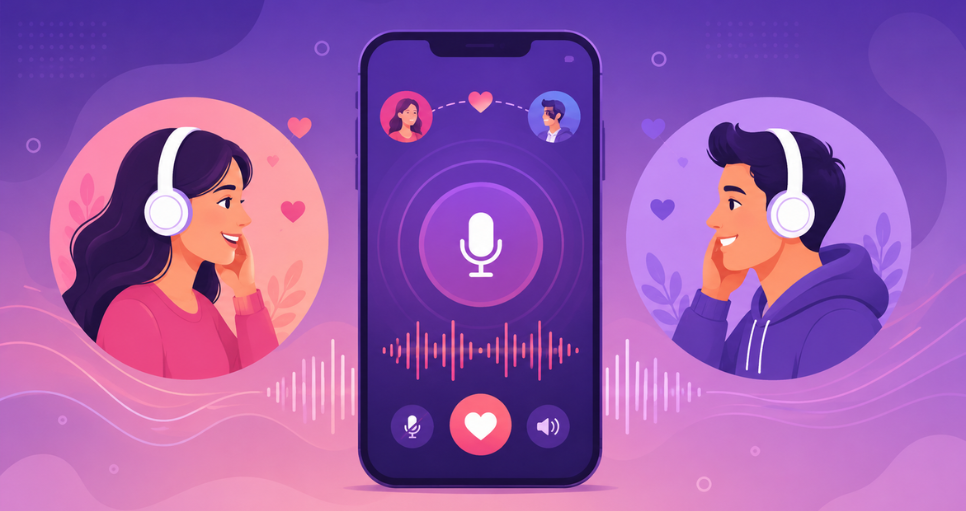
That gap is exactly what's driving interest in audio dating app development, a shift toward voice-first connections that prioritize personality and chemistry over curated profile pictures.
Instead of judging a match in half a second based on looks, users get to hear tone, humor, and genuine conversation before ever seeing a face.
This approach filters out superficial swiping culture and creates space for more authentic first impressions.
This guide walks through what it takes to build an audio dating app, from core features through launch.
Why Audio-First Dating Is Changing the Online Dating Landscape?
Traditional swipe-based apps have hit a fatigue point with users.
Voice dating app development taps into something photo-based platforms can't offer: genuine personality and chemistry heard before ever seeing a face, creating a fundamentally different first impression experience.
1. Voice reveals authentic personality faster
Tone, humor, and conversational rhythm say more about compatibility than a curated photo ever could.
Users pick up on genuine warmth, confidence, or wit within seconds of hearing someone speak, something static images simply cannot convey.
2. It reduces superficial judgment and photo-based bias
Removing photos from the first interaction shifts focus away from appearance-based snap judgments.
This creates space for connections based on personality, values, and conversational chemistry rather than surface-level attraction alone, appealing especially to daters tired of shallow swiping culture.
3. It addresses growing swipe fatigue among users
Standard dating app development has leaned heavily on endless photo swiping for over a decade, and users increasingly report burnout from this format.
Audio-first apps offer a refreshing alternative that feels more intentional and less like scrolling through a catalog.
4. It builds safer, more accountable interactions
Voice-based conversations naturally discourage catfishing and reduce anonymous harassment compared to text-only messaging.
Hearing a real voice adds a layer of accountability and authenticity that makes users feel more confident about who they're actually talking to.
5. It pairs well with smart matching technology
Modern AI dating app development can analyze speech patterns, tone, and conversational cues to improve match quality beyond basic demographic filters.
This creates more meaningful pairings based on genuine compatibility signals rather than static profile data alone.
6. It appeals strongly to younger, audio-native users
Younger daters raised on podcasts, voice notes, and audio-first social platforms already prefer voice communication over text in daily life.
Audio dating apps meet this generation where their communication habits already naturally are.
Key Features to Include in an Audio Dating App
Getting audio dating app features right means designing around voice as the primary connection point, not an afterthought.
These six categories cover the essentials every audio-first platform needs to deliver genuine, engaging user experiences.
1. Voice profile creation and prompts
Instead of photo grids, users record short voice intros or answer prompts aloud.
This gives potential matches a genuine sense of personality, tone, and conversational style right from the very first profile view, well before any messaging begins.
2. Voice-based matching algorithm
Successful custom audio dating app development relies on algorithms that weigh voice compatibility alongside standard preferences like location and interests.
Some platforms even analyze speech patterns or tone to suggest matches more likely to click conversationally, not just on paper.
3. Live audio rooms or voice chat
Group audio rooms let multiple users mingle in a low-pressure, conversational setting before committing to one-on-one matches.
This format mirrors real-world social dynamics better than isolated private messaging and helps users find compatible personalities naturally.
4. Private voice messaging and calls
Whether you're aiming to build a dating app like Tinder with an audio twist, or something entirely original, private voice messaging lets matched users connect directly through calls or voice notes before ever exchanging phone numbers or meeting in person.
5. Smart icebreakers and conversation starters
Strong audio matchmaking app development includes built-in conversation prompts that reduce awkward silence and help users find common ground quickly.
Voice-based icebreakers, like shared prompt responses, give matches an easy, natural way to start talking.
6. Safety and moderation tools
Voice recording review, reporting features, and AI-based content moderation protect users from harassment or inappropriate behavior.
Given the more personal nature of voice interactions, robust safety tools matter even more than in standard text-based dating apps.
Choosing the Right Tech Stack for Voice-Based Matching
Voice-based platforms demand different technical infrastructure than photo-driven apps.
Successful audio dating app development requires careful stack decisions around audio processing, real-time streaming, and matching algorithms, all working together reliably at scale.
1. Select a cross-platform mobile framework
Most dating app development companies rely on React Native or Flutter for building iOS and Android apps simultaneously from a single codebase.
This approach speeds up development timelines significantly while maintaining native-level performance for audio recording and playback features.
2. Choose reliable audio processing libraries
Quality online dating app development depends heavily on audio libraries that handle recording, compression, and playback smoothly across different devices and network conditions.
Popular choices include WebRTC for real-time audio and native SDKs for platform-specific optimization.
3. Implement real-time voice streaming infrastructure
Live audio rooms and voice calls require low-latency streaming infrastructure to feel natural and responsive.
Successful voice dating app development often integrates services like Agora, Twilio, or Daily.co, which handle the technical complexity of real-time audio delivery.
4. Build a scalable backend architecture
Node.js, Django, or Ruby on Rails paired with cloud hosting on AWS or Google Cloud gives your platform room to grow.
Any experienced dating app development company will emphasize backend scalability early, since audio streaming demands more server resources than text-based apps.
5. Plan your database structure for voice data
Understanding audio dating app development cost starts with database planning, since storing and retrieving voice files efficiently requires a different architecture than standard text or image data.
Cloud storage solutions like AWS S3 work well for audio file management at scale.
6. Integrate speech recognition and analysis tools
Speech-to-text APIs and voice analysis tools help with content moderation, transcription, and even matching algorithms that consider tone or speech patterns.
Google Cloud Speech-to-Text and similar services provide reliable, scalable options for processing voice data accurately.
7. Add AI-powered matching capabilities
Many AI app development companies now offer machine learning models that analyze voice compatibility signals alongside traditional preferences.
Integrating these tools helps surface better matches based on genuine conversational chemistry rather than static demographic filters alone.
8. Ensure robust security and data encryption
Voice data is inherently more personal than text, making encryption and secure storage essential.
Any serious dating app development project needs end-to-end encryption for voice messages and calls, protecting user privacy and building necessary platform trust.
Design and Development Process: From Concept to MVP
Turning your idea into a working product requires a structured process.
Successful audio dating app development moves through distinct stages cost concept validation, design, technical build, and testing cost each building on the last before reaching a launch-ready MVP.
1. Validate your concept and define your niche
Whether you want to develop a dating app like Hinge with a voice-first twist, or something entirely different, start by validating demand.
Survey potential users, study competitor gaps, and confirm real interest before committing development resources to full production.
2. Wireframe core user flows and screens
Map out every essential screen cost onboarding, voice profile creation, matching, and messaging cost before writing code.
Successful custom audio dating app development starts with clear wireframes that visualize how users move through the app naturally and intuitively.
3. Design the matching algorithm logic
Decide how voice compatibility factors into your matching system alongside standard preferences like location and interests.
Early-stage AI dating app development planning here determines whether your algorithm surfaces genuinely compatible matches or simply randomizes based on basic filters.
4. Create high-fidelity UI mockups
Move from wireframes to polished visual designs using tools like Figma.
Strong online dating app development prioritizes intuitive navigation and visual appeal, since first impressions heavily influence whether new users stick around past the initial onboarding experience.
5. Estimate budget and development timeline
Before building, calculate realistic mobile app development cost based on your feature list, team size, and platform choice.
Accurate budgeting upfront prevents scope creep later and helps set clear expectations for stakeholders or investors funding the project.
6. Build the backend and core infrastructure
Set up servers, databases, and APIs that support voice recording, storage, and real-time streaming.
Reliable audio matchmaking app development requires backend architecture built for scale from day one, since audio data demands more resources than typical text-based apps.
7. Develop core frontend features
Build the actual user-facing app, including voice profile creation, matching screens, and messaging interfaces.
This stage transforms your wireframes and mockups into a fully functional, interactive product that real users can actually navigate and use.
8. Integrate third-party services and APIs
Connect payment processing, push notifications, speech recognition, and real-time audio streaming services into your core app.
These integrations add essential functionality without requiring you to build every technical component entirely from scratch.
9. Conduct internal testing and bug fixes
Test every feature thoroughly across devices and network conditions before releasing to real users.
Catching bugs, crashes, and usability issues internally prevents a rocky first impression once your MVP reaches its initial beta audience.
10. Launch a limited MVP for real feedback
Release your MVP to a small user group rather than a full public launch.
Many teams partner with an experienced dating app development company at this stage to gather structured feedback and refine features before scaling to a wider audience.
How Much Does It Cost to Develop an Audio Dating App?
Budget planning starts with understanding where your money actually goes.
Dating app development cost varies significantly based on features, platform choice, and team location, typically ranging from $8,000 for a lean MVP to $70,000 or more for a fully-featured, scalable audio dating platform.
|
Development Element |
Description |
Cost Range |
|
UI/UX Design |
Wireframes, prototypes, and visual design for core screens |
$400 – $600 |
|
Voice Profile Creation |
Audio recording, playback, and profile prompt features |
$650 – $850 |
|
Matching Algorithm |
Voice compatibility logic combined with standard filters |
$900 – $1,200 |
|
Real-Time Voice Streaming |
Live audio rooms, voice calls, low-latency infrastructure |
$1,300 – $1,700 |
|
Backend & Database Architecture |
Server setup, database design, audio file storage |
$1,000 – $1,400 |
|
Speech Recognition & Analysis |
Speech-to-text, tone analysis, transcription integration |
$750 – $1,000 |
|
AI-Powered Matching |
Machine learning models for compatibility scoring |
$850 – $1,100 |
|
Safety & Moderation Tools |
Content moderation, reporting, voice review systems |
$500 – $750 |
|
Third-Party Integrations |
Push notifications, payment gateways, analytics |
$350 – $550 |
|
QA Testing & Deployment |
Cross-device testing, bug fixes, app store submission |
$400 – $650 |
Conclusion
Audio dating app development represents a genuine shift away from the fatigue and superficiality that's come to define swipe-based platforms.
By prioritizing voice, tone, and genuine conversation over curated photos, this approach creates space for more authentic connections from the very first interaction.
Building a successful audio dating app requires careful attention to voice-specific features, reliable real-time streaming infrastructure, and thoughtful safety measures given the more personal nature of voice communication.
From initial concept validation through MVP launch, every stage matters, and rushing through planning or technical decisions often costs more time and money later.
For founders willing to invest in getting this right, audio-first dating offers a genuine opportunity to stand out in a crowded, increasingly homogeneous market.
FAQ's
Audio dating apps prioritize voice recordings, calls, and audio profiles over photos, letting users hear personality and tone before seeing a match's face.
A basic MVP with core voice features typically takes three to five months, depending on team size and how many additional features get included initially.
Voice-based algorithms can analyze tone, speech patterns, and conversational cues alongside standard filters like location and interests, creating more nuanced compatibility signals.
Yes, ideally. Developers experienced with real-time audio streaming, speech recognition APIs, and voice data storage help avoid common technical pitfalls during the build.
Extremely important. Voice interactions feel more personal than text, making robust moderation, reporting tools, and content review even more critical than standard dating apps.
Yes, existing platforms can integrate voice profiles, calls, or audio rooms as new features, though this often requires significant backend and infrastructure updates.
Real-time voice streaming with low latency across varying network conditions is often the most technically demanding aspect, requiring specialized infrastructure and testing.
Voice verification during signup, combined with AI-based audio analysis and user reporting tools, helps reduce fake profiles more effectively than photo-only verification methods.
Younger users raised on podcasts and voice notes tend to adapt to audio-first platforms quickly, though the format appeals across various age groups seeking authenticity.
Most successful launches start with core voice profiles and matching, adding live audio rooms later once the core user base and engagement patterns are established.

CrinPro
CrinPro Solutions is a leading IT company that helps startups and enterprises build innovative digital products. From intuitive mobile applications and high-performance websites to AI-powered solutions and enterprise software, our team delivers scalable, secure, and user-focused products tailored to unique business needs. With expertise across multiple industries, we transform ideas into digital experiences that drive growth, improve efficiency, and create long-term business value.