Key Takeaways
-
Hinge's relationship-focused approach offers a strong model for building a modern dating platform.
-
A successful app should combine personalized matching, engaging profiles, messaging, and strong safety features.
-
AI can improve recommendations, moderation, personalisation, and compatibility analysis.
-
Dating app development can cost approximately $8,000–$80,000+, depending on complexity and technology requirements.
-
Continuous optimisation, user feedback, privacy, and safety are essential for long-term growth.
How to Develop a Dating App Like Hinge?
Dating has moved from simple profile browsing to highly personalized digital experiences. Users now expect dating platforms to understand their preferences, encourage meaningful conversations, and provide safer ways to connect with potential partners.
Hinge has built its identity around this approach. Instead of focusing only on the number of matches, the platform emphasises detailed profiles, prompts, comments, personalized recommendations, and connections that can eventually move beyond the app. Hinge describes itself as a dating app designed to help users make meaningful connections, with its recommendation system learning from user preferences and activity.
This product philosophy has created an interesting opportunity for entrepreneurs. A Hinge-like app development project can combine profile-based matchmaking, interactive prompts, intelligent recommendations, and conversation-focused features to create a differentiated dating experience.
However, developing such a platform requires more than copying the visible features of Hinge. Businesses need to understand the underlying user journey, matchmaking logic, privacy requirements, moderation systems, monetisation strategy, and technology infrastructure.
This guide explains how to develop a dating app like Hinge, from defining the concept and selecting features to choosing the technology stack, integrating AI, estimating development costs, and preparing the launch application.
Market Statistics
-
According to Grand View Research, the global online dating application market size was valued at USD 7,939.2 million in 2022 and is projected to reach USD 14.42 billion by 2030, growing at a CAGR of 7.6% from 2023 to 2030.
-
The global dating app market is valued at approximately $12.5 billion, with over 350 million active users worldwide.
-
According to Business of Apps, Hinge stands out with rapid growth, surging roughly 25% in downloads and hitting around $550 million in revenue by capitalising on "swipe fatigue" and marketing itself as the app meant to be deleted.
-
Roughly 23 million people globally pay for premium features across dating services, generating over $1.45 billion in annual in-app purchases and subscriptions.
Why Hinge Has Become a Model for Modern Dating Apps
The dating app market has become increasingly competitive, making differentiation essential for new platforms. Hinge stands out by positioning itself around meaningful relationships rather than encouraging users to endlessly browse profiles. Its product experience focuses on helping users understand someone's personality before deciding whether to connect.
This approach has influenced entrepreneurs researching dating app development companies, as it demonstrates how thoughtful product design can shape user behaviour, engagement, and the quality of connections.”
Focus on Meaningful Connections
Instead of making profile photos the only major interaction point, Hinge uses prompts, written responses, and profile details to give users more context about potential matches. This creates additional opportunities for users to find common interests and start conversations.
Conversation-Oriented Interactions
Users can interact with specific parts of another person's profile, giving them a natural starting point for conversation. This reduces the pressure of creating an opening message from scratch and can make interactions feel more personal.
Relationship-Focused Positioning
Hinge has built its brand around helping people find relationships rather than simply increasing the number of matches. For businesses planning online dating app development, this highlights the importance of defining a clear purpose and target audience before building the platform.
Personalized Discovery
Modern dating platforms increasingly use behavioural data and user preferences to improve recommendations. Instead of displaying completely random profiles, matchmaking systems can prioritise people who are more likely to share compatible interests, preferences, or relationship goals.
Stronger User Engagement
A combination of profile prompts, personalized recommendations, likes, comments, and messaging can encourage users to interact more meaningfully. For a new dating platform, the lesson is not to copy Hinge feature-for-feature but to understand how its product experience addresses user problems.
What Makes Hinge Different From Traditional Dating Platforms?
A successful dating platform needs a clear reason for users to choose it over dozens of alternatives. Hinge differentiates its experience by giving users more context about potential matches and encouraging interactions around profile content rather than relying entirely on quick swipes.
For businesses planning a new dating product, these characteristics can provide useful direction without requiring a direct copy of Hinge's platform.
Profiles Designed to Show Personality
Hinge-style profiles can include photographs, written prompts, interests, lifestyle information, and other personal details. This gives users multiple ways to understand someone's personality before deciding to interact.
Likes With Context
Rather than making every interaction a simple like or dislike, users can respond to a particular photo or prompt. This creates a more natural starting point for conversations and can increase the quality of interactions.
Compatibility-Focused Matching
A modern matchmaking app development strategy can combine profile preferences, user behaviour, interests, location, and relationship goals to identify potentially compatible users. The matching algorithm can become more effective as the system learns from interactions and user feedback.
User-Controlled Preferences
Users should be able to define important preferences such as age range, distance, interests, relationship intentions, and other relevant criteria. Giving users control helps reduce irrelevant recommendations and improves the overall discovery experience.
Safety and Trust Features
Dating platforms handle personal information and facilitate interactions between people who may not know each other. Features such as profile verification, reporting, blocking, moderation, privacy controls, and suspicious-activity detection are therefore essential.
Simple but Purposeful User Experience
The interface should make important actions easy to understand. Complicated navigation can discourage users from completing profiles, exploring matches, or starting conversations. A clean experience can help users move naturally from registration to profile creation, discovery, matching, and messaging.
Choosing the Right Dating App Model for Your Target Audience
Not every dating platform needs to follow the same business model or user experience. The right approach depends on the target audience, relationship goals, geographic market, and monetisation strategy. Before beginning development, businesses should decide what type of dating experience they want to create.
General Dating Platforms
These apps target a broad audience and allow users to discover potential matches based on preferences such as age, location, interests, and relationship goals. They can include profile discovery, matching, messaging, subscriptions, and premium features.
Relationship-Focused Dating Apps
A relationship-focused platform prioritises meaningful connections rather than maximising the number of interactions. Detailed profiles, personality prompts, compatibility scores, and conversation-based matching can be used to create a more intentional experience.
Niche Dating Platforms
Niche platforms target specific communities or interests. For example, Muslim dating app development can focus on users seeking culturally relevant matchmaking experiences, while other platforms can be designed around particular lifestyles, professions, interests, or relationship preferences.
LGBTQ+ Dating Platforms
Dedicated platforms can provide experiences designed around the needs of LGBTQ+ communities. LGBTQ+ dating app development may include flexible identity and preference settings, inclusive profile options, privacy controls, community-specific discovery, and enhanced safety mechanisms.
Matchmaking Platforms
These platforms place greater emphasis on compatibility and personalized recommendations. Advanced algorithms can analyse user preferences, profile information, interactions, and feedback to identify suitable matches.
Social Dating Apps
Social-oriented dating platforms can combine dating with community features such as interest-based groups, events, live interactions, or social discovery. This model can give users additional ways to interact beyond traditional one-to-one matching.
Features That Define a Successful Hinge-Style Dating Experience
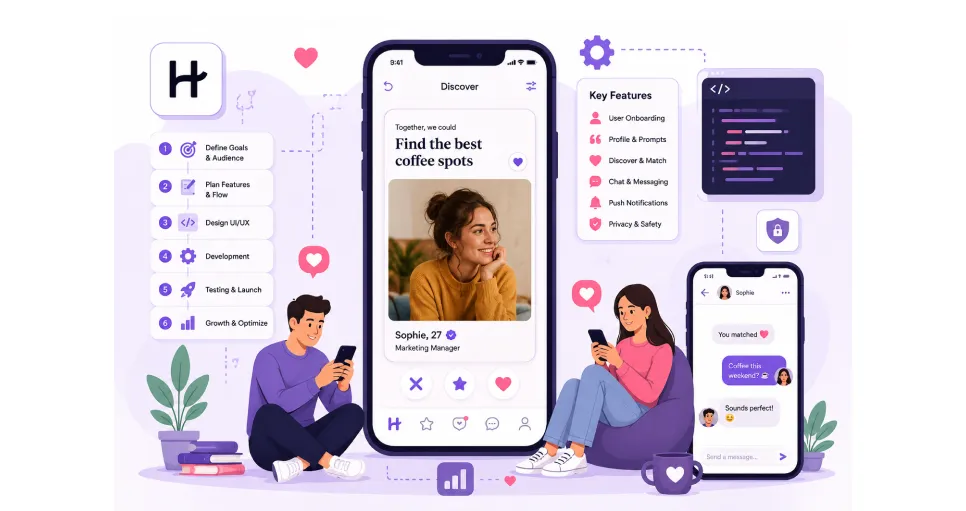
The success of a dating platform depends heavily on how easily users can create profiles, discover compatible people, interact safely, and build meaningful conversations. Instead of adding every possible function at launch, businesses should prioritise features that support the core user journey.
User Registration and Profile Creation
Users should be able to register using email, phone number, or supported social accounts. Profile creation can include photos, prompts, interests, location, relationship preferences, occupation, and other optional details. A detailed profile gives the matching system more information while helping users make informed decisions about potential connections.
Personalized Profile Prompts
Prompt-based profiles can encourage users to share opinions, interests, experiences, and personality traits. Users can respond to different prompts and choose which answers appear publicly on their profiles. This approach makes profiles more engaging than relying entirely on photographs.
Advanced Discovery and Filters
Users should be able to discover potential matches based on relevant preferences such as the following:
-
Age range
-
Location and distance
-
Relationship goals
-
Interests
-
Lifestyle preferences
-
Education or profession
-
Languages
-
Other customizable preferences
The platform should also allow users to modify these settings as their preferences change.
Likes, Comments, and Matches
Users can like a specific profile element, such as a photograph or prompt, or express general interest. When interest is mutual, the system can create a match and unlock further communication. This interaction model can make conversations more contextual and reduce the friction associated with starting a conversation.
In-App Messaging
Once users match, they should be able to communicate through a secure messaging system. Useful features can include text messages, image sharing where appropriate, read indicators, message notifications, and conversation controls.
Profile Verification
Verification can help reduce fake profiles and improve trust. Depending on the platform, businesses can implement phone verification, email verification, selfie verification, or other identity-checking mechanisms.
Safety, Blocking, and Reporting
Safety should be incorporated into the product from the beginning. Users should have simple options to block or report other accounts, while administrators need moderation tools for reviewing reported profiles and suspicious behaviour.
Push Notifications
Notifications can alert users about new matches, likes, messages, profile interactions, and other relevant activity. Users should have control over notification preferences to avoid unnecessary interruptions.
Subscription and Premium Features
A dating app can offer premium functionality such as advanced filters, increased visibility, unlimited interactions, profile boosts, or additional discovery options through subscription plans or one-time purchases.
Admin Dashboard
The administrative panel should allow the business to manage users, profiles, subscriptions, reports, content, verification requests, and platform analytics from one centralized system.
AI-Powered Recommendations
AI can analyse profile information and user behaviour to improve match recommendations, personalise discovery, and identify patterns that may indicate compatibility.
From Concept to Launch: Building Your Hinge-Inspired Dating Platform
Building a dating platform requires a structured process that connects product strategy, user experience, technology, security, and continuous optimisation. A clear dating app development process helps businesses control development time and create a product that can evolve after launch.
Step 1: Research the Market and Define the Concept
Start by studying the target audience, competitors, user expectations, and market gaps. Decide whether the application will target a broad audience or a specific community, and define the relationship experience you want to provide. At this stage, establish the platform's unique value proposition rather than simply replicating an existing dating application.
Step 2: Define the MVP Scope
Identify the minimum set of features required for the first release. A dating app MVP may include registration, profile creation, preferences, discovery, matching, messaging, notifications, reporting, and basic administration.
Step 3: Design the User Experience
Create wireframes and interactive prototypes for registration, profile creation, discovery, matching, messaging, subscriptions, and other major workflows. The design should be simple enough for first-time users to understand while providing enough flexibility for users to express their personalities.
Step 4: Develop the Application
The development team builds the frontend, backend, database, APIs, authentication system, matching logic, and administrative dashboard according to the approved architecture.
Businesses can choose custom dating app development when they need unique matching algorithms, specialised user flows, custom branding, or features that aren't available in generic dating solutions.
Step 5: Implement Matching and Recommendation Logic
The matching engine is one of the most important components of a dating platform. It can consider user preferences, location, interests, relationship goals, profile information, interactions, and feedback to generate relevant recommendations.
Step 6: Add Security and Moderation
Implement account verification, encrypted communication, secure authentication, privacy controls, reporting, blocking, content moderation, and suspicious-activity monitoring.
Because dating platforms involve sensitive personal information and direct communication, privacy and safety should be considered throughout development rather than added immediately before launch.
Step 7: Test the Platform
Conduct comprehensive testing across different devices and operating systems. Testing should cover functionality, performance, usability, security, APIs, payments, notifications, matching logic, and edge cases. Beta testing with a limited group of users can also reveal usability issues that may not appear during technical testing.
Step 8: Launch and Measure User Behavior
After deployment, monitor important metrics such as profile completion, daily active users, match rates, conversations started, retention, subscription conversions, and user reports. These insights can help determine which features need improvement and which parts of the user journey create friction.
Step 9: Improve and Scale
A dating application should continue evolving after launch. Based on user feedback and analytics, businesses can introduce AI recommendations, advanced filters, premium features, new communication tools, and additional safety mechanisms.
Choosing an experienced dating app development company can help businesses manage this continuous product cycle while maintaining performance, security, and scalability.
Technology Choices Behind a Scalable Dating Platform
The technology stack determines how efficiently a dating application performs, scales, integrates with third-party services, and handles sensitive user information. The right choices depend on the application's features, expected user base, supported platforms, and long-term product roadmap.
|
Technology Layer |
Recommended Technologies |
Estimated Cost Contribution |
|
UI/UX Design |
Figma, Adobe XD |
$1,500–$5,000 |
|
Android Development |
Kotlin |
$4,000–$12,000 |
|
iOS Development |
Swift |
$5,000–$12,000 |
|
Cross-Platform Development |
Flutter, React Native |
$5,000–$15,000 |
|
Backend Development |
Node.js, Python, Laravel |
$5,000–$15,000 |
|
Database |
PostgreSQL, MySQL, MongoDB |
$1,000–$4,000 |
|
Cloud & Hosting |
AWS, Google Cloud, Azure |
$500–$3,000+ |
|
APIs & Integrations |
Maps, authentication, payment, messaging APIs |
$1,000–$6,000+ |
|
AI & Recommendation Engine |
Python, TensorFlow, ML APIs |
$3,000–$15,000+ |
|
Security & Testing |
Encryption, QA, penetration testing |
$2,000–$8,000 |
These figures are approximate cost contributions, not separate mandatory expenses that should simply be added together. The actual budget depends on whether the business chooses native or cross-platform development, the number of features, complexity of the matchmaking engine, integrations, and development team rates.
The technology investment should be planned alongside the broader mobile app development cost because architecture, platform selection, integrations, and AI capabilities can significantly influence the overall project budget.
The Role of AI in Creating Smarter Dating Experiences
Artificial intelligence is becoming an important part of modern dating platforms because it can analyse large amounts of profile and behavioural data to make discovery more personalized. When implemented responsibly, AI can improve matchmaking, user engagement, safety, and the overall dating experience.
AI-Powered Match Recommendations
AI algorithms can analyse information such as interests, preferences, relationship goals, location, profile interactions, and previous matches to identify users who may be more compatible. Instead of relying only on manually selected filters, an intelligent recommendation engine can continuously learn from user behaviour and improve the relevance of suggested profiles.
Personalized Discovery
AI can study which profiles users interact with, skip, like, or match with. These behavioural signals can help the platform adjust recommendations over time and create a more personalized discovery feed.
Smarter Profile Suggestions
AI can assist users while creating their profiles by suggesting improvements to profile descriptions, identifying incomplete information, or recommending prompts that encourage more meaningful responses.
AI-Powered Conversation Assistance
Dating platforms can optionally use AI to suggest conversation starters based on shared interests or profile information. These tools should remain optional and should not replace genuine communication between users.
Businesses evaluating AI APIs for dating app developers can integrate established AI services for recommendations, text analysis, moderation, and other intelligent features without building every AI capability from scratch.
Safety and Content Moderation
AI can help identify suspicious behaviour, inappropriate content, spam, fake profiles, and potentially harmful interactions. Automated detection can work alongside human moderation to improve platform safety.
Compatibility Analysis
A more advanced AI dating app development strategy can evaluate multiple compatibility signals instead of relying on a simple matching score. The system could consider communication preferences, shared interests, relationship intentions, and behavioural patterns while keeping users in control of their preferences.
Understanding the Cost of Building a Dating App in 2026
The cost of developing a dating app like Hinge depends on the product scope, matching logic, platform selection, integrations, security requirements, and level of customisation. Instead of looking at development cost only by app type, businesses can estimate the budget according to the level of functionality they want to launch with.
|
Development Level |
What You Get |
Estimated Cost |
Timeline |
|
Starter MVP |
Registration, profiles, preferences, basic matching, likes, messaging, notifications |
$8,000–$20,000 |
2–3 months |
|
Growth-Ready App |
Advanced profiles, filters, matching, chat, verification, subscriptions, admin panel |
$20,000–$40,000 |
3–5 months |
|
Hinge-Like Platform |
Prompt-based profiles, personalized recommendations, advanced matching, moderation, payments, analytics |
$40,000–$60,000 |
5–7 months |
|
AI-Powered Dating Platform |
AI matchmaking, behavioral recommendations, AI moderation, personalization, advanced analytics, scalable infrastructure |
$60,000–$80,000+ |
7–10+ months |
These figures are approximate and can vary depending on the development team's location, technology choices, number of platforms, integrations, and customisation requirements.
For businesses comparing the overall dating app development cost, it is also important to budget for post-launch maintenance, cloud hosting, API usage, security updates, moderation, and future feature development.
Key Challenges to Solve Before Launching Your Dating App
Developing a dating app is only one part of building a successful platform. Businesses also need to prepare for challenges related to user trust, privacy, engagement, scalability, and competition. Addressing these issues early can reduce operational risks and create a stronger foundation for long-term growth.
Building Trust and User Safety
Users need to feel comfortable sharing personal information and communicating with strangers. Fake profiles, spam, harassment, scams, and inappropriate content can negatively affect the platform's reputation.
Maintaining User Privacy
Dating platforms collect sensitive information such as photographs, locations, preferences, conversations, and profile details. Businesses need strong access controls, encryption, secure authentication, and appropriate data-handling practices to protect this information.
Solving the Cold-Start Problem
A new dating platform needs enough active users to provide relevant recommendations. If users see very few suitable profiles, they may leave before becoming engaged.
Maintaining Match Quality
Simply increasing the number of matches does not guarantee a successful dating experience. Poor recommendations can lead to low engagement and user frustration.
Standing Out in a Competitive Market
The dating industry already includes numerous established platforms. A new application needs a clear value proposition rather than simply offering another version of the same swipe-and-match experience.
Controlling Long-Term Costs
Development expenses do not end after launch. Businesses need ongoing budgets for server infrastructure, maintenance, security, third-party services, moderation, customer support, and feature upgrades.
Working with an experienced development partner and planning these recurring expenses from the beginning can make the product more financially sustainable. A reliable mobile app development company can also help prioritise features and scale the architecture as the user base expands.
Conclusion
Building a dating app like Hinge requires more than replicating an existing platform. The strongest products focus on a specific audience, meaningful interactions, relevant matchmaking, user safety, and a smooth experience from profile creation to conversation. Features such as personalized recommendations, profile prompts, secure messaging, verification, and AI-powered matching can help create a more engaging dating experience.
A well-planned development strategy also helps businesses manage technical complexity and investment more effectively. By starting with a focused product, selecting the right technology stack, prioritising privacy and safety, and continuously improving the platform based on user feedback, businesses can build a dating application that is scalable, competitive, and designed for long-term growth.
FAQ's
A Hinge-like dating app can cost around $40,000–$60,000, while an advanced AI-powered platform may cost $60,000–$80,000+.
A basic dating app may take 2–3 months, while an advanced platform with AI, advanced matching, and multiple integrations can take 7–10+ months.
Core features include user profiles, prompts, preferences, matching, likes, messaging, notifications, verification, reporting, blocking, and an admin dashboard.
Yes. AI can analyze preferences and user behaviour to improve match recommendations, personalization, compatibility analysis, and content moderation.
A clear niche, distinctive matchmaking approach, strong safety features, personalized experiences, and a well-defined value proposition can help a new platform differentiate itself.
Common technologies include Flutter, React Native, Swift, Kotlin, Node.js, Python, PostgreSQL, MongoDB, AWS, and Google Cloud, depending on the application's requirements.

CrinPro
CrinPro Solutions is a leading IT company that helps startups and enterprises build innovative digital products. From intuitive mobile applications and high-performance websites to AI-powered solutions and enterprise software, our team delivers scalable, secure, and user-focused products tailored to unique business needs. With expertise across multiple industries, we transform ideas into digital experiences that drive growth, improve efficiency, and create long-term business value.