Key Takeaways:
- Build around a clear dating niche instead of simply copying Tinder’s swipe interface.
- Prioritize matching, profiles, chat, privacy, moderation, and safety features in your MVP.
- Choose your technology stack based on scalability, budget, real time needs, and product complexity.
- Use AI where it improves matchmaking, moderation, recommendations, or fraud detection rather than adding AI for novelty.
- Plan development, testing, launch, analytics, and ongoing improvements around real user engagement and match quality.
Thinking about building a dating app? Good, but here is the hard truth first. Most founders copy the swipe screen and stop thinking there.
Then users leave in a week because matching feels dumb, chats feel dead, and nobody trusts the profiles.
That is the real problem. Not the design. Not the logo.
In this guide, I will walk you through everything you actually need to build a dating app like Tinder. From the idea, to features, to tech, to safety, to launch. Simple language, real steps, no fluff.
What Is Tinder and How Does a Dating App Work?
A dating app is a mobile platform that helps people discover potential partners based on profiles, preferences, location, interests, and mutual interest, with features for matching and communication.
The dating app industry made a bit over 6 billion dollars in 2025, with Tinder still leading in both downloads and revenue among rivals like Bumble and Hinge.
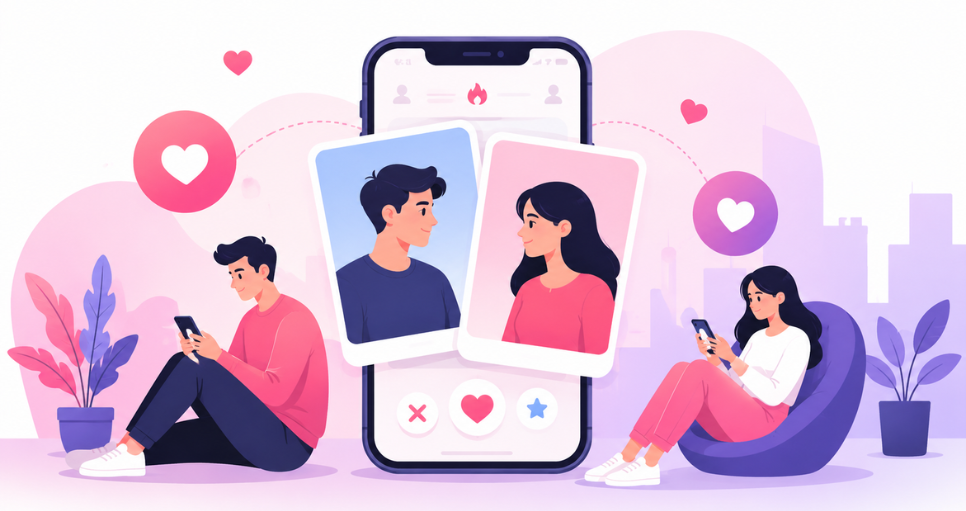
Tinder is a location based dating app built around a simple swipe experience. Users view profiles, swipe right to show interest or left to pass, and can chat when interest is mutual.
How Does a Dating App Work?
1. Create a Profile
Users sign up, add photos, personal details, interests, preferences, and location. This information creates the profile that other users see.
2. Discover Potential Matches
The app uses preferences, location, age range, interests, and other signals to recommend relevant profiles. This is where the discovery experience really starts.
3. Show Interest and Match
Users can like or pass on profiles. When two people express mutual interest, the system creates a match and opens the door for communication.
4. Chat and Build a Connection
Matched users can exchange messages, photos, voice notes, or calls. Notifications bring users back when they receive a new message or interaction.
Stop Copying Tinder, Build Your Own Dating App Idea First
This is where most Tinder clone app development projects fail before they even start.
Copying the interface does not give you an edge. Everyone can copy a swipe screen now. That is not a business.
1. Pick A Real Audience
Maybe it is Gen Z. Maybe working professionals. Maybe people who actually want something serious, not another hookup app.
Niche ideas work well here too. A concept like Muslim dating app development often needs its own onboarding flow, its own privacy rules, and its own community expectations, which is very different from a general audience app.
2. Find The Actual Problem
Ask what current apps are failing at. Too many fake profiles? Bad matches? No safety? Write it down. This becomes your whole product direction.
3. Choose Your Matching Model
You have options here, and this decision shapes your whole app.
- Mutual matching, like Tinder
- Curated matching, like a matchmaker picks for you
- Interest based matching
- Behavior based matching
- AI powered recommendations
If your idea leans toward deep profiles and intentional dating instead of quick swipes, it helps to study how a project like develop a dating app Like Hinge approaches prompts and compatibility instead of instant swiping.
My honest take. If your app does not answer who it is for in one sentence, go back and fix that before touching any code.
Dating App Features You Actually Need
This is one of the biggest parts of Tinder like app development, so let us slow down here.
Do not build every feature on day one. That is a mistake I see constantly with new founders. Build small, learn fast, then grow.
Essential MVP Features
- Phone and email login: Give users secure authentication options without making signup feel like a chore.
- Social login: Speed up onboarding with trusted identity providers while keeping account access simple.
- Profile creation and photo upload: Let users add photos, interests and preferences that support better profile recommendations.
- Location based discovery: Use geolocation to surface relevant profiles within a user’s preferred dating radius.
- Swipe and match: Build the core discovery loop around likes, dislikes and mutual matching.
- Basic chat: Let matched users start private conversations without leaving the dating platform.
- Push notifications: Alert users about new matches, messages and relevant profile activity.
- Block and report: Give users immediate tools to handle unwanted contact, abuse or suspicious profiles.
- Privacy settings: Let users control profile visibility, location sharing and other personal information.
Advanced Dating App Features
- Advanced filters: Help users refine discovery using age, interests, distance and other preferences.
- Profile verification: Add identity or photo checks to strengthen trust and reduce fake dating profiles.
- Voice messages: Give matches a more natural way to communicate beyond text chat.
- Video calling: Help users connect face to face before deciding to meet offline.
- Read receipts and typing indicators: Add familiar real time messaging signals that make conversations feel responsive.
- Incognito mode: Give privacy focused users more control over who can discover their profile.
- Super likes and boosts: Create premium engagement tools that can support a freemium monetization model.
- Rewind: Let users recover an accidental swipe without disrupting the discovery experience.
AI Powered Features
- AI matchmaking: Analyze preferences and behavioral signals to improve compatibility based recommendations.
- Smart profile recommendations: Use recommendation models to surface profiles based on changing user interests and activity.
- Fake profile detection: Apply machine learning signals to identify suspicious accounts before they harm user trust.
- Image moderation: Automatically flag potentially unsafe or inappropriate images for review.
- Toxicity detection in chats: Use NLP models to identify abusive or harmful language and support safer conversations.
- Personalized date suggestions: Generate relevant date ideas using profile interests, preferences and conversation context.
Trust And Safety Features
This deserves its own space. Dating apps handle personal data, user generated content and real world interactions, so safety cannot be an afterthought.
- Profile verification: Use verification workflows to strengthen identity signals and discourage fake accounts.
- Report and block: Give users simple controls to report harassment, scams or unwanted interactions.
- Content moderation: Combine automated detection with human review for user generated content.
- Age verification: Add appropriate age checks to protect users and meet platform requirements.
- Fraud detection: Monitor unusual account behavior and signals linked to scams or suspicious activity.
- Privacy controls: Give users meaningful control over profile visibility, location data and account information.
- My advice after years of watching apps evolve: prove the matching experience first. Boosts can wait. If users find good matches and return tomorrow, you have something worth building.
Dating App Development Process From Idea To Launch
Here is the full Dating App Development Process, step by step, the way I would actually walk a founder through it.
1. Discovery and Understanding the Goal
Before touching Figma or writing code, define what the dating app is actually trying to solve. I have seen founders jump straight into features and only later realize their audience, business model, or matching experience was unclear.
Example: A founder targeting busy professionals might prioritize verified profiles, location based matching, and meaningful recommendations instead of endless swiping.
- Define the target audience and dating intent
- Identify the core problem and value proposition
- Set MVP goals, KPIs, and success metrics
Key takeaway: A clear product goal keeps online dating app development focused instead of feature heavy.
2. Market and Competitor Research
Study existing dating platforms before deciding what to build. Look at Tinder, Bumble, Hinge, niche dating apps, user reviews, pricing, onboarding, matching logic, and trust features. The useful gaps are often hiding in complaints, not competitor homepages.
Example: If users repeatedly complain about fake profiles, identity verification and stronger moderation could become your differentiator.
- Analyze competitors and user reviews
- Identify underserved audiences
- Compare monetization and engagement models
- Map feature gaps and user pain points
Key takeaway: Good market research gives your dating product a reason to exist.
3. Defining the Product Clearly
Now turn research into a practical product plan. Decide how users create profiles, discover people, express interest, match, communicate, and eventually convert to paid members.
Example: Your MVP might support profile creation, location based discovery, swiping, matching, messaging, reporting, and one premium subscription.
- Define user personas and user journeys
- Separate MVP features from later upgrades
- Choose your monetization model
- Create a realistic product roadmap
This is where AI dating app development should be treated carefully. AI can improve recommendations or moderation, but it should solve a real user problem.
4. UX and UI Design
Dating apps live or die by their user experience. A beautiful interface means little if users cannot understand how to create a profile, discover matches, or start a conversation within seconds.
Example: During onboarding, ask only the questions needed for useful matchmaking. For LGBTQ+ dating app development, inclusive profile options and privacy controls also need careful UX planning.
- Create wireframes and clickable prototypes
- Design onboarding and profile flows
- Plan swipe, match, chat, and discovery screens
- Test accessibility and mobile usability
A simple flow usually beats a clever one.
5. Technical Architecture Planning
Once the user journey is clear, plan the technology underneath it. This includes the mobile framework, backend, database, APIs, authentication, cloud infrastructure, real time communication, and security architecture.
Example: A scalable architecture could use Flutter for the mobile application, Node.js for backend services, PostgreSQL for structured user data, Redis for caching, and AWS for infrastructure. This foundation also supports reliable matchmaking app development as your user base grows.
- Plan API architecture and data models
- Define authentication and authorization
- Design scalable matching services
- Plan location and real time data handling
Do this early. Architecture decisions become expensive to change after thousands of users arrive.
6. MVP Development
Build the smallest usable version that can prove your core dating concept. Do not spend months building every premium feature before knowing whether people actually enjoy the matching experience.
Example: Your first release could include registration, profiles, discovery, matching, messaging, notifications, blocking, reporting, and basic analytics.
A sensible MVP focuses on:
- Core matchmaking workflow
- Secure authentication
- Profile and media management
- Basic chat and notifications
- Admin controls and moderation
I would rather launch ten well tested features than thirty unfinished ones.
7. Third Party Integrations
Some functionality does not need to be built from scratch. Payment gateways, maps, push notifications, analytics, communication services, identity verification, and AI services can often be connected through established APIs.
For example, AI APIs for dating app developers can support use cases such as profile analysis, recommendation systems, content moderation, and conversational experiences.
- Payment integration
- Maps and geolocation APIs
- Push notification services
- Analytics platforms
- AI and moderation APIs
Choose integrations based on reliability, privacy, pricing, documentation, and scalability, not simply popularity.
8. QA and Security Testing
This is where teams discover the uncomfortable stuff. A dating app handles private conversations, photos, location data, identity information, and potentially payment details, so functional testing alone is not enough.
Example: Test what happens when a user blocks someone during an active chat, loses internet during a match, or attempts to access another user's private profile.
- Test authentication and authorization
- Check API security and data exposure
- Test chat and notification reliability
- Perform load and performance testing
- Validate reporting and moderation workflows
Security should be designed into the product, not added after launch.
9. Beta Testing With Real Users
Internal testing tells you whether the app works. Real users tell you whether the app makes sense. Those are very different things.
Invite a controlled group from your target audience and watch how they actually use the product.
Example: You may discover that users understand swiping immediately but struggle to complete profile verification. That insight is far more useful before public launch.
- Track onboarding completion
- Monitor match and conversation rates
- Collect qualitative feedback
- Record usability problems
- Fix high impact issues first
A small beta can reveal problems that hundreds of hours of internal testing miss.
10. App Store Launch
Once the product is stable, prepare the release for the Apple App Store and Google Play. Store approval is only one part of launch. Your screenshots, description, privacy disclosures, positioning, and acquisition plan also influence whether people install the app.
Example: A niche dating app for professionals should communicate its audience and core benefit immediately instead of presenting itself as another generic dating platform.
- Prepare store listings and screenshots
- Complete privacy disclosures
- Configure production infrastructure
- Set up crash monitoring
- Prepare launch marketing
A launch should be treated as the beginning of learning, not the finish line.
11. Analytics Setup
You need evidence to understand what users are doing. Install analytics before launch so you can measure the complete funnel from registration to meaningful interaction.
Example: If thousands of users create accounts but very few complete profiles, the problem may be onboarding rather than matchmaking.
Track metrics such as:
- Registration completion rate
- Profile completion rate
- Match rate
- Conversation start rate
- Daily and monthly active users
- Retention rate
- Subscription conversion
Good analytics turn user behavior into product decisions.
12. Ongoing Improvement After Launch
A dating app is never really finished. User preferences change, competitors release new features, and your own data will expose problems you could not predict during development.
This is also where online dating app development becomes an ongoing product discipline rather than a one time coding project.
Example: If analytics show users match often but rarely start conversations, improve profile prompts, icebreakers, recommendations, or chat discovery before adding another premium feature.
- Review analytics and user feedback
- Improve matchmaking quality
- Strengthen trust and safety
- Optimize retention and monetization
- Release features through controlled iterations
My biggest advice here is simple. Do not confuse adding features with improving the product. A smaller app that consistently creates meaningful matches can outperform a crowded app with twice as many features.
Technology Stack For Dating App Development
Now that the product direction is clear, technology decisions get much easier.
Choosing the right platform mix also affects budget planning, and this is exactly where a resource like mobile app development cost becomes useful before you commit to a stack.
|
Technology Layer |
Recommended Technologies |
|
Mobile App |
iOS with Swift and SwiftUI, Android with Kotlin, Cross platform with Flutter or React Native |
|
Backend |
Node.js, Python, Java, or Go |
|
Database |
PostgreSQL for structured data, Redis for caching, MongoDB for flexible data models |
|
Real Time Communication |
WebSockets for chat, Firebase for rapid setup, WebRTC for voice and video calling |
|
Cloud Infrastructure |
AWS, Google Cloud, or Microsoft Azure |
Security And Trust In Dating App Development
Dating apps carry unusually personal information. Location, photos, private conversations, sometimes health or identity details.
Cover authentication, authorization, encryption, secure API communication, location privacy, account recovery, profile verification, abuse reporting, fraud detection, and clear data deletion options.
Privacy And Legal Basics
Depending on your target market, you may need to think about GDPR, CCPA, App Store rules, and Google Play rules around age and data handling. I am not a lawyer, so always get proper legal review for your specific markets. This is not something to guess your way through.
Native Cross Platform Or No Code, What Should You Pick
No code tools can help you test an idea quickly. But once matching logic, real time chat, moderation, and scale come into play, most serious dating platforms move toward proper custom dating app development.
|
Approach |
Speed |
Control |
Best for |
|
Native |
Slower |
Very high |
Top performance apps |
|
Flutter |
Fast |
High |
Cross platform apps |
|
React Native |
Fast |
High |
Shared codebase teams |
|
No code tools |
Very fast |
Moderate |
Early idea validation |
For a properly structured long term build, working with a dedicated dating app development company tends to save more time and money over the full product life than it costs upfront.
How To Scale A Dating App Like Tinder
Once users start growing, new problems appear that never showed up in testing with a hundred people.
Think about load balancing, caching, CDN usage, database indexing, geospatial indexing, message queues, monitoring, and auto scaling.
The Real Scaling Challenge Nobody Talks About
You need enough users in the same city or community for matching to actually feel good. A technically perfect app with too few local users still gives poor matches.
This is a business problem as much as a technical one, and honestly, it is the one thing most development guides completely miss.
Dating App Monetization Models That Actually Work
Do not monetize too early. Let users feel real value first. Adding paywalls too soon kills trust before it even builds.
|
Model |
Example |
|
Freemium |
Free basic access |
|
Subscription |
Premium plans |
|
Boosts |
Extra visibility |
|
Super likes |
Priority interaction |
|
In app purchases |
One time features |
|
Advertising |
Free tier revenue |
Dating App Development Cost, What Actually Affects It
Cost depends on your platform choice, feature complexity, matching logic, integrations, security needs, and your development team's location.
|
App scope |
Estimated Cost |
Typical Timeline |
|
MVP |
$9,000 to $20,000 |
2 to 4 months |
|
Growth stage |
$20,000 to $40,000 |
4 to 6 months |
|
Advanced platform |
$40,000 to $65,000 |
6 to 9 months |
|
Enterprise scale |
$65,000 to $90,000+ |
9 to 15+ months |
If you want a detailed cost breakdown instead of a general idea, our guide on Dating App Development Cost goes deeper into every cost driver separately.
Choosing The Right Dating App Development Company
At this stage, most founders start comparing vendors. Do not judge purely on portfolio screenshots.
When comparing Dating App Development Companies, ask about their approach to matching architecture, real time systems, security, scalability, testing, and support after launch.
Questions Worth Asking Any Partner
- Have you built real time applications before
- Can you share relevant case studies
- How would you design matching for my idea
- How is location data protected
- What is your QA process
- How does the system scale
- Who owns the source code
- What support happens after launch
Common Mistakes Founders Make
I have seen these mistakes repeat across different teams, different years, same patterns.
- Copying Tinder without differentiation: A Tinder style interface is easy to copy. A strong dating app needs a clear niche, user value, and matching experience that gives people a reason to stay.
- Building too much too soon: Many founders overload the MVP with features before validating the core idea. Start with matching, profiles, chat, safety, and the essentials.
- Treating safety as an afterthought: Fake profiles, harassment, scams, and moderation can damage trust quickly. Build verification, reporting, blocking, and moderation into dating app development from day one.
- Choosing technology without context: I have seen teams pick frameworks simply because they are popular. Good Dating App Development Companies choose the stack around scalability, skills, budget, integrations, and product needs.
- Chasing downloads instead of engagement: Thousands of installs mean little if users never match or return. Focus on match quality, conversations, retention, and local user density before adding more features.
Final Thoughts
Building a dating app like Tinder is not really about copying a swipe screen. It is about understanding people, trust, and timing.
Get the matching right. Get safety right. Then everything else, the features, the tech, the growth, tends to follow naturally.
If you take one thing from this guide, let it be this. A dating app succeeds when people feel safe enough to be themselves on it. Build for that first, and the rest becomes much easier.
FAQ's
A dating app can cost around $9,000 to $90,000+, depending on features, platforms, AI, security, integrations, and development complexity.
An MVP usually takes 2 to 4 months. A more advanced dating platform with AI, video, moderation, and complex matching can take 6 to 15+ months.
Core features include registration, profiles, location based discovery, swiping, matching, chat, notifications, blocking, reporting, and privacy controls.
Yes. AI can support matchmaking, profile recommendations, fake profile detection, image moderation, toxicity detection, and personalized dating suggestions.
Native apps offer stronger platform control, while Flutter and React Native can reduce development time. The right choice depends on budget, features, and long term goals.
Users set preferences and discover profiles based on factors such as location, age, interests, and behavior. A mutual like creates a match and enables communication.
Use profile verification, age checks, encryption, reporting, blocking, moderation, fraud detection, privacy controls, and secure authentication from the beginning.
Yes. Common models include subscriptions, boosts, super likes, premium features, in app purchases, and advertising. Freemium models are also widely used.

CrinPro
CrinPro Solutions is a leading IT company that helps startups and enterprises build innovative digital products. From intuitive mobile applications and high-performance websites to AI-powered solutions and enterprise software, our team delivers scalable, secure, and user-focused products tailored to unique business needs. With expertise across multiple industries, we transform ideas into digital experiences that drive growth, improve efficiency, and create long-term business value.