Key Takeaways:
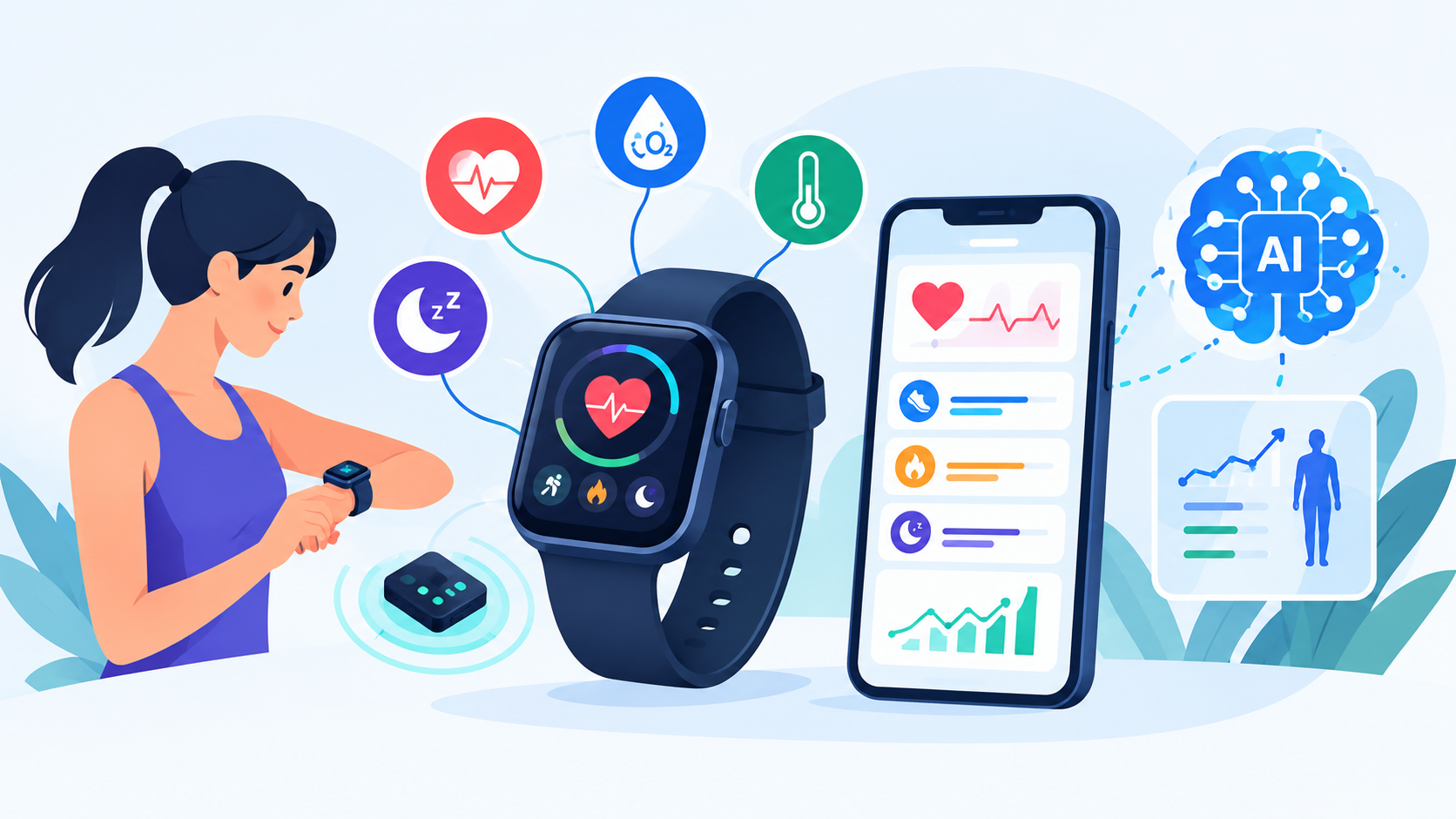
- Wearable health apps connect smart devices with mobile and healthcare platforms to track health measurements and daily activity.
- Sensor integration is essential for collecting and synchronising data from compatible wearables reliably.
- AI-powered insights can help identify trends and support remote monitoring, but they require appropriate validation and oversight.
- Privacy and security should be built into the application through encryption, access controls, consent management, and applicable compliance measures.
- Development costs vary according to features, device compatibility, AI capabilities, and healthcare integrations, with indicative budgets ranging from $8,000 to $90,000+.
Wearable health apps are transforming how people track their health, monitor daily activity, and share relevant health data with healthcare professionals. By connecting smartwatches, fitness bands, sensors, and medical wearables to mobile applications, users can access health insights beyond traditional clinical settings.
In 2027, wearable health app development is increasingly focused on real-time monitoring, AI-assisted insights, and personalised health experiences. Depending on the device, apps can track measurements such as heart rate, sleep patterns, activity levels, blood oxygen estimates, and other physiological signals.
For healthcare providers, these applications can support remote patient monitoring and help identify changes that may require clinical review. Businesses exploring Healthcare App Development Services should prioritise reliable data collection, privacy safeguards, and clear communication of what wearable measurements can, and cannot, indicate.
A successful wearable health app combines compatible sensors, secure data processing, intuitive dashboards, and carefully validated insights to support more informed health management.
Wearable Health App Development Market Statistics
- The global wearable devices fitness app market size was valued at US$ 3,645.6 million in 2025 and is estimated to grow at a compound annual growth rate (CAGR) of 13.7% from 2025 to 2033.
- The global Wearable Device App Development Service market size is predicted to grow from US$ 4,970 million in 2025 to US$ 15,790 million in 2032; it is expected to grow at a CAGR of 18.1% from 2026 to 2032.
- The wearable healthcare devices market is expected to grow from USD 45.29 billion in 2025 to USD 75.98 billion by 2030, registering a CAGR of 10.9% during the forecast period.
Wearable Health Apps and Their Role in Modern Digital Healthcare
Wearable health apps connect personal devices with digital healthcare platforms, helping users and healthcare professionals access relevant health information over time. Their role extends beyond fitness tracking to include preventive wellness, chronic condition monitoring, and remote care support.
Common Types of Wearable Health Apps
|
App Type |
Primary Function |
Example Data |
|
Fitness and Wellness Apps |
Track activity and daily habits |
Steps, calories, exercise duration |
|
Heart Health Apps |
Monitor selected cardiovascular measurements |
Heart rate, rhythm notifications on supported devices |
|
Sleep Monitoring Apps |
Analyse sleep patterns |
Sleep duration, stages, movement |
|
Chronic Care Apps |
Support ongoing health monitoring. |
Glucose readings from compatible devices, blood pressure measurements |
|
Remote Patient Monitoring Apps |
Share health data with care teams |
Device readings, trends, alerts |
|
Rehabilitation Apps |
Track recovery and prescribed exercises |
Movement, repetitions, activity progress |
How Wearables Support Healthcare Providers
Wearable devices can collect repeated measurements outside clinical visits, giving healthcare professionals additional information about a patient's daily patterns. With appropriate consent and clinical workflows, this information may help teams monitor progress, review changes, and plan follow-up care.
For example, a remote monitoring programme may collect readings from a compatible device and display trends in a clinician dashboard. Integrating these capabilities through healthcare app development services can help connect wearable devices, patient dashboards, and secure clinical workflows.
Personalised and Preventive Health Experiences
Wearable apps can turn raw measurements into understandable charts, reminders, and progress summaries. Personalised guidance may help users build healthier routines, while carefully validated monitoring features can support earlier clinical review when needed.
How Wearable Sensors Collect and Process Health Data in Real Time
Wearable health apps rely on sensors and connected devices to collect measurements, transmit data, and present useful information to users or healthcare professionals. The accuracy and usefulness of these insights depend on sensor capabilities, device quality, and data-processing methods.
|
Sensor Type |
Data Collected |
Common Applications |
|
Optical Heart Rate Sensor (PPG) |
Heart rate and pulse-related signals |
Fitness tracking and heart-rate monitoring |
|
ECG Sensor |
Electrical activity of the heart |
Rhythm assessment on supported devices |
|
Accelerometer |
Movement and acceleration |
Step counting, activity tracking, and sleep analysis |
|
Gyroscope |
Orientation and rotational movement |
Exercise tracking and motion analysis |
|
SpO₂ Sensor |
Estimated blood oxygen saturation |
Wellness monitoring and selected clinical use cases |
|
Skin Temperature Sensor |
Changes in skin temperature |
Trend monitoring and wellness insights |
|
Continuous Glucose Monitor (CGM) |
Glucose readings from a compatible medical sensor |
Diabetes management |
|
Blood Pressure Monitor |
Blood pressure measurements from supported devices |
Cardiovascular monitoring |
Not every wearable includes all these sensors, and consumer devices do not necessarily provide clinically accurate measurements for every use case.
How Data Moves From Sensors to the App
A typical data pipeline follows these steps:
- Data collection: Sensors capture physiological signals or movement.
- Signal processing: Device software filters noise and converts signals into measurements.
- Data transmission: Bluetooth, Wi-Fi, or another supported connection transfers readings to the app or a connected service.
- Data storage: The application securely stores relevant readings according to its requirements.
- Analysis and visualisation: The app displays trends, summaries, and appropriate notifications.
Essential Features of a Wearable Health App for Digital Healthcare
A wearable health app should combine accurate data collection, clear visualisation, and secure connectivity to deliver a useful health-monitoring experience. The feature set depends on the target users, supported devices, and whether the app focuses on wellness or clinical monitoring.
|
Feature |
Purpose |
|
Device Pairing and Synchronisation |
Connect wearables through Bluetooth or supported APIs and synchronise readings. |
|
Real-Time Health Dashboard |
Display available measurements, trends, and activity summaries. |
|
Health Alerts and Notifications |
Notify users when readings meet configured thresholds or require attention. |
|
Historical Data and Trends |
Track changes in health measurements over time. |
|
AI-Powered Insights |
Summarise patterns and provide appropriately validated, personalised guidance. |
|
Remote Patient Monitoring |
Share selected readings with authorised healthcare professionals. |
|
Medication and Appointment Reminders |
Help users follow care plans and attend scheduled appointments |
|
User Profiles and Goals |
Support individual preferences, activity targets, and relevant health settings. |
|
Data Privacy and Security |
Protect health information through encryption, access controls, and secure authentication. |
|
Healthcare Platform Integration |
Connect with compatible health records, clinical systems, or approved data platforms. |
AI Insights and Remote Patient Monitoring in Digital Healthcare
AI-powered wearable health apps can analyse data collected by connected devices to identify patterns, personalise health insights, and support remote patient monitoring. When designed and validated appropriately, these capabilities can help users understand their health trends and give healthcare professionals additional information for follow-up care.
1. AI-Powered Health Insights
AI models can analyse historical and real-time measurements to identify changes in activity, sleep, heart rate, or other supported health indicators. Based on the app's intended use, these insights may help users recognise trends and understand when further review could be appropriate.
2. Alerts and Anomaly Detection
Wearable apps can use predefined thresholds or validated AI models to flag unusual readings and changes in health patterns. Alerts should account for device limitations, data quality, and individual context to reduce unnecessary notifications. Potentially urgent findings should follow clearly defined escalation procedures.
3. Remote Patient Monitoring
Remote patient monitoring allows healthcare teams to review health measurements collected outside traditional clinical settings. A connected platform can send data to clinician dashboards, display historical trends, and notify authorised staff when readings require review. These workflows can support ongoing care for selected patients, depending on clinical protocols and device suitability.
4. Personalised Recommendations
AI can help tailor activity goals, sleep summaries, medication reminders, and other app experiences to a user's recorded patterns and preferences. Recommendations should remain within the app's intended scope and avoid presenting uncertain predictions as confirmed medical findings.
5. Implementation Considerations
Building these capabilities requires reliable data pipelines, appropriate model selection, validation, and continuous performance monitoring. The AI app development cost may increase when a platform needs custom models, specialised analytics, clinical validation, or complex integrations.
Technology Stack and IoT Integrations for Wearable Health Apps
A wearable health app requires a technology stack that can connect devices, process health data, deliver insights, and protect sensitive information. The right combination depends on supported wearables, app platforms, integration requirements, and expected user volume.
|
Technology Layer |
Common Technologies |
Purpose |
|
Mobile Frontend |
Flutter, React Native, Swift, Kotlin |
Build iOS and Android experiences |
|
Web Dashboard |
React.js, Next.js, Angular |
Display health trends and clinician dashboards |
|
Backend and APIs |
Node.js, Python, Java, .NET |
Manage user accounts, health data, and business logic |
|
Database |
PostgreSQL, MySQL, MongoDB |
Store profiles, measurements, and historical records |
|
Cloud Infrastructure |
AWS, Microsoft Azure, Google Cloud |
Support hosting, storage, backups, and scalability |
|
Device Connectivity |
Bluetooth Low Energy (BLE), device SDKs |
Connect wearables and synchronise measurements |
|
Health Data Platforms |
Apple HealthKit, Android Health Connect |
Access compatible health data with user permission |
|
AI and Analytics |
Python, PyTorch, TensorFlow, and managed AI APIs |
Analyse trends and generate validated insights |
|
Notifications |
Firebase Cloud Messaging, SMS and email APIs |
Deliver reminders and monitoring alerts |
|
Security and Monitoring |
OAuth 2.0, OpenID Connect, encryption, audit logs |
Protect accounts, data access, and system activity |
Connecting Wearables Through IoT
IoT app development plays an important role when an application collects data from connected sensors and medical devices. Bluetooth connectivity can support direct communication between a wearable and a smartphone, while cloud APIs can transfer authorised measurements to remote dashboards and monitoring services.
Developers should account for device compatibility, intermittent connectivity, duplicate readings, data synchronisation, and differences in measurement formats.
Choosing a Scalable Architecture
A modular architecture separates device connectivity, data processing, analytics, and user interfaces. This makes it easier to add new wearable devices, support additional healthcare integrations, and update AI capabilities without rebuilding the entire application.
The technology stack should also include access controls, encryption, audit logging, backup procedures, and monitoring from the beginning.
Wearable Health App Development Cost and Timeline in 2027
The wearable health app development cost depends on the app's features, supported devices, AI capabilities, healthcare integrations, security requirements, and target platforms. A basic wellness tracker generally requires less development effort than a clinical monitoring platform with real-time alerts and clinician dashboards.
Estimated Development Cost and Timeline:
|
App Type |
Estimated Cost |
Development Timeline |
|
Basic Wearable Health App |
8,000–20,000 |
2–3 months |
|
Mid-Level Health Monitoring App |
20,000–40,000 |
3–5 months |
|
AI-Powered Wearable Health App |
40,000–70,000 |
5–7 months |
|
Enterprise Remote Monitoring Platform |
70,000–90,000+ |
7–10+ months |
What Influences the Development Budget?
- Device compatibility: Supporting multiple wearables, manufacturers, and sensor types can increase integration and testing effort.
- AI capabilities: Personalised insights, anomaly detection, and predictive analytics may require additional model development, evaluation, and monitoring.
- Healthcare integrations: Connecting with clinical systems, remote monitoring platforms, and electronic health records can add complexity.
- Security and compliance: Encryption, access controls, consent management, audit logs, and applicable healthcare regulations need to be considered.
- Platform coverage: Supporting iOS, Android, web dashboards, and clinician portals increases the overall scope.
- Ongoing operations: Cloud hosting, data storage, third-party APIs, maintenance, and device compatibility updates can create recurring expenses.
Businesses comparing the Healthcare App Development Cost with a wearable-specific project should distinguish between general healthcare functionality and additional device connectivity or monitoring requirements.
Privacy, Security, and Healthcare Compliance for Wearable Health Apps
Wearable health apps collect sensitive information, including physiological measurements, activity patterns, and personal health records. Protecting this data is essential for maintaining user trust and meeting applicable legal and regulatory requirements.
1. Data Privacy and User Consent
Explain what information the app collects, why it is needed, and how it will be used or shared. Obtain appropriate consent before accessing device data or sharing measurements with healthcare providers. Collect only the information necessary for the app's intended purpose and establish clear retention and deletion policies.
2. Secure Data Storage and Transmission
Use encryption to protect health information in transit and at rest. Secure APIs, strong authentication, role-based access controls, and carefully managed credentials can help prevent unauthorised access.
3. Healthcare Regulations and Standards
Compliance requirements depend on the countries where the app operates, the type of health data collected, and whether the product is intended for wellness or clinical use. Depending on the use case, developers may need to assess regulations such as HIPAA in the United States, GDPR in the European Union, and applicable medical-device requirements.
4. Safe Alerts and Clinical Decision Support
Health alerts must be designed carefully to avoid unnecessary anxiety or misleading conclusions. Developers should validate thresholds and algorithms, communicate measurement limitations, and establish escalation procedures for clinically significant alerts. AI-generated insights should not be presented as confirmed diagnoses without appropriate clinical validation and regulatory assessment.
5. Auditing and Ongoing Risk Management
Maintain suitable audit logs for data access, permission changes, and important system events. Review vulnerabilities, monitor unusual activity, update dependencies, and test security controls regularly.
Wearable Health App Development Process: Key Stages from Planning to Launch
Building a wearable health app requires careful planning, device integration, secure data handling, and thorough testing. Following a structured process helps teams validate the concept, manage technical risks, and deliver a reliable user experience.
1. Market Research and Requirement Analysis
Research target users, competing applications, wearable devices, and healthcare needs. Define the app's primary purpose, supported measurements, target platforms, and success criteria before development begins.
2. Feature Planning and Technical Feasibility
Prioritise essential features such as device pairing, health dashboards, activity tracking, and notifications. Assess device compatibility, available APIs, data limitations, and whether proposed monitoring features are technically and clinically appropriate.
3. UI/UX Design and Prototyping
Design intuitive dashboards, clear health charts, accessible navigation, and understandable alerts. Create interactive prototypes and gather feedback from intended users and healthcare professionals where relevant.
4. Technology Stack and Architecture Selection
Choose suitable mobile frameworks, backend technologies, databases, cloud services, and device integration methods. Plan data flows, access controls, scalability, and integration boundaries before implementation.
5. Wearable and IoT Integration
Connect supported devices using Bluetooth, manufacturer SDKs, or approved health-data platforms. Test synchronisation, connectivity interruptions, measurement timestamps, and data consistency across supported devices.
6. App and Backend Development
Develop user accounts, health dashboards, historical records, notifications, and administrative or clinician interfaces. Implement secure APIs and data-processing workflows, adding AI capabilities only where they serve a defined and testable purpose.
7. Testing, Validation, and Security Review
Test functionality, device compatibility, performance, usability, privacy controls, and security. Validate health-data processing and any AI-assisted insights against suitable test cases. Clinical features may require additional validation and regulatory review before release.
8. Deployment, Monitoring, and Maintenance
Prepare app-store releases, production infrastructure, backups, and monitoring. After launch, track errors and performance, resolve defects, update device integrations, and evaluate user feedback to guide improvements.
A Wearable App Development Company can coordinate these stages across mobile engineering, device integration, cloud infrastructure, security, and quality assurance.
Common Challenges in Wearable Health App Development and Their Solutions
Developing a wearable health app involves several technical and operational challenges. Addressing them early helps improve data reliability, user experience, and long-term performance.
|
Challenge |
Why It Matters |
Practical Solution |
|
Device Compatibility |
Wearables use different sensors, protocols, and data formats. |
Support selected devices first and test integrations across models. |
|
Data Accuracy |
Sensor readings can vary with movement, placement, and device quality |
Validate data processing and communicate measurement limitations |
|
Connectivity Issues |
Bluetooth interruptions or weak internet connections can delay synchronisation. |
Support offline buffering, retry mechanisms, and reliable background synchronisation. |
|
Battery Consumption |
Frequent sensor readings and background activity can drain device batteries. |
Optimise sampling frequency, background tasks, and data transmission. |
|
Data Privacy |
Health records require careful protection and permission management |
Apply encryption, access controls, consent management, and retention policies. |
|
AI Reliability |
Models may generate misleading insights or unnecessary alerts. |
Evaluate models with representative data and use appropriate clinical oversight. |
|
Healthcare Integration |
External systems may use different formats and interfaces. |
Use secure APIs, standardised data formats, and integration testing. |
|
Scalability and Performance |
Large volumes of device data can increase processing and infrastructure demands |
Use scalable cloud services, efficient data pipelines, and performance monitoring. |
Keeping the App Reliable After Launch
Challenges continue after deployment as wearable operating systems, device firmware, APIs, and user requirements change. Regular compatibility testing, security updates, monitoring, and feedback-driven improvements help maintain a dependable application.
For apps supporting clinical monitoring, teams should also establish clear procedures for failed data transfers, missing readings, and alerts that require professional review. A reliable system should make data gaps visible rather than treating missing measurements as normal results.
Key Benefits of Wearable Health Applications in Digital Healthcare
Wearable health applications can make health information more accessible, support daily wellness habits, and help healthcare teams monitor selected patients beyond clinical visits. Their value depends on device accuracy, appropriate use, and how effectively the collected data is integrated into care workflows.
1. Continuous Access to Health Trends
Wearable apps can organise measurements such as heart rate, activity, and sleep into understandable charts. Users can review changes over time rather than relying only on occasional measurements.
2. Greater Patient Engagement
Personalised goals, progress summaries, reminders, and activity tracking can encourage users to take a more active role in managing their health and maintaining daily routines.
3. Support for Remote Care
When suitable devices and clinical workflows are in place, wearable apps can share relevant measurements with authorised healthcare professionals. This may help clinicians review progress and determine whether follow-up is needed.
4. More Informed Healthcare Decisions
Historical measurements can provide additional context during consultations. Clinicians may use this information alongside symptoms, examinations, and other clinical evidence when assessing a patient's condition.
5. Improved Operational Efficiency
Automated data collection, summaries, and configurable alerts can reduce some manual reporting tasks. Healthcare teams can focus their attention on information that meets established review criteria.
6. Opportunities for Personalised Wellness
Wearable apps can adapt activity targets and wellness reminders to recorded patterns and user preferences. Any health-related recommendations should be appropriately validated and clearly distinguish general wellness guidance from medical advice.
Conclusion
Wearable health app development in 2027 is bringing together connected sensors, AI-assisted insights, and remote patient monitoring to create more personalised digital health experiences. From fitness tracking to clinical monitoring, these applications can help users understand health trends and give healthcare professionals additional information for ongoing care.
Successful development requires more than connecting a wearable to a mobile app. Businesses must prioritise reliable device integration, secure data handling, intuitive design, appropriate validation, and compliance with applicable healthcare requirements.
Starting with essential features and expanding through user feedback and testing can help businesses control development costs while building a scalable product. With the right technology and safeguards, wearable health apps can support better-informed health management without replacing professional medical assessment.
FAQ's
Development may cost around 8,000–90,000+, depending on features, device integrations, AI capabilities, and platform complexity.
A basic app may take 2–3 months, while an advanced or enterprise platform may require 5–10 months or longer.
Common technologies include Flutter, React Native, Swift, Kotlin, Node.js, Python, cloud platforms, Bluetooth Low Energy, and device-specific SDKs.
Yes. AI can help analyse health trends, identify unusual patterns, personalise wellness insights, and support monitoring workflows when appropriately validated.
They commonly use Bluetooth Low Energy, manufacturer SDKs, and health-data platforms such as Apple HealthKit and Android Health Connect, subject to device compatibility and user permissions.
Not always. Apps designed for general wellness may be treated differently from software intended to diagnose, prevent, monitor, or treat medical conditions. Regulatory requirements depend on the intended use and jurisdiction.
They can use encryption, secure authentication, access controls, consent management, audit logs, and appropriate data retention policies.

CrinPro
CrinPro Solutions is a leading IT company that helps startups and enterprises build innovative digital products. From intuitive mobile applications and high-performance websites to AI-powered solutions and enterprise software, our team delivers scalable, secure, and user-focused products tailored to unique business needs. With expertise across multiple industries, we transform ideas into digital experiences that drive growth, improve efficiency, and create long-term business value.