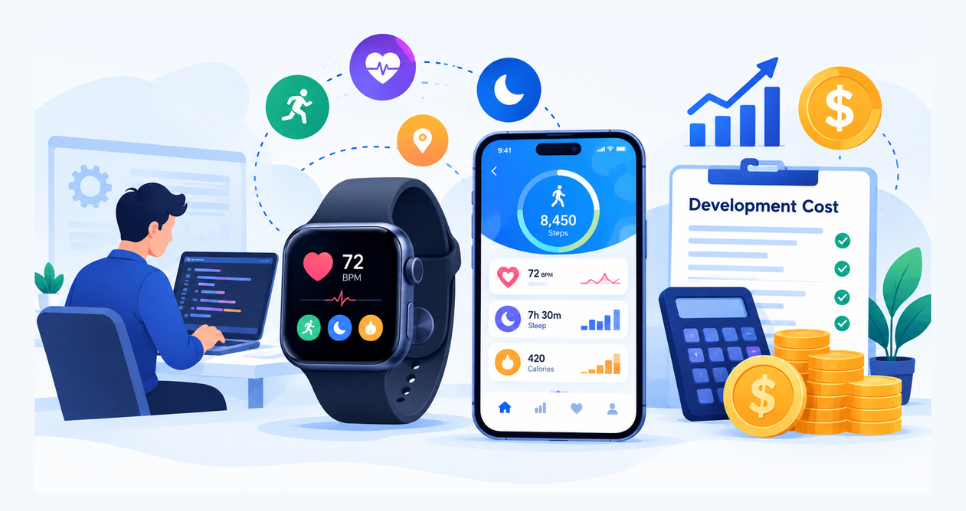
Key Takeaways:
- Battery efficiency shapes every decision: wearable apps must be optimized differently than standard mobile apps due to tight power constraints.
- Costs scale with platform and feature complexity: a basic single-platform app costs far less than a multi-platform build with AI and IoT integration.
- Screen size demands simpler design: glanceable, minimal interfaces perform better than feature-dense screens on small wearable displays.
- Companion apps add to total cost: most wearable apps require a connected smartphone app and backend infrastructure, not just the watch app alone.
- Testing takes longer than standard apps: battery consumption testing and real-world usage validation require extended timelines beyond typical QA cycles.
Smartwatches and fitness trackers have quietly become one of the most personal pieces of technology people own, tracking heart rate, sleep, workouts, and notifications throughout the day.
For businesses building health, fitness, or productivity products, a wearable app isn't a nice-to-have anymore; it's often the primary way users interact with the device itself.
But wearable app development cost varies significantly depending on the platform, device compatibility, and features involved.
Building for a smartwatch comes with its own technical constraints, smaller screens, limited processing power, and battery considerations that don't apply to standard mobile apps.
This guide breaks down exactly what shapes that cost, from core features and technology choices to realistic pricing and development timelines, so you can budget accurately from the start.
Wearable App Development: Overview and Market Potential
Wearable app development has moved well beyond simple step counters, powering everything from continuous health monitoring to real-time notifications and workout coaching.
Understanding wearable app development pricing starts with recognizing just how fast this market is actually growing right now.
1. The Wearable Market Is Expanding Rapidly
This isn't a niche space anymore. The global wearable technology market is projected to grow from $104.95 billion in 2026 to $238.71 billion by 2032, growing at a CAGR of 14.7%.
Businesses building apps for this ecosystem now are positioning themselves early in a market still climbing steeply.
2. Health and Fitness Remain the Dominant Use Case
Fitness and wellness hold the largest share of the wearable technology market at 33.4% in 2026, driven by growing consumer demand for activity tracking, sleep monitoring, and heart rate analysis.
Businesses building wearable apps for this segment tap into the category users engage with most consistently.
3. AI Integration Is Becoming Standard, Not Optional
Around 63% of wearable devices launched in 2024 included AI-driven health analytics, while 41% integrated ECG monitoring functionality.
Businesses building wearable apps today increasingly need to plan for AI-powered features from the start, rather than treating them as a future add-on.
4. Technical Constraints Shape the Entire Build
Wearable devices come with smaller screens, limited processing power, and tighter battery budgets than smartphones.
Battery limitations remain a real concern, with 36% of users reporting dissatisfaction around charging frequency.
These hardware realities directly shape how wearable apps get designed and optimized from day one.
Must-Have Features for Wearable Apps
A great wearable app isn't defined by cramming in every possible function; it's defined by doing a few things exceptionally well within tight screen and battery constraints. These core wearable app features determine whether users actually keep the app active on their device.
1. Real-Time Sensor Data Tracking
Wearables rely heavily on built-in sensors to track heart rate, steps, sleep, and movement continuously throughout the day.
Apps extending into IoT energy management or environmental monitoring use similar real-time sensor integration, processing data efficiently without draining battery life faster than users find acceptable.
2. Battery-Efficient Background Processing
Since wearables have significantly smaller batteries than smartphones, smartwatch app development requires careful optimization of background processes.
Apps that constantly ping sensors or sync data aggressively drain battery life quickly, frustrating users who expect their device to last through a full day without frequent charging.
3. Seamless Companion App Syncing
Most wearable device app development pairs the watch or band with a companion smartphone app, syncing data, settings, and notifications between both.
This connection needs to work reliably in the background, since users expect their wearable data to appear instantly on their phone without manual syncing steps.
4. Glanceable, Minimal UI Design
Wearable screens are small, so custom wearable app development prioritizes simple, glanceable interfaces over dense menus or lengthy text.
Users check wearable apps quickly, often mid-activity, so information needs to be readable and actionable within a second or two of glancing at the screen.
5. Voice and Gesture Controls
Given limited screen space, many wearable apps rely on voice commands or simple gestures, like wrist flicks or taps, for navigation instead of complex touch interactions.
This hands-free interaction matters especially during workouts or activities where typing or tapping small screens isn't practical or safe.
6. Health Data Privacy and Security
Wearables collect deeply personal health data- heart rate, sleep patterns, location- that requires strong encryption and clear privacy controls.
Apps handling this sensitive information need to comply with relevant health data regulations, since breaches here damage user trust more severely than typical app data leaks.
Technology Stack for Wearable App Development
Building for wearables requires a different set of tools than standard mobile development, shaped by tighter hardware constraints and platform-specific requirements.
Choosing the right wearable app technology stack directly affects performance, battery efficiency, and long-term maintainability.
1. Platform SDKs: WatchOS and Wear OS
Apple's WatchKit and Google's Wear OS SDK form the foundation of most wearable technology app development projects, each with platform-specific design guidelines and hardware APIs.
Building natively for these platforms gives developers direct access to sensors, haptics, and battery-efficient background processing that cross-platform tools sometimes can't fully replicate.
2. Cross-Platform Frameworks: Flutter and React Native
For businesses building both companion mobile apps and wearable extensions, Flutter and React Native support IoT wearable app development by sharing code across platforms.
This approach reduces development time significantly, though performance-critical features often still require native code for the wearable component specifically.
3. Backend and Cloud Infrastructure
Wearable apps generate continuous streams of sensor data requiring reliable backend processing.
Much of modern IoT software development relies on cloud platforms like AWS IoT or Google Cloud IoT Core to handle real-time data ingestion, storage, and analysis at scale without overwhelming the wearable device itself.
4. Bluetooth Low Energy (BLE) Protocols
Most wearables communicate with companion smartphone apps through BLE, designed specifically for low power consumption during continuous data transmission.
Reliable BLE implementation ensures smooth syncing between the wearable and phone without draining battery life faster than users find acceptable for daily use.
5. Health Data APIs: HealthKit and Google Fit
Integrating with platform-specific health data APIs lets wearable apps share and access fitness and health metrics consistently across the broader device ecosystem.
This integration matters significantly for apps wanting to combine wearable sensor data with other health app data the user already tracks.
6. Machine Learning for On-Device Analytics
Lightweight ML models running directly on the wearable device enable features like fall detection, irregular heart rhythm alerts, or activity recognition without constantly sending data to the cloud.
On-device processing reduces latency and battery drain compared to relying entirely on cloud-based analysis for every data point.
Step-by-Step Wearable App Development Process
Building a reliable wearable app takes more than adapting a phone app to a smaller screen.
A clear wearable app development process reduces risk, accounts for hardware constraints, and ensures the final product actually performs well on limited battery and processing power.
1. Discovery and Requirement Gathering
Every successful project starts with understanding the target device, user needs, and core functionality the app needs to deliver.
Teams also assess how the wearable app fits within overall mobile app development cost planning, since companion apps and backend infrastructure add to the total budget.
2. Market Research and Platform Selection
Teams research competitor apps and decide which platforms to target: WatchOS, Wear OS, or both.
This stage shapes the entire wearable app development roadmap, since platform choice affects available APIs, design guidelines, and how much of the codebase can realistically be shared across devices.
3. Feature Prioritization and Roadmap Planning
Given tight screen space and battery constraints, teams must prioritize ruthlessly.
Smartwatch app development benefits from starting with a focused feature set rather than cramming in every possible function, since overloaded wearable apps drain battery faster and confuse users with cluttered, hard-to-navigate interfaces.
4. UI/UX Design for Small Screens
Design happens before development begins, with wireframes specifically built for wearable screen sizes and glanceable interactions.
Wearable technology app development requires designers to think differently than standard mobile design, prioritizing simplicity, large touch targets, and information that's readable within a quick glance.
5. Backend Architecture and Data Pipeline Setup
This stage builds the infrastructure handling continuous sensor data streams from the wearable device.
Understanding enterprise app development cost upfront matters here, since backend systems processing real-time health or activity data at scale require more robust architecture than standard mobile app backends.
6. Native or Cross-Platform Development
Developers build the actual wearable app, choosing between native development for maximum performance or cross-platform frameworks for faster, more cost-effective builds.
Wearable device app development often requires native components even within cross-platform projects, since battery-sensitive features need direct hardware access.
7. Sensor and Bluetooth Integration
This stage connects the app to the device's built-in sensors and establishes reliable Bluetooth Low Energy communication with the companion smartphone app.
IoT wearable app development depends heavily on getting this integration right, since unreliable syncing frustrates users and undermines the app's core value.
8. Health Data and Third-Party API Integration
Apps connecting to HealthKit, Google Fit, or other health platforms need careful integration to ensure data flows accurately and securely.
Custom wearable app development often requires this step to differentiate the app, letting it combine data across multiple sources for richer, more useful insights.
9. Quality Assurance and Battery Testing
Before launch, the app undergoes functional testing alongside specialized battery consumption testing unique to wearable devices.
Leading mobile app development companies simulate real-world usage patterns, ensuring the app performs reliably without draining the device faster than users find acceptable for daily wear.
10. Launch and Post-Launch Optimization
Once testing confirms stability, the app goes live on the relevant app store.
Understanding wearable app development cost doesn't end at launch, since ongoing updates, battery optimization improvements, and new sensor integrations continue based on real user feedback and evolving device capabilities.
Wearable App Development Cost: Pricing Breakdown
There's no single number that fits every project. Overall software development cost for a wearable app typically ranges from AED 35,000 to AED 300,000 or more, depending on complexity, platform choice, and how many sensors and integrations the app actually requires.
|
Solution Tier |
What's Included |
Estimated Cost |
|
Basic Wearable App |
Single platform (WatchOS or Wear OS), core sensor tracking, simple UI, companion app sync |
35,000 – 60,000 |
|
Business Wearable Solution (Most Popular) |
Multi-platform support, health data API integration, custom UI/UX, advanced sensor and Bluetooth features |
60,000 – 120,000 |
|
Enterprise Wearable Platform |
Full-scale custom build, AI-driven on-device analytics, IoT integration, advanced security and compliance, scalable backend infrastructure |
120,000 – 300,000+ |
Factors That Influence Wearable App Development Cost
Two businesses building similar wearable apps can end up with very different final numbers.
Wearable app development cost depends on several variables that shift pricing significantly, often by tens of thousands of dirhams for what looks like a comparable project on paper.
1. Platform and Device Compatibility
Building for a single platform, either WatchOS or Wear OS, costs less than supporting both simultaneously.
Each platform has different design guidelines, hardware APIs, and testing requirements, meaning multi-platform support adds real development time and cost compared to focusing on one device ecosystem first.
2. Technology Choices and Native vs. Cross-Platform Development
The wearable app technology stack chosen directly affects cost.
Native development delivers better performance and battery efficiency but requires separate codebases for each platform, while cross-platform frameworks reduce cost by sharing code, though sometimes at the expense of certain hardware-specific optimizations.
3. Sensor and Hardware Integration Complexity
Apps relying on multiple sensors, heart rate, GPS, accelerometer, ECG, require more development and testing time than apps using basic step tracking alone.
Each additional sensor integration adds complexity, since accurate data processing and battery-efficient handling of multiple data streams simultaneously isn't trivial to build.
4. Health Data and Third-Party API Integrations
Connecting to platforms like HealthKit, Google Fit, or specialized health databases adds both licensing considerations and integration time.
Apps combining data from multiple sources to deliver richer insights cost more to build than standalone apps tracking a single, isolated metric.
5. AI and On-Device Analytics Features
Adding machine learning capabilities, like fall detection or irregular heart rhythm alerts, running directly on the device increases development complexity significantly.
These features require specialized expertise in lightweight, on-device model optimization, since standard cloud-based AI approaches don't work well given wearable processing constraints.
6. Companion App and Backend Infrastructure
Most wearable apps need a companion smartphone app and backend infrastructure to store and process data.
Building and maintaining this broader ecosystem, not just the wearable app itself, adds significantly to total project cost, since it essentially requires building and syncing multiple connected applications.
Wearable App Development Timeline: Key Stages and Duration
Understanding a realistic wearable app development timeline helps businesses plan launches and set expectations with stakeholders.
Each stage takes a different amount of time depending on complexity, and rushing any of them typically creates problems later.
1. Discovery and Planning (1-2 Weeks)
This stage covers requirement gathering, platform selection, and feature prioritization before any design or coding begins.
Smartwatch app development projects benefit from spending adequate time here, since unclear requirements discovered mid-project cause far more delay than thorough upfront planning would have taken.
2. UI/UX Design (2-4 Weeks)
Designing for small, glanceable screens takes longer than it might seem, since every element needs careful consideration for readability and touch accuracy.
This stage includes wireframes, prototypes, and iterative testing to ensure the interface works well within wearable-specific constraints before development begins.
3. Backend and Infrastructure Setup (2-3 Weeks)
Building the backend systems that handle sensor data, user accounts, and companion app syncing happens in parallel with early frontend work.
This stage matters more for apps needing real-time data processing or complex integrations than simple, single-feature wearable apps.
4. Core Development (4-10 Weeks)
This is where most of the actual coding happens, connecting sensors, building the UI, and implementing core functionality.
Timelines vary significantly here; projects requiring AI app development companies for on-device analytics or machine learning features typically take longer than straightforward tracking apps.
5. Third-Party and Health API Integration (1-3 Weeks)
Connecting to platforms like HealthKit or Google Fit requires careful testing to ensure data syncs accurately.
This stage can extend timelines if integrations reveal compatibility issues or if the app needs to combine data from multiple sources reliably.
6. Quality Assurance and Battery Testing (2-4 Weeks)
Beyond standard functional testing, wearable apps require specialized battery consumption testing across different usage patterns.
This stage often takes longer than expected, since catching battery drain issues requires extended real-world testing rather than quick, isolated test runs.
7. App Store Submission and Review (1-2 Weeks)
Once testing confirms stability, the app goes through platform-specific review processes for the Apple Watch App Store or Google Play.
Review timelines vary, and wearable apps sometimes face additional scrutiny around health data handling and battery performance claims.
8. Post-Launch Monitoring and Optimization (Ongoing)
Launch isn't the finish line. Teams monitor crashes, battery performance, and user feedback closely during the first few weeks, making adjustments based on real-world usage patterns that testing environments couldn't fully predict beforehand.
Final Thoughts
Wearable app development comes with a unique set of challenges, tight battery budgets, small screens, and specialized sensor integrations, that standard mobile app projects simply don't face.
Understanding these constraints from the start, along with realistic costs and timelines, helps businesses avoid the common pitfalls that derail wearable projects mid-development.
Whether you're building a simple fitness tracker companion app or a full enterprise wearable platform with AI-driven analytics, the roadmap covered here gives you a practical starting point.
Businesses that plan carefully around hardware limitations, budget realistically for both development and ongoing optimization, and prioritize a focused feature set are the ones building wearable apps that users actually keep active on their devices long-term.
FAQ's
Costs typically range from AED 35,000 for a basic wearable app to AED 300,000 or more for enterprise-grade platforms with AI and IoT integrations.
Most wearable apps take three to six months to build, depending on platform support, feature complexity, and how many sensor integrations are required.
It depends on your target audience. Many businesses start with the platform their core users already own, then expand once the app proves demand.
Battery efficiency remains the top challenge, since wearables have significantly smaller batteries than smartphones, requiring careful optimization of sensors and background processes.
Most do, since companion apps handle data syncing, deeper settings, and functionality that doesn't fit within the wearable's limited screen and processing power.
Plan for 15-20% of your original development cost annually, covering battery optimization updates, security patches, and feature improvements based on real usage data.
Native development offers better performance and battery efficiency, while cross-platform frameworks reduce cost. The right choice depends on your budget and performance priorities.
Wearable apps handling personal health data need to comply with relevant regulations like HIPAA or GDPR, depending on your target market and data type.

CrinPro
CrinPro Solutions is a leading IT company that helps startups and enterprises build innovative digital products. From intuitive mobile applications and high-performance websites to AI-powered solutions and enterprise software, our team delivers scalable, secure, and user-focused products tailored to unique business needs. With expertise across multiple industries, we transform ideas into digital experiences that drive growth, improve efficiency, and create long-term business value.