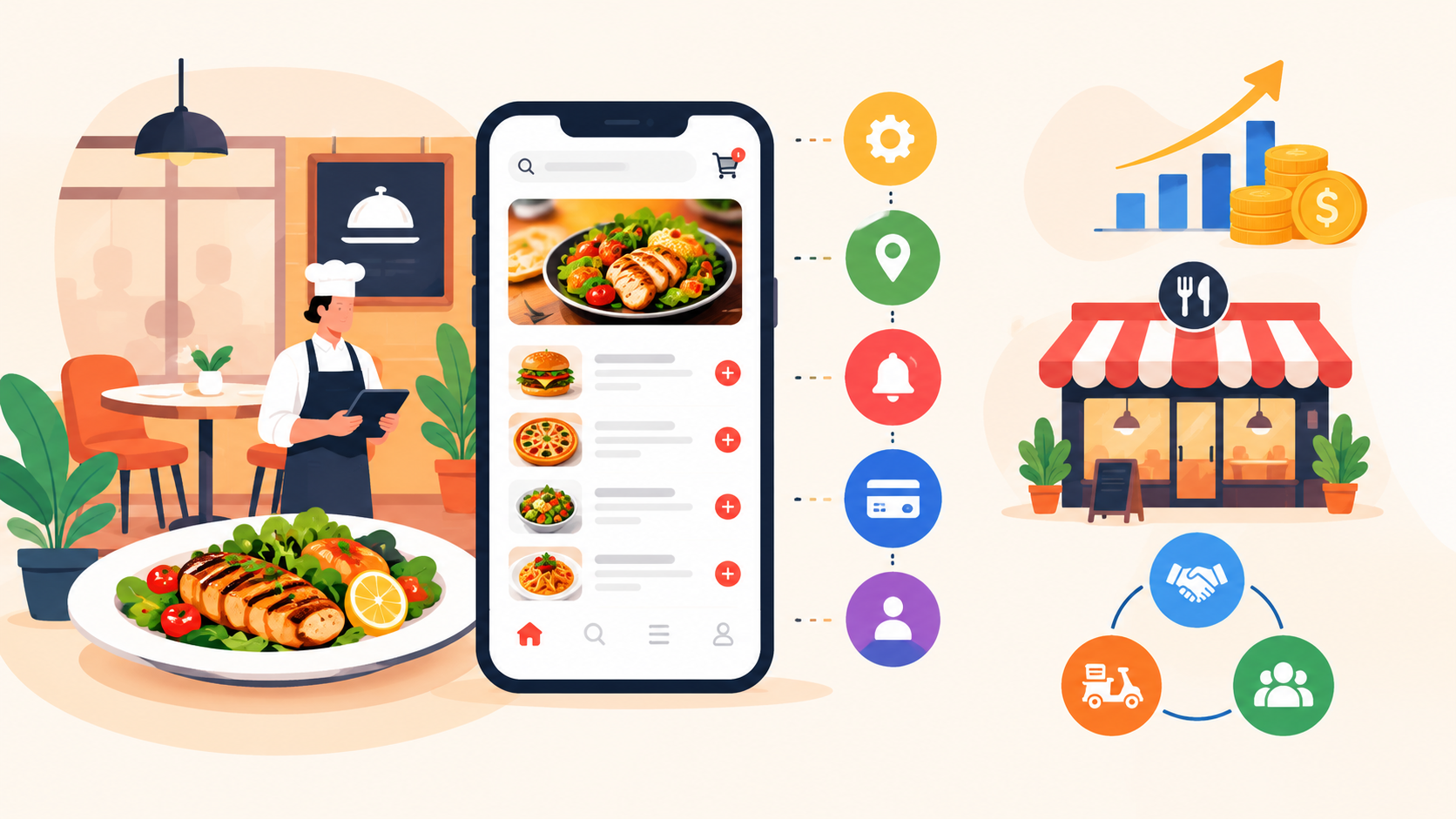
Key Takeaways:
- Restaurant app development can support online ordering, reservations, delivery, customer engagement, and restaurant operations.
- Essential features can include digital menus, online ordering, payments, reservations, order tracking, notifications, loyalty programmes, and analytics.
- A structured development process helps businesses manage planning, design, development, testing, deployment, and post-launch improvements.
- The technology stack should be selected according to performance, scalability, security, integration, and budget requirements.
- Restaurant apps can generate revenue through commissions, delivery charges, subscriptions, featured listings, advertising, and service fees.
- The estimated restaurant app development cost ranges from $8,000 to $80,000+, depending on complexity, features, platforms, integrations, and customization.
Restaurant apps have changed how customers discover restaurants, browse menus, place orders, make reservations, and receive food. For restaurant businesses, these apps can simplify daily operations while creating more convenient ways to connect with customers.
The scope of restaurant app development can range from a simple ordering application to a complete platform that combines online ordering, reservations, delivery management, customer engagement, payments, and restaurant administration.
A successful restaurant app requires thoughtful planning around features, user experience, technology, security, integrations, and scalability. This guide explores the essential restaurant app features, development process, technology stack, benefits, challenges, business models, monetization strategies, and restaurant app development cost to help businesses understand what it takes to build a restaurant app.
Restaurant App Development Market Statistics in 2026
- The global restaurant management software market size was valued at USD 6.6 billion in 2025 and is projected to grow from USD 7.6 billion in 2026 to USD 24.1 billion by 2033, at a CAGR of 18.0% from 2026 to 2033.
- North America dominated the restaurant management software market with the largest revenue share of 32.1% in 2025.
- The restaurant management software market size was valued at USD 6.72 billion in 2025. The market is projected to grow from USD 7.95 billion in 2026 to USD 30.48 billion by 2034, exhibiting a CAGR of 18.28% during the forecast period.
Why Businesses Invest in Restaurant Apps for Growth and Customer Engagement
Restaurant apps are becoming an important digital channel for businesses that want to improve customer engagement, streamline operations, and create additional revenue opportunities. Instead of relying only on third-party platforms, restaurants can use their own applications to build direct relationships with customers.
1. Direct Customer Engagement
A dedicated app allows restaurants to communicate directly with customers through personalized offers, loyalty rewards, push notifications, and updates. This can encourage repeat orders and improve customer retention.
2. Convenient Online Ordering
Customers can browse menus, customize dishes, select delivery or pickup options, and complete payments through a single platform. For businesses considering food delivery app development costs, integrating ordering and delivery functionality from the beginning can help create a more accurate project budget.
3. Better Order Management
Digital ordering can reduce manual order-taking and help restaurants manage incoming orders more efficiently. Restaurant staff can view order details, update statuses, and coordinate preparation through a centralized system.
4. Improved Customer Experience
Features such as personalized recommendations, saved addresses, order history, table reservations, and real-time delivery updates can create a smoother experience for customers.
5. Valuable Business Insights
Restaurant apps can collect useful information about orders, popular dishes, customer preferences, and purchasing patterns. Businesses can use these insights to improve menus, promotions, inventory planning, and marketing strategies.
6. Greater Revenue Opportunities
Restaurants can generate revenue through direct food orders, delivery charges, subscriptions, loyalty programmes, promotional offers, and other digital services. A well-designed app can therefore become both a customer engagement channel and an additional tool for business growth.
Essential Restaurant App Features for Better Customer Experience
The right feature set depends on whether the app focuses on ordering, reservations, delivery, restaurant operations, or a combination of these services. A modern platform should provide convenient functionality for customers while helping restaurant staff manage daily operations efficiently. Working with an experienced mobile app development company can help businesses prioritize features according to their operational and customer requirements.
1. User Registration and Profiles
Customers should be able to create accounts, manage personal information, save addresses, view order history, and manage preferences. Social login and secure authentication can make registration faster and more convenient.
2. Digital Menu
A digital menu should display dishes with names, descriptions, prices, images, ingredients, and customization options. Restaurants can also organize items by categories and update menu availability when needed.
3. Online Food Ordering
Customers should be able to add items to their cart, customize orders, select pickup or delivery, and place orders through the application. A smooth ordering flow can reduce friction and improve conversions.
4. Table Reservation
Reservation functionality allows customers to check available tables, select a preferred date and time, and receive booking confirmations. Restaurants can manage reservations and seating availability from the administrative panel.
5. Secure Payments
The app can support cards, digital wallets, UPI, and other relevant payment methods. Secure payment processing, transaction records, refunds, and digital receipts are important for a reliable checkout experience.
6. Order Tracking
Customers can receive real-time updates as their order moves through stages such as confirmed, preparing, ready for pickup, out for delivery, and delivered.
7. Push Notifications
Notifications can inform customers about order confirmations, delivery updates, reservation reminders, special offers, and other important events.
8. Ratings and Reviews
Customers can rate restaurants, dishes, and delivery experiences. Reviews can provide useful feedback while helping other customers make informed decisions.
9. Restaurant Management Dashboard
Restaurant staff should have tools to manage menus, orders, reservations, customers, promotions, payments, delivery operations, and business reports from a centralized dashboard.
10. Analytics and Reporting
Analytics can provide insights into sales, order volumes, popular dishes, customer behavior, and operational performance. These insights can help restaurants make better business decisions.
For businesses planning custom restaurant app development, the feature set should be prioritized according to the target audience, operating model, and long-term growth strategy.
Restaurant App Development Process: From Planning to Launch
A structured restaurant app development process helps businesses turn their idea into a functional, scalable, and user-friendly application. Each stage should be planned carefully to reduce development risks and ensure the final product meets business and customer requirements.
1. Research and Requirement Analysis
The process begins by identifying the target customers, business model, competitors, required platforms, core features, and operational requirements. The development team defines the project scope and technical requirements based on these findings.
2. UI/UX Design
Designers create wireframes, user flows, prototypes, and visual interfaces for the application. The focus should be on making menu browsing, ordering, reservations, payments, and other key actions simple and intuitive.
3. Technology Selection
The development team selects suitable frontend frameworks, backend technologies, databases, cloud infrastructure, APIs, and third-party services. Technology choices should consider performance, scalability, security, and long-term maintenance.
4. Frontend and Backend Development
Developers build the customer-facing application along with the backend systems that manage users, menus, orders, reservations, payments, notifications, and business logic. Separate dashboards may also be developed for restaurant administrators and delivery staff.
5. API and Third-Party Integration
External services such as payment gateways, maps, push notifications, analytics tools, POS systems, and delivery services can be integrated according to the application's requirements. Businesses expanding into food delivery app development may require additional logistics and delivery integrations.
6. Testing and Quality Assurance
The application is tested for functionality, usability, security, compatibility, performance, and payment reliability. Testing across different devices and real-world ordering scenarios helps identify problems before launch.
7. Deployment
After successful testing, the application is configured for production and submitted to the relevant app stores. Backend servers, databases, analytics, monitoring, and security configurations are also prepared for the live environment.
8. Maintenance and Updates
Post-launch support includes bug fixes, security updates, performance improvements, operating-system compatibility updates, and new feature development. Continuous monitoring helps businesses keep the application reliable as customer expectations and business requirements evolve.
Restaurant App Technology Stack: Key Technologies and Tools
Choosing the right restaurant app technology stack helps ensure that the application performs reliably, supports future growth, and can integrate with essential restaurant and delivery systems.
|
Technology Layer |
Common Technologies |
Estimated Cost Impact |
|
Mobile App |
Flutter, React Native, Swift, Kotlin |
$2,000–$8,000 |
|
Frontend |
React.js, Next.js |
$1,500–$4,000 |
|
Backend |
Node.js, Laravel, Django, .NET |
$3,000–$8,000 |
|
Database |
PostgreSQL, MySQL, MongoDB |
$1,000–$3,000 |
|
Payment Integration |
Stripe, PayPal, Razorpay |
$1,000–$4,000 |
|
Maps & Location |
Google Maps API, Mapbox |
$1,000–$4,000 |
|
Notifications |
Firebase Cloud Messaging, Twilio |
$500–$2,000 |
|
Cloud Infrastructure |
AWS, Microsoft Azure, Google Cloud |
$1,000–$5,000 |
|
Analytics |
Firebase Analytics, Google Analytics |
$500–$2,000 |
|
AI & Recommendations |
TensorFlow, OpenAI APIs, ML frameworks |
$3,000–$10,000+ |
The figures above are approximate technology-related development costs rather than fixed vendor charges. Actual expenses depend on the selected technologies, integration complexity, API usage, and project scope. A capable restaurant software development company can help select a technology stack that balances performance, scalability, and budget.
Key Benefits of Restaurant Apps for Businesses and Customers
A well-designed restaurant app can create value for both businesses and customers by simplifying ordering, improving communication, and supporting more efficient restaurant operations.
Benefits for Businesses
- Increased Direct Orders: A dedicated application gives restaurants another channel for receiving orders directly from customers and reducing reliance on third-party platforms.
- Better Customer Retention: Loyalty programmes, personalized offers, rewards, and notifications can encourage customers to return and place repeat orders.
- Improved Operational Efficiency: Digital ordering, automated notifications, reservation management, and centralized dashboards can reduce manual work for restaurant staff.
- Access to Customer Insights: Order history, purchasing patterns, popular menu items, and customer preferences can provide useful data for improving marketing and business decisions.
- Stronger Brand Presence: A branded app provides restaurants with a direct digital presence and greater control over the customer experience.
Benefits for Customers
- Convenient Ordering: Customers can browse menus, customize meals, place orders, and make payments without calling the restaurant.
- Easy Reservations: Customers can check availability and reserve tables from their mobile devices.
- Real-Time Updates: Notifications and order tracking keep customers informed about preparation, pickup, delivery, and reservation status.
- Personalized Experience: Saved preferences, previous orders, recommendations, loyalty points, and customized offers can make the app more relevant to individual users.
- Multiple Payment Options: Supporting cards, digital wallets, UPI, and other payment methods gives customers greater flexibility during checkout.
For restaurants planning to expand their digital ordering capabilities, integrating food delivery app development functionality can further extend the platform's reach and delivery capabilities.
Key Challenges Businesses Face in Restaurant App Development
Building a restaurant app involves several technical and operational challenges. Identifying these issues early can help businesses plan the development strategy, budget, and infrastructure more effectively.
1. Managing Real-Time Orders
Restaurants need to receive and process orders quickly while keeping customers updated about preparation and delivery status. Delays in synchronization can result in incorrect order information and poor customer experiences.
2. Integrating Multiple Systems
Restaurant apps may need to connect with POS systems, payment gateways, inventory software, maps, delivery platforms, and accounting tools. Ensuring that these systems communicate reliably can increase development complexity.
3. Handling Peak-Time Traffic
Restaurants may experience significant increases in orders during weekends, holidays, special events, or promotional campaigns. The platform needs scalable infrastructure to maintain performance during traffic spikes.
4. Ensuring Payment Security
Payment processing requires secure handling of transactions, authentication, refunds, and sensitive financial information. Businesses should use reliable payment providers and follow applicable security requirements.
5. Providing a Consistent User Experience
The application should remain easy to use across different devices and screen sizes. Complicated ordering, reservation, or checkout flows can increase abandonment and negatively affect customer satisfaction.
6. Protecting Customer Data
Restaurant applications can handle personal information, addresses, order histories, and payment-related data. Appropriate authentication, access controls, encryption, and security testing are essential.
Businesses that require complex workflows or extensive integrations may benefit from working with an experienced on-demand app development services provider that understands real-time ordering and delivery requirements.
Restaurant App Business Models: Choosing the Right Model for Your Business
The business model determines how a restaurant app creates value and generates revenue. Businesses can choose a model based on their target customers, restaurant operations, market size, and delivery strategy.
1. Single-Restaurant App
A single restaurant can develop its own branded application for menu browsing, online ordering, reservations, loyalty programmes, and customer engagement. This model provides greater control over branding and customer relationships.
2. Multi-Restaurant Marketplace
A marketplace connects customers with multiple restaurants through one platform. Restaurants can manage their menus and orders while customers can compare restaurants, dishes, prices, and delivery options.
3. Restaurant Aggregator
An aggregator brings different restaurants together and earns revenue by facilitating orders or charging participating restaurants. This model can scale across multiple locations but requires strong restaurant onboarding and operational management.
4. Restaurant Delivery Platform
A delivery-focused platform connects restaurants with customers and delivery partners. The application can manage orders, driver assignments, GPS tracking, delivery status, and payments.
5. Subscription-Based Model
Businesses can offer monthly or annual memberships that provide benefits such as free delivery, exclusive discounts, loyalty rewards, or priority reservations. Subscription models can create recurring revenue and encourage customer retention.
6. SaaS Restaurant Management Model
A software-as-a-service model provides restaurants with tools for order management, reservations, menus, customer management, analytics, and other operations through a recurring subscription.
The selected model directly influences the required features, user panels, integrations, and infrastructure. Businesses should define their revenue strategy early so the restaurant app development architecture can support the chosen model from the beginning.
How Does a Restaurant App Make Money? Top Revenue Strategies
Restaurant apps can generate revenue through multiple channels depending on whether they operate as single-restaurant platforms, marketplaces, or delivery services. Combining more than one monetization strategy can create diversified revenue streams.
1. Commission on Orders
Multi-restaurant platforms can charge restaurants a percentage of each order processed through the application. The commission structure can vary based on restaurant agreements, order volume, and services provided.
2. Delivery Charges
Apps that offer delivery can charge customers a delivery fee based on distance, location, order value, or delivery conditions. Businesses may also use variable pricing during high-demand periods.
3. Subscription Plans
Restaurants can offer membership plans that provide benefits such as free delivery, discounts, exclusive offers, or priority reservations. Recurring subscriptions can provide a predictable revenue stream.
4. Featured Restaurant Listings
Restaurants can pay to receive greater visibility within search results, promotional sections, or featured listings. This can create an additional advertising-based revenue channel.
5. In-App Advertising
Restaurant platforms can display sponsored restaurants, promotional banners, special offers, or relevant advertisements. Advertising revenue can increase as the platform's customer base grows.
6. Convenience or Service Fees
A platform can charge customers a small service or convenience fee for processing orders, reservations, or other transactions. The fee should be clearly communicated during checkout.
7. Premium Restaurant Software
A restaurant technology platform can provide advanced management tools through paid subscription tiers. Premium features may include analytics, customer management, inventory tools, reporting, and automation.
A clear monetization strategy should be defined before development because it influences payment workflows, subscription management, restaurant dashboards, reporting, and other platform requirements. Businesses can also explore Booking App Development functionality when reservations are an important part of their revenue model.
How Much Does Restaurant App Development Cost?
The restaurant app development cost can range from approximately $8,000 to $80,000+, depending on the app's features, number of platforms, user panels, integrations, technology stack, design complexity, and level of customization.
|
App Type |
Estimated Cost |
Development Timeline |
|
Basic Restaurant App |
$8,000–$15,000 |
2–3 months |
|
Standard Restaurant App |
$15,000–$30,000 |
3–4 months |
|
Advanced Restaurant App |
$30,000–$50,000 |
4–6 months |
|
Enterprise Restaurant Platform |
$50,000–$80,000+ |
6–9+ months |
These are estimated development ranges rather than fixed prices. The final restaurant app development cost depends on the required functionality, design complexity, development approach, integrations, geographic location of the development team, and ongoing infrastructure requirements.
Factors That Influence the Cost of Restaurant App Development
The final development budget can vary significantly depending on the scope and technical requirements of the restaurant application. Understanding these factors helps businesses prepare a more realistic budget before development begins.
1. Number of Platforms
Building for iOS, Android, and web requires additional development and testing compared with supporting a single platform. Cross-platform frameworks can sometimes reduce development effort when the project is suitable for a shared codebase.
2. Feature Complexity
Basic ordering and menu functionality generally require less effort than advanced features such as real-time tracking, loyalty programmes, AI recommendations, automated delivery management, and detailed analytics.
3. Third-Party Integrations
Payment gateways, maps, POS systems, inventory software, CRM platforms, delivery services, analytics tools, and notification providers can increase development complexity and integration costs.
4. UI/UX Customization
A highly customized interface with unique branding, animations, personalized user flows, and advanced interactions usually requires more design and development resources than a standard application.
5. Real-Time Functionality
Features such as live order tracking, driver locations, real-time availability, and instant status updates require specialized backend architecture and communication systems, which can increase development effort.
6. AI and Automation
AI-powered recommendations, demand forecasting, chatbots, automated customer support, and intelligent marketing can add both development and infrastructure expenses.
7. Development Team Location
Development rates vary by region and team expertise. Choosing between an in-house team, freelancer, local agency, or offshore provider can significantly affect the overall budget.
Businesses should define their requirements before requesting estimates from mobile app development companies. A detailed scope makes it easier to compare proposals and understand what is included in the quoted price.
Conclusion
Restaurant apps can help businesses create a more convenient ordering and reservation experience while improving operational efficiency and customer engagement. From digital menus and online ordering to delivery tracking, loyalty programmes, analytics, and restaurant management, the right combination of features can support different business models and growth strategies.
The estimated restaurant app development cost of $8,000–$80,000+ provides a general starting point, but the actual budget depends on the application's scope, platforms, integrations, design, technology choices, and level of customization.
Businesses can reduce development risks by defining their requirements clearly, prioritizing essential functionality, selecting an appropriate technology stack, and developing advanced capabilities in phases. With the right planning and development partner, a restaurant app can become a scalable digital channel for improving customer experiences and supporting long-term business growth.
FAQ's
Restaurant app development can cost approximately $8,000 to $80,000+, depending on features, platforms, integrations, design, and customization.
A basic restaurant app may take around 2–3 months, while an advanced or enterprise platform can require 6–9+ months.
Common features include digital menus, online ordering, payments, table reservations, order tracking, notifications, reviews, loyalty programmes, and an admin dashboard.
Yes. A restaurant app can include delivery management, driver assignment, GPS tracking, real-time order updates, and delivery notifications.
Revenue can come from order commissions, delivery charges, subscriptions, service fees, featured listings, advertising, and premium restaurant management services.
Yes. AI can support personalized recommendations, chatbots, demand forecasting, automated customer support, marketing, and other intelligent features.
Evaluate the company's relevant experience, portfolio, technical expertise, communication, pricing, development process, scalability capabilities, and post-launch support.

CrinPro
CrinPro Solutions is a leading IT company that helps startups and enterprises build innovative digital products. From intuitive mobile applications and high-performance websites to AI-powered solutions and enterprise software, our team delivers scalable, secure, and user-focused products tailored to unique business needs. With expertise across multiple industries, we transform ideas into digital experiences that drive growth, improve efficiency, and create long-term business value.