Key Takeaways
-
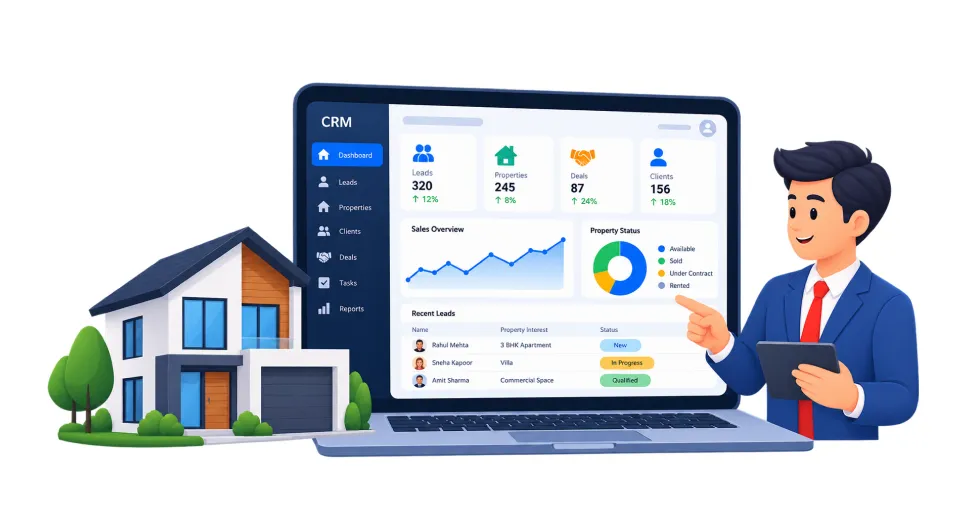
Real estate CRM software development helps businesses manage leads, listings, and client relationships from one centralized platform.
-
Custom CRM solutions improve sales workflows, automate follow-ups, and help agents close more property deals efficiently.
-
Real estate CRM development cost depends on features, integrations, technology stack, and overall platform complexity.
-
AI, cloud technology, and automation are shaping the future of modern real estate CRM platforms.
-
Choosing the right CRM approach helps businesses improve productivity, scalability, and long-term customer engagement.
Real Estate CRM Software Development: Features, Technology, Cost & Business Benefits
Running a real estate business without the right tools gets exhausting fast. Leads slip through the cracks. Follow-ups get forgotten in the middle of a busy week. Agents end up doing manual work instead of closing deals. Sound familiar?
Honestly, most brokerages feel this pain almost every single day. The good news is that real estate CRM software development can fix most of this mess. A well-built CRM brings your leads, listings, and client conversations into one place.
In this blog, we will walk through what real estate CRM software actually means, its features, development process, cost, and future trends.
What Do You Actually Mean By Real Estate CRM Software
Real estate CRM software is a digital system that helps agents and brokers manage leads, property listings, client communication, and sales pipelines from one centralized platform, improving efficiency, follow-ups, and overall customer relationship management across the real estate business.
Market Size Of Real Estate CRM Software
Numbers help build trust, so let us look at where this industry actually stands right now. According to Fortune Business Insights, the overall real estate software market was valued at 12.96 billion dollars in 2025 and is projected to grow from 14.44 billion dollars in 2026 to 34.39 billion dollars by 2034, at a CAGR of 11.45%. Within this, CRM software alone holds the largest type share at 56%.
Looking specifically at CRM software, Market Reports World values the real estate CRM software market at 521.46 million dollars in 2024, expected to reach 696.21 million dollars by 2033, growing at a CAGR of 3.3%. As of 2023, over 78% of real estate companies with more than 50 agents were already using CRM platforms to manage client relationships and streamline operations.
Cloud-based adoption is rising fast too. Fortune Business Insights puts cloud deployment share at 67%, while Market Reports World shows 64% of CRM platforms are cloud-hosted. Mobile usage is climbing as well, with 71% of users preferring CRM tools that come with a mobile app.
Business Benefits Of Real Estate Agent CRM Software
Real estate CRM solutions help agents automate follow-ups, manage leads, improve client relationships, track sales performance, and increase conversions through centralized data, smart workflows, and better business insights.
-
Better lead conversion happens when agents follow up on time using CRM reminders and automation
-
Faster response time keeps buyers engaged and reduces the chance they move to a competitor
-
Improved agent productivity comes from automated tasks and centralized property data access
-
Centralized customer data gives your whole team one clear view of every buyer and seller
-
Better decision-making becomes possible when dashboards show real-time sales and performance data
-
Higher revenue visibility helps owners track pipeline value and forecast monthly closing numbers
Types of Real Estate CRM Software You Can Develop
Different real estate businesses need different CRM setups depending on how they operate and sell.
|
Type |
Short Explanation |
|
Residential Real Estate CRM |
Manages buyer and seller communication, property inquiry management, and residential listing tracking for home sales |
|
Commercial Real Estate CRM |
Handles lease tracking, tenant communication, and commercial property portfolio management for brokers and investors |
|
Property Management CRM |
Property CRM Software Development supports rental tracking, tenant requests, and property inventory management daily |
|
Real Estate Brokerage CRM |
A broking-focused platform often works as a real estate sales CRM, helping teams manage leads, monitor sales pipelines, and coordinate agent activities across multiple offices. |
|
Real Estate Agent CRM |
Built for individual agents to manage leads, appointment scheduling, and personalized client communication easily |
Essential Features to Consider During Custom Real Estate CRM Development
Picking the right real estate CRM features decides whether your CRM actually gets used or just sits there unopened.
Lead Management System
Real estate lead management software is at the heart of every successful CRM platform. It covers lead capture automation, lead qualification, and lead nurturing workflow, so no inquiry gets lost.
A strong lead tracking system pulls leads from your website, MLS integration, and Zillow or Realtor.com, then routes them to the right agent automatically.
Without this, teams waste hours on manual entry, and honestly, that is where most deals quietly die.
Property Listing Management
Agents need one place to manage property listing management, property inventory management, and property search functionality.
Good listing tools sync directly with MLS database integration, keeping every property record accurate across platforms.
This reduces duplicate work and keeps buyer and seller management smooth, since nobody wants to show a property that already sold last week.
AI Lead Scoring and Predictive Analytics
Modern CRM platforms use AI-based lead scoring, machine learning algorithms, and predictive analytics to rank leads by how likely they are to close.
This is where working with experienced AI app development companies really pays off, since accurate scoring models take real expertise to build. Smart property recommendations and automated customer replies also fall under this feature, saving agents hours every week.
Agent Management and Performance Tracking
Brokerages need visibility into agent performance tracking, sales activity tracking, and task management system data.
Role-based access control ensures managers see team-wide numbers while agents see only their own pipeline.
Reporting dashboards and business intelligence dashboard tools turn raw activity into decisions leadership can actually act on, not just spreadsheets nobody reads.
Document Management and Security
Contracts, disclosures, and agreements need a secure home. Document management paired with DocuSign integration speeds up signing, while data encryption, SSL encryption, and two-factor authentication protect sensitive client information.
GDPR and CCPA compliance matter here too, especially for firms working across regions with strict data privacy laws.
Mobile CRM App and Third-Party Integration
Agents live on the road, so a mobile CRM app is not optional anymore; it is expected. Partnering with skilled mobile app development companies ensures the app works offline, syncs fast, and feels native.
Third-party integrations like Google Calendar API, WhatsApp Business API, Twilio, and Zapier connect your CRM to tools agents already use daily.
How to Develop a Real Estate CRM Software Step by Step
Building a CRM is not magic. It is a series of steps, done in order, done properly. Here is how it actually works, explained simply.
Step 1: Requirement Analysis
This is where everything starts. You sit down and figure out what your business actually needs. Do you manage residential deals, commercial leases, or both?
A trusted CRM software development company will ask questions about your team size, your workflow, and your budget before writing a single line of code.
Skipping this step is the number one mistake I have seen teams make; they build first and ask questions later, and it always costs more in the end.
Step 2: CRM Workflow Planning
Now the team maps out how leads move through your system, from first contact to closed deal. This includes:
-
Lead capture points like website forms and MLS feeds
-
Follow-up automation rules and reminder schedules
-
Sales pipeline stages your agents already use
Good planning here saves months of rework later.
Step 3: UI/UX Design
Nobody wants to use a CRM that feels confusing.
Designers build simple screens, clear buttons, and dashboards that make sense even to agents who are not tech-savvy. This step focuses on user experience design and making sure the tool feels natural, not like homework.
|
Purpose |
Technologies |
|
Web Interface Design |
Figma, Adobe XD |
|
Frontend Framework |
React.js, Angular, Vue.js |
|
Mobile Responsive Design |
React Native, Flutter |
|
Dashboard Components |
Material UI, Tailwind CSS |
Step 4: Backend Development
Developers set up the database architecture, server logic, and core CRM functions. User authentication and role-based access get built in right here, so only the right people see the right data.
This stage often overlaps with early planning around web app development cost, since backend complexity is usually the biggest cost driver.
|
Development Area |
Recommended Technologies |
|
Backend Framework |
Node.js, Laravel, Django, .NET Core |
|
Database |
PostgreSQL, MySQL, MongoDB |
|
Authentication |
OAuth, JWT, Firebase Authentication |
|
Cloud Infrastructure |
AWS, Microsoft Azure, Google Cloud |
|
Storage |
Amazon S3, Cloud Storage |
Step 5: API Integration
Your CRM needs to talk to other tools. This step connects the MLS API, Google Maps API, payment tools like Stripe, and messaging tools like Twilio.
Data encryption gets applied across these connections to keep information safe while it moves between systems.
Step 6: Testing
Before anything goes live, quality assurance testing catches bugs, broken links, and security gaps.
Teams test backup systems, check GDPR compliance, and confirm the app works smoothly on both mobile and desktop. This step is boring, sure, but skipping it is how CRMs crash on launch day.
|
Testing Type |
Tools |
|
Functional Testing |
Selenium, Cypress |
|
API Testing |
Postman |
|
Performance Testing |
JMeter |
|
Security Testing |
OWASP Tools |
Step 7: Deployment
The CRM goes live. Data migration happens here too, moving old spreadsheets and contact lists into the new system.
Teams also start comparing actual spend against early estimates, like real estate app development cost, to see how close the project landed to budget.
|
Requirement |
Technologies |
|
Cloud Hosting |
AWS, Azure, Google Cloud |
|
Containerization |
Docker |
|
Deployment Automation |
CI/CD Pipelines |
|
Monitoring |
CloudWatch, Datadog |
Step 8: Maintenance
Software is never really finished. Bugs get fixed, features get added, and security patches keep rolling out. Regular maintenance keeps your CRM fast, safe, and useful for years, not just the first six months.
How Much Does Real Estate CRM Development Cost?
The real estate software development cost typically ranges from $9,000 to $90,000+, depending on CRM complexity, features, integrations, technology stack, customization level, and development timeline.
A basic CRM may cost around $9,000 to $25,000, while advanced enterprise solutions with AI, automation, and third-party integrations can exceed $90,000.
|
CRM Type |
Cost Range |
Timeline |
Best For |
|
Basic CRM |
$9,000 to $25,000 |
6 to 10 weeks |
Solo agents and small agencies |
|
Mid-Level CRM |
$25,000 to $55,000 |
3 to 5 months |
Growing brokerages needing automation |
|
Enterprise CRM |
$55,000 to $90,000+ |
6 to 9 months plus |
Large brokerages needing AI and deep integrations |
A few factors that swing the price up or down:
-
Features: More automation and AI features naturally raise the development complexity and cost
-
Technology: Choices like React.js, Node.js, or cloud infrastructure on AWS affect long-term scalability
-
Integrations: Adding MLS, DocuSign, or Stripe integrations increases both cost and development timeline
-
UI complexity: Custom dashboards and advanced reporting dashboard views take extra design and dev hours
-
Security requirements: GDPR compliance, encryption, and access control all add engineering time upfront
If you are still budgeting, it helps to look at a general real estate app development cost breakdown before locking in a final number, since app and CRM costs often overlap.
Custom CRM vs Ready-Made CRM: Which One Is Better
Custom CRM offers better flexibility, scalability, and workflow control, while ready-made CRM provides faster setup with limited customization. The right choice depends on your budget, business needs, and growth plans.
|
Factor |
Custom CRM |
Ready-made CRM |
|
Cost |
Higher upfront investment |
Lower starting cost |
|
Customization |
Fully tailored to your workflow |
Limited to existing features |
|
Time to launch |
Takes longer to build |
Ready to use almost instantly |
|
Scalability |
Built to scale with your business |
May hit feature limits later |
|
Ownership |
You own the full platform. |
You rent access through subscription. |
Choosing the right real estate CRM software company also plays an important role because experienced developers can customize workflows, integrations, and automation according to your business requirements.
How to Monetize Your Real Estate CRM Software
Explore effective monetization models for real estate CRM software, including subscriptions, premium features, and enterprise plans.
-
Charge a monthly subscription fee based on the number of agents using the CRM platform
-
Offer tiered pricing plans with basic, professional, and enterprise feature access levels
-
Sell premium add-ons like AI chatbot integration or advanced predictive analytics separately
-
License your CRM to other brokerages as a white-label real estate business solution
-
Charge setup fees for MLS integration, data migration, and custom onboarding support
-
Offer paid API access to third-party developers wanting to build on your platform
-
Bundle your CRM with broader real estate app development services for a full package deal
-
Sell anonymized market insights and analytics reports to investors or property developers
Future Trends In Real Estate CRM Development
The next few years are going to change how CRM tools work, quite a bit, actually.
-
AI automation is already reducing manual data entry, and it will only expand further into scheduling and communication.
-
Predictive analytics will help agents know which leads are worth chasing before competitors even notice them.
-
Voice-enabled CRM tools are coming too; agents will soon update records just by talking to their phones.
-
IoT integration could connect smart property sensors directly into CRM dashboards for real-time property status.
-
Blockchain property record systems may eventually make transaction history tamper-proof and instantly verifiable.
Conclusion
Real estate CRM software development is not just a tech trend; it is quickly becoming the backbone of how modern brokerages operate.
From lead tracking to AI-powered insights, the right CRM saves time, reduces missed opportunities, and keeps client relationships strong.
Whether you choose a custom build or a ready-made platform, the goal stays the same: helping your team close more deals with less chaos.
Take your time picking the right development partner, plan your budget realistically, and build something your agents will actually want to use every single day.
FAQ's
It is the process of building custom software that helps real estate businesses manage leads, listings, client communication, and sales pipelines in one centralized platform.
Costs typically range from $9,000 for basic CRM tools to $90,000+ for enterprise-level platforms with AI and deep integrations.
Basic CRM builds take 6 to 10 weeks, while enterprise-level platforms with advanced features can take 6 to 9 months or longer to complete.
Custom CRM offers full control and scalability, while a ready-made CRM is faster and cheaper to launch; the right choice depends on your business needs.
Yes, features like AI lead scoring, predictive analytics, and smart property recommendations are common additions in modern real estate CRM platforms.
Most CRMs integrate with MLS API, Google Maps API, DocuSign, Twilio, and marketing tools like Mailchimp to streamline daily operations.
Reputable CRM platforms use data encryption, two-factor authentication, role-based access control, and GDPR compliance to protect client information.
Yes, most modern CRM platforms include a dedicated mobile CRM app so agents can manage leads and listings while out in the field.

CrinPro
CrinPro Solutions is a leading IT company that helps startups and enterprises build innovative digital products. From intuitive mobile applications and high-performance websites to AI-powered solutions and enterprise software, our team delivers scalable, secure, and user-focused products tailored to unique business needs. With expertise across multiple industries, we transform ideas into digital experiences that drive growth, improve efficiency, and create long-term business value.