Key Takeaways:
- Quick commerce apps enable rapid delivery through coordinated ordering, inventory, and fulfilment systems.
- Real-time inventory updates, GPS tracking, and automated dispatch improve delivery efficiency.
- A scalable technology stack supports growing orders, multiple dark stores, and reliable performance.
- Development costs range from approximately $8,000 to $90,000+, depending on scope and complexity.
- Starting with an MVP and expanding gradually helps businesses validate demand and control costs.
Quick commerce is changing how consumers purchase groceries, household essentials, personal care products, and other everyday items. Instead of waiting hours or days for an order, customers can receive selected products within 10–30 minutes through a network of local fulfilment centres, nearby stores, and delivery partners.
Businesses entering this market need more than a shopping interface. A successful quick commerce platform must coordinate real-time inventory, order processing, nearby delivery partners, route planning, and fulfilment operations to meet short delivery windows without compromising reliability.
In 2027, businesses planning to build such platforms should focus on operational efficiency, convenient customer experiences, and scalable technology. Understanding the business model, essential features, infrastructure, and development requirements helps establish a practical foundation for a quick commerce application.
Quick Commerce App Development Market Statistics
- The global quick commerce market size was valued at USD 244.7 billion in 2025 and is projected to grow from USD 297.5 billion in 2026 to USD 1,303.5 billion by 2033, at a CAGR of 23.5% from 2026 to 2033.
- The global quick commerce market size was valued at USD 184.55 billion in 2025 and is projected to grow from USD 199.92 billion in 2026 to USD 385.36 billion by 2034, exhibiting a CAGR of 8.55% over the forecast period.
Understanding How a 10–30 Minute Delivery Platform Operates
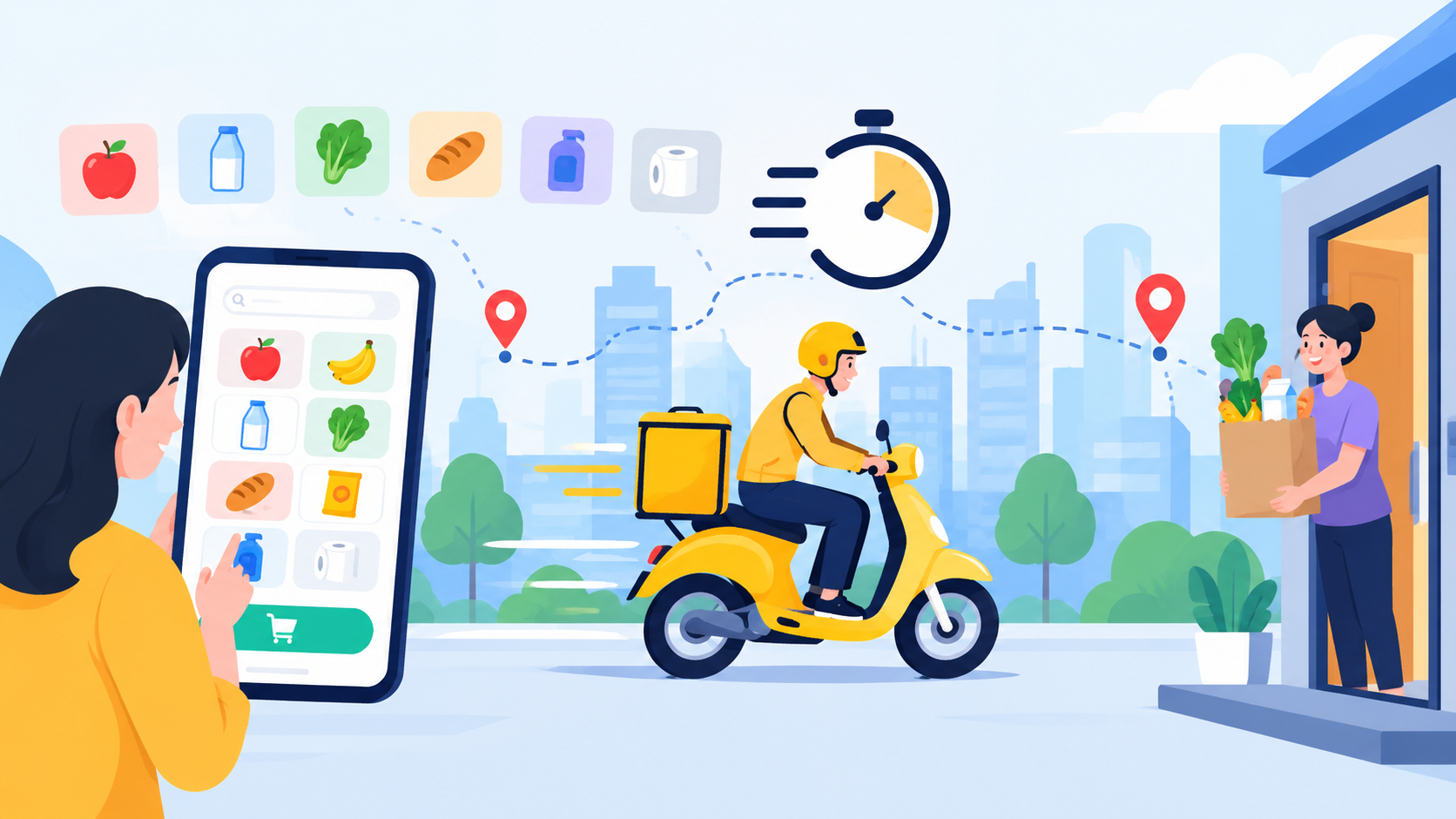
A quick commerce platform connects customers, local fulfilment centres, delivery partners, and business administrators through a coordinated digital system. Its primary goal is to move an order from product selection to doorstep delivery within a short time while maintaining accurate inventory and reliable service.
1. Customer Order Placement
Customers browse available products, check prices, add items to their cart, and complete checkout. The app uses the customer's delivery address or location to display products and delivery estimates relevant to their area.
2. Local Inventory and Order Allocation
After an order is placed, the system identifies a nearby dark store or fulfilment centre with the required products in stock. Inventory availability, delivery distance, store workload, and operating capacity can influence which location receives the order.
3. Picking, Packing, and Dispatch
Store staff receive the order details, pick the requested items, verify quantities, and prepare the package. The order management system then coordinates dispatch with an available delivery partner.
4. Last-Mile Delivery and Tracking
Delivery partners receive order assignments and navigation details. GPS-based tracking provides location updates, while estimated arrival times help customers understand the delivery progress.
5. Real-Time Operational Coordination
The platform synchronises order status, inventory changes, payment confirmations, and delivery updates. Automated notifications keep customers informed, while administrative dashboards help operators identify delays and resolve fulfilment issues.
6. Why This Operating Model Matters
A fast delivery promise depends on the entire workflow rather than delivery speed alone. Poor inventory accuracy, distant fulfilment locations, delayed picking, or inefficient dispatch can disrupt the customer experience.
Businesses must therefore design the application around operational efficiency, real-time coordination, and dependable delivery estimates.
Essential Features Every Quick Commerce App Needs for Fast Order Fulfilment
A quick commerce application needs features that help customers place orders easily while enabling store teams, delivery partners, and administrators to coordinate fulfilment efficiently. Each interface should support the specific tasks required to maintain a 10–30 minute delivery window.
Customer App Features
- Location-Based Product Availability: Display products available for delivery to the customer's selected address.
- Smart Search and Filtering: Help users find groceries, snacks, household supplies, and other essentials quickly.
- Real-Time Inventory: Show current stock levels and reduce orders for unavailable products.
- Fast Checkout and Payments: Support saved addresses, digital payment options, and convenient checkout.
- Order Tracking: Display order confirmation, packing, dispatch, and delivery progress.
- Personalised Recommendations: Suggest relevant products based on shopping history and preferences.
- Push Notifications: Send order updates, delivery alerts, offers, and restock notifications.
Store and Inventory Management Features
- Order Management Dashboard: Organise incoming orders by status and fulfilment priority.
- Picking and Packing Workflow: Help staff locate products, verify quantities, and prepare orders efficiently.
- Stock Synchronisation: Update inventory after purchases, cancellations, returns, and stock adjustments.
- Low-Stock Alerts: Notify store teams when popular products need replenishment.
- Substitution Management: Allow approved replacement options when an item becomes unavailable.
Delivery Partner App Features
- Order Assignment: Display assigned deliveries, pickup instructions, and customer details.
- GPS Navigation: Provide directions to fulfilment centres and customer addresses.
- Delivery Status Updates: Record pickup, en-route, and completed stages.
- Proof of Delivery: Support suitable confirmation methods, such as a delivery PIN or photo where appropriate.
- Earnings and Delivery History: Help delivery partners review completed orders and earnings.
Admin and Business Management Features
- Centralised Dashboard: Monitor orders, sales, inventory, delivery performance, and service issues.
- Delivery Zone Management: Configure serviceable areas and estimated delivery windows.
- Promotions and Pricing: Manage discounts, product offers, and customer campaigns.
- Analytics and Reporting: Review order volumes, cancellations, fulfilment times, and customer retention.
- Role-Based Access: Restrict sensitive operational and financial functions to authorised users.
The final feature set should reflect the business model, target market, and fulfilment capacity. Launching with reliable ordering, inventory, payment, and delivery workflows is often more practical than introducing advanced automation before core operations are stable.
How Quick Commerce Apps Manage Dark Stores, Inventory, and Delivery Operations
Quick commerce businesses rely on a tightly coordinated fulfilment network to meet short delivery windows. Dark stores, accurate inventory records, efficient picking processes, and nearby delivery partners work together to move orders from checkout to dispatch with minimal delays.
1. Dark Stores and Local Fulfilment Centres
Dark stores are retail fulfilment locations designed primarily to prepare online orders rather than serve walk-in shoppers. Positioning them near high-demand neighbourhoods can reduce travel distances and improve delivery efficiency.
Businesses should evaluate population density, customer demand, property costs, product categories, and delivery coverage before choosing store locations. A well-planned network helps balance fulfilment speed with operational expenses.
2. Real-Time Inventory and Stock Synchronisation
Inventory systems need to reflect product availability across fulfilment locations. When an order is confirmed, the platform should reserve the relevant stock and update availability to reduce overselling.
Automated stock alerts and demand forecasting can help teams identify fast-moving products, plan replenishment, and reduce losses caused by excess or expired inventory.
3. Efficient Picking, Packing, and Order Allocation
Order management software can group tasks, guide store staff through picking lists, and prioritise orders according to fulfilment requirements. The system should also allocate orders to suitable locations based on stock availability, distance, workload, and delivery capacity.
4. Last-Mile Delivery Coordination
Delivery operations need to match prepared orders with available riders. Assignment rules can consider proximity, workload, traffic conditions, and delivery deadlines. Accurate navigation and timely status updates help reduce avoidable delays.
Businesses investing in logistics software development can connect inventory, order management, dispatch, and delivery tracking within a coordinated operational system.
5. Using Data to Improve Delivery Performance
Operational analytics can identify recurring bottlenecks, such as slow picking, stock discrepancies, rider shortages, and delays in particular delivery zones. Managers can use these insights to adjust staffing, inventory placement, and service areas.
The most effective quick commerce model combines suitable local infrastructure with software that coordinates every fulfilment stage. Promising a 10–30 minute delivery window is only sustainable when the operational network can consistently support it.
Technology Stack Required to Build a Scalable Quick Commerce Platform
A scalable quick commerce platform requires technologies that support real-time inventory updates, fast order processing, secure payments, location tracking, and efficient delivery management. The technology stack should also accommodate growing order volumes and multiple dark stores without compromising performance.
|
Technology Layer |
Common Technologies |
Purpose |
|
Mobile App Development |
Flutter, React Native, Swift, Kotlin |
Customer and delivery partner applications |
|
Frontend Development |
React.js, Next.js |
Customer web portals and administrative dashboards |
|
Backend Development |
Node.js, Python, Java |
Order processing, business logic, and API management |
|
Database Management |
PostgreSQL, MongoDB, Redis |
Customer records, inventory data, order storage, and caching |
|
Cloud Infrastructure |
AWS, Microsoft Azure, Google Cloud |
Hosting, scalability, backups, and application deployment |
|
Real-Time Communication |
WebSockets, Firebase |
Live order updates, notifications, and delivery status changes |
|
Maps and Location |
Google Maps Platform, Mapbox |
Location selection, route planning, and delivery tracking |
|
Payment Integration |
Razorpay, Stripe, PayPal |
Online payments, refunds, and transaction processing |
|
Analytics and Monitoring |
Google Analytics, Grafana, Prometheus |
Order performance, application health, and operational insights |
Choosing the Right Technology Architecture
The right architecture depends on expected order volumes, delivery coverage, inventory complexity, and integration requirements. An MVP may use a modular monolithic backend, while a larger platform may benefit from independently scalable services for inventory, payments, dispatch, and order management.
On-Demand App Development Services can help businesses select suitable technologies, connect essential systems, and build a foundation that supports future expansion. A mobile app development company can also help determine whether native or cross-platform development is more appropriate for customer and delivery partner apps.
Quick Commerce App Development Process: 8 Key Stages From Research to Launch
Building a quick commerce app requires more than developing an ordering interface. The process must account for customer demand, inventory availability, store operations, delivery capacity, and the technical infrastructure needed to fulfil orders within a short delivery window.
1. Conduct Market Research and Competitor Analysis
Start by researching target customers, shopping habits, local demand, competitor offerings, and delivery expectations. Identify the product categories, service areas, and delivery windows that make the business commercially viable.
2. Define Requirements and Business Goals
Document the essential features, user roles, inventory workflows, payment methods, and delivery processes. Establish measurable goals for order fulfilment time, order accuracy, customer retention, and operating costs.
3. Plan the Architecture and Technology Stack
Choose the frontend, backend, database, cloud infrastructure, and integrations required to support the platform. Plan for real-time inventory synchronisation, peak-hour traffic, and future expansion into additional locations.
4. Design the User Experience and Interface
Create intuitive interfaces for customers, delivery partners, store staff, and administrators. Keep product discovery, checkout, address selection, and order tracking simple so customers can complete purchases with minimal friction.
5. Develop the Minimum Viable Product
Build the core application with registration, product listings, search, cart management, checkout, order placement, and basic inventory controls. A focused MVP allows businesses to test their service model before investing in advanced features.
6. Integrate Payments and Delivery Operations
Connect payment gateways, maps, notifications, inventory systems, and delivery assignment workflows. Test how the platform responds to unavailable products, failed payments, order cancellations, and delivery delays.
7. Test Performance, Security, and Order Accuracy
Conduct functional, integration, usability, and load testing. Verify inventory accuracy, prevent duplicate orders, secure customer information, and test whether the system can handle peak demand without slowing down.
8. Deploy, Monitor, and Improve
Launch in a controlled service area before expanding to additional locations. Monitor application performance, delivery times, cancellations, customer feedback, and operational costs to identify improvements.
A food delivery app development company with relevant on-demand commerce experience can help businesses plan these stages, integrate essential systems, and prepare the platform for real-world operations.
Integrating Payments, GPS Tracking, Inventory, and Logistics Systems
A quick commerce platform relies on several connected systems to process orders, maintain stock accuracy, and coordinate deliveries within a 10–30 minute window. Reliable integrations help businesses reduce manual work, prevent order errors, and provide customers with accurate updates throughout the fulfilment process.
1. Payment Gateway Integration
Payment gateways enable customers to pay through cards, digital wallets, UPI, and other supported methods. The application should handle payment confirmations, refunds, failed transactions, and order status updates reliably.
Webhooks and transaction validation help ensure that an order is confirmed only when the payment status meets the platform's requirements. Cash on delivery can also be supported where the business model and operational policies allow it.
2. GPS Tracking and Route Optimisation
GPS-enabled systems help delivery partners navigate to customers, share location updates, and identify the most efficient routes. Dispatch logic can consider distance, traffic conditions, rider availability, and delivery deadlines when assigning orders.
Businesses evaluating GPS tracking app development costs should account for map API usage, live location updates, route optimisation, tracking frequency, and the number of delivery partners. These requirements can affect both initial development and recurring operating expenses.
3. Inventory and Order Management Integration
Inventory systems should synchronise product availability across dark stores and customer-facing applications. When an order is placed, the platform needs to reserve stock, update inventory records, and prevent multiple customers from purchasing the same unavailable item.
Integration with warehouse or store management systems can also support stock replenishment, low-stock alerts, expiry tracking where relevant, and order picking workflows.
4. Delivery Partner and Logistics Integration
Delivery management systems coordinate rider assignment, order pickup, delivery status, and proof of delivery. Depending on the operating model, the platform can use its own fleet, integrate with external delivery providers, or combine both approaches.
5. Notifications and Business Analytics
Push notifications, SMS, and email can inform customers about order confirmation, packing, dispatch, and delivery. Analytics tools can track fulfilment time, failed deliveries, inventory discrepancies, and rider utilisation.
By connecting these systems through secure APIs, webhooks, and event-driven workflows, businesses can create a more coordinated operation. The result is a quick commerce platform that can manage orders more reliably while adapting to changing demand and delivery conditions.
Common Challenges in Building a Reliable 10–30 Minute Delivery Platform
Developing a quick commerce app involves technical and operational challenges that can affect delivery speed, customer satisfaction, and profitability. Addressing these issues early helps businesses create a platform that can handle fluctuating demand and maintain reliable service.
|
Challenge |
Business Impact |
Practical Solution |
|
Inventory Inaccuracy |
Customers may order unavailable products. |
Synchronise stock levels in real time and reserve inventory when orders are confirmed. |
|
Delivery Delays |
Late orders can reduce customer trust and repeat purchases. |
Optimise rider allocation, delivery zones, and route planning. |
|
Demand Fluctuations |
Peak-hour orders can overwhelm stores and delivery teams. |
Use demand forecasting and flexible staffing or rider allocation. |
|
High Operating Costs |
Store operations, rider payments, and rapid fulfilment can reduce margins. |
Optimise delivery zones, picking workflows, and order batching where practical. |
|
System Performance Issues |
Slow searches, checkout failures, or delayed updates can disrupt orders. |
Use caching, performance monitoring, load testing, and scalable infrastructure. |
|
Integration Failures |
Payment, inventory, or dispatch errors can interrupt fulfilment. |
Implement API validation, retries, monitoring, and clear failure-handling workflows. |
|
Data Security and Privacy |
Exposed customer, payment, or location information can create financial and legal risks. |
Apply encryption, access controls, secure authentication, and appropriate data-retention policies. |
|
Expansion into New Areas |
Different demand patterns and store capacities can complicate operations. |
Expand in phases and assess local demand, delivery coverage, and fulfilment capacity before launch. |
Balancing Speed With Operational Efficiency
A short delivery promise is only sustainable when the business can fulfil it consistently. Promising a 10-minute delivery window across an area with insufficient inventory or limited rider availability can increase costs and customer dissatisfaction.
Businesses should therefore define realistic delivery zones, monitor actual fulfilment times, and adjust delivery estimates according to current capacity. Pilot launches, operational dashboards, and regular performance reviews can help identify bottlenecks before they affect a larger customer base.
Quick Commerce App Development Cost and Timeline in 2027
The quick commerce app development cost depends on the application's features, platform coverage, inventory management requirements, payment integrations, delivery automation, and expected order volume. A basic MVP requires less investment than an advanced platform supporting multiple dark stores, real-time dispatch, predictive analytics, and complex logistics workflows.
Estimated Development Cost and Timeline
|
Quick Commerce App Type |
Estimated Cost |
Development Timeline |
|
Basic Quick Commerce MVP |
8,000–20,000 |
2–3 months |
|
Mid-Level Delivery Platform |
20,000–45,000 |
3–5 months |
|
Advanced Quick Commerce App |
45,000–70,000 |
5–7 months |
|
Enterprise Multi-Store Platform |
70,000–90,000+ |
7–10+ months |
What Influences the Total Development Budget?
- Feature complexity: Product discovery, customer accounts, checkout, order tracking, inventory synchronisation, and administrative dashboards influence development effort. Advanced demand forecasting, automated dispatch, and multi-store controls can increase the budget further.
- Platform selection: Building customer and delivery applications for both iOS and Android, alongside web-based store and admin dashboards, requires additional implementation and testing.
- Third-party integrations: Payment gateways, maps, notifications, inventory systems, and delivery services may involve integration costs and recurring usage charges. Businesses can compare these requirements with the broader food delivery app development cost when planning a related ordering platform.
- Operational complexity: Supporting multiple dark stores, high order volumes, automated stock replenishment, and sophisticated dispatch rules requires more extensive backend logic and performance testing.
- Maintenance and scalability: Post-launch support, security updates, cloud hosting, monitoring, and API maintenance should be included in the long-term budget. Businesses comparing delivery-focused solutions should also review the Courier delivery app development cost, particularly when evaluating rider management and delivery tracking requirements.
How to Keep Development Costs Under Control
- Launch with essential ordering, payment, inventory, and delivery features.
- Start in a limited service area to validate demand and fulfilment workflows.
- Use managed cloud services and established payment or mapping APIs where appropriate.
- Add advanced automation after analysing real order volumes and operational bottlenecks.
- Reserve a separate budget for ongoing maintenance and infrastructure expenses.
A phased development strategy helps businesses validate their quick commerce model before investing in extensive automation or wider geographic coverage.
Revenue Models and Monetisation Strategies for Quick Commerce Businesses
A sustainable quick commerce business needs a revenue model that balances customer affordability with the costs of inventory, store operations, technology, and rapid delivery. Combining multiple revenue streams can help businesses improve profitability while maintaining a convenient shopping experience.
1. Delivery and Convenience Fees
Businesses can charge customers a delivery fee based on order value, delivery distance, demand, or service level. Convenience fees may also apply to selected premium services. These charges should remain transparent so customers understand the total cost before checkout.
2. Product Sales and Retail Margins
Selling groceries, household essentials, personal care products, and other frequently purchased items generates revenue through product margins. Businesses can improve margins by managing supplier agreements, reducing wastage, and maintaining appropriate inventory levels.
3. Subscription and Membership Plans
Paid memberships can offer benefits such as free delivery above a minimum order value, exclusive discounts, priority service, or special offers. Recurring subscriptions may encourage repeat purchases and create more predictable revenue.
4. Advertising and Sponsored Product Placements
Brands and suppliers can pay to promote selected products within search results, category pages, banners, or personalised recommendations. Sponsored placements can create an additional revenue stream, provided they remain relevant and clearly distinguishable from organic results.
5. Commission From Partner Stores
Marketplace-based platforms can earn commissions from third-party retailers or local stores for orders placed through the application. Commission structures should account for product categories, fulfilment responsibilities, and partner agreements.
6. Data-Driven Operational Optimisation
Analytics can help businesses understand purchasing patterns, identify popular products, forecast demand, and reduce inventory waste. These capabilities do not necessarily generate direct revenue, but they can improve margins and operational efficiency when used responsibly.
7. Choosing a Sustainable Monetisation Mix
The most suitable revenue model depends on the business structure, customer segment, order frequency, average basket value, and fulfilment costs. For example, a retailer operating its own dark stores may focus on product margins and memberships, while a marketplace may rely more heavily on commissions and advertising.
Conclusion
Quick commerce app development in 2027 requires a combination of reliable technology, accurate inventory management, efficient delivery operations, and a customer-friendly ordering experience. Businesses must coordinate every stage of fulfilment, from product discovery and payment processing to store picking and last-mile delivery.
Starting with a focused MVP, validating demand in a limited service area, and expanding gradually can help businesses manage development costs and operational risks. As order volumes increase, real-time tracking, automated dispatch, demand forecasting, and scalable infrastructure can support more efficient operations.
Ultimately, a successful quick commerce platform is not defined by delivery speed alone. It depends on consistently fulfilling orders, controlling operating costs, and providing customers with a convenient and dependable shopping experience.
FAQ's
Quick commerce app development involves building digital platforms that enable customers to order everyday products for rapid delivery, often within 10–30 minutes.
Development can cost approximately $8,000 to $90,000 or more, depending on features, integrations, platforms, and operational complexity.
A basic MVP may take 2–3 months, while an advanced or enterprise platform can require 5–10 months or longer.
Essential features include product search, inventory availability, secure checkout, order tracking, delivery assignment, notifications, and an administrative dashboard.
They use inventory management systems to synchronise stock levels, reserve products for confirmed orders, and notify store teams when replenishment is required.
Common technologies include Flutter or React Native, React.js, Node.js, PostgreSQL, cloud platforms, payment gateways, and mapping APIs.
Yes. AI can support demand forecasting, product recommendations, inventory planning, delivery assignment, and analysis of customer purchasing patterns.
Revenue can come from product margins, delivery fees, subscriptions, marketplace commissions, and sponsored product placements.

CrinPro
CrinPro Solutions is a leading IT company that helps startups and enterprises build innovative digital products. From intuitive mobile applications and high-performance websites to AI-powered solutions and enterprise software, our team delivers scalable, secure, and user-focused products tailored to unique business needs. With expertise across multiple industries, we transform ideas into digital experiences that drive growth, improve efficiency, and create long-term business value.