Key Takeaways:
- Build a pet care marketplace that connects owners with trusted walkers, sitters, groomers, and other local providers.
- Prioritize pet profiles, provider search, easy booking, live GPS tracking, and secure payments.
- Create separate owner, provider, and admin panels to manage bookings, services, payouts, and user activity.
- Start with a focused MVP, then add AI matching, geofencing, wearables, and other advanced features as demand grows.
- Protect user trust with provider verification, clear location permissions, secure payments, honest reviews, and reliable support.
Ever lost sleep because your dog walker never texted back?
That worry is real. Pet owners want trusted help fast. Providers want steady bookings. Right now, both sides juggle calls, texts, and cash.
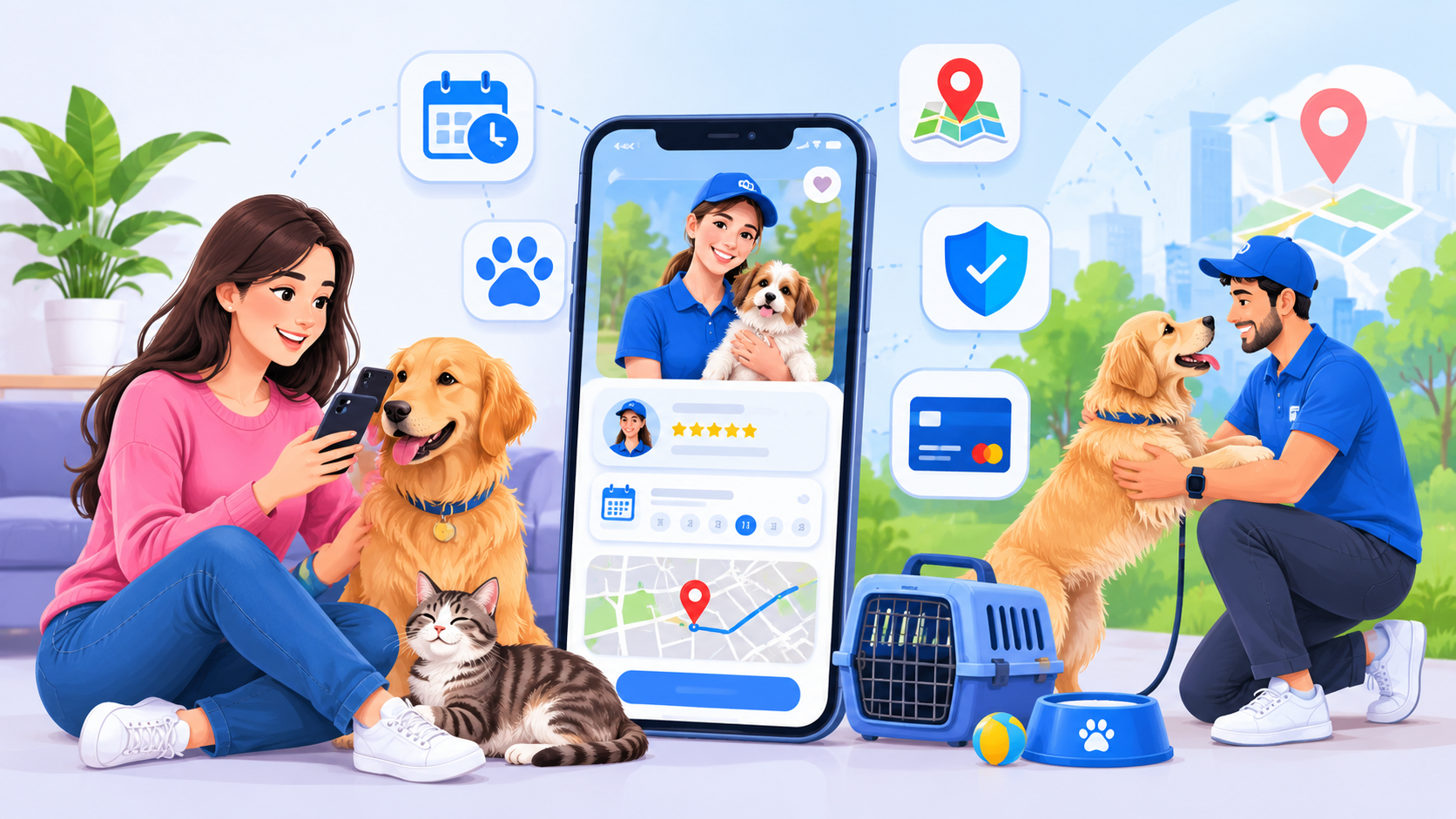
Pet care marketplace app development fixes that mess. One platform brings booking, pet profiles, live GPS tracking, secure payments, and verified provider checks together.
This blog covers features, tech stack, steps, cost, mistakes, revenue ideas, and trends.
What Is a Pet Care Marketplace App and How Does It Work?
A pet care marketplace app is a digital platform that connects pet owners with verified service providers. Owners book dog walking, sitting, grooming, or boarding, track services live, and pay securely inside one app.
Rover, Wag, and Care.com work this way in the U.S. Pawshake does the same in several other countries. If you want the bigger picture, start with marketplace app development.
Here is how it works.
- Pet owners sign up and build a pet profile with breed, vaccination status, and diet needs.
- Providers join, upload credentials, and pass identity verification and background screening where the law allows.
- Owners search by distance, pick open time slots, and confirm the booking.
- Providers share live location during walks. Owners get alerts and route history.
- The app collects payment, keeps a platform commission, and sends the payout to the provider.
Pet Care Marketplace App Development Market Overview
The market focuses on developing digital platforms that connect pet owners with service providers, products, and pet care solutions.
- According to Business Research Insights, the global pet care apps market is valued at USD 3.48 billion in 2026 and is projected to reach USD 6.73 billion by 2035, growing at a CAGR of 7.7% (2026–2035).
- According to Fortune Business Insights, the global mobile pet care market was valued at USD 0.86 billion in 2025 and is projected to reach USD 1.38 billion by 2034, growing at a CAGR of 5.37% during 2026–2034.
- According to Research and Markets, the global mobile pet care market was valued at USD 760.7 million in 2025 and is projected to reach USD 1.26 billion by 2034, growing at a CAGR of 5.65% during 2026–2034.
Why Are Businesses Investing in Pet Care Marketplace App Solutions in 2027?
Pet owners want fast, safe help, and providers want steady work. A marketplace app serves both sides well.
1. Steady Demand and Repeat Bookings
Pet parents book dog walking, pet sitting, and grooming again and again. Recurring bookings and loyalty programs boost customer retention. That gives your business steady, predictable income.
2. Faster Service Discovery
Owners find local pet care providers through geospatial search and distance filters. They compare ratings, prices, and open time slots in seconds. Less calling, more booking.
3. Built-in Trust and Safety
Identity verification, verified reviews, and incident reporting build trust. Owners feel safer handing over a pet.
4. Better Control and Lower Costs
An admin dashboard tracks users, bookings, and transactions in one place. Automated commission calculation and provider payouts cut manual work. You scale without a giant team.
Must-Have Features to Include in a Pet Care Marketplace App
These features keep both sides happy. Each panel needs its own tools, so plan them one by one.
Pet Owner Panel
|
Feature |
What It Does |
|
Registration and Login |
Owners sign up by email, phone, or social login. Secure authentication protects personal data. |
|
Pet Profile Creation |
Store breed, age, photo, microchip ID, and temperament. Supports multiple pets. |
|
Health and Vaccination Records |
Upload vaccination status, medical history, and dietary needs for sitters to view. |
|
Provider Search and Filters |
Find walkers, sitters, and groomers by distance, price, rating, and availability. |
|
Booking and Rescheduling |
Pick time slots, confirm appointments, and manage recurring bookings in a few taps. |
|
Live Tracking |
Watch the walk on a live map and view route history after the service ends. |
|
Secure Payments |
Pay by card or digital wallet. Data stays encrypted and follows PCI DSS rules. |
|
Reviews and Chat |
Send in-app messages and leave verified reviews after completed bookings. |
Pet Service Provider Panel
A smooth calendar is central to booking app development. Providers must see and control their time easily.
|
Feature |
What It Does |
|
Provider Onboarding |
Upload ID, certifications, and insurance details for identity and credential checks. |
|
Service Listings |
Manage service listings, set prices, durations, and service areas. |
|
Availability Calendar |
Update availability and sync calendars to prevent double booking. |
|
Request Management |
Accept, decline, or reschedule service requests with automated booking notifications. |
|
Walk Tools |
Start and end walks, share live GPS, and send photo updates to owners. |
|
Earnings Dashboard |
View completed jobs, platform fees, and payout status in one place. |
|
Payout Setup |
Link a bank account through Stripe Connect for secure provider payouts. |
|
Ratings and Feedback |
See verified customer reviews and improve service quality over time. |
Admin Panel
|
Feature |
What It Does |
|
User Management |
Approve, suspend, or remove users with role-based access control. |
|
Provider Approvals |
Review credentials and screening results before providers go live. |
|
Service Catalogue |
Set service categories, pricing rules, and descriptions across the marketplace. |
|
Commission Control |
Set the commission percentage and platform transaction fees for each service. |
|
Transaction Monitoring |
Track payments, refunds, and payment reconciliation in one dashboard. |
|
Dispute Resolution |
Handle refund disputes, service complaints, and support tickets quickly. |
|
Review Moderation |
Remove fake reviews and keep ratings honest and verified. |
|
Analytics Reports |
Track bookings, revenue, retention, and service coverage by area. |
Advanced Features of a Pet Care Marketplace Platform
Once your MVP works, these upgrades set your platform apart and keep users coming back.
1. Live GPS Tracking and Geofencing
Live GPS tracking shows each walk on a map in real time. Geofencing sends entry and exit alerts, and route history proves the service happened. Ask for background location access with clear consent. Planning GPS tracking app development costs early helps you budget for the Google Maps Platform and Apple Core Location.
2. AI Provider Matching
AI matches owners with sitters based on breed, behavior, and past reviews. Predictive matching cuts bad bookings and boosts repeat use. Owners feel understood, not just served.
3. Pet Health Tracking
Connect smart wearables to log steps, sleep, and heart rate. Share health records with the vet. Sitters see alerts for medication and feeding schedules.
4. In-App Chat and Video Calls
Owners can chat or video call a sitter during a stay. Twilio handles SMS and calls. Firebase Cloud Messaging sends push alerts for every update.
5. Emergency and Incident Reporting
One-tap SOS lets a provider report an incident, alert the emergency contact, and reach a licensed veterinarian. Every report is logged for pet safety records.
6. Smart Pricing and Subscriptions
Dynamic pricing adjusts rates in busy seasons. Subscription plans give owners discounts on recurring pet care services. Loyalty grows with every booking.
Step-by-Step Pet Care Marketplace App Development Process
Follow these eight steps in order. Skipping one early usually costs more time and money later.
1. Business Requirements and Market Research
Start with people, not code. Talk to ten dog owners and five sitters in your target city. Ask what annoys them most.
I have seen founders skip this step. One built only for dog walking. Owners kept asking for cat sitting and grooming too.
Do this first.
- Study Rover, Wag, and Care.com. Note what users love and hate.
- Pick one launch city and one core service.
- Check local rules on licenses, insurance, and background screening. They vary by state.
- Read app store reviews to spot gaps.
2. Marketplace Business Model and User Roles
Your app is a two-sided marketplace. You must win over owners and providers at the same time. Tough, but doable.
Define three roles. Pet owner, service provider, and admin. Each role gets its own permissions through role-based access control.
Then pick how you earn. For example, a $30 walk with a 15 per cent commission gives you $4.50.
Decide early who pays the fee. Owner, provider, or both. Changing it later upsets people.
3. Feature Planning and MVP Scope
An MVP is your first, lean version. It should answer one question. Can an owner book a trusted walker in under two minutes?
Build these first.
- Pet profiles with vaccination records
- Provider search and filters
- Booking engine with availability
- Payments through Stripe Connect
- Verified reviews
- Basic admin dashboard
Save AI matching and wearables for version two. Use the MoSCoW method to sort must-haves from nice-to-haves.
4. UI/UX Design and User Journey Mapping
Picture a busy owner on the couch. A dog sits on one arm. They have one free hand. Design for that moment.
- Map the journey from search to booking, payment, live walk, and review.
- Use Figma for wireframes and clickable prototypes.
- Use big buttons, clear pet photos, and short forms.
- Test with five real users before coding.
A tiny fix here saves weeks of rework later.
5. Backend Architecture and API Development
Strong pet care marketplace app development starts with a backend that can grow. Pick a stack your team knows well.
Common choices.
- Node.js or Python (Django, FastAPI) for REST APIs
- PostgreSQL for bookings and payments
- Redis for caching
- WebSockets for live updates and chat
- MongoDB for flexible pet profile data
Your booking engine is the heart. Use database transactions so two owners cannot grab the same time slot.
Add encryption, secure authentication, and role-based access from day one. Many teams use on-demand app development services for this part.
6. Frontend Development and Third Party Integrations
Choose Flutter or React Native for one codebase on iOS and Android. Pick Swift and Kotlin for fully native apps.
Use React for the admin dashboard and Next.js for the web app.
Plug in these tools.
- Google Maps Platform for Maps SDK, Places API, and Routes API
- Apple Core Location for iOS location permissions
- Stripe Connect for marketplace payments and payouts
- Twilio for SMS and SendGrid for email
- Firebase Cloud Messaging and Apple Push Notification service for alerts
Ask for location access only when needed. Explain why in plain words. Users say yes to clear reasons.
7. Quality Assurance, Security and Performance Testing
Test like a nervous pet parent. Book a walk, cancel it, rebook it, and pay for it. Then try it on a weak signal.
- Functional tests for booking, cancellations, and refunds
- GPS tests on real phones during real walks
- Load tests with k6 or JMeter for busy weekends
- Security tests for data leaks and weak logins
- Payment checks that follow PCI DSS
A classic bug is the time zone mix-up. A 9 AM walk shows up at 2 PM. Test for it early.
Stripe handles card data, which lowers your PCI burden. Still, protect personal data with consent and data minimization.
8. App Deployment and Continuous Improvement
Launch in one city first. Release on the App Store and Google Play. Use CI/CD tools like GitHub Actions to ship updates safely.
Watch these numbers.
- Booking completion rate
- Repeat bookings
- Cancellation rate
- Provider response time
- Crash reports in Firebase Crashlytics
Lesson learned. Sign up for providers before owners. An empty marketplace feels dead.
Then improve every two weeks based on feedback.
How Much Does Pet Care Marketplace App Development Cost?
The full range runs from $8,000 to $90,000+. More features, platforms, and integrations push the price up.
|
Stage |
Estimated Cost |
Timeline |
|
MVP with core features |
$8,000 to $25,000 |
2 to 4 months |
|
Mid-level app with iOS, Android, GPS, and admin panel |
$25,000 to $50,000 |
4 to 6 months |
|
Advanced marketplace with AI matching, wearables, video, and analytics |
$50,000 to $90,000+ |
6 to 9 months |
Common Mistakes to Avoid When Building a Pet Care Marketplace
Most marketplace apps fail for simple reasons. Spot these six early, and you save time and money.
1. Weak Provider Verification
Mistake: Letting anyone join without identity or credential checks.
Solution: Add identity verification, credential checks, and background screening where the law allows.
2. Booking Conflicts
Mistake: Two owners book the same sitter at the same time.
Solution: Use real-time availability, database transactions, and calendar sync.
3. Poor Onboarding
Mistake: Long sign-up forms make providers quit before they finish.
Solution: Split onboarding into short steps and save progress automatically.
4. Ignoring Location Privacy
Mistake: Tracking location all day without clear consent.
Solution: Ask for GPS permission clearly, track only during active services, and delete old route data.
5. Overbuilding the First Version
Mistake: Launching with every feature delays release and burns budget.
Solution: Ship a focused MVP, then add features based on real user feedback.
6. Choosing the Wrong Tech Partner
Mistake: Hiring a team with no marketplace experience.
Solution: Pick a pet care app development company with proven marketplace work.
How to Make Money From a Pet Care Marketplace App?
A marketplace can earn in several ways. Pick one or two at launch, then add more as you grow.
- Booking commission: Take a platform commission on every completed booking.
- Service fee: Charge owners a small transaction fee at checkout.
- Provider subscriptions: Offer premium profiles and business plans for busy providers.
- Featured listings: Let top providers pay for sponsored placement in search results.
- Premium membership: Give owners perks like priority booking and lower fees.
- Partnerships: Partner with insurers and pet brands to earn referral income.
Future Trends Shaping Pet Care Marketplace Apps in 2027
The next wave of pet care apps will feel smarter, safer, and more personal. Here is what to watch.
1. AI Recommendations and Predictive Matching
AI will learn each pet's habits and suggest the best sitter or groomer. Predictive matching can spot likely cancellations early. Owners get better matches with less searching.
2. Smart Wearables and Health Data
Collars and trackers already log activity, sleep, and heart rate. Apps will pull this data into pet health records. Vets and sitters can then spot problems sooner.
3. Stronger Trust and Privacy Rules
Expect closer attention to fake reviews and location data. Groups like Pet Sitters International, NAPPS, and the AVMA shape care standards. Build with consent first.
4. Subscription and Wellness Services
Owners want one app for walks, grooming, training, and vet visits. Subscription bundles and wellness plans make this easy. They also lift retention and monthly revenue.
Conclusion
Pet care marketplace app development works best when trust comes first. Start with a small MVP, verify every provider, and protect owners' data.
Add live GPS tracking, secure payments, and honest reviews. Then grow step by step. Pet parents want help they can count on. Build that, and bookings follow.
Ready to start? Share your idea with a development team and plan your first launch city.
FAQ's
A pet care marketplace app connects pet owners with walkers, sitters, groomers, and other providers. Users can book services and pay through one platform.
Owners create pet profiles, search for providers, and book services. Providers accept requests, complete the service, and receive payments through the app.
Include pet profiles, provider search, booking, GPS tracking, secure payments, in-app chat, reviews, notifications, and an admin dashboard.
They can use identity checks, background screening, license verification, and reference checks where applicable to help protect pets and owners.
GPS tracks a provider's location during an active service. Owners can view live routes, check progress, and receive walk completion updates.
Yes. A booking system can let owners schedule daily, weekly, or custom dog walks without creating a new request every time.
A pet profile should include its name, breed, age, photo, vaccination records, allergies, medical needs, feeding schedule, and emergency contacts.
Stripe Connect is one option for marketplace payments. It supports connected provider accounts, payment collection, and payouts in supported regions.

CrinPro
CrinPro Solutions is a leading IT company that helps startups and enterprises build innovative digital products. From intuitive mobile applications and high-performance websites to AI-powered solutions and enterprise software, our team delivers scalable, secure, and user-focused products tailored to unique business needs. With expertise across multiple industries, we transform ideas into digital experiences that drive growth, improve efficiency, and create long-term business value.