Key Takeaways:
- Consistency Is What Keeps Subscribers Loyal - Platforms that deliver reliably every single morning build the kind of daily trust that drives long-term retention and organic subscriber growth.
- Costs Range Between $7,000 and $80,000 - Subscription management, route optimization, and AI forecasting are the biggest budget drivers that shift your final investment significantly.
- Subscription Management Is the Core of Everything - Flexible schedules, easy pause controls, and seamless auto-billing directly determine whether subscribers stay or cancel after their first frustrating experience.
- Route Optimization Directly Impacts Your Bottom Line - Efficient morning delivery routes reduce fuel costs, improve on-time performance, and allow your fleet to cover significantly more subscribers per shift.
- AI and IoT Are Already Shaping Subscriber Expectations - Demand forecasting, smart refrigerator integration, and voice ordering are actively influencing what subscribers expect from milk delivery platforms right now.
The growing demand for doorstep grocery and dairy deliveries has created new opportunities for businesses to invest in digital solutions.
Consumers now expect fresh milk and dairy products to be delivered quickly, conveniently, and on schedule, making dedicated delivery apps an essential business tool.
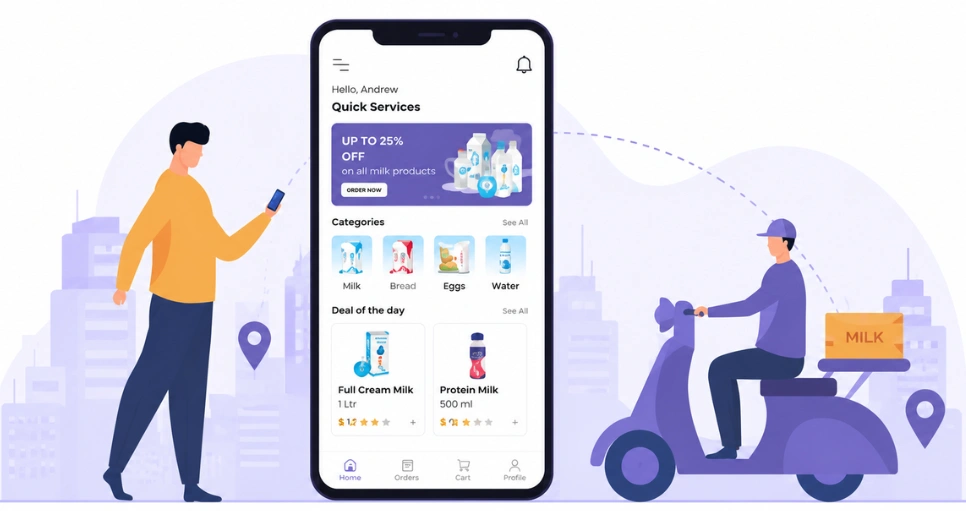
Milk delivery app development enables dairy businesses, startups, and distributors to automate subscriptions, manage deliveries, streamline inventory, and improve customer satisfaction through a seamless mobile experience.
With the right features and technology, these apps can increase operational efficiency while building long-term customer loyalty.
But what does it take to build a successful milk delivery application? In this guide, we'll explore the development process, essential features, cost factors, and the latest industry trends to help you launch a scalable and profitable milk delivery app.
Understanding the Milk Delivery App Market Before You Build
Before investing in a milk delivery app, understanding customer expectations, market trends, and industry challenges is essential. Thorough market research helps businesses identify opportunities, reduce risks, and develop solutions that meet evolving consumer demands successfully.
1. Rising Demand for Subscription-Based Deliveries
Consumers increasingly prefer subscription-based milk delivery services for convenience and consistency. Daily doorstep deliveries, flexible scheduling, and easy payment options encourage customer loyalty while creating predictable recurring revenue for businesses.
2. Growing Competition in the Dairy Industry
The digital dairy market continues to expand as local dairies, startups, and established brands adopt mobile applications. Understanding competitor offerings helps businesses identify market gaps and develop unique features that attract and retain customers.
3. Customer Expectations Are Continuously Evolving
Modern users expect real-time order tracking, multiple payment options, personalized subscriptions, and responsive customer support. Building an app that addresses these expectations improves customer satisfaction, strengthens brand loyalty, and supports long-term business growth.
Must-Have Features That Keep Subscribers Coming Back Every Morning
Features are what turn a milk delivery app from a basic ordering tool into a daily habit subscribers genuinely rely on and recommend to everyone in their neighborhood without hesitation.
1. Flexible Subscription and Delivery Schedule Management
Subscribers need full control over their delivery frequency, quantity adjustments, and pause options without calling anyone. Self-service subscription management keeps customers satisfied and reduces cancellations significantly over time.
2. Real-Time Delivery Tracking and Morning Notifications
Knowing exactly when fresh milk will arrive removes the uncertainty that frustrates early morning subscribers. Automated delivery notifications and live driver tracking create the reliable, predictable experience that builds lasting daily loyalty.
3. Easy Reordering and Product Customization Options
One-tap reordering with options to switch between milk types, add dairy products, and modify quantities keeps the experience effortless. Subscribers who can customize without friction are significantly more likely to stay long term.
4. Secure In-App Payment and Auto-Billing System
Supporting cards, digital wallets, and automatic monthly billing removes payment friction entirely. Subscribers who pay automatically without manual intervention every cycle churn at significantly lower rates than those on manual payment arrangements.
5. Delivery Feedback and Rating System
A quick post-delivery rating option keeps quality standards high and gives your operations team actionable data. Subscribers who feel heard through feedback mechanisms consistently show stronger long-term retention than those on platforms without it.
6. Smart Vacation and Pause Controls
Life is unpredictable and subscribers need the ability to pause deliveries during travel or holidays instantly. Platforms that make pausing simple retain far more subscribers than those that make stopping feel easier than pausing temporarily.
From Idea to Launch: The Complete Milk Delivery App Development Roadmap
Every successful mobile app development project follows a deliberate, structured process where each stage builds directly on the one before it. Rushing or skipping stages is where budgets break down and launch timelines collapse entirely. Here is the complete roadmap.
Step 1: Market Research and Business Model Validation
Strong dairy delivery app development always begins with validating real demand before building anything. Study your target market, analyze competitors, identify underserved subscriber segments, and confirm genuine business viability first.
Step 2: Define Subscription Model and Platform Scope
Solid milk subscription app development requires clear decisions about subscription tiers, delivery frequencies, product catalog depth, and revenue structure before any design or development resources get allocated to the actual build.
Step 3: Choose Your Development Partner
Experienced teams in booking app development bring relevant scheduling and subscription management expertise to milk delivery projects. Review portfolios, check references, and confirm they understand recurring order logic thoroughly before signing anything.
Step 4: UI/UX Design and Prototyping
Strong custom milk delivery app development design prioritizes simplicity, morning-use friendliness, and effortless subscription management. Wireframes and interactive prototypes validate the experience with real potential subscribers before development resources get committed.
Step 5: Core Platform Development
This is where milk delivery app development complexity becomes fully apparent. Your team builds the subscription engine, delivery scheduling logic, customer-facing interface, and driver management tools that power daily operations reliably.
Step 6: Route Optimization and Driver Management
Much like water delivery app development, efficient route planning is mission-critical for morning delivery windows. Build intelligent route optimization tools that minimize travel time, reduce fuel costs, and ensure consistent on-time delivery performance.
Step 7: Admin Panel and Operations Dashboard
Reliable milk delivery management software gives your operations team full visibility over subscriptions, delivery routes, inventory levels, and customer accounts from one centralized and intuitive management interface without requiring developer support.
Step 8: Payment Integration and Subscription Billing
Every reputable milk delivery app development company treats recurring payment infrastructure as a mission-critical system. Set up auto-billing, failed payment recovery, invoice generation, and multi-method payment support from the very beginning.
Step 9: AI Features and Demand Forecasting
Partnering with experienced AI app development companies during this stage adds intelligent demand prediction, personalized product recommendations, and smart inventory management that reduces waste and improves operational efficiency significantly across your entire delivery network.
Step 10: Launch Strategy and Post-Launch Optimization
Successful dairy delivery app development launch strategies combine app store optimization, local marketing campaigns, and subscriber acquisition drives that happen simultaneously before and immediately after your platform goes live to real customers.
How Much Does It Cost to Build a Milk Delivery App in 2026
Understanding the real mobile app development cost before committing to a milk delivery app project keeps your budget grounded and your expectations realistic.
Costs typically range between $7,000 and $80,000 for a fully functional platform. Here is exactly where that investment goes across every major development component.
|
Development Component |
What It Covers |
Estimated Cost |
|
UI/UX Design |
Wireframes, user flow mapping, interactive prototypes, and final screen designs for a seamless morning delivery experience |
$700 – $1,200 |
|
Frontend Development |
Mobile app screens for iOS and Android built with React Native or Flutter for smooth cross-platform performance |
$1,200 – $2,200 |
|
Backend Development |
Server-side logic, database architecture, API development, and all core third-party service integrations |
$2,000 – $3,500 |
|
Subscription and Scheduling Engine |
Recurring order management, flexible delivery frequency controls, pause functionality, and advance scheduling system |
$1,500 – $2,500 |
|
Route Optimization and Driver Management |
Intelligent morning delivery route planning, driver assignment logic, and real-time fleet tracking system |
$1,200 – $2,000 |
|
Payment Gateway and Auto-Billing |
Multi-method payment setup, automatic recurring billing, failed payment recovery, and invoice generation system |
$800 – $1,400 |
|
Real-Time Tracking and Notifications |
Live delivery tracking, automated morning arrival alerts, and push notification management system |
$700 – $1,200 |
|
Admin Panel and Operations Dashboard |
Subscription management, delivery oversight, inventory tracking, route planning, and business analytics interface |
$1,200 – $2,000 |
|
QA Testing and Bug Fixing |
Functional, performance, subscription flow, and device compatibility testing across iOS and Android versions |
$800 – $1,400 |
|
Launch and Post-Launch Support |
App store submission, ASO setup, performance monitoring, and 30-day post-launch issue resolution support |
$500 – $900 |
Future Trends Shaping the Milk Delivery App Market
The milk delivery app development landscape is evolving rapidly as consumer expectations, emerging technologies, and operational demands push platforms toward smarter, faster, and more personalized delivery experiences. Here are the eight trends shaping where this market is heading next.
1. AI-Powered Demand Forecasting and Inventory Management
Leading mobile app development companies are integrating AI forecasting tools that predict subscriber demand patterns, reduce dairy waste, and optimize inventory levels automatically without requiring constant manual intervention from operations teams.
2. Subscription Model Innovation Driving Down Costs
Evolving subscription structures are directly influencing milk delivery app development cost calculations as platforms add tier-based pricing, family bundles, and flexible commitment options that increase average order value while reducing subscriber churn meaningfully.
3. IoT-Connected Smart Refrigerator Integration
Reducing software development cost through smarter IoT integrations is becoming a priority as milk delivery platforms explore direct connections with smart refrigerators that automatically trigger reorders when stock levels drop below subscriber-defined thresholds.
4. Hyperlocal Dark Store Fulfillment Models
Custom milk delivery app development projects increasingly incorporate dark store fulfillment logic that positions micro-warehouses closer to subscriber clusters, dramatically reducing morning delivery windows and improving freshness guarantees for every daily order.
5. Sustainability Tracking and Eco-Friendly Packaging Options
Milk subscription app development platforms are adding carbon footprint tracking, reusable bottle management systems, and eco-packaging selection tools that resonate strongly with environmentally conscious subscribers who actively choose brands aligned with their values.
6. Expansion Into Broader Beverage and Grocery Categories
Much like water delivery app development platforms that expanded into broader product categories, milk delivery apps are diversifying into juices, eggs, bread, and fresh produce to increase average order values and reduce churn among existing subscribers.
7. Voice Commerce and Smart Speaker Ordering Integration
The next evolution in milk delivery app development includes voice-activated ordering through Alexa and Google Home, allowing subscribers to manage deliveries, pause subscriptions, and place orders entirely through conversational commands without touching their phone screens.
8. Real-Time Analytics and Business Intelligence Tools
Sophisticated app development services are now building advanced analytics dashboards into milk delivery platforms that give business owners real-time visibility into subscriber behavior, delivery performance, route efficiency, and revenue trends across every operational dimension.
Conclusion
Building a milk delivery app in 2026 is a genuinely compelling business opportunity in a market where convenience, consistency, and subscription-based commerce are converging in ways that create real and lasting value for both businesses and their daily subscribers.
The features, costs, development roadmap, and future trends covered in this guide give you a complete and honest picture of what a smart milk delivery app investment actually looks like from planning through post-launch growth.
Success in this space comes from building the right subscription experience, choosing a development partner who understands recurring delivery operations, and launching a platform that earns subscriber trust through reliability and consistency every single morning without exception.
FAQ's
Milk delivery app development is the process of building a platform that manages daily subscriber deliveries, recurring orders, route optimization, and payment processing through a single mobile application.
Costs typically range between $7,000 and $80,000 depending on features, subscription management complexity, route optimization requirements, team location, and overall platform scope and scale.
A basic milk delivery app takes 3 to 4 months to build. A fully featured platform with AI demand forecasting, route optimization, and subscription management can take 6 to 9 months.
Core features include flexible subscription management, real-time delivery tracking, morning push notifications, auto-billing, route optimization, easy reordering, vacation pause controls, and a comprehensive admin operations dashboard.
Auto-billing systems charge subscribers automatically on their selected cycle, whether daily, weekly, or monthly, with built-in failed payment recovery logic and instant digital invoice generation sent directly to the subscriber after each successful transaction.
Milk delivery apps require recurring subscription management, early morning route optimization, flexible pause controls, and daily delivery scheduling logic that standard on-demand delivery platforms are not architecturally designed to handle natively.
React Native or Flutter for mobile, Node.js for backend, PostgreSQL for database, Google Maps API for route optimization, Stripe for recurring billing, and Firebase for push notifications form a reliable foundation.
Absolutely. Starting with core subscription management, basic route planning, auto-billing, and real-time tracking validates your business model before investing in AI demand forecasting, IoT integrations, and advanced analytics capabilities.
Route optimization algorithms calculate the most efficient morning delivery sequence based on subscriber locations, delivery time windows, driver availability, and real-time traffic conditions to minimize travel time and ensure consistent on-time delivery performance.
Look for proven experience in subscription-based delivery platforms, route optimization expertise, transparent pricing, recurring billing knowledge, and a clearly defined post-launch support model before making any final development partner decision.

CrinPro
CrinPro Solutions is a leading IT company that helps startups and enterprises build innovative digital products. From intuitive mobile applications and high-performance websites to AI-powered solutions and enterprise software, our team delivers scalable, secure, and user-focused products tailored to unique business needs. With expertise across multiple industries, we transform ideas into digital experiences that drive growth, improve efficiency, and create long-term business value.