Key Takeaways:
- Water delivery app development helps automate ordering, payments, tracking, and recurring deliveries through one convenient platform.
- Build customer, driver, and admin apps together to streamline operations and deliver a better user experience.
- Start with an MVP, validate demand, then add AI, subscriptions, loyalty programs, and advanced analytics over time.
- Choose a scalable tech stack with secure APIs, cloud hosting, and real-time tracking for long-term business growth.
- Subscription plans, delivery fees, memberships, and corporate accounts create steady, recurring revenue opportunities.
- Growing demand for convenient water delivery makes now a strong time to invest in water delivery app development.
You open your fridge and the water jug is empty. Again. You call your local supplier, and nobody picks up. Sound familiar? That gap between "I need water" and "water shows up at my door" is exactly why water delivery app development has turned into one of the hottest ideas in the on-demand delivery space this year.
Companies like Primo Water, Culligan, and h2go have already shown that people want water on their own schedule, not someone else's.
The bottled water industry keeps climbing too, and that growth is pulling investors and small business owners alike toward building their own delivery platform.
In this guide, we'll walk through what a water delivery app actually is, how it works, the features it needs, the tech behind it, what it costs to build, and where this space is heading next.
What is a Water Delivery App? And Market Size
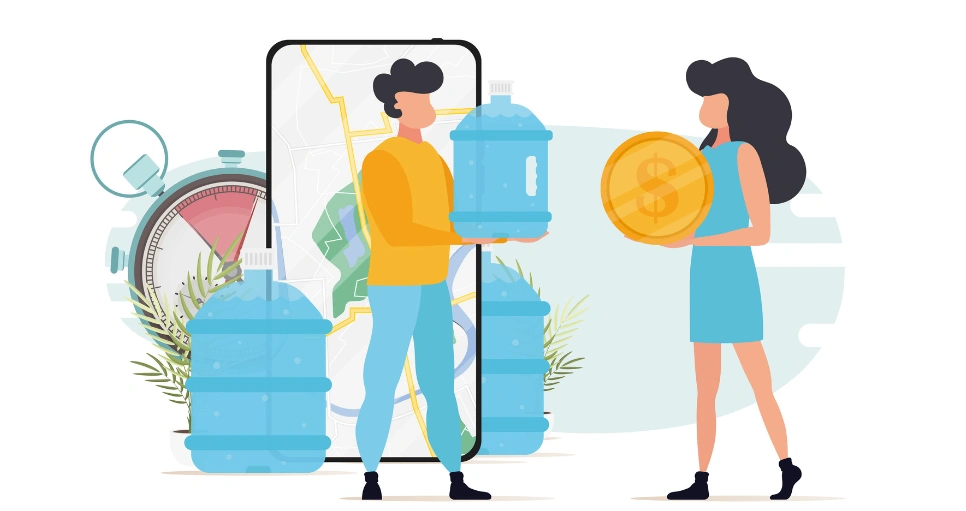
A water delivery app lets customers order bottled or purified water online and get it delivered on a schedule they pick, with live tracking the whole way.
The demand behind these apps is growing steadily. According to Market Reports World, the global water delivery service market is projected to grow from USD 24,044.21 million in 2026 to USD 35,246.79 million by 2035, expanding at a 4.3% CAGR during the forecast period.
The report also notes that bottled water delivery remains the leading market segment, while Asia-Pacific holds the largest market share, driven by rapid urbanization and increasing demand for convenient access to safe drinking water.
This isn't a fad. It's a shift in how a basic daily need gets fulfilled, and the businesses that get there first with a smooth drinking water delivery app tend to keep their customers for years.
How Does an On-Demand Water Delivery App Work?
An on-demand water delivery app connects a thirsty customer to the nearest available driver in just a few taps, turning what used to be a phone call and a wait into a five-minute job.
Step-by-step process
Step 1: Browse and Place an Order
The customer opens the app, picks their water type and quantity, maybe a few extra cans, and taps to place the order. No calls, no waiting on hold.
Step 2: Make a Secure Payment
Payment happens right in the app through a secure gateway. Cards, wallets, whatever the customer prefers, it's all encrypted and quick.
Step 3: Order Processing and Delivery
The order lands with the nearest vendor or driver. Route optimization kicks in, GPS tracking turns on, and the customer can watch their delivery move in real time.
Step 4: Delivery Completion and Reordering
The driver confirms the drop, maybe with a photo, and the app nudges the customer toward their next scheduled order or subscription refill.
Behind this simple flow sits a mix of inventory management, dispatch logic, and hyperlocal delivery routing that most customers never see, but definitely feel when it works well.
Types of Water Delivery Apps
Not every water business needs the same kind of app. Here's how the common models break down.
|
Type |
What It Covers |
|
Bottled drinking water delivery |
Regular home or office delivery of bottled drinking water on request or schedule |
|
Water can delivery |
Focused on large cans or jars, common for households and small offices |
|
RO water delivery |
Purified RO water delivered in containers, often refilled and returned |
|
Mineral water delivery |
Delivery of packaged mineral water brands, sold by bottle or case |
|
Commercial water supply |
Bulk supply to offices, restaurants, and factories on contract terms |
|
B2B water supply |
Business-to-business orders with invoicing, bulk pricing, and repeat contracts |
|
Residential water delivery |
Direct-to-home delivery, usually smaller orders on a personal schedule |
|
On-demand delivery |
Order now, get water within hours, no subscription needed |
|
Scheduled delivery |
Customer picks fixed days and times for recurring drops |
|
Subscription-based delivery |
Auto-renewing plans that refill water without the customer reordering each time |
Most successful platforms actually blend two or three of these together, say, subscription billing plus on-demand top-ups, since real customers rarely fit into just one box.
Water Delivery App Features Every On-Demand Business Should Have
A water delivery app lives or dies by its features. Skip the wrong one and you'll hear about it in one-star reviews. Here's what actually matters, split by who uses it.
Customer App Features Every User Needs
- Registration : Quick sign-up with phone number or email gets new customers ordering in under a minute.
- Login : Fast, secure login that remembers the customer's saved details for repeat visits.
- Address management : Multiple saved addresses for home, office, or a parent's house, switchable in one tap.
- Product catalog: A clean, searchable list of water types, sizes, and brands, so nobody scrolls forever.
- Subscription plans: Set-and-forget refill plans that keep water flowing without a fresh order every time.
- One-time orders: For the customer who just needs an extra can this week, no commitment required.
- Reorder: One tap to repeat the last order, which honestly should exist in every delivery app ever made.
- Order tracking: Live map view showing exactly where the driver is and when they'll arrive.
- Delivery scheduling: Pick a day and time window that actually fits a real calendar.
- Secure payment: Encrypted checkout that protects card details on every single transaction.
- Coupons: Discount codes and referral offers that keep customers coming back.
- Push notifications: Order confirmations, driver updates, and reminders sent straight to the phone.
- Ratings: Simple star ratings after each delivery, which double as quality control for the business.
- Support: In-app chat or call support for the rare but real moments something goes wrong.
If you're building this from scratch, working with experienced app development services can save you from rebuilding half these features twice after launch.
Delivery Agent App Features That Improve Efficiency
- Login: A separate, simple login built for drivers, not customers, so nothing gets mixed up.
- Order management: A clear queue of assigned deliveries with all the details a driver needs upfront.
- Route optimization: Smart routing that groups nearby stops so drivers aren't zigzagging across town.
- Navigation: Built-in GPS navigation that guides drivers turn by turn to each address.
- Status updates: Drivers mark orders as picked up, in transit, or delivered, keeping everyone in the loop.
- Earnings dashboard: A running total of daily and weekly earnings, which keeps drivers motivated and informed.
- Delivery proof: Photo or signature capture at drop-off, protecting both the driver and the business from disputes.
Many teams building this side of the platform lean on established mobile app development companies with real experience in booking app development, since driver-facing tools need to be just as reliable as the customer side, sometimes more.
Admin Panel Features
- Dashboard: A bird's-eye view of orders, revenue, and active drivers, all in one screen.
- Customer management: Full customer records, order history, and support notes in one place.
- Inventory: Real-time stock tracking so nobody promises water that isn't actually on the shelf.
- Vendor management: Onboarding and monitoring for every supplier or franchise partner on the platform.
- Delivery management: Assigning, reassigning, and monitoring every delivery from a central admin view.
- Pricing: Flexible pricing rules by product, zone, or customer type.
- Coupons: Creating and tracking promo codes across the whole customer base.
- Reports: Daily, weekly, and monthly reports on sales, deliveries, and driver performance.
- Analytics: Deeper data on customer behavior, peak hours, and repeat order rates.
- CRM: Built-in customer relationship tools that help teams follow up and retain subscribers.
- Notifications: System-wide alerts for low stock, failed payments, or delayed deliveries.
Getting this panel right often comes down to budget, and that's usually where founders start asking about web app development cost before locking in a final feature list.
Advanced Features for Water Delivery Management Software
Once the basics are covered, a modern water delivery management software platform needs a layer of smart, automated tools to actually compete in 2026.
1. AI Forecasting
AI demand forecasting studies past orders and predicts how much water a zone will need next week, cutting down on both shortages and waste.
2. AI Chatbot
An AI chatbot handles common questions, order changes, and complaints instantly, freeing up human support for the trickier cases.
3. Smart Subscriptions
Smart subscriptions adjust delivery frequency automatically based on how fast a household actually uses its water.
4. Delivery Reminders
Predictive delivery reminders nudge customers before they run out, based on their own usage patterns rather than a fixed calendar.
5. Voice Ordering
Voice ordering lets busy customers reorder water hands-free, just by speaking to their phone or smart speaker.
6. QR Delivery
QR-based delivery lets drivers scan a code at drop-off, instantly logging proof and updating inventory in one motion.
7. GPS Optimization
GPS optimization recalculates driver routes in real time as new orders and traffic conditions come in.
8. Dynamic Pricing
Dynamic pricing adjusts delivery fees during peak demand or long-distance routes, protecting margins without upsetting regulars.
9. Loyalty Program
A loyalty program rewards long-term subscribers with points, discounts, or free deliveries, keeping churn low.
10. Referral System
A referral system turns happy customers into your best (and cheapest) marketing channel.
11. Fleet Analytics
Fleet analytics tracks driver performance, fuel use, and delivery times, giving owners real data to fix bottlenecks.
Companies that want this level of sophistication usually end up talking to AI app development companies early in the process, since bolting AI on after launch rarely works as smoothly as building it in from day one.
Custom Water Delivery App Development Process from Planning to Launch
Building a custom water delivery app isn't a weekend project. It's a sequence of stages, and skipping one usually shows up later as a costly fix.
1. Market research
Before a single line of code gets written, smart teams study their local competition, pricing, and customer habits. Skip this step and you're guessing, not building. Real research at this stage covers:
- Studying local water suppliers and how they price bottled water, RO water, and cans today
- Mapping out gaps in existing delivery service, like slow response time or no online ordering
- Understanding customer pain points around scheduling, contracts, and payment friction
- Sizing the target market, residential, commercial, or both
- Checking regional water quality compliance rules that could affect the business model
2. Requirement Gathering
This is where the business owner and the development team sit down and map out exactly what the app needs to do, and just as importantly, what it doesn't. A solid requirement gathering phase usually produces:
- A full feature list split across the customer app, delivery agent app, and admin panel
- Clear priorities, so must-have features don't get delayed by nice-to-have ones
- A list of integrations needed, like payment gateways, maps, and notification services
- Defined user roles, since a customer, driver, vendor, and admin all need different permissions
- A realistic budget range and timeline based on the features chosen
3. Business Model Selection
Subscription, on-demand, B2B, or a mix, this decision shapes almost every feature that comes after it. Choosing the right model means thinking through:
- Whether the business leans toward recurring delivery or one-time on-demand orders
- If B2B water supply contracts will run alongside regular residential delivery
- How commission, delivery fees, or membership plans will actually generate revenue
- Whether a single-vendor or multi-vendor marketplace setup fits the business better
- How hyperlocal delivery zones will be defined and priced
4. UI/UX Design
Good design here means a customer can order water without thinking twice. Clean layouts, obvious buttons, no confusion. Strong UI/UX work for a water delivery app focuses on:
- A simple, uncluttered home screen that puts reordering front and center
- Clear visual cues for subscription status, delivery windows, and order tracking
- Accessible design that works well for older users too, not just tech-savvy ones
- Consistent design language across the customer app, driver app, and admin dashboard
- Fast load times, since nobody wants to wait around just to order water
5. Wireframing
Wireframes are the rough skeleton of every screen, done before real design work starts, so changes are cheap and fast at this stage. Good wireframing work typically includes:
- Low-fidelity sketches of every core screen, from login to checkout
- Mapping the full user journey, browse, order, pay, track, repeat
- Early feedback loops with real stakeholders before a single pixel gets polished
- Flagging edge cases early, like failed payments or address errors
- Aligning the customer flow with the driver and admin flow so nothing conflicts later
6. MVP Planning
A minimum viable product focuses on the core ordering flow first, letting a business launch fast and add extras later based on real feedback. This is usually where mobile app development cost gets discussed in real numbers, since MVP scope directly drives the budget. A well-scoped MVP generally includes:
- Core ordering, payment, and delivery tracking, and not much else at first
- One clear business model, rather than trying to launch every model at once
- A single delivery zone to test operations before expanding city by city
- Basic admin tools to manage orders and inventory without extra bells and whistles
- A feedback loop built in from day one, so version two is shaped by real usage
7. App Development
This is the actual build phase, customer app, driver app, and admin panel, coded and tested in parallel by the mobile app development team. Real development work at this stage covers:
- Writing and testing the customer-facing app across both iOS and Android
- Building the delivery agent app with route optimization and status updates baked in
- Developing the admin panel for inventory, vendor management, and reporting
- Running sprint-based development cycles so progress stays visible and measurable
- Catching bugs early through continuous testing, not just at the very end
8. Backend Development
The backend handles orders, payments, user data, and every background process that keeps the whole system running without hiccups. Solid backend work usually means:
- Building APIs that connect the customer app, driver app, and admin panel smoothly
- Setting up secure, scalable databases to store orders, users, and inventory records
- Handling real-time updates, like order status and live driver location
- Managing subscription billing logic so recurring orders process automatically
- Building in redundancy, so one server hiccup doesn't take down the whole platform
9. API & Third-Party Integrations
This is where the app connects to Google Maps for tracking, Stripe for payments, Twilio for messaging, Firebase for notifications, and AWS for hosting, tying the whole platform together into one working product. Integration work at this stage typically covers:
- Google Maps API for live GPS tracking, route optimization, and delivery zones
- Stripe or PayPal for secure, PCI-compliant payment processing
- Twilio for SMS alerts and order confirmations customers actually read
- Firebase for push notifications and real-time database syncing
- AWS or Google Cloud for hosting, storage, and handling traffic as the business scales
10. Technology Stack Used for Water Delivery App Development
Picking the right stack isn't about chasing trends. It's about picking tools your team can actually support two years from now, not just what looks good in a pitch deck.
Beyond the stack itself, four ongoing stages keep a water delivery app running smoothly long after launch.
|
Layer |
Common Technology |
|
Frontend |
Flutter, React Native, Swift, Kotlin |
|
Backend |
Node.js, NestJS, Laravel, Django |
|
Database |
PostgreSQL, MySQL, MongoDB, Firebase |
|
Cloud |
AWS, Google Cloud, Microsoft Azure |
|
Payment Gateway |
Stripe, PayPal, Razorpay |
|
Maps |
Google Maps API, Mapbox |
|
Notifications |
Firebase Cloud Messaging, Twilio, SendGrid |
|
Authentication |
Auth0, Firebase Authentication, OAuth 2.0 |
|
Analytics |
Real-time analytics dashboards, custom reporting tools |
|
AI tools |
Machine learning models for demand forecasting and route optimization |
|
DevOps |
CI/CD pipelines, automated deployment tools |
|
Security |
AES-256 encryption, SSL/TLS, role-based access control |
11. Testing
Automated and manual QA runs across every release cycle, catching bugs in the ordering flow, payment gateway, and driver app before customers ever see them. Regression testing especially matters here, since a small update to route optimization shouldn't quietly break the checkout process.
12. Deployment
Staged rollouts push new versions across app stores and cloud environments in phases, not all at once. This lets a team catch issues with a small group of users first, then expand once everything checks out, keeping downtime and customer complaints to a minimum.
13. Maintenance
Ongoing bug fixes, OS updates, and version support keep the app compatible as phones, payment gateways, and map APIs change over time. A water delivery platform that skips regular maintenance tends to break quietly, usually right when order volume peaks.
14. Scaling
Cloud infrastructure built to handle growing order volume means the app doesn't slow down or crash the moment a business expands to a new city or adds hundreds of new subscribers. Good scaling planning covers server capacity, database load, and delivery zone expansion, all before growth actually happens.
How Much Does Water Delivery App Development Cost?
Software development cost for a water delivery platform depends heavily on features, team location, and how polished the launch needs to be.
|
Package |
Features Included |
Estimated Cost |
Timeline |
|
Basic MVP |
Customer app, simple ordering, basic payment, single driver app |
$8,000 – $15,000 |
6–8 weeks |
|
Standard |
Customer + driver + admin panel, subscriptions, route optimization, notifications |
$15,000 – $35,000 |
3–4 months |
|
Advanced |
Full feature set, CRM, analytics, multi-vendor support, loyalty program |
$35,000 – $60,000 |
5–6 months |
|
Enterprise |
AI forecasting, dynamic pricing, multi-region scaling, custom integrations |
$60,000 – $90,000+ |
6–9 months |
These numbers shift based on where your development team is based and how many custom integrations you're asking for. A business that starts lean with an MVP and scales up as revenue grows usually ends up spending less overall than one that tries to build everything on day one.
Revenue Model for Water Delivery Software Development
A water delivery software development project should pay for itself many times over, but only if the revenue model actually matches how customers behave.
- Delivery Fee: A flat or distance-based fee charged per delivery, the simplest and most common model out there.
- Subscription: Recurring monthly or weekly plans that guarantee predictable revenue and steady customer retention.
- Commission: Taking a percentage cut from third-party vendors or suppliers listed on the platform.
- Featured Listings: Charging vendors extra to appear higher in search results or category pages.
- Ads: In-app banner or promoted product ads, usually a smaller revenue stream but easy to add.
- Membership: Premium membership tiers offering perks like free delivery or priority scheduling.
- Convenience Fee: A small added charge for rush orders or off-schedule deliveries.
- Corporate Plans: Bulk contracts with offices and businesses, often the highest-value accounts on the platform.
Most successful platforms don't lean on just one of these. They blend two or three, usually delivery fees plus subscriptions, to keep revenue steady even when order volume dips.
Common Development Challenges for Successful Water Delivery App Solutions
Every water delivery app solution runs into a few of the same walls. Knowing them ahead of time saves a lot of late-night debugging.
1. Route Optimization
Challenge: Poorly planned routes waste fuel and delay customers, especially as order volume grows.
Solution: Smart routing algorithms group nearby stops automatically, cutting both delivery time and cost.
2. Inventory Management
Challenge: Overselling water that isn't actually in stock damages trust fast.
Solution: Real-time inventory syncing between the warehouse and the app prevents that gap entirely.
3. Delivery Delays
Challenge: Traffic, weather, or driver shortages can throw off delivery windows.
Solution: Live tracking and proactive notifications keep customers informed instead of frustrated.
4. Subscription Handling
Challenge: Pausing, skipping, or changing a subscription shouldn't require a phone call.
Solution: Self-service subscription controls right inside the customer app fix this cleanly.
5. Scalability
Challenge: An app built for one city can buckle fast when it expands to five.
Solution: Cloud infrastructure designed for scaling from the start avoids a costly rebuild later.
6. Payment Failures
Challenge: Failed transactions frustrate customers and cost businesses real revenue.
Solution: Multiple payment gateway options and automatic retry logic reduce failed payments significantly.
7. Driver Management
Challenge: Coordinating dozens of drivers across shifting routes gets messy without the right tools.
Solution: A dedicated driver dashboard with clear order assignment keeps everyone organized.
8. Seasonal Demand
Challenge: Summer heat spikes orders, and slow seasons leave drivers underutilized.
Solution: Demand forecasting helps businesses staff and stock appropriately all year round.
9. Water Quality Compliance
Challenge: Regulatory requirements around drinking water vary by state and city.
Solution: Building compliance tracking into the admin panel keeps records ready for audits.
Upcoming Trends Shaping the Future of Water Delivery Software
The next few years are going to push water delivery app development company teams toward some genuinely interesting territory.
- AI Automation: AI is quietly taking over dispatch, pricing, and support, cutting manual work across the board.
- Predictive Ordering: Apps will start ordering for customers before they even realize they're running low.
- IoT Dispensers: IoT-enabled water dispensers will report their own fill levels straight to the app.
- Drone Delivery: Short-distance drone delivery is already being tested for small, urgent orders.
- EV Fleets: Electric vehicle fleets are becoming the standard choice for eco-conscious delivery businesses.
- Voice Commerce: Ordering water by voice command will become as normal as texting is today.
- Smart Routing: Routing will keep getting sharper, factoring in weather, traffic, and driver history together.
- Sustainability Tracking: Customers will expect to see the environmental impact of their delivery choices, right in the app.
Conclusion
Water delivery isn't a niche idea anymore, it's a real, growing business with real demand behind it.
A solid water delivery app development project needs the right features, a dependable tech stack, and a budget that matches your actual goals, whether that's $8,000 for a lean MVP or $90,000+ for a full enterprise build.
Get the basics right, customer app, driver app, admin panel, and the growth tends to follow on its own.
The market's only getting bigger from here. If you're ready to build one, now's a pretty good time to start that conversation.
FAQ's
A basic app starts around $8,000, while enterprise solutions with AI and advanced features can cost $90,000+ or more.
An MVP takes about 6–8 weeks, while a feature-rich enterprise app usually takes 6–9 months.
It should include user registration, subscriptions, online payments, live tracking, notifications, and an admin dashboard.
Yes. An MVP lets you launch faster, validate your idea, and add advanced features as your business grows.
Popular technologies include Flutter, React Native, Node.js, PostgreSQL, AWS, Google Maps API, and Stripe.
They generate revenue through subscriptions, delivery fees, memberships, vendor commissions, and premium services.
Live tracking improves delivery transparency, reduces customer inquiries, and helps businesses manage drivers efficiently.
Yes. AI helps with demand forecasting, route optimization, smart subscriptions, chatbots, and personalized customer experiences.

CrinPro
CrinPro Solutions is a leading IT company that helps startups and enterprises build innovative digital products. From intuitive mobile applications and high-performance websites to AI-powered solutions and enterprise software, our team delivers scalable, secure, and user-focused products tailored to unique business needs. With expertise across multiple industries, we transform ideas into digital experiences that drive growth, improve efficiency, and create long-term business value.