Key Takeaways:
- Define your grocery marketplace model, target users, revenue streams, and business goals before development.
- Build customer, shopper, store, and admin apps for complete marketplace operations.
- Add AI features like smart recommendations, voice search, and demand forecasting.
- Use scalable technology like Flutter, Node.js, AWS, and secure payment APIs.
- Start with an MVP to test your grocery delivery idea faster.
- Prioritize real-time inventory, GPS tracking, and smooth order management.
- Plan your budget based on features, platforms, integrations, and scalability needs.
- Choose an experienced development partner for long-term app growth and support.
Groceries can't wait. Neither can your business.
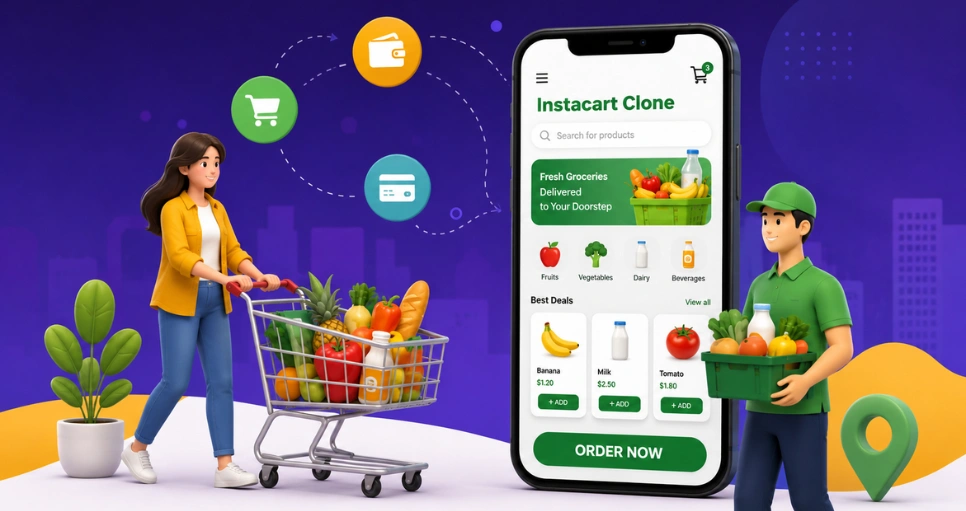
A shopper in Austin, Miami, or Seattle expects fresh produce at the door in hours, not days. That's why more brands are investing in Instacart clone app development to build a hyperlocal grocery delivery platform with real-time inventory, AI-powered shopping, last-mile delivery, and a scalable marketplace model.
According to the Market Data Forecast U.S. Online Grocery Market Report (May 2026), the U.S. online grocery market is projected to grow steadily through 2034, creating new opportunities for supermarkets, retail chains, and local grocery stores.
Thinking about launching one?
In this guide, you'll learn the development process, must-have features, technology stack, estimated cost, and proven strategies to build a successful Instacart-like app in 2026.
What Is Instacart? And Why Businesses Want to Build an Instacart Clone App
Instacart is a grocery delivery marketplace that connects customers with supermarkets, local grocery stores, and personal shoppers through one app.
It lets people order groceries online, track deliveries in real time, and receive fresh items at their doorstep. If you're planning to launch a grocery delivery business, this model is worth a closer look.
Why do businesses build an Instacart clone app?
- Reach more customers with a multi-store online grocery marketplace.
- Create recurring revenue through commissions, subscriptions, and delivery fees.
- Help local grocery stores sell online without building separate apps.
- Offer faster, more convenient shopping with same-day and scheduled delivery.
- Scale into new cities using one digital platform and centralized operations.
How Does an Instacart Clone App Work?
Want to know what happens after a customer taps "Place Order"? Here's the complete workflow behind an Instacart clone app.
Step 1: Browse & Place an Order
Customers choose a store, add products to the cart, select delivery, and complete secure checkout in minutes.
Step 2: Order Management & Store Approval
The admin routes the order, and the store confirms product availability before assigning it to a shopper.
Step 3: Shopping & Real-Time Delivery
A shopper picks the items, confirms replacements if needed, and delivers the order with live tracking.
Step 4: Payment, Delivery & Feedback
After delivery, payment is finalized, and customers rate the experience to improve future service quality.
Must-Have Features of an Instacart Clone On-Demand Grocery Delivery App
A successful On-Demand grocery delivery app needs more than basic ordering. If you want repeat customers and smooth operations, these core features create a better shopping experience while helping your business scale faster.
1. Customer Registration & Smart Product Discovery
Let customers sign up, search products, apply filters, and save favorites. A trusted mobile app development company can also add AI search for faster shopping.
2. Shopping Cart, Secure Checkout & Digital Payments
Give users a smooth cart, multiple payment options, promo codes, and quick checkout. Fewer checkout steps often lead to more completed grocery orders.
3. Store Inventory & Order Management
Store owners should manage inventory, pricing, promotions, and incoming orders in real time. Accurate stock levels reduce cancellations and improve customer trust.
4. Admin Dashboard & Business Analytics
Track users, stores, drivers, commissions, coupons, reports, and sales from one place. Many AI app development companies also add predictive business analytics.
5. Live Order Tracking & One-Tap Reordering
Customers want updates, not guesses. Real-time tracking, delivery alerts, order history, and one-tap reorder keep them coming back for weekly groceries.
6. Shopper App & Delivery Management
Help shoppers accept orders, scan barcodes, chat with customers, use GPS navigation, upload delivery proof, and track earnings from one dashboard.
7. Ratings, Reviews & Customer Support
Let customers rate products, review deliveries, and contact support. Quick issue resolution builds trust and helps improve your grocery marketplace over time.
8. AI Recommendations & Smart Booking Experience
Use AI to recommend products, predict repeat purchases, and personalize offers. If you've explored booking app development, you'll recognize how smart scheduling improves convenience.
Advanced AI Grocery Delivery App Features to Beat Instacart
Want your app to stand out in a crowded market? These AI-powered grocery delivery app features help shoppers save time, improve delivery accuracy, and give your business a real competitive edge.
1. AI Shopping Assistant & Voice Shopping
Help customers find products with voice search, smart suggestions, and quick answers. Strong mobile app development makes this experience feel natural.
2. Recipe Shopping & Smart Pantry Scanner
Customers scan their pantry or choose a recipe. The app adds missing items to the cart with one tap.
3. Smart Product Replacement & Price Comparison
If an item is unavailable, AI suggests better options and compares prices across nearby stores to help customers save more.
4. Family Cart & Smart Budget Planner
Families share one cart, set spending limits, and track grocery costs together. It also supports smarter weekly shopping.
5. Predictive Shopping & AI Demand Forecasting
AI learns shopping habits, predicts future orders, and helps stores manage inventory. This can also reduce mobile app development cost over time.
6. Dynamic Pricing & Delivery Route Optimization
AI adjusts pricing, picks faster delivery routes, and improves ETA accuracy. Customers get quicker deliveries and a better overall experience.
Step-by-Step Instacart Clone Grocery Delivery App Development Process
Building a successful grocery delivery app development project takes more than coding. Follow these proven steps to create a scalable grocery marketplace that customers enjoy and businesses can grow with confidence.
1. Planning & Business Strategy
Start with a clear plan. Ask yourself what problem your app will solve and who will use it.
- Define your target audience.
- Choose a marketplace or aggregator model.
- Decide your revenue streams.
- Set project goals and budget.
A strong plan reduces risks before development begins.
2. Market Research & Competitor Analysis
Study apps like Instacart, Walmart Grocery, and Shipt. Look at customer reviews to find common problems and opportunities.
Focus on:
- Customer expectations
- Delivery coverage
- Pricing strategy
- AI-powered features
- Loyalty programs
Many mobile app development companies begin every project with detailed market research because better insights lead to better products.
3. Requirement Gathering
Now list every feature your app needs. Think about each user, not just the customer.
Include requirements for:
- Customer app
- Shopper app
- Store panel
- Admin dashboard
- Delivery partner portal
This step keeps your project organized from day one.
4. UI/UX Design
Your design should feel simple from the first tap. Customers should find products quickly and complete checkout without confusion.
Design key screens like:
- Home page
- Product catalog
- Smart search
- Shopping cart
- Secure checkout
- Live order tracking
A clean user experience helps increase repeat purchases.
5. Build the MVP
Don't launch every feature at once. Build a Minimum Viable Product (MVP) first and test it with real users.
Your MVP should include:
- User registration
- Product search
- Shopping cart
- Online payments
- Order tracking
- Basic admin panel
Launch, collect feedback, then improve.
6. Develop the Backend
The backend runs your grocery marketplace behind the scenes. It handles users, orders, payments, inventory, and real-time data without delays.
Build secure modules for:
- User management
- Inventory synchronization
- Order management
- Payment processing
- Notifications
- Customer data
Recommended tech stack: Node.js, Python, Java, PostgreSQL, MongoDB, Redis, AWS, and Firebase. A scalable backend keeps your app ready for future growth.
7. Build the Frontend
Now create fast, responsive apps for every user. A clean interface makes grocery shopping simple and keeps customers coming back.
Develop:
- Customer app
- Shopper app
- Store panel
- Admin dashboard
Recommended tech stack: Flutter or React Native for cross-platform apps, Swift for iOS, Kotlin for Android, and Google Maps SDK for live tracking and navigation.
8. Integrate Essential APIs
APIs add important features without building everything from scratch.
Use:
- Stripe – Secure payments
- Google Maps – Live location and navigation
- Firebase – Authentication and push notifications
- Twilio – SMS alerts
- SendGrid – Email updates
- OneSignal – Push notifications
- Mixpanel – User analytics
- OpenAI – AI shopping assistant and smart recommendations
These integrations improve performance while reducing development time.
9. QA Testing
Test every feature before launch. Even a small issue can affect customer trust.
Check:
- App speed
- Payment flow
- GPS tracking
- Login security
- API performance
- Cross-device compatibility
Fix problems before your customers find them.
10. Launch Your App
Publish the app after final testing. Then monitor how people use it and respond quickly to feedback.
Track:
- Downloads
- Orders
- Delivery success
- Customer reviews
- Conversion rate
A successful launch is only the beginning.
11. Maintenance & Continuous Improvements
After launch, keep improving your platform. Customer needs change, and your app should grow with them.
Regular updates include:
- Bug fixes
- Security patches
- Feature upgrades
- Performance optimization
- AI improvements
- Cloud scaling
Ongoing maintenance also helps control long-term software development cost by fixing small issues before they become expensive problems.
How Much Does Grocery Delivery App Development Cost in 2026?
Planning your budget is just as important as choosing features. Your Instacart clone app development cost depends on app complexity, AI features, platforms, integrations, and the size of your development team. So, how much should you expect to invest?
|
App Version |
Best For |
Estimated Cost (USD) |
Development Timeline |
|
Basic MVP |
Startups testing the market |
$8,000 – $15,000 |
6–8 Weeks |
|
Standard App |
Small grocery businesses |
$15,000 – $35,000 |
3–4 Months |
|
Advanced App |
Growing grocery marketplaces |
$35,000 – $60,000 |
5–6 Months |
|
Enterprise Solution |
Large supermarket chains & multi-city platforms |
$60,000 – $90,000+ |
6–9 Months |
Factors Affecting Instacart Like App Development Cost
No two grocery apps cost the same. Your Instacart like app development budget changes based on features, technology, security, and long-term business goals. Here's where your investment usually goes.
|
Cost Factor |
How It Affects Development |
Estimated Cost Impact (USD) |
|
Features & App Complexity |
More AI features, real-time tracking, loyalty programs, and multi-store support require more development hours. |
+$5,000 – $20,000 |
|
Platform Choice |
Building for iOS, Android, or both increases design, development, and testing efforts. |
+$3,000 – $10,000 |
|
AI & Automation |
AI shopping assistant, smart search, price prediction, and demand forecasting add advanced development work. |
+$4,000 – $15,000 |
|
Third-Party Integrations |
Stripe, Google Maps, Firebase, Twilio, SendGrid, OneSignal, Mixpanel, and OpenAI require API integration and maintenance. |
+$2,000 – $8,000 |
|
Development Team Location |
Hiring teams in the U.S., Europe, or Asia changes hourly rates and the overall project budget. |
10%–60% Cost Variation |
|
Security & Compliance |
PCI DSS, GDPR, CCPA, SOC 2, data encryption, secure payments, and user authentication increase development effort. |
+$3,000 – $12,000 |
|
Cloud Infrastructure |
AWS, Google Cloud, storage, backups, CDN, and server scaling affect both setup and ongoing costs. |
+$2,000 – $8,000 |
|
Scalability |
Multi-city support, high traffic, load balancing, and microservices require stronger architecture. |
+$3,000 – $10,000 |
|
QA Testing |
Functional, performance, security, API, and device testing help reduce launch issues. |
+$2,000 – $7,000 |
|
Maintenance & Updates |
Bug fixes, feature updates, security patches, cloud monitoring, and OS compatibility continue after launch. |
15%–20% of annual development cost |
Monetization Strategies for Instacart Like Multi Vendor Grocery App Development
Want your grocery app to make money long after launch? A smart Instacart-like multi-vendor grocery app development strategy combines recurring income, marketplace commissions, and premium services instead of relying on one revenue source.
1. Delivery Fees & Express Delivery
Charge standard or express delivery fees based on distance, delivery windows, and order size to create steady daily revenue.
2. Subscription Plans & Commission
Offer monthly memberships for free delivery while earning commission from every order placed by partner grocery stores.
3. Sponsored Products & Featured Listings
Let brands pay to promote products or appear at the top of search results, categories, and homepage banners.
4. Smart Ads & Surge Pricing
Display targeted ads and increase delivery charges during peak demand, holidays, or bad weather to improve marketplace revenue.
5. White Label Solutions & Affiliate Revenue
License your platform to retailers and earn affiliate income by recommending partner products, services, or grocery brands.
Common Challenges of Instacart Clone Grocery Marketplace App Development
Building a grocery platform sounds exciting, but challenges appear during Instacart Clone Grocery Marketplace App Development. From inventory issues to delivery problems, solving these areas helps you create a reliable marketplace.
1. Managing Real-Time Inventory Accuracy
Challenge: Keeping product availability updated across multiple stores is difficult and can lead to canceled orders.
Solution: Use inventory synchronization, barcode systems, and real-time stock updates to improve product accuracy.
2. Handling Multi-Store Order Fulfillment
Challenge: Managing orders from supermarkets, local stores, and different vendors can make fulfillment complex.
Solution: Build a smart order management system with vendor dashboards and automated workflows.
3. Creating a Smooth Delivery Experience
Challenge: Late deliveries, wrong routes, and poor coordination can reduce customer trust.
Solution: Add GPS tracking, route optimization, delivery scheduling, and shopper management tools.
4. Maintaining Secure Payments & Data Privacy
Challenge: Handling customer payments and personal data requires strong security standards.
Solution: Use PCI DSS, GDPR, CCPA, encryption, and secure payment gateways for safer transactions.
5. Scaling the App for More Users
Challenge: Growing traffic, more stores, and higher order volume can affect app speed.
Solution: Use cloud infrastructure, scalable architecture, caching, and performance monitoring.
6. Balancing Customer, Store & Shopper Needs
Challenge: A marketplace must satisfy customers, vendors, and delivery partners at the same time.
Solution: Create separate apps, clear workflows, analytics dashboards, and feedback systems.
How to Choose the Right Instacart Style Custom Grocery Delivery App Development Company?
Choosing the right partner for grocery shopping app development can decide your app’s future. Look for a team with grocery marketplace experience, strong technology skills, and a clear development process.
- Check Grocery App Experience: Choose a company that understands multi-vendor platforms, store panels, shopper apps, and delivery workflows.
- Review Technical Expertise: Look for skills in AI, cloud solutions, APIs, payment gateways, and scalable mobile app architecture.
- Study Previous Projects: Check their portfolio, client reviews, case studies, and experience building on-demand delivery solutions.
- Evaluate Development Process: A reliable team should offer planning, UI/UX design, MVP development, testing, launch, and support.
- Focus on Security Standards: Ask about data protection, secure payments, encryption, and compliance practices for customer safety.
- Compare Pricing & Support: Choose a partner with transparent costs, post-launch maintenance, updates, and long-term technical support.
Conclusion
The grocery delivery market keeps growing as customers look for faster, smarter, and simpler shopping experiences.
A well-planned Instacart clone app development strategy helps you create a platform with better ordering, delivery, and store management.
From AI features to secure payments, every decision shapes your app’s success. Focus on real customer needs first.
If you understand your users, technology, and business model, your grocery platform can grow into a trusted marketplace.
FAQ's
The cost usually ranges from $8,000 to $90,000+, depending on features, platforms, AI, integrations, and app complexity.
A basic MVP can take 6–8 weeks, while advanced enterprise platforms may require 6–9 months for development and testing.
Key features include product search, cart, payments, live tracking, shopper management, store panels, admin dashboards, and AI recommendations.
Revenue comes from delivery fees, subscriptions, store commissions, sponsored listings, advertisements, surge pricing, and white-label solutions.
Yes. AI can power smart recommendations, voice shopping, demand forecasting, price comparison, and personalized shopping experiences.
Common technologies include Flutter, React Native, Node.js, Python, PostgreSQL, AWS, Google Maps API, Firebase, and OpenAI.
Add AI shopping tools, better personalization, local store partnerships, faster delivery options, loyalty rewards, and smarter customer experiences.
It helps businesses enter online grocery markets, connect with local stores, create new revenue streams, and scale across multiple locations.

CrinPro
CrinPro Solutions is a leading IT company that helps startups and enterprises build innovative digital products. From intuitive mobile applications and high-performance websites to AI-powered solutions and enterprise software, our team delivers scalable, secure, and user-focused products tailored to unique business needs. With expertise across multiple industries, we transform ideas into digital experiences that drive growth, improve efficiency, and create long-term business value.