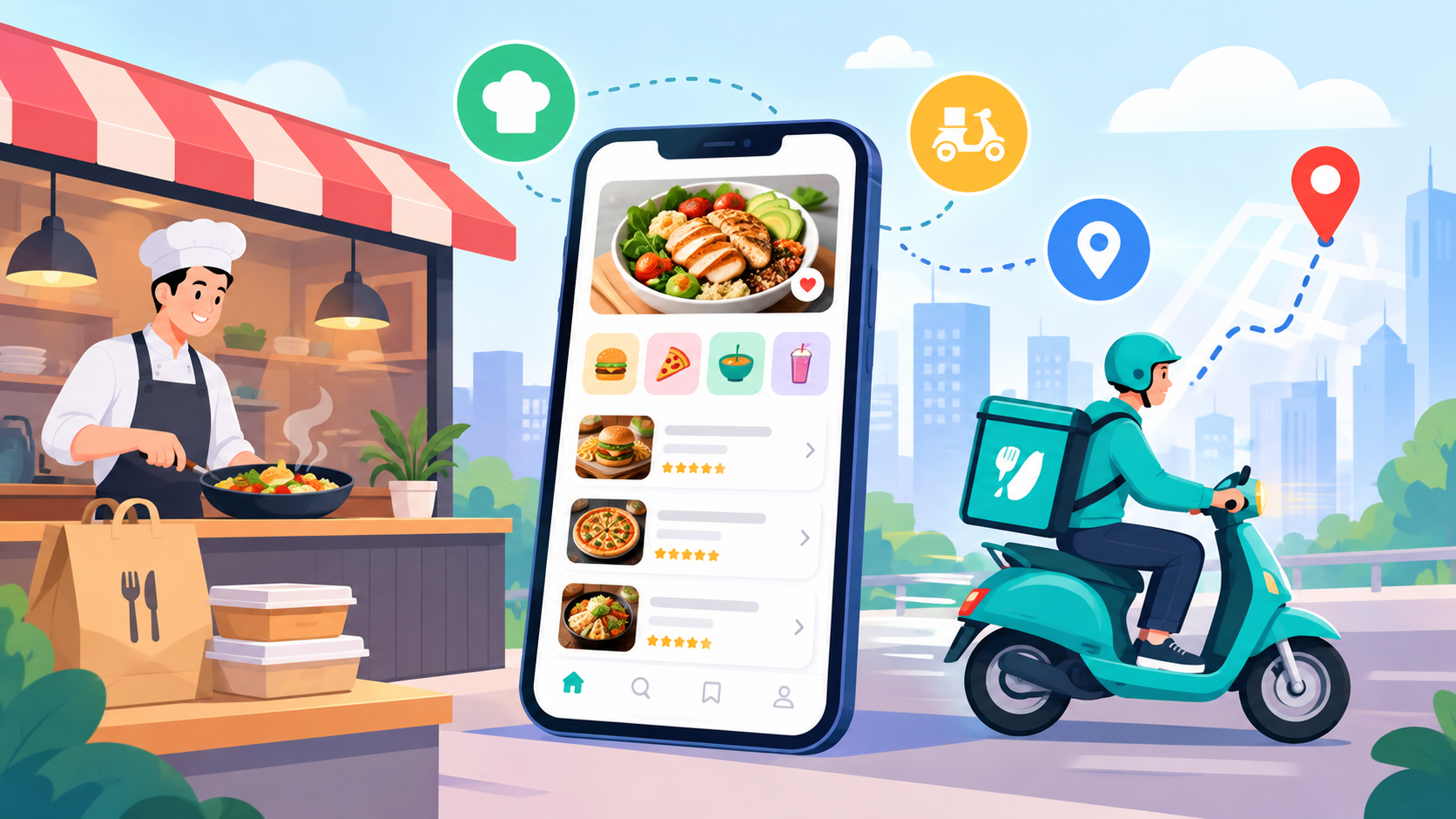
Key Takeaways:
- A Deliveroo-like platform needs multiple connected interfaces for customers, restaurants, delivery partners, and administrators.
- Core features include ordering, payments, restaurant management, delivery assignment, GPS tracking, notifications, and customer support.
- AI can add advanced capabilities such as personalized recommendations, predictive delivery times, intelligent support, and fraud detection.
- Food delivery app development can cost 6,000–90,000+, depending on features, integrations, applications, technology, and overall complexity.
- A phased development approach can help businesses launch core functionality first and expand the platform based on customer and operational requirements.
Food delivery platforms have evolved beyond simple online ordering. Modern apps connect customers with restaurants, assign delivery partners, process digital payments, provide real-time order tracking, and use intelligent automation to improve the overall experience. Deliveroo is an example of this multi-sided marketplace model, bringing customers, restaurants, and delivery partners together through a connected digital platform.
Businesses planning to enter this market in 2027 need to think beyond copying the visible features of an existing app. A successful food delivery platform requires separate experiences for customers, restaurants, delivery partners, and administrators, supported by reliable backend infrastructure.
The development budget also depends on the platform's complexity, integrations, location-based services, payment systems, and advanced capabilities such as AI-powered recommendations or automated support. Understanding these requirements early can help businesses plan their product roadmap, technology stack, development timeline, and overall investment more effectively.
This guide explains how to build a food delivery app like Deliveroo in 2027, covering its business model, essential and advanced features, development process, technology requirements, cost factors, revenue opportunities, and implementation challenges.]
Food Delivery App Market Statistics
- The global online food delivery services market size was valued at USD 380.4 billion in 2024 and is projected to grow from USD 428.2 billion in 2026 to USD 618.4 billion by 2030, at a CAGR of 9.0% from 2025 to 2030.
- The global online food delivery market size was valued at USD 319.99 billion in 2025 and is projected to grow from USD 350.63 billion in 2026 to USD 728.83 billion by 2034, exhibiting a CAGR of 9.58% during the forecast period.
How Does a Deliveroo-Like Food Delivery App Work from Order to Delivery?
A Deliveroo-like food delivery platform operates as a multi-sided marketplace that coordinates customers, restaurants, delivery partners, and platform administrators. Each participant interacts with a dedicated interface while the backend manages orders, payments, locations, notifications, and delivery workflows.
1. Customer Places an Order
Customers browse nearby restaurants, explore menus, customize items, add products to their cart, and select a delivery or payment option. The platform can use location data to display restaurants that serve the customer's area.
2. The Restaurant Receives and Prepares the Order.
Once an order is confirmed, the restaurant receives it through its restaurant application or dashboard. Restaurant staff can accept or reject the order, update preparation status, and notify the platform when the food is ready.
3. Delivery Partner Is Assigned
The platform identifies an available delivery partner based on factors such as location, availability, estimated travel distance, and delivery requirements. The assigned rider receives the order details and navigation information.
4. Order Is Picked Up and Delivered
The delivery partner collects the prepared food and travels to the customer's location. Real-time location tracking can allow customers and administrators to monitor delivery progress and estimated arrival time.
5. Payment and Order Completion
The platform processes the customer's payment and records the transaction. After successful delivery, the order is marked as completed, while restaurants and delivery partners can receive their applicable earnings through the platform's settlement system.
6. Admin Manages the Ecosystem
The admin panel provides centralized control over users, restaurants, delivery partners, orders, commissions, payments, promotions, disputes, and platform analytics.
This connected workflow is the foundation of a food delivery marketplace. Businesses can then build additional automation, personalization, and operational features on top of it as the platform grows.
Core User Roles in a Food Delivery Platform and Their Responsibilities
A Deliveroo-like platform is not a single application with one type of user. It typically consists of interconnected interfaces for customers, restaurants, delivery partners, and administrators. Each role requires different features and permissions while sharing data through the same backend infrastructure.
1. Customer App
The customer-facing application is where users discover restaurants, browse menus, place orders, make payments, and track deliveries. Important functions include:
- User registration and profile management
- Location-based restaurant discovery
- Restaurant and menu browsing
- Search and filters
- Cart and order customization
- Multiple payment options
- Live order tracking
- Delivery notifications
- Ratings and reviews
- Offers, coupons, and loyalty rewards
- Order history and reorder options
- Customer support
2. Restaurant App or Dashboard
Restaurants need a dedicated interface to manage their digital storefront and incoming orders. Core functions can include:
- Restaurant profile management
- Menu and pricing management
- Order acceptance and rejection
- Food preparation status updates
- Inventory or item availability updates
- Order history
- Sales reports
- Promotion management
- Earnings and payout information
Businesses can use restaurant app development services to create restaurant-side workflows that are connected to the central food delivery platform.
3. Delivery Partner App
The delivery application helps riders manage assigned orders and complete deliveries efficiently. Key features include:
4. Delivery partner registration and verification
- Online/offline availability
- New delivery requests
- Order pickup information
- GPS navigation
- Route tracking
- Delivery status updates
- Earnings dashboard
- Delivery history
- Notifications
- Support and issue reporting
5. Admin Panel
The admin dashboard provides centralized control over the entire marketplace. Administrators can manage customers, restaurants, delivery partners, orders, payments, commissions, promotions, complaints, and platform analytics.
Designing these roles as connected but appropriately separated experiences helps the platform maintain clear permissions and workflows while providing each participant with the tools needed to complete their tasks.
Must-Have Features for a Deliveroo-Like Food Delivery App
A food delivery platform needs features that support the complete ordering and delivery cycle, from restaurant discovery to final delivery. The following capabilities should form the core product before adding more advanced functionality.
1. Restaurant Discovery and Search
Customers should be able to find restaurants based on location, cuisine, ratings, delivery time, price range, and availability. Search suggestions and filters can make it easier to narrow down options.
2. Digital Menu and Food Customization
Restaurant pages should display menus with images, descriptions, prices, dietary information, add-ons, and customization options. Restaurants should also be able to update item availability and pricing.
3. Cart and Checkout
The cart should provide a clear summary of selected items, customization charges, delivery fees, taxes, discounts, and the final payable amount. A streamlined checkout process can reduce unnecessary steps before order confirmation.
4. Multiple Payment Options
The platform can support cards, digital wallets, bank-based payment methods, and other regionally relevant payment options. Secure payment processing and transaction confirmation are essential for reliable checkout.
5. Real-Time Order Tracking
Customers should be able to follow an order from restaurant confirmation through preparation, pickup, and delivery. GPS-based tracking can display the delivery partner's current location and estimated arrival time.
6. Delivery Management
The system should help assign orders to available delivery partners and provide them with pickup information, navigation, status updates, and delivery instructions.
7. Push Notifications
Automated notifications can inform users about order confirmation, preparation, pickup, delivery progress, payment status, promotions, and completed orders.
8. Ratings and Reviews
Customers can rate restaurants and delivery experiences after an order. Restaurants and administrators can use this feedback to monitor service quality and identify recurring issues.
9. Offers and Loyalty Programs
Discount codes, promotional campaigns, referral rewards, loyalty points, and personalized offers can help platforms encourage repeat orders.
10. Customer Support
In-app support can allow users to report missing items, delayed deliveries, payment issues, incorrect orders, or other problems. Support teams can manage these cases through the admin dashboard.
These features establish the core functionality required for a food delivery marketplace. Businesses can then expand the platform with AI, automation, personalization, and advanced analytics as their operational requirements grow.
Recommended Technology Stack for Food Delivery App Development
A Deliveroo-like platform requires a technology stack capable of handling real-time orders, location tracking, payments, restaurant operations, delivery logistics, and customer interactions. The final selection depends on the platform's scale, development approach, integrations, and expected traffic.
|
Technology Layer |
Common Technologies |
Purpose |
Estimated Development Cost |
|
Frontend |
React Native, Flutter, Swift, Kotlin |
Customer and delivery applications |
USD 4,000–12,000 |
|
Web Dashboard |
React.js, Next.js, Angular |
Restaurant and admin interfaces |
USD 3,000–8,000 |
|
Backend |
Node.js, Python, Django, FastAPI |
APIs, business logic, order management |
USD 5,000–12,000 |
|
Database |
PostgreSQL, MySQL, MongoDB |
Users, menus, orders, payments, delivery data |
USD 2,000–5,000 |
|
Cloud Infrastructure |
AWS, Google Cloud, Microsoft Azure |
Hosting, storage, scaling, networking |
USD 2,000–7,000 |
|
Maps & Location |
Google Maps Platform, Mapbox |
GPS tracking, geolocation, routes |
USD 1,500–5,000 |
|
Payment Gateway |
Stripe, PayPal, regional payment providers |
Online payments and transaction processing |
USD 1,500–4,000 |
|
Notifications |
Firebase Cloud Messaging, SMS and email APIs |
Order and delivery notifications |
USD 1,000–3,000 |
|
Analytics |
Firebase Analytics, Google Analytics, custom dashboards |
User and operational insights |
USD 1,000–4,000 |
|
AI Layer |
OpenAI APIs, machine learning services, recommendation models |
Recommendations, support, forecasting, automation |
USD 2,000–8,000 |
How Much Does It Cost to Build a Food Delivery App Like Deliveroo?
The cost to build a food delivery app like Deliveroo can range from $6,000 to $90,000+, depending on the app type, features, integrations, design complexity, technology stack, and development team. A basic MVP with essential ordering and delivery features requires less investment, while a full-scale platform with separate customer, restaurant, delivery partner, and admin applications requires a larger budget.
|
App Type |
Estimated Cost |
Timeline |
|
Basic Food Delivery MVP |
6,000–15,000 |
2–3 months |
|
Mid-Level Platform |
15,000–40,000 |
3–5 months |
|
Advanced Food Delivery App |
40,000–65,000 |
5–7 months |
|
Deliveroo-Like Enterprise Platform |
65,000–90,000+ |
7–10+ months |
Businesses researching food delivery app development costs should also consider ongoing expenses such as cloud hosting, payment processing, map APIs, third-party services, maintenance, and future feature upgrades.
The final budget should be calculated according to the required platform scope rather than the number of features alone.
Key Factors That Affect Food Delivery App Development Cost
The total development budget depends on the scope and complexity of the platform. Key factors include:
1. Number of Applications
A platform with separate customer, restaurant, delivery partner, and admin interfaces requires more development than a single-app MVP. This directly affects the overall restaurant app development cost as well.
2. Features and Customization
Advanced functions such as live tracking, AI recommendations, loyalty programs, automated support, dynamic delivery assignment, and analytics increase development effort.
3. Third-Party Integrations
Payment gateways, maps, SMS, push notifications, analytics, restaurant POS systems, and other APIs add integration and testing requirements.
4. UI/UX Design
Custom interfaces, personalized user journeys, animations, accessibility features, and responsive dashboards can increase design and development costs.
5. Technology and Infrastructure
The selected frontend, backend, database, cloud architecture, and real-time communication technologies affect both initial development and ongoing infrastructure expenses.
6. Security and Scalability
Platforms handling large numbers of orders and payments require stronger authentication, data protection, monitoring, testing, and scalable infrastructure.
7. Development Team
Costs can also vary based on the team's location, technical expertise, project complexity, and engagement model. Businesses may work with a food delivery app development company for end-to-end development or use specialized teams for particular components.
Understanding these factors before development helps businesses create a more realistic budget and prioritize features according to their launch requirements.
Revenue Models for Building a Profitable Food Delivery Platform
A food delivery marketplace can generate revenue through multiple channels rather than relying on a single income source. Businesses can combine different models based on their target market, restaurant partnerships, and operational strategy.
1. Restaurant Commission
The platform can charge restaurants a percentage of each completed order. Commission rates can vary based on agreements, restaurant categories, and services provided by the platform.
2. Delivery Fees
Customers can be charged a delivery fee based on distance, location, order size, demand, or other delivery conditions. Businesses may also offer reduced or free delivery for selected orders or subscription members.
3. Advertising and Sponsored Listings
Restaurants can pay to promote their listings, dishes, or promotional campaigns within the application. Sponsored placements can create an additional revenue stream while giving restaurants greater visibility.
4. Subscription Plans
A subscription program can provide benefits such as reduced delivery fees, exclusive offers, loyalty rewards, or other customer benefits in exchange for a recurring payment.
5. Service or Platform Fees
The platform can apply a service fee to selected orders to help cover technology, payment processing, customer support, and marketplace operations.
6. Restaurant Software Services
Beyond marketplace commissions, businesses can offer restaurants additional digital tools such as analytics, order management, menu management, customer insights, or integrations as paid services.
A combination of these revenue models can help a food delivery platform diversify its income while supporting different participants across the marketplace.
Third-Party APIs and Integrations Needed for a Food Delivery App
Third-party integrations can provide essential capabilities without requiring every service to be built from scratch. For a Deliveroo-like platform, the required APIs depend on the target market, business model, and technical architecture.
|
Integration |
Purpose |
|
Maps and Location APIs |
Processes online payments, refunds, and transaction confirmations |
|
Push Notification Services |
Supports restaurant discovery, GPS tracking, routes, and delivery distance calculations |
|
SMS and Email APIs |
Sends order, payment, delivery, and promotional notifications |
|
Restaurant POS Integration |
Supports OTP verification, alerts, receipts, and customer communication |
|
Authentication Services |
Enables secure login, registration, OTP, and account verification |
|
Analytics Tools |
Tracks customer behavior, orders, revenue, and application performance |
|
Customer Support Tools |
Enables chat, ticket management, automated responses, and issue resolution |
|
AI APIs |
Supports recommendations, intelligent customer support, forecasting, and automation |
Why API Integration Matters
A food delivery platform depends on real-time data exchange between customers, restaurants, delivery partners, and administrators. For example, when a restaurant accepts an order, the status needs to reach the customer and delivery system immediately.
APIs should therefore be selected based on reliability, security, documentation, scalability, regional availability, and pricing. Businesses should also plan for API failures and create fallback mechanisms for critical services such as payments, maps, and notifications.
UI/UX Design Considerations for a Deliveroo-Like Food Delivery App
A food delivery platform handles multiple user journeys, so the interface should be designed around the specific tasks of customers, restaurants, delivery partners, and administrators. A simple and consistent experience can make ordering and delivery workflows easier to navigate.
1. Keep Food Discovery Simple
The customer home screen should make nearby restaurants, cuisines, offers, delivery times, and popular dishes easy to discover. Search and filtering should allow users to find relevant options without navigating through unnecessary screens.
2. Design a Smooth Ordering Journey
Customers should be able to move from restaurant selection to menu browsing, customization, cart, and checkout with minimal friction. Important information such as item prices, delivery charges, discounts, taxes, and estimated delivery time should remain clear.
3. Prioritize Real-Time Delivery Information
The tracking screen should clearly communicate the current order status, delivery partner information, estimated arrival time, and relevant location details. Visual status indicators can help customers understand where their order is in the delivery process.
4. Simplify Restaurant Operations
Restaurant interfaces should prioritize speed because staff may manage multiple orders simultaneously. Order status, preparation time, item availability, and incoming requests should be easy to access and update.
5. Make Rider Actions Quick
Delivery partners often interact with the application while moving between locations. The interface should minimize unnecessary steps and provide clear access to pickup details, navigation, delivery instructions, and status updates.
6. Maintain Consistent Design
Typography, navigation patterns, buttons, icons, notifications, and interaction behaviors should remain consistent across the platform. Accessibility considerations such as readable text, adequate contrast, and touch-friendly controls should also be incorporated.
A well-planned UX helps ensure that mobile app development focuses not only on technical functionality but also on making each critical task quick, understandable, and reliable.
Security and Data Protection Measures for Food Delivery Apps
A food delivery platform processes customer accounts, delivery addresses, payment information, restaurant data, and delivery partner details. Security should therefore be incorporated into the architecture from the beginning rather than treated as a final development step.
1. Secure User Authentication
Use secure login mechanisms, OTP verification, session management, and appropriate access controls. Different user roles should only be able to access the functions and information relevant to them.
2. Protect Payment Information
Payment transactions should be processed through trusted payment providers and appropriate security standards. Sensitive payment information should not be unnecessarily stored within the application's own systems.
3. Encrypt Sensitive Data
Data transmitted between applications, APIs, and backend services should use secure communication protocols. Sensitive information stored in databases should also be protected through appropriate encryption and access controls.
4. Secure APIs and Integrations
APIs connect customers, restaurants, delivery partners, payment systems, and external services. Authentication, authorization, rate limiting, input validation, and monitoring can help protect these endpoints from unauthorized access and misuse.
5. Protect Location Data
Since delivery platforms rely heavily on addresses and real-time location information, access to location data should be restricted to legitimate business requirements. Businesses should also establish appropriate data retention and deletion practices.
6. Monitor Suspicious Activity
Logging and monitoring can help identify unusual login attempts, fraudulent transactions, account abuse, repeated refund requests, or other suspicious activity. Alerts and administrative review processes can then be introduced where necessary.
7. Regular Security Testing
Penetration testing, vulnerability assessments, dependency updates, access reviews, and security audits should be performed throughout the platform's lifecycle.
Building these protections into the development process helps create a more secure foundation as the food delivery platform expands and handles increasing transaction volumes.
Development Timeline for Building a Food Delivery App
The development timeline for a food delivery app depends on the number of applications, feature complexity, integrations, testing requirements, and customization. A basic MVP can be launched faster, while a Deliveroo-like enterprise platform requires significantly more time.
|
Development Stage |
Estimated Timeline |
Key Activities |
|
Planning & Research |
1–2 weeks |
Business model, requirements, market and competitor research |
|
UI/UX Design |
2–4 weeks |
User flows, wireframes, prototypes, interface design |
|
Core Development |
5–10 weeks |
Customer, restaurant, delivery, and admin functionality |
|
API & Third-Party Integration |
2–4 weeks |
Payments, maps, notifications, authentication, POS |
|
Testing & Security |
2–4 weeks |
Functional, performance, security, and usability testing |
|
Deployment |
1–2 weeks |
Production setup, app deployment, monitoring, and launch |
Overall Development Time
A basic food delivery MVP may take approximately 2–3 months, while a mid-level platform can require 3–5 months. A feature-rich Deliveroo-like platform with multiple applications, advanced integrations, AI capabilities, and enterprise-level infrastructure may take around 7–10+ months.
Businesses can also use a phased development approach, launching core ordering and delivery functionality first and adding advanced features after collecting real-world user and operational data. This can help manage both development scope and initial investment.
Common Challenges in Food Delivery App Development and How to Address Them
Building a food delivery marketplace involves more than developing ordering and payment functionality. Businesses need to plan for operational, technical, and customer-facing challenges as the platform grows.
1. Managing Real-Time Operations
Orders, restaurant preparation, rider availability, payments, and delivery status need to remain synchronized. A scalable backend and reliable real-time communication architecture can help reduce delays and inconsistent order information.
2. Maintaining Delivery Efficiency
Long delivery distances, traffic, restaurant preparation delays, and limited rider availability can affect delivery times. Location-based assignment, route optimization, and predictive delivery systems can help improve operational coordination.
3. Handling High Order Volumes
Traffic and order volumes can increase significantly during meal times, weekends, promotions, or special events. Cloud-based infrastructure, caching, database optimization, and scalable APIs can help the platform handle demand spikes.
4. Coordinating Multiple User Groups
Customers, restaurants, delivery partners, and administrators have different workflows. Clearly separated permissions and purpose-built interfaces can reduce confusion and improve operational efficiency.
5. Controlling Development Costs
Adding every possible feature before launch can increase both the initial budget and development timeline. Businesses can prioritize core marketplace functionality and introduce advanced capabilities through later development phases.
6. Retaining Customers
Users can easily switch between competing food delivery services. Personalized recommendations, loyalty programs, reliable delivery, responsive support, and relevant promotions can help businesses create a stronger customer experience.
7. Maintaining Security
The platform must protect customer information, addresses, payments, restaurant data, and delivery partner accounts. Regular security testing, monitoring, access controls, and secure integrations should remain part of ongoing platform maintenance.
Conclusion
Building a food delivery app like Deliveroo in 2027 requires more than creating an online ordering interface. The platform needs connected systems for customers, restaurants, delivery partners, and administrators, supported by reliable payments, location services, real-time tracking, secure APIs, and scalable backend infrastructure.
Businesses can start with an MVP containing essential ordering and delivery capabilities and gradually introduce advanced features such as AI recommendations, predictive delivery estimates, intelligent customer support, and operational analytics.
The estimated development cost of 6,000–90,000+ provides a broad planning range, but the actual investment depends on the platform's scope, customization, integrations, technology choices, and development requirements. Careful planning and a phased approach can help businesses build a scalable platform while managing development resources effectively.
FAQ's
A food delivery app can cost approximately 6,000–90,000+, depending on features, integrations, platform complexity, and development requirements.
A basic MVP may take 2–3 months, while a feature-rich Deliveroo-like platform can take 7–10+ months.
A complete platform generally includes a customer app, restaurant app or dashboard, delivery partner app, and admin panel.
Core features include restaurant discovery, menus, carts, payments, order tracking, delivery management, notifications, reviews, and customer support.
Yes. AI can support personalized recommendations, customer service, delivery-time prediction, fraud detection, demand forecasting, and other automation.
Common technologies include Flutter or React Native, Node.js or Python, PostgreSQL or MongoDB, cloud platforms, mapping APIs, payment gateways, and notification services.
Common revenue models include restaurant commissions, delivery fees, service fees, sponsored listings, subscriptions, and additional restaurant services.

CrinPro
CrinPro Solutions is a leading IT company that helps startups and enterprises build innovative digital products. From intuitive mobile applications and high-performance websites to AI-powered solutions and enterprise software, our team delivers scalable, secure, and user-focused products tailored to unique business needs. With expertise across multiple industries, we transform ideas into digital experiences that drive growth, improve efficiency, and create long-term business value.