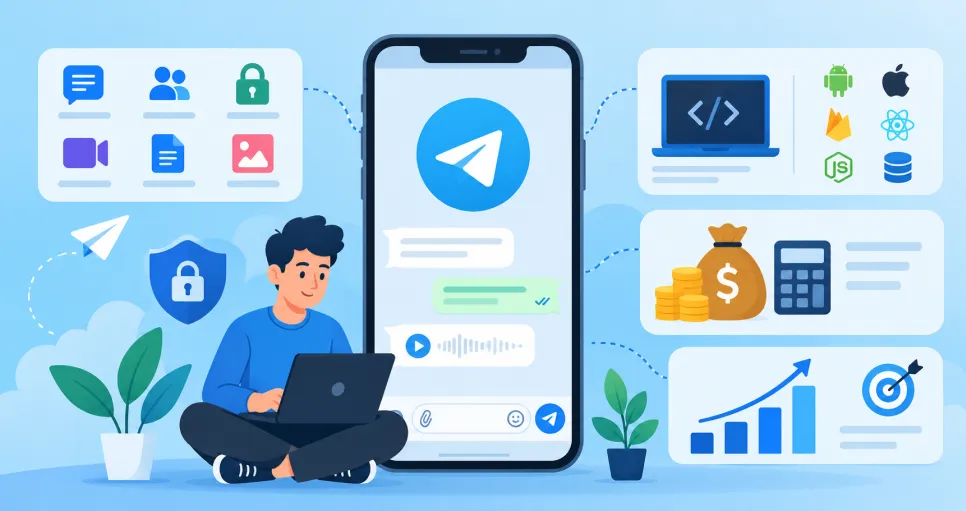
Key Takeaways:
-
App development cost: Building a Telegram-like app can cost around $8,000 to $70,000, depending on features and complexity.
-
Real-time messaging, voice and video calls, groups, channels, and media sharing are key functionalities for modern communication platforms.
-
Strong security, authentication, encryption, and privacy controls are essential for protecting users and building trust.
-
Scalable cloud infrastructure helps support growing users, conversations, media files, and concurrent connections.
-
Starting with an MVP can help control costs, validate the concept, and create a clear path for future expansion.
Telegram's rise from a niche privacy-focused messenger to a platform boasting hundreds of millions of active users proves there's still genuine room for new players in the messaging space, provided you solve real problems better than the giants already dominating it.
Founders exploring Telegram clone app development often assume it's simply about copying features, but Telegram's actual success comes from a specific combination of speed, security, scalability, and genuinely useful functionality like channels, bots, and large group support.
Building something comparable requires understanding not just what features to include, but the underlying architecture that makes real-time messaging work reliably at massive scale.
This guide breaks down exactly what it takes, from core features and technology through business models and realistic development costs.
What Makes Telegram Successful? Key Takeaways for Founders
Telegram’s success comes from combining fast communication, privacy-focused features, scalable technology, and a strong user experience.
For founders exploring Telegram-like app development, its growth offers valuable lessons about product simplicity, innovation, community building, and long-term scalability.
1. Focus on Speed and Simplicity
Telegram delivers fast messaging through a clean, intuitive interface that minimizes unnecessary steps.
Founders should prioritize quick performance, simple navigation, reliable synchronization, and frictionless communication so users can complete everyday tasks without confusion across devices.
2. Build Features Around User Needs
Telegram continuously expands beyond basic messaging with channels, groups, bots, file sharing, voice chats, and other tools.
Founders can follow this approach by introducing practical features that solve real problems instead of adding functionality without purpose.
3. Prioritize Privacy and Security
Strong privacy options can help build user trust and differentiate communication platforms in competitive markets.
Founders should consider secure authentication, data protection, privacy controls, transparent policies, and appropriate encryption while designing messaging experiences for modern users.
4. Create a Scalable Ecosystem
Telegram supports large communities, content distribution, automated bots, and diverse communication formats within one platform.
Founders should design scalable infrastructure and flexible APIs early, allowing their product to support growing users, new features, integrations, and evolving business opportunities.
Must-Have Features for a Telegram-Like App
A successful messaging platform needs more than basic chat functionality.
The right mobile app development features can improve communication, privacy, engagement, and retention while helping businesses create a scalable product that meets modern user expectations across multiple devices and platforms.
1. Real-Time Messaging
A strong messaging system should deliver texts instantly with reliable synchronization.
Messaging app development should support one-to-one chats, group conversations, message status, reactions, attachments, replies, and forwarding while maintaining smooth performance during traffic and usage during peak periods.
2. Groups and Channels
Telegram-like apps should support large communities through groups and broadcast channels.
During chat app development, features such as admin controls, moderation tools, pinned posts, member permissions, comments, and content sharing can improve community management across communities.
3. Voice and Video Calls
High-quality voice and video calling can make communication more versatile.
Users should have reliable one-to-one and group calling, call controls, mute options, camera switching, and stable connections across networks and supported devices with minimal connection interruptions.
4. File and Media Sharing
Users expect convenient ways to share photos, videos, documents, audio, and other files.
The app should support multiple formats, previews, compression options, large file transfers, cloud storage, and organized media access within conversations without reducing convenience.
5. Privacy and Security
Security features can strengthen user trust and protect conversations.
Include two-factor authentication, encryption, passcode locks, disappearing messages, privacy controls, session management, spam protection, reporting tools, secure access, device management, and monitoring to create a safer communication environment effectively.
6. Bots and Integrations
Bots can extend an app beyond messaging by supporting automation, customer service, payments, content delivery, and productivity tools.
Developer APIs and integrations allow businesses to create an adaptable ecosystem that encourages third-party innovation and engagement for users.
Choosing the Right Business Model for Your Messaging App
Choosing the right business model is essential for building a profitable messaging platform without compromising user experience also improve the mobile app development services.
Instant messaging app development should consider target users, monetization options, operating costs, scalability, and long-term revenue opportunities.
1. Freemium Model
Offer core messaging features for free while charging for premium tools.
Secure messaging app development can include paid features such as enhanced privacy controls, larger file storage, advanced customization, exclusive communication tools, or priority customer support for subscribers.
2. Subscription-Based Model
Charge users monthly or annually for access to premium functionality.
Subscriptions can include additional storage, exclusive stickers, advanced administrative controls, enhanced security features, better customization, or business communication tools, creating predictable recurring revenue for the platform.
3. Advertising Model
Display relevant advertisements within selected areas of the application while keeping conversations uninterrupted.
Businesses can monetize a large active user base through sponsored content, banner placements, video ads, or targeted promotions based on user interests and engagement patterns.
4. In-App Purchases
Let users purchase digital products such as stickers, emojis, themes, virtual gifts, profile enhancements, or other customization options.
Small, optional purchases can generate additional revenue while allowing users to personalize their messaging experience according to preferences.
5. Business Accounts
Create paid accounts for companies that need advanced communication and customer engagement tools.
Businesses can access verified profiles, automated replies, chatbots, analytics, promotional messaging, customer support features, and branded communication experiences through dedicated plans.
6. Custom Enterprise Solutions
Offer specialized communication platforms for organizations that require unique workflows, branding, integrations, and administrative controls.
Custom messaging app development can provide businesses with tailored solutions for internal communication, customer service, collaboration, and secure information exchange.
7. API and Platform Monetization
Provide developers with APIs, bots, automation tools, and integration capabilities through paid plans.
Businesses can charge based on usage, request volume, or advanced functionality, creating revenue while building a broader ecosystem around the messaging platform.
8. Transaction-Based Revenue
Integrate payments, commerce, bookings, or other financial services into the messaging experience.
The platform can earn commissions or transaction fees whenever users purchase products, send payments, book services, or complete other supported transactions through the application.
Technology Stack Required to Build an App Like Telegram
Building a Telegram-style platform requires a reliable technology stack that supports real-time communication, secure data handling, scalability, and rich media.
Telegram clone app development should combine suitable frameworks, databases, APIs, cloud infrastructure, and security tools effectively for modern communication platforms.
1. Frontend Frameworks
React Native or Flutter can support cross-platform mobile experiences, while Swift and Kotlin provide native iOS and Android development.
The frontend should deliver responsive interfaces, smooth navigation, real-time updates, media previews, and accessible controls across devices reliably and consistently.
2. Real-Time Communication
WebSocket technology enables instant message delivery and synchronization between users and servers.
For voice and video chat app development, WebRTC, Socket. IO, or similar solutions can support live calls, signaling, connectivity, and real-time communication reliably across networks effectively.
3. Backend Technologies
Node.js, Python, Java, or Go can handle messaging logic, authentication, user management, notifications, file processing, and API requests.
A scalable backend architecture helps maintain reliable performance as conversations, users, and concurrent connections increase smoothly for growing user bases.
4. Database Systems
PostgreSQL, MySQL, MongoDB, or Cassandra can store profiles, messages, settings, contacts, and application data.
Redis can support caching and real-time workloads, helping reduce latency while improving responsiveness across high-traffic communication environments in production applications.
5. Cloud Infrastructure
AWS, Microsoft Azure, or Google Cloud can provide scalable computing, storage, databases, backups, content delivery, and monitoring.
Cloud infrastructure helps messaging apps handle traffic spikes, large media libraries, distributed users, and growing operational requirements reliably as demand grows.
6. Media Storage and Delivery
Object storage services such as Amazon S3 can manage photos, videos, documents, and audio files.
Content delivery networks can support social media development, while compression and optimized streaming help reduce bandwidth usage and improve loading performance effectively.
7. APIs and Integrations
Telegram-like app development can benefit from APIs for payments, maps, authentication, analytics, notifications, and external services.
Well-designed APIs make the platform easier to extend while enabling integrations with business tools, third-party applications, and services as requirements evolve.
8. Security Technologies
Encryption, secure authentication, multi-factor verification, role-based permissions, device management, and monitoring tools protect accounts and conversations.
Security should cover data transmission, storage, session handling, APIs, and administrative access throughout the application lifecycle consistently and securely for users.
Telegram-Like App Development Process: Step-by-Step Guide to Building the App
Building a messaging platform requires careful planning, intuitive design, robust infrastructure, and thorough testing.
A structured mobile app development process helps founders transform ideas into scalable products while balancing user experience, performance, security, communication features, and long-term business goals effectively.
1. Define the App Requirements
Start by defining the app’s purpose, target audience, core communication needs, monetization model, and competitive advantage.
During Telegram clone app development, document required features, supported platforms, scalability goals, security expectations, and measurable outcomes before technical implementation begins, with clear direction.
2. Create a Product Roadmap
Create a detailed product roadmap covering registration, profiles, conversations, groups, channels, calls, media sharing, notifications, privacy, and administration.
A structured messaging app development roadmap helps teams prioritize features, assign resources, establish milestones, and maintain development clarity throughout the project effectively.
3. Conduct Market Research
Study competitors, audience preferences, communication habits, pricing models, and emerging trends before finalizing functionality.
Research during social media app development helps identify market gaps, discover valuable differentiators, validate assumptions, and shape features around genuine user expectations and behaviors with confidence.
4. Design the UI/UX
Design intuitive user journeys for onboarding, chats, channels, calls, settings, and media sharing.
During chat app development, create wireframes and prototypes that emphasize simple navigation, accessible controls, responsive layouts, consistent branding, and frictionless interactions across supported devices for users overall.
5. Choose the Technology Stack
Select frameworks, backend technologies, databases, cloud platforms, APIs, and security tools suited to your requirements.
Instant messaging app development needs technologies capable of handling concurrent connections, real-time synchronization, media traffic, scalability, and reliable performance across platforms efficiently at scale.
6. Build the Development Team
Choose an experienced development team with relevant communication-platform expertise.
Hire a dedicated developers for hire can provide focused resources for frontend, backend, testing, DevOps, and security, while improving collaboration, accountability, flexibility, and control throughout the product development lifecycle for future growth.
7. Develop Core Features
Build authentication, profiles, messaging, groups, channels, notifications, file sharing, and communication features according to approved designs.
Secure messaging app development should also include encryption, access controls, session management, privacy settings, abuse prevention, and secure API practices from the start.
8. Implement Real-Time Communication
Implement WebSockets, WebRTC, or suitable communication technologies for instant interactions, calling, and synchronization.
Real-time chat app development should support message delivery, presence indicators, typing status, call signaling, connection recovery, and efficient data handling across variable networks reliably and securely at scale.
9. Test and Optimize the App
Before launch, test functionality, usability, compatibility, security, performance, and scalability across devices and browsers.
Businesses can hire mobile app developers to strengthen testing teams, resolve defects, optimize critical workflows, validate integrations, and ensure dependable performance under realistic workloads before production.
10. Launch and Maintain
Deploy the application through suitable cloud infrastructure, monitor production performance, gather feedback, and release improvements continuously.
Ongoing real-time chat app development should address security updates, scalability, feature enhancements, analytics, bug fixes, and changing user expectations after launch for long-term stability.
Cost to Build an App Like Telegram
The chat app development cost can range from $8,000 to $70,000, depending on features, platforms, integrations, security, and complexity.
Basic messaging apps need less investment, while advanced solutions with calls, channels, cloud storage, encryption, and automation require higher budgets and development resources overall.
|
Development Element |
Estimated Cost |
Description |
|
Business Analysis & Planning |
$400–500 |
Defines the target audience, business goals, core requirements, workflows, and project scope. |
|
UI/UX Design |
$500–600 |
Covers wireframes, prototypes, chat screens, navigation, themes, and responsive interface design. |
|
User Registration & Profiles |
$500–600 |
Includes signup, login, profile creation, profile photos, settings, and account management. |
|
Real-Time Messaging |
$900–1000 |
Supports one-to-one chats, group conversations, message status, replies, reactions, and message synchronization. |
|
Voice & Video Calls |
$700–800 |
Enables voice and video calling with call controls, connectivity, and communication management. |
|
Groups & Channels |
$700–800 |
Provides group creation, channels, member controls, admin tools, pinned content, and moderation features. |
|
Media & File Sharing |
$600–700 |
Supports photos, videos, documents, audio, file previews, downloads, and cloud-based media handling. |
|
Privacy & Security |
$800–900 |
Includes encryption, authentication, privacy controls, session management, permissions, and account protection. |
|
Notifications & Integrations |
$500–600 |
Handles push notifications and integrations with APIs, analytics, payments, and other external services. |
|
Testing, Deployment & Maintenance |
$700–800 |
Covers quality assurance, performance testing, deployment, monitoring, updates, bug fixes, and ongoing support. |
Common Challenges in Building a Messaging App Like Telegram
Building a messaging platform like Telegram involves technical and business challenges around scalability, security, communication, and user retention. The whatsapp like app development cost also varies considerably based on infrastructure, advanced features, integrations, and overall project complexity.
1. Handling Real-Time Communication
Real-time messaging requires fast delivery, synchronization, and stable connections across devices. During voice and video chat app development, poor connectivity can cause delays, dropped calls, and inconsistent communication experiences for users.
Solution: Use WebSockets, WebRTC, optimized servers, connection recovery, and efficient data synchronization to maintain reliable communication even during traffic spikes or unstable network conditions.
2. Ensuring Data Security
Messaging platforms handle sensitive conversations, media, and personal information. Custom messaging app development must address unauthorized access, account breaches, insecure APIs, and improper data storage while maintaining convenient user experiences.
Solution: Implement encryption, multi-factor authentication, secure APIs, access controls, session management, vulnerability testing, and continuous monitoring to protect accounts and communications throughout the application lifecycle.
3. Supporting Massive User Growth
A growing user base can quickly increase server requests, storage requirements, and concurrent connections. A social media app development company must design infrastructure that handles unpredictable traffic without affecting application speed, reliability, or availability.
Solution: Use cloud infrastructure, load balancing, caching, content delivery networks, database optimization, and horizontal scaling to distribute workloads efficiently and maintain consistent performance as adoption increases.
4. Managing Development Expenses
Advanced messaging features, security, media storage, integrations, and communication services can increase the overall messaging app development cost significantly. Poor planning may lead to unnecessary spending, feature delays, and budget overruns during development.
Solution: Define an MVP, prioritize essential functionality, select scalable technologies, use reliable third-party services, and establish milestones that allow businesses to control spending while validating the product progressively.
5. Building Advanced Communication Features
Developing groups, channels, disappearing messages, file sharing, bots, and other advanced capabilities requires extensive backend logic. Telegram clone app development becomes more complex when multiple features must operate together without creating usability or performance issues.
Solution: Build modular architecture, develop features incrementally, reuse reliable components, and perform integration testing regularly so every module remains compatible, stable, and maintainable as functionality expands.
6. Maintaining High Availability
Users expect messaging platforms to remain accessible throughout the day. Server failures, infrastructure issues, or maintenance problems can interrupt conversations and damage trust, especially when users depend on the application for important communications.
Solution: Implement redundant infrastructure, automated backups, failover systems, monitoring, disaster recovery procedures, and health checks to reduce downtime and quickly restore services when technical problems occur.
7. Managing Content and User Safety
Large messaging communities may encounter spam, scams, abusive content, fake accounts, and inappropriate behavior. Maintaining safety becomes increasingly difficult as user activity grows and moderation requirements become more complex across groups, channels, and private conversations.
Solution: Combine automated detection, reporting tools, account verification, moderation dashboards, blocking controls, and human review processes to identify harmful activity quickly while protecting legitimate users and maintaining community standards.
8. Delivering Consistent User Experiences
Users may access messaging platforms through smartphones, tablets, desktops, and different operating systems. Mobile app development services must ensure interfaces, conversations, notifications, and account settings remain synchronized and consistent across supported devices.
Solution: Use responsive design, cross-platform frameworks where appropriate, centralized synchronization, thorough device testing, and automated quality assurance to maintain dependable experiences across platforms, screen sizes, operating systems, and network conditions.
Final Thoughts
Building an app like Telegram requires more than replicating messaging functionality. Businesses need to create a fast, secure, scalable, and engaging communication platform that can handle growing users and increasing data volumes.
Features such as real-time messaging, voice and video calls, channels, groups, file sharing, notifications, and privacy controls can significantly improve the user experience.
However, development also involves challenges related to security, infrastructure, moderation, integrations, and ongoing maintenance. The total cost depends on platform selection, feature complexity, technology stack, development resources, and scalability requirements.
Starting with a focused MVP can help businesses validate their idea, manage investment, and collect user feedback before expanding.
With the right architecture and development strategy, a messaging app can become a competitive and scalable digital product for modern users worldwide.
FAQ's
The cost can range from $8,000 to $70,000, depending on features, platforms, integrations, security requirements, design complexity, and overall development scope.
A basic messaging app may take several months, while an advanced platform with video calls, channels, encryption, cloud storage, and extensive integrations may require significantly more time.
Essential features include real-time messaging, group chats, channels, voice and video calls, media sharing, push notifications, privacy controls, user profiles, and account management.
Yes. Voice and video communication can be implemented using technologies such as WebRTC or third-party communication APIs to support reliable real-time calls.
Use encryption, secure authentication, multi-factor verification, role-based permissions, protected APIs, session management, regular security testing, and continuous monitoring to protect users and their data.
Yes. Scalable cloud infrastructure, load balancing, caching, database optimization, and distributed systems can help the application handle large numbers of users and concurrent connections.
Common monetization models include premium subscriptions, advertisements, in-app purchases, business accounts, paid APIs, virtual gifts, and transaction-based services.
Common technologies include Flutter, React Native, Swift, Kotlin, Node.js, Python, WebSocket, WebRTC, PostgreSQL, MongoDB, Redis, AWS, Azure, and Google Cloud.
Yes. A customized messaging platform can be designed for businesses, communities, education, healthcare, customer support, or other specific industries with tailored workflows and features.
Start with an MVP, prioritize essential features, use cross-platform development where suitable, integrate reliable third-party services, and add advanced functionality gradually after validating user demand.

CrinPro
CrinPro Solutions is a leading IT company that helps startups and enterprises build innovative digital products. From intuitive mobile applications and high-performance websites to AI-powered solutions and enterprise software, our team delivers scalable, secure, and user-focused products tailored to unique business needs. With expertise across multiple industries, we transform ideas into digital experiences that drive growth, improve efficiency, and create long-term business value.