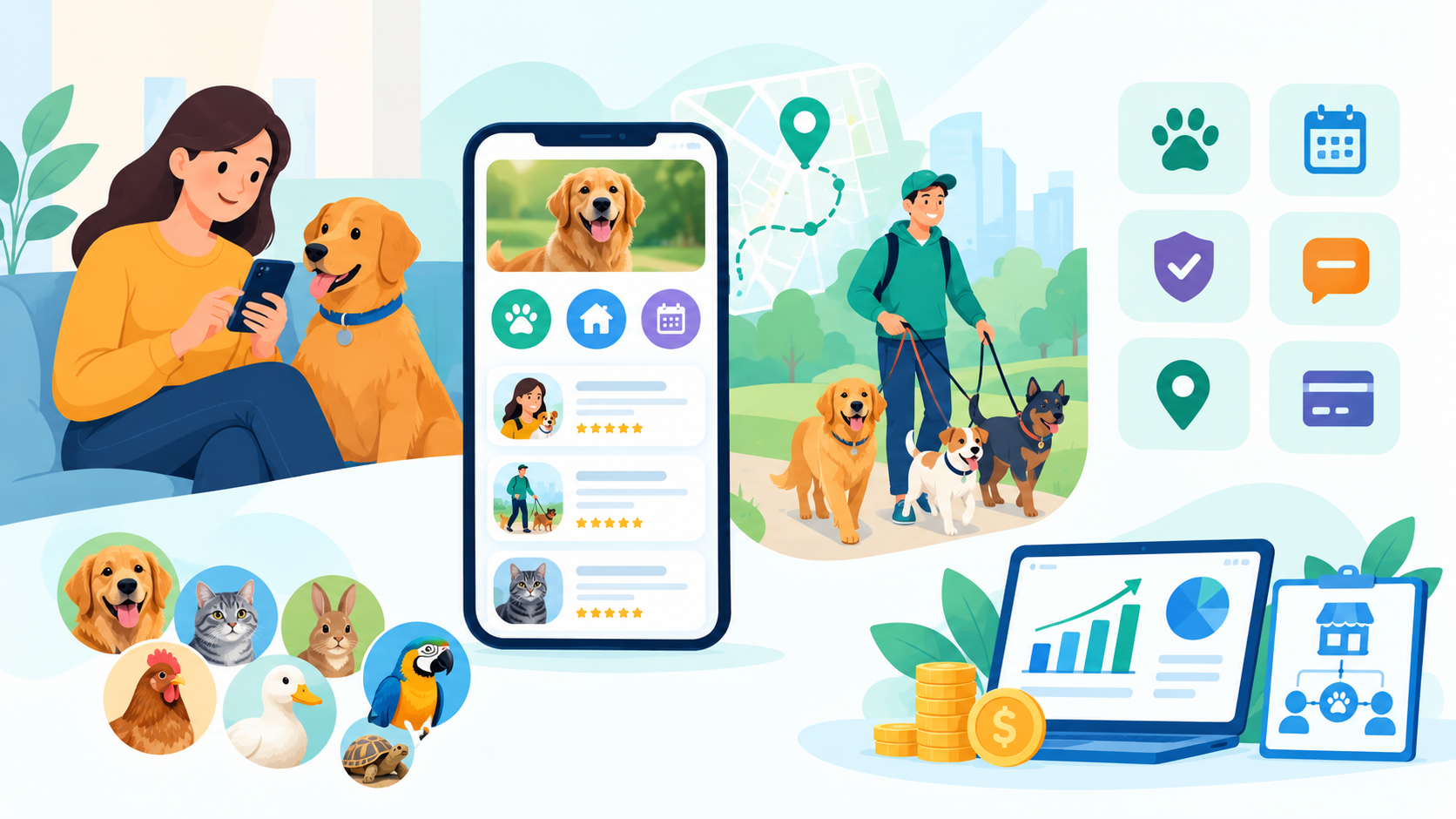
Key Takeaways:
- A Rover-like app needs trusted pet sitters, location-based search, booking, payments, messaging, reviews, and verification.
- Start with an MVP, validate demand locally, then expand into boarding, daycare, grooming, or specialized pet services.
- Development costs depend on features, technology, platforms, integrations, security, team expertise, and scalability requirements.
- A strong monetization strategy can combine booking commissions, service fees, subscriptions, sponsored listings, and partner services.
- Long-term success depends on marketplace trust, provider retention, repeat bookings, secure technology, useful analytics, and scalable architecture.
Your pet deserves more than a random sitter from a search result.
Finding trusted pet sitters and dog walkers can be difficult when owners cannot quickly verify experience, availability, reviews, or pricing. A poorly designed booking experience can make the problem worse.
That is where technology-driven solutions help. If you want to build an app like Rover, you need a marketplace that makes finding, comparing, booking, and communicating with pet caregivers simple and trustworthy.
In this guide, we cover the essential features, technology stack, development process, estimated cost, monetization, security, and scaling considerations.
What Is a Pet Care App? And How Does Rover-Like App Development Work?
A pet care app is a mobile platform that connects pet owners with trusted sitters, walkers, and boarders nearby. It lets users search, book, pay, and chat with verified caregivers in one place, making pet care easy, safe, and fast.
That is the short version. Now let's look at how it actually works behind the screen.
A pet owner opens the app. They search. They pick a sitter. They pay. The app quietly handles the trust part in the background, and that trust part is the whole business.
Here is the basic workflow, in plain steps.
- Owner opens the app and searches for sitters nearby using location-based search.
- User checks sitter profiles, reviews, and prices before booking anything.
- Booking gets confirmed, and payment moves through a secure gateway like Stripe Connect.
- Sitter and owner chat, share pet updates, then close the job with a review.
Simple on the surface. A lot of moving parts underneath.
And the market backs this up. The global pet sitting services market was valued at $2.9 billion in 2025. It is expected to reach $5.5 billion by 2030, growing at a 13.66% CAGR. Online platforms and apps already handle 70.6% of all bookings, which tells you where owners are headed.
That is not a small niche anymore. It is a fast-moving marketplace, and custom pet care app development is how founders are grabbing a share of it.
Benefits Of Rover Clone Pet Sitting App Development
A Rover-style build gives you a tested model, not a guess. You are not inventing demand; you are meeting it.
1. Faster Market Entry
You skip years of trial and error. The Rover model has already proved what pet owners want. You just build it better, faster, and for your own market.
2. Proven Business Model
Commission-based marketplaces work. Rover, Wag, and PetBacker already show that owners will pay for convenience and sitters will pay a fee for steady bookings.
3. Recurring Revenue
Pet care is not a one-time need. Owners book again and again, which means your app earns from repeat bookings, not just first-time downloads.
4. Trust Built In From Day One
When you plan verification, reviews, and secure payments from the start, users trust you faster. Trust is what actually drives bookings in this space.
5. Room to Scale
Start with dog walking and sitting. Add boarding, daycare, or exotic pet care later. A good marketplace app development approach lets you grow without rebuilding everything.
6. Lower Financial Risk
Because the model is proven, investors and partners take you more seriously. You are not pitching an unknown idea; you are pitching a better version of one that already works.
Features You Must Have During Rover-Style Pet Sitter App Development
Good dog walking app features are what separate a real product from a basic booking form. Here is what actually matters.
|
Feature |
Why It Matters |
|
Sitter Profiles and ID Verification |
Builds trust fast, shows background checks, badges, and real reviews upfront. |
|
Location-Based Search and Maps |
Owners find nearby sitters instantly using GPS and Google Maps Platform. |
|
Secure Booking and Online Payments |
Stripe Connect-style split payments keep money safe for both sides. |
|
In-App Messaging and Push Notifications |
Real-time chat and alerts keep owners calm during a booking. |
|
Reviews, Ratings, and Cancellation Rules |
Honest feedback and clear refund policy reduce disputes later. |
|
AI-Powered Matching and Chat Support |
Smart algorithms rank sitters by fit, not just distance, and AI chat answers quick questions. |
You do not need every feature on day one. Start lean. Add depth as your user base grows.
Step-by-Step Rover-Like On-Demand Pet Care App Development Process
Building this kind of app is not one big leap. It is eight smaller, honest steps, done in order.
Step 1. Define Your Pet Care Marketplace
Start by deciding who you serve and which services you will offer.
Choose between dog walking, pet sitting, boarding, daycare, and drop-in visits.
Define your target location, pricing model, provider onboarding, commission structure, and MVP scope before development begins.
This stage prevents unnecessary features from inflating your mobile app development cost.
Step 2. Plan User Journeys and MVP Features
Map separate journeys for pet owners, pet sitters, and administrators.
Owners need pet profiles, location-based search, provider profiles, availability, booking, messaging, payments, and reviews.
Providers need calendars, pricing, booking requests, earnings, and customer communication.
Keep the first release focused. A smaller MVP is easier to validate.
Step 3. Design the UX and UI
Design the booking experience around trust and simplicity. An owner should move naturally from service discovery to sitter comparison, messaging, booking, payment, and review. Providers need an equally clear dashboard for availability, services, bookings, and earnings.
Wireframes should come before polished screens because changing a workflow later is expensive.
Step 4. Choose the Technology Stack
Your technology stack should support location services, real-time communication, secure payments, scalable booking logic, push notifications, and cloud infrastructure.
For a marketplace MVP, a modular architecture can often be more practical than starting with complex microservices.
|
Layer |
Recommended technology |
|
Mobile app |
Flutter or React Native |
|
Web admin |
React or Next.js |
|
Backend |
Node.js with NestJS |
|
Database |
PostgreSQL |
|
Cache |
Redis |
|
Cloud |
AWS |
|
Storage |
Amazon S3 |
|
Maps |
Google Maps Platform or Mapbox |
|
Payments |
Stripe Connect |
|
Notifications |
Firebase Cloud Messaging |
|
API |
REST or GraphQL |
|
Real-time chat |
WebSockets |
|
Analytics |
Mixpanel or Google Analytics |
A capable pet care app development services provider can help select the stack according to your expected users, geography, integrations, and scaling requirements.
Step 5. Build the Backend and Marketplace Logic
Now develop the core backend that connects owners and providers. Build APIs for authentication, pet profiles, services, availability, bookings, payments, messaging, reviews, notifications, and provider verification.
Pay special attention to booking conflicts. A sitter should not accidentally become available for two overlapping appointments.
Step 6. Add Search, Location, Booking and Payments
Location-based discovery is central to a Rover-style marketplace. Integrate maps and geolocation so owners can find relevant caregivers by distance, service, availability, price, and ratings.
Then connect the booking engine with secure marketplace payments. Stripe Connect can support customer payments and provider payouts, while your backend manages commissions, refunds, cancellations, and transaction records.
For businesses focused specifically on dog walking, working with a dog walking app development company can also help address scheduling, GPS tracking, recurring walks, and location-based workflows.
Step 7. Add Trust, Safety and Communication
Pet care requires more trust than many ordinary service marketplaces. Build provider profiles, identity verification, reviews, ratings, secure messaging, emergency information, dispute handling, and appropriate screening workflows.
Push notifications should keep both sides informed about booking requests, confirmations, reminders, messages, and service updates. These details make the platform feel dependable rather than merely functional.
Step 8. Test, Launch and Scale
Test the complete marketplace before launch, including booking conflicts, payment failures, cancellations, refunds, notifications, location accuracy, authentication, and API security. Run usability testing with real pet owners and caregivers because edge cases often appear only outside the development team.
Launch in one market first, monitor booking conversion, repeat bookings, provider utilization, cancellations, customer acquisition cost, and lifetime value, then scale.
How Much Does Pet Care App Development Cost
On-demand app development cost depends on how many features you want and how polished you want them to be.
|
App Stage |
Timeline |
Estimated Cost |
|
Basic MVP (core booking only) |
2 to 3 months |
$8,000 to $20,000 |
|
Mid-Level App (payments, chat, maps) |
4 to 6 months |
$20,000 to $45,000 |
|
Full-Featured Marketplace |
6 to 9 months |
$45,000 to $70,000 |
|
Enterprise-Grade Platform |
9 to 12 months |
$70,000 to $90,000+ |
Common Mistakes to Avoid in Pet Care App Development
Some mistakes are small and fixable. Some cost months of rework. Here are the ones founders repeat most.
1. Skipping Verification
Launching without proper sitter background checks just to save time and money early on. Build identity and background verification into the MVP itself, since trust cannot be added later without losing users.
2. Ignoring the Sitter Side
Overdesigning the owner app and treating the sitter dashboard as an afterthought. Give sitters an earnings dashboard and booking tools too, because a happy sitter side keeps the whole marketplace alive.
3. Choosing the Wrong Tech Partner
Picking one of the cheapest mobile app development companies without checking marketplace experience. Ask for past two-sided marketplace work specifically, not just general app portfolios that look nice but lack depth.
4. Weak Payment Security
Treating payment integration as a quick plug-in step near the end of the project. Use PCI-compliant tools like Stripe Connect from day one, since payment trust is hard to rebuild once broken.
5. No Plan for Scale
Hardcoding features in a way that blocks future growth into daycare or boarding. Plan dog walking app development with modular services so new categories slot in without a full rebuild later.
How to Recover the Complete Pet Care Marketplace Development Cost Through Monetization
Software development cost feels heavy upfront. The good news: a marketplace pays itself back if the revenue model is thought through early.
1. Commission on Every Booking
Charge sitters a percentage per completed job, usually 15 to 20 percent. This is the core revenue engine, and it scales naturally as your booking volume grows month over month.
2. Service and Booking Fees
Add a small fixed fee on top of commission for owners. It feels minor per booking, but across thousands of bookings it becomes a steady, reliable income stream.
3. Subscription and Premium Tiers
Offer owners a membership for perks like priority support or discounted rates. This is where solid booking app development pays off, since repeat subscribers boost customer lifetime value fast.
4. Featured and Sponsored Listings
Let sitters pay extra to appear higher in search results. It is optional for them, but it adds a clean, high-margin revenue layer for you.
5. Add-on Services
Grooming, training, or pet insurance partnerships bring extra commission without extra development work. Small additions, but they raise average order value over time.
Track your GMV, take rate, and customer acquisition cost closely. Those three numbers tell you honestly whether your monetization plan is actually working
Future Trends in Pet Service Marketplace App
The next wave of pet services booking app growth is already forming, and it is worth planning for now, not after competitors get there first.
- AI-based sitter matching using multiple signals, not just distance and price.
- Real-time video check-ins during boarding and daycare stays.
- Subscription bundles that include tele-vet access and wellness tracking.
- Voice search for faster, hands-free sitter discovery on the go.
- Expansion into exotic pet care, a small but fast-growing niche.
- Cross-border sitter networks for pet-friendly international travel.
Owners are getting more comfortable with AI features inside everyday apps. Working with AI app development companies early can help you build smarter matching and support tools before this becomes standard across the industry.
Conclusion
If you build an app like Rover, the real challenge is creating a trusted pet care marketplace, not simply copying its interface.
A successful platform connects pet owners with pet sitters and dog walkers through location-based search, provider profiles, availability, booking, secure payments, messaging, reviews, and trust features.
Your development plan should also consider the technology stack, MVP scope, scalability, data security, and marketplace monetization. Start with a focused service and local market, learn from real users, then expand.
Done thoughtfully, a Rover-style app can turn everyday pet care needs into a scalable digital marketplace.
FAQ's
A Rover-like pet care app can cost around $8,000 to $90,000+, depending on features, platforms, integrations, design, security, and development team location.
A basic MVP may take 2 to 3 months. A full-featured marketplace with payments, messaging, maps, verification, and advanced features can take 6 to 12 months.
Core features include pet profiles, sitter profiles, location-based search, availability calendars, booking, payments, messaging, reviews, notifications, provider verification, and admin management.
The platform can earn through booking commissions, service fees, subscriptions, featured listings, sponsored placements, and partnerships with grooming, training, insurance, or other pet service providers.
Flutter or React Native can support cross-platform apps, while Node.js, PostgreSQL, Redis, AWS, Stripe Connect, Google Maps, and Firebase can handle backend, payments, location, cloud, and notifications.
Use identity verification, background screening, verified reviews, secure payments, provider profiles, ratings, messaging, cancellation policies, dispute handling, emergency contacts, and responsive customer support.
Yes. Start with essential booking, search, profiles, payments, messaging, and reviews. Test the marketplace with real users, learn what works, then invest in advanced features and wider expansion.
Yes. AI can support sitter matching, personalized recommendations, customer support, search, fraud detection, and automated assistance. Matching should use relevant signals such as location, availability, service type, ratings, and user preferences.

CrinPro
CrinPro Solutions is a leading IT company that helps startups and enterprises build innovative digital products. From intuitive mobile applications and high-performance websites to AI-powered solutions and enterprise software, our team delivers scalable, secure, and user-focused products tailored to unique business needs. With expertise across multiple industries, we transform ideas into digital experiences that drive growth, improve efficiency, and create long-term business value.