Key Takeaways:
- EV software development powers battery management, charging, navigation, fleet operations, and connected vehicle features.
- Modern electric vehicles depend on software to improve safety, efficiency, performance, and customer experience.
- Core EV software features include real-time monitoring, OTA updates, route optimization, remote control, predictive maintenance, and cloud connectivity.
- Successful EV software projects follow a structured process from planning and UI design to development, testing, deployment, and ongoing maintenance.
- Custom EV software development helps businesses improve operations, reduce costs, and build scalable mobility platforms.
- Choosing an experienced EV software development company reduces technical risks and improves long-term product success.
Electric vehicles are becoming more common, but building a successful EV takes much more than a powerful battery. Without the right software, features like battery management, smart charging, connected vehicle services, navigation, and remote monitoring cannot work together smoothly. That challenge is why EV software development has become a key part of the electric mobility ecosystem.
This guide explains what EV software development is, how it works, the features every EV platform should include, its business benefits, the technologies behind it, development costs, and the step-by-step process to build a secure and scalable EV solution.
What Is EV Software Development and How Does It Work?
EV software development is the process of building software that manages charging, battery performance, vehicle connectivity, navigation, fleet operations, and other digital functions in electric vehicles.
Electric Vehicle Software Development combines embedded software, cloud platforms, mobile applications, APIs, IoT devices, GPS, AI, and analytics into one connected ecosystem. Instead of focusing only on the vehicle itself, EV software development is a specialized part of automotive software development that also connects drivers, charging stations, fleet operators, and energy providers.
Electric vehicle software development combines embedded systems, cloud platforms, mobile applications, and IoT technologies to create connected and intelligent EV experiences.
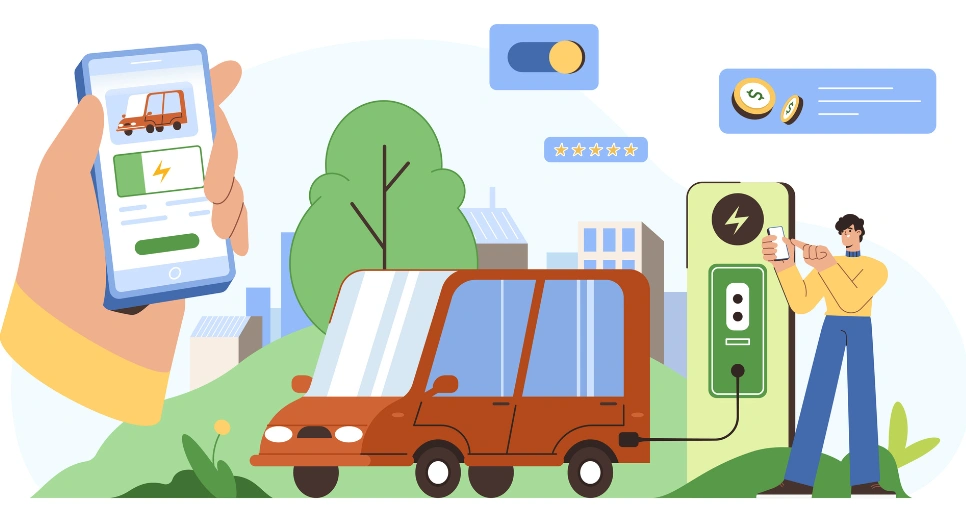
For example, when a driver checks battery health through a mobile app, finds the nearest charging station, reserves a charger, pays online, and receives charging notifications, multiple software systems work together behind the scenes.
Businesses often combine mobile app development with cloud infrastructure to deliver seamless EV experiences.
How EV Software Differs from Traditional Automotive Software
Traditional automotive software mainly controls mechanical vehicle functions.
Modern EV software manages:
- Battery Management Systems (BMS)
- Smart charging
- Connected vehicle services
- OTA (Over-the-Air) updates
- AI-powered diagnostics
- Fleet management
- Energy optimization
According to the International Energy Agency (IEA), software-defined vehicles are becoming the industry's next major architecture, allowing manufacturers to improve vehicle functionality through continuous software updates instead of hardware replacements.
Why Is EV Software Important for Modern Electric Vehicles?
EV software is important because it controls the digital intelligence that makes electric vehicles efficient, connected, safe, and easy to use.
Modern EVs are no longer just transportation devices. They have become software-defined vehicles (SDVs) where software controls an increasing share of vehicle functionality.
Software-defined vehicles rely on centralized software architectures and over-the-air updates to continuously improve vehicle functionality throughout their lifecycle.
This shift matters because software can:
- Improve battery efficiency
- Extend driving range
- Reduce charging time
- Enable remote diagnostics
- Deliver new features through OTA updates
- Improve fleet utilization
- Optimize energy consumption
For example, instead of visiting a dealership, a vehicle owner can receive performance improvements through an OTA update.
The IEA reports that centralized software architectures reduce wiring complexity while making continuous feature improvements possible through software updates.
What Are the Main Types of EV Software?
EV software includes multiple applications that manage vehicle performance, charging, connectivity, fleet operations, and customer experiences.
|
Software Type |
Primary Purpose |
|
Battery Management Software |
Monitor battery health and charging cycles |
|
Charging Management Software |
Manage charging stations and payments |
|
EV Fleet Management Software |
Track commercial fleets |
|
Vehicle Monitoring Software |
Monitor vehicle performance |
|
Navigation Software |
Optimize EV-friendly routes |
|
EV Mobile Apps |
Driver control and charging access |
|
OTA Update Systems |
Deliver remote software updates |
1. Battery Management Software
Battery Management Systems monitor battery temperature, voltage, charging cycles, and health to maximize battery lifespan.
2. EV Charging Software Development
Charging software helps users locate stations, book chargers, make payments, and monitor charging sessions.
Businesses developing EV charging app solutions often integrate payment gateways, RFID authentication, and live charger availability.
3. Fleet Management Software
Electric Vehicle Management Software allows logistics companies to monitor vehicle locations, battery levels, charging schedules, and driver performance.
Businesses can also explore a fleet management software guide when planning commercial EV operations.
4. Vehicle Monitoring Software
Vehicle monitoring continuously tracks diagnostics, energy usage, fault detection, and driving behavior.
5. Navigation Software
EV navigation differs from traditional GPS because it recommends charging stops based on battery range and charger availability.
6. Mobile Applications
EV App Development focuses on customer-facing applications that provide:
- Vehicle controls
- Charging history
- Digital payments
- Push notifications
- Remote locking
- Battery monitoring
What Features Should Every EV Software Solution Include?
Every EV software solution should include features that improve vehicle management, charging convenience, operational efficiency, and user experience.
Essential features include:
1. Real-Time Vehicle Monitoring
Real-time vehicle monitoring gives users a live view of battery status, vehicle health, charging progress, speed, location, and energy use. In production EV platforms, this feature helps fleet operators catch issues early instead of waiting for a vehicle breakdown. It also powers telematics software, remote diagnostics, and cloud-based fleet dashboards for faster decisions.
2. Battery Analytics
Battery analytics tracks State of Charge (SoC), State of Health (SoH), temperature, charging cycles, and battery degradation. Enterprise EV platforms rely on Battery Management Systems (BMS) to extend battery life, improve range prediction, and reduce replacement costs. Better battery insights also support safer fast charging and long-term vehicle performance.
3. Route Optimization
Route optimization helps drivers and EV fleets choose the most efficient route based on traffic, battery range, road conditions, charger availability, and energy consumption. Commercial delivery fleets use AI-powered route planning to lower charging stops, improve delivery times, and reduce operating costs without increasing fleet size.
4. Charging Station Locator
A charging station locator helps drivers quickly find nearby charging stations using GPS, live availability, connector compatibility, charging speed, and pricing. EV charging apps that include reservation options and real-time charger status reduce waiting time and improve the overall charging experience.
5. GPS Tracking
GPS tracking provides accurate vehicle location, trip history, driver activity, and geofencing. Fleet operators use this data to improve dispatching, monitor driver safety, recover stolen vehicles, and optimize route planning across large commercial EV fleets.
6. IoT Integration
IoT integration connects electric vehicles with charging stations, cloud servers, sensors, telematics devices, and smart energy systems. At scale, this continuous data flow supports remote monitoring, predictive maintenance, energy optimization, and software-defined vehicle architecture without manual intervention.
7. Remote Vehicle Controls
Remote vehicle controls allow users to lock or unlock doors, start charging, control climate settings, locate the vehicle, or schedule charging from a mobile app. These connected features improve convenience while giving businesses better control over shared vehicles and commercial fleets.
8. Predictive Maintenance
Predictive maintenance uses AI, machine learning, vehicle diagnostics, and sensor data to identify component failures before they happen. Fleet operators reduce downtime, lower repair costs, and keep vehicles on the road longer by replacing parts before they fail instead of reacting after a breakdown.
9. Push Notifications
Push notifications keep users informed about charging completion, battery level, maintenance reminders, software updates, payment confirmations, and security alerts. Timely notifications improve customer engagement while helping drivers avoid missed charging sessions or unexpected battery issues.
10. Payment Gateway Integration
Payment gateway integration allows drivers to pay for charging sessions using credit cards, digital wallets, subscriptions, or fleet accounts. Businesses also use secure payment systems for billing, invoicing, loyalty programs, and recurring memberships across public charging networks.
11. Cloud Dashboard
A cloud dashboard brings vehicle data, charging sessions, fleet analytics, battery reports, revenue, and operational insights into one place. Operations teams often depend on centralized dashboards to monitor thousands of connected EVs, chargers, and users without managing each asset individually.
12. Over-the-Air (OTA) Updates
OTA updates allow manufacturers to fix bugs, improve battery management, add new features, strengthen cybersecurity, and enhance vehicle performance without requiring a service center visit. Software-defined vehicles rely on secure OTA updates to deliver continuous improvements throughout the vehicle lifecycle.
For example, predictive maintenance analyzes battery and sensor data to identify problems before failures occur, reducing downtime and repair costs.
Advanced AI-powered diagnostics often require partnerships with experienced AI development companies.
What Are the Biggest Benefits of Custom EV Software Development?
Custom EV software development helps businesses improve operational efficiency, enhance user experience, and support long-term scalability in the growing electric mobility market.
Key benefits include:
1. Better Battery Performance
Battery analytics improve charging behavior and extend battery lifespan.
2. Lower Maintenance Costs
Predictive maintenance reduces unexpected breakdowns.
3. Improved Fleet Operations
Fleet operators optimize routes, charging schedules, and driver performance.
4. Better Customer Experience
Customers enjoy remote controls, instant charging updates, and simplified payments.
5. Smarter Business Decisions
Cloud dashboards provide analytics for utilization, energy consumption, and operational efficiency.
Smart mobility software development helps businesses improve operational efficiency, enhance user experience, and support long-term scalability in the growing electric mobility market.
How Does the EV Software Development Process Work?
The EV software development process involves planning, system design, development, testing, deployment, and ongoing maintenance to deliver secure and scalable solutions.
Typical development stages include:
1. Requirement Analysis
Requirement analysis defines the product vision, business goals, target users, compliance needs, and technical scope before development begins. In production EV projects, teams map charging workflows, Battery Management System (BMS) requirements, telematics, OCPP support, user roles, and third-party APIs early. This step avoids costly feature changes once development starts.
2. Market Research
Market research validates customer demand, competitor features, pricing models, and market gaps before investing in development. Early-stage startups often compare EV charging apps, fleet management software, and connected vehicle platforms to identify high-value MVP features that solve real user problems instead of copying every competitor.
3. Feature Planning
Feature planning prioritizes the functions that deliver the highest business value while keeping the first release simple. Product teams usually begin with charging station discovery, battery monitoring, digital payments, GPS navigation, and push notifications. AI recommendations, smart charging, predictive maintenance, and V2G capabilities are commonly added in later releases.
4. UI/UX Design
UI/UX design creates a simple and distraction-free experience for drivers, fleet managers, and charging station operators. EV users expect fast navigation, clear battery status, live charger availability, and one-tap payments. A clean interface reduces learning time and increases daily app engagement across mobile and in-vehicle screens.
5. Software Architecture
Software architecture defines how mobile apps, cloud servers, embedded systems, IoT devices, databases, and APIs work together. Enterprise EV platforms usually use a scalable cloud architecture that supports real-time vehicle diagnostics, OTA updates, charging management, fleet tracking, and secure communication between connected devices.
6. Development
Development transforms approved designs into a working EV software platform using agile sprints and continuous integration. Engineering teams build mobile apps, backend services, charging management modules, payment systems, GPS tracking, battery analytics, and API integrations while testing each feature throughout development.
7. Testing
Testing verifies that every software component works safely across different vehicles, charging stations, mobile devices, and network conditions. Validation covers performance, cybersecurity, battery communication, payment security, API reliability, real-time data synchronization, and OTA update stability before production deployment.
8. Deployment
Deployment launches the EV software into production after completing security checks, cloud configuration, and infrastructure validation. Most businesses release an MVP first, monitor user behavior, fix early issues, and gradually roll out advanced capabilities like AI-powered route optimization and predictive analytics.
9. Maintenance
Maintenance keeps EV software secure, reliable, and ready for changing market demands after launch. Production platforms receive regular OTA updates, bug fixes, cybersecurity patches, API upgrades, performance improvements, and new smart mobility features to support long-term growth and better customer retention.
For example, a startup building an EV charging platform may first launch an MVP with charging discovery and payment features before adding AI recommendations later.
Businesses planning large-scale platforms often combine this with custom software development services.
What Technologies Are Used in EV Software Development?
EV software development uses mobile frameworks, cloud platforms, IoT, AI, databases, APIs, and embedded systems.
Typical technology stack:
|
Layer |
Technologies |
|
Mobile |
Flutter, React Native, Swift, Kotlin |
|
Backend |
Node.js, Java, .NET, Python |
|
Database |
PostgreSQL, MongoDB |
|
Cloud |
AWS, Azure, Google Cloud |
|
IoT |
MQTT, CAN Bus |
|
Maps |
Google Maps API |
|
AI |
TensorFlow, OpenAI models, ML frameworks |
|
APIs |
OCPP, payment APIs, navigation APIs |
What Are the Biggest Challenges in EV Software Development?
EV software development faces challenges related to cybersecurity, hardware integration, scalability, compliance, and real-time data processing.
Major challenges include:
- Cybersecurity: Protects EV apps, cloud systems, and connected vehicles from hacking, malware, and unauthorized access.
- Data Privacy: Keeps driver, vehicle, payment, and location data safe from misuse or data leaks.
- Charging Interoperability: Makes different EVs and charging stations work together using common communication standards like OCPP and ISO 15118.
- OTA Reliability: Delivers software updates safely without interrupting vehicle performance or causing system failures.
- Cloud Scalability: Supports thousands of connected vehicles, charging sessions, and real-time users without slowing down.
- Real-Time Communication: Shares live battery, GPS, charger, and vehicle data with very low delay.
- Regulatory Compliance: Follows automotive safety, cybersecurity, and data privacy rules across different countries.
- For example, charging software must securely communicate with chargers, payment providers, cloud servers, and mobile applications without delays.
How Much Does EV Software Development Cost?
EV software development costs depend on product complexity, integrations, platform choice, AI capabilities, and development team size.
Typical ranges:
|
Solution |
Estimated Cost |
|
MVP EV App |
$8,000–$20,000 |
|
Charging Management Platform |
$15,000–$30,000 |
|
Fleet Management Platform |
$30,000–$60,000+ |
|
Enterprise EV Ecosystem |
$60,000 - $90,000+ |
Cost factors include:
- Number of features
- Mobile platforms
- Cloud infrastructure
- AI integration
- IoT hardware
- Security
- Third-party APIs
- Maintenance
Understanding overall mobile app development cost helps create a realistic project budget.
Where Is EV Software Used?
EV software supports connected mobility across passenger vehicles, charging infrastructure, commercial fleets, public transportation, ride-sharing services, and smart cities.
Common applications include:
- Passenger EVs
- Charging networks
- Delivery fleets
- Public buses
- Ride-sharing platforms
- Smart city mobility
- Corporate fleets
How Do You Choose the Right EV Software Development Company?
The right EV charging app development company combines automotive expertise, cloud engineering, mobile development, IoT integration, cybersecurity, and long-term support.
Before selecting a partner, evaluate:
- EV industry experience
- Automotive software portfolio
- Cloud expertise
- AI capabilities
- Security practices
- Support services
- Agile development process
Many businesses compare leading mobile app development companies before selecting a long-term technology partner.
What Is the Future of Electric Vehicle Software Development?
The future of EV software development centers on software-defined vehicles, AI, connected mobility, smart charging, autonomous technologies, and energy optimization.
Future trends include:
- AI-powered battery optimization: AI predicts battery health, improves charging speed, and helps extend battery life.
- Vehicle-to-Grid (V2G): EVs can send unused power back to the electric grid and lower energy costs.
- Autonomous EV platforms: Smart software supports self-driving features and safer driver assistance systems.
- Digital twins: Virtual vehicle models help test software, detect issues, and improve performance before deployment.
- Predictive analytics: Real-time vehicle data helps prevent breakdowns and reduces maintenance costs.
- Smart charging ecosystems: Intelligent charging schedules reduce electricity costs and balance grid demand.
- Edge computing: Faster data processing inside the vehicle reduces delays and improves response times.
- Personalized in-vehicle experiences: Software remembers driver preferences for navigation, climate, music, and seat settings.
Tools and Practical Applications
Businesses can build EV platforms using:
- Cloud platforms like AWS, Azure, or Google Cloud
- Mapping services such as Google Maps Platform
- OCPP-compatible charging management systems
- AI frameworks for predictive maintenance
- Analytics dashboards for fleet optimization
What's Next?
The next step after understanding EV software development is validating your business requirements and defining an MVP that solves a real customer problem.
Start by identifying your target users, listing essential features, selecting the right technology stack, and planning integrations. Then choose an experienced software development company with expertise in automotive software, cloud platforms, IoT, and AI to reduce development risks and accelerate product delivery.
Conclusion
EV software development is becoming the foundation of modern electric mobility. From battery management and charging platforms to connected vehicles and fleet operations, software now determines how efficiently electric vehicles perform throughout their lifecycle.
Businesses investing in scalable, secure, and intelligent EV software today will be better positioned to compete in tomorrow's connected transportation ecosystem.
FAQ's
EV software development builds apps and platforms for battery management, charging, navigation, fleet tracking, remote controls, and connected vehicle services.
Core features include battery monitoring, GPS tracking, smart charging, OTA updates, payment integration, predictive maintenance, cloud dashboards, and alerts.
An MVP usually takes 3–6 months. Enterprise EV software with AI, IoT, and fleet features can take 9–18 months, based on project scope.
EV software costs typically range from $8,000 to $90,000+, depending on features, integrations, AI capabilities, and platform complexity.
Common technologies include Flutter, React Native, Node.js, Python, AWS, Azure, Google Cloud, MQTT, OCPP, AI, IoT, and PostgreSQL.
Custom EV software improves fleet efficiency, battery performance, user experience, data insights, and long-term scalability while supporting business growth.
EV startups, charging station operators, fleet companies, automotive brands, logistics businesses, and smart city providers commonly build EV software.
Choose a company with EV domain expertise, IoT and cloud experience, strong security practices, AI capabilities, and proven automotive software projects.

CrinPro
CrinPro Solutions is a leading IT company that helps startups and enterprises build innovative digital products. From intuitive mobile applications and high-performance websites to AI-powered solutions and enterprise software, our team delivers scalable, secure, and user-focused products tailored to unique business needs. With expertise across multiple industries, we transform ideas into digital experiences that drive growth, improve efficiency, and create long-term business value.