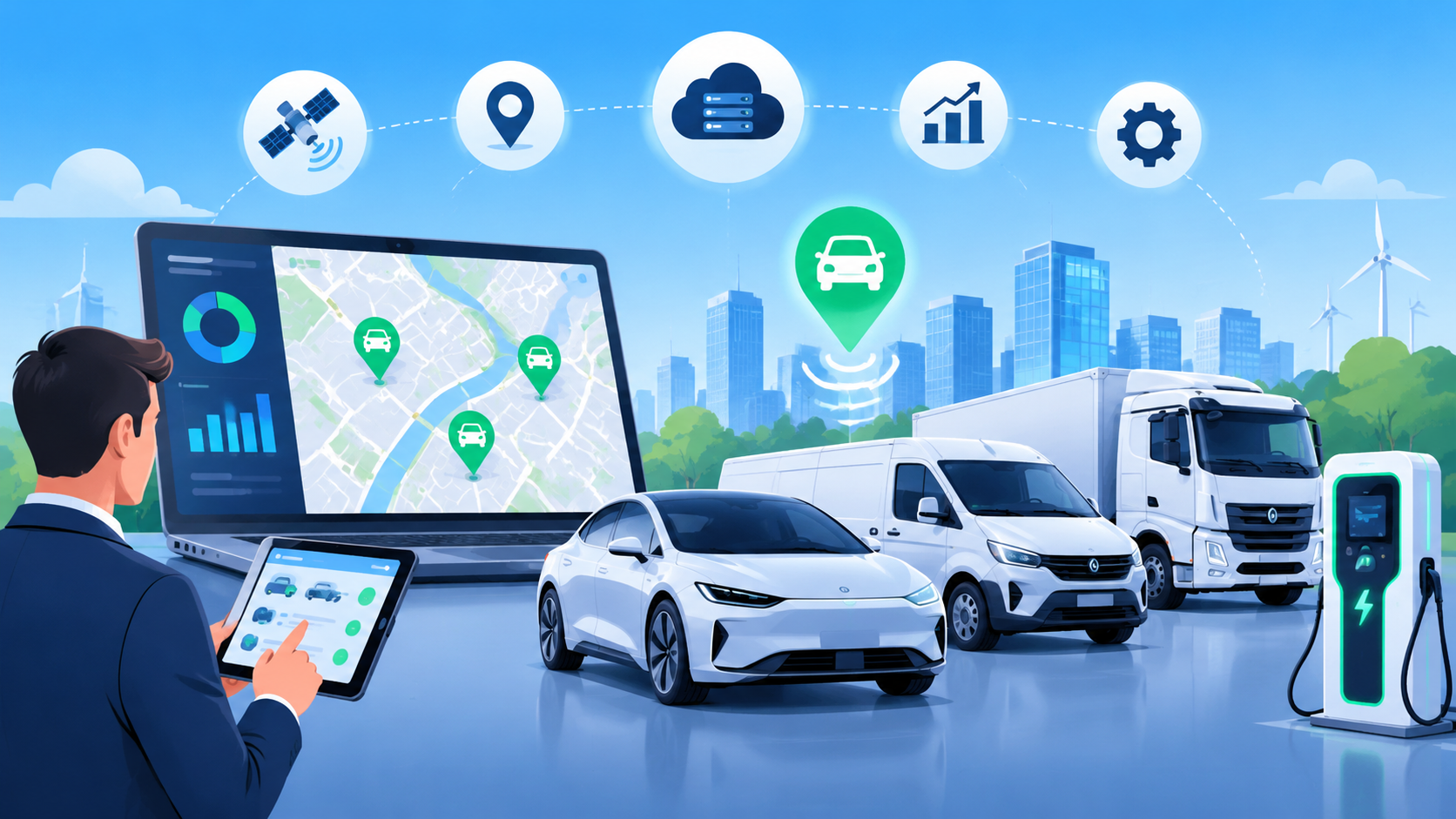
Key Takeaways:
- EV fleet software combines GPS tracking, telematics, and charging management.
- AI helps optimise routes, predict maintenance, and improve fleet utilisation.
- Secure integrations support reliable vehicle and charging data.
- Development costs range from $7,000 to $80,000+, depending on complexity.
- A scalable MVP helps businesses control costs and expand gradually.
Electric vehicles are becoming an important part of commercial transportation, logistics, public mobility, and corporate fleet operations. As businesses transition from conventional vehicles to electric fleets, they need digital systems that can coordinate vehicle performance, battery health, charging schedules, energy consumption, and daily operations.
EV fleet management software brings these capabilities together through a centralised platform. Fleet operators can monitor vehicle locations, review telematics data, track charging activity, manage maintenance schedules, and analyse operating costs. These insights help businesses make informed decisions while improving fleet visibility and resource utilisation.
The growing complexity of electric mobility also creates opportunities for AI-driven optimisation. Predictive analytics can help estimate energy requirements, identify potential maintenance issues, recommend charging windows, and improve vehicle allocation. When integrated with suitable charging infrastructure and fleet systems, these capabilities can support more efficient operations.
However, developing a reliable platform requires more than GPS tracking and vehicle dashboards. Businesses must consider compatibility with different vehicle models, charging networks, telematics devices, energy systems, and existing enterprise applications. Security, data accuracy, and scalability are equally important as fleet size increases.
A structured development approach allows businesses to start with essential monitoring and charging features before introducing advanced automation. The goal is to build a connected EV fleet platform that helps operators control costs, improve vehicle availability, and make better use of their electric mobility investments.
Market Statistics
- The EV Fleet Management Software Market was valued at USD 1.47 billion in 2025 and is projected to grow to USD 5 billion by 2035, at a CAGR of 13.1%.
- The electric vehicle fleet management market is projected to grow from USD 9.10 billion in 2025 to USD 32.25 billion by 2030, at a CAGR of 22.7% over the period.
- The electric vehicle fleet management market size has grown strongly in recent years. It will grow from $24.92 billion in 2025 to $26.29 billion in 2026 at a compound annual growth rate (CAGR) of 5.5%.
How EV Fleet Management Systems Work: Vehicles, Charging, and Fleet Data
An EV fleet management system connects electric vehicles, charging infrastructure, telematics devices, and fleet operations through a central software platform. It collects data from these sources, processes it, and presents actionable information through dashboards, alerts, and automated workflows.
1. Vehicle Data Collection
Connected vehicles and telematics devices provide information such as location, speed, battery state of charge, mileage, energy consumption, and diagnostic alerts. The platform collects available data through vehicle APIs, onboard diagnostics, or compatible telematics hardware.
2. Charging Station Connectivity
The system communicates with supported charging stations to retrieve charging status, session information, energy consumption, and availability. Depending on the infrastructure, it may also coordinate charging schedules and help operators identify suitable charging locations.
3. Centralised Data Processing
A backend platform processes incoming vehicle and charging data, stores historical records, and updates fleet dashboards. It can combine information from multiple vehicles and charging networks to give fleet managers a consolidated operational view.
4. Fleet Monitoring and Decision Support
Fleet managers can monitor vehicle locations, battery levels, charging progress, maintenance alerts, and utilisation. Configurable rules can trigger notifications when a battery reaches a specified threshold, a vehicle reports a fault, or a charging session encounters an issue.
5. AI-Powered Optimisation
AI and analytics can use historical fleet data, vehicle availability, route requirements, and charging patterns to recommend more efficient schedules. For example, a system may suggest charging a vehicle during a lower-demand period or assigning a sufficiently charged vehicle to an upcoming delivery.
6. Integration With Business Systems
The platform can exchange information with dispatch software, maintenance systems, enterprise resource planning (ERP) platforms, and energy management tools. These integrations help businesses coordinate vehicle availability with operational requirements.
For example, a delivery fleet might use the platform to identify an available vehicle, check its battery level, assign a suitable route, and schedule charging after the vehicle returns.
Integrating vehicle data with charging infrastructure helps businesses monitor energy consumption, manage charging schedules, and improve fleet efficiency. Energy software development services can help build connected solutions that support energy monitoring, charging optimisation, and more efficient electricity usage across EV fleets.
Essential Features of a Modern EV Fleet Management Platform
A modern EV fleet management platform should help businesses monitor vehicles, manage charging operations, control maintenance costs, and coordinate daily fleet activities. The feature set depends on fleet size, vehicle types, charging infrastructure, and operational goals.
|
Feature |
Key Capabilities |
Business Value |
|
Real-Time Fleet Dashboard |
Displays vehicle locations, battery levels, availability, and operational status. |
Gives fleet managers a consolidated view of fleet activity |
|
GPS Tracking and Geofencing |
Tracks vehicle locations, route history, and entry or exit from defined areas |
Improves visibility and supports route monitoring |
|
Battery and Energy Monitoring |
Records state of charge, energy consumption, and available battery diagnostics |
Helps operators plan vehicle usage and charging |
|
Charging Session Management |
Monitors charging status, station availability, session duration, and energy usage |
Improves charging coordination and utilisation |
|
Route and Trip Management |
Plans trips using distance, vehicle range, and charging requirements |
Helps reduce unnecessary travel and charging interruptions |
|
Predictive Maintenance |
Analyses available diagnostic and historical data to flag potential maintenance needs |
Supports proactive servicing and vehicle availability |
|
Fleet Scheduling and Allocation |
Assigns vehicles according to availability, battery level, and trip requirements |
Helps balance workload across the fleet |
|
Driver and Trip Management |
Maintains driver assignments, trip records, and driving-related information |
Improves operational coordination and accountability |
|
Alerts and Notifications |
Sends configurable alerts for low battery, faults, charging issues, and geofence events |
Enables faster responses to operational problems |
|
Analytics and Reporting |
Reports energy consumption, vehicle utilisation, charging expenses, and maintenance trends |
Supports cost analysis and fleet planning |
|
User Roles and Access Control |
Provides role-based permissions for administrators, fleet managers, drivers, and technicians |
Protects sensitive information and limits unauthorised access |
|
Third-Party Integrations |
Connects charging networks, telematics providers, maintenance tools, and business systems |
Reduces disconnected workflows and duplicate data entry |
Prioritising Features for an EV Fleet MVP
Businesses do not need to implement every advanced capability at launch. An initial release can focus on vehicle tracking, battery monitoring, charging records, maintenance alerts, and basic reporting. These features establish a useful operational foundation before more sophisticated automation is introduced.
As fleet requirements grow, operators can add predictive maintenance, intelligent charging schedules, route optimisation, and advanced analytics. This phased approach helps control development complexity while ensuring the platform addresses practical fleet management needs.
EV Charging Management, Battery Monitoring, and Energy Optimisation
Charging management is a central part of EV fleet operations because vehicle availability depends on battery capacity, charging access, and energy requirements. A well-designed platform helps fleet operators coordinate charging sessions, monitor battery performance, and manage energy consumption without disrupting daily schedules.
1. Smart Charging and Session Management
EV fleet software can connect with compatible charging stations to display availability, charging status, session duration, and energy consumption. Fleet managers can assign vehicles to suitable charging points and coordinate charging around planned departures.
Where supported by the charging infrastructure, smart charging controls can schedule sessions according to vehicle requirements, site capacity, electricity tariffs, and operational priorities.
2. Battery Health and Performance Monitoring
Battery monitoring helps operators understand vehicle readiness and identify unusual changes in charging or energy consumption. The platform can track available battery indicators, state of charge, charging cycles, and diagnostic information when supported by the vehicle or telematics provider.
Historical data can also help identify potential battery performance issues. However, battery health estimates depend on the accuracy and availability of vehicle data and should not be treated as definitive diagnostics without appropriate validation.
3. Energy Consumption and Cost Control
Energy analytics allow fleet managers to compare consumption across vehicles, routes, and operating periods. This can help identify inefficient routes, vehicles with unusual energy usage, and charging patterns that increase operating expenses.
For organisations planning charging infrastructure or fleet-wide energy management, Energy Software Development Services can support integrations between EV fleet applications, charging stations, energy management systems, and compatible electricity monitoring platforms.
4. Intelligent Charging Schedules
Charging schedules can be aligned with vehicle departure times, expected trip distances, battery levels, and available charging capacity. For example, vehicles scheduled for early-morning deliveries may receive priority over vehicles that will remain parked for several hours.
AI-assisted optimisation can help recommend charging windows and balance demand across multiple vehicles. Automated charging decisions should still follow configured limits, equipment capabilities, and operational safety requirements.
5. Integrating Charging Networks
Fleet operators may use chargers from different manufacturers or charging network providers. Standards such as OCPP can support communication between compatible charging stations and charging management systems, while vehicle and fleet integrations may use additional APIs or protocols.
A flexible integration architecture helps businesses manage charging activity across supported infrastructure without relying on a single provider. The result is better coordination between vehicle readiness, charging availability, and daily fleet requirements.
GPS Tracking, Telematics, and Real-Time Vehicle Monitoring
GPS tracking and telematics help fleet operators monitor electric vehicles, review driving activity, and make informed operational decisions. By combining location data with vehicle telemetry, an EV fleet management platform provides a clearer view of fleet performance and day-to-day operations.
1. Real-Time GPS Tracking
GPS tracking displays vehicle locations on a live map, helping fleet managers monitor movement, check estimated arrival times, and identify route deviations. Dispatch teams can use this information to assign vehicles efficiently, coordinate deliveries, and respond to unexpected delays.
2. Vehicle Telematics and Performance Data
Telematics systems collect vehicle information such as speed, mileage, battery state of charge, energy consumption, charging status, and diagnostic alerts, depending on vehicle and integration capabilities. Analysing this data helps operators understand vehicle performance and identify potential maintenance needs.
3. Geofencing and Automated Alerts
Geofencing allows fleet managers to define virtual boundaries around depots, warehouses, charging stations, and delivery zones. The platform can generate alerts when vehicles enter or leave designated areas, helping teams monitor vehicle movement and support operational policies.
4. Trip History and Fleet Utilisation
Historical trip records help businesses review routes, driving patterns, idle time, distance travelled, and vehicle utilisation. These insights can reveal inefficient journeys, underused vehicles, and opportunities to improve fleet scheduling.
5. Connecting Tracking With Fleet Operations
When GPS tracking, telematics, and fleet dashboards work together, businesses gain a more complete view of vehicle activity. This information can support better dispatch decisions, more effective maintenance planning, and improved coordination between drivers and fleet managers.
How AI Improves EV Fleet Planning and Operational Efficiency
Artificial intelligence can help EV fleet operators make better decisions by analysing vehicle performance, charging demand, route conditions, and historical operating data. Instead of relying entirely on manual planning, fleet managers can use AI-powered insights to improve resource allocation and reduce avoidable operational delays.
1. Predictive Maintenance and Vehicle Health
AI models can analyse diagnostic information, battery performance, and maintenance histories to identify patterns associated with potential vehicle issues. These insights can help fleet operators schedule inspections proactively and reduce unexpected downtime, although predictions depend on data quality and model accuracy.
2. Intelligent Route and Dispatch Planning
AI-assisted route planning can consider traffic conditions, delivery schedules, vehicle range, battery charge levels, and charging station availability. This helps dispatch teams select practical routes while accounting for the additional energy constraints of electric vehicles.
3. Smarter Charging and Energy Forecasting
By examining historical usage, electricity tariffs, charging patterns, and planned journeys, AI can estimate future charging demand and recommend suitable charging windows. Fleet operators may use these insights to avoid unnecessary charging delays and manage energy expenses more effectively.
4. Fleet Utilisation and Demand Forecasting
AI can analyse vehicle usage patterns to identify underutilised vehicles, forecast operational demand, and recommend more efficient fleet allocation. Businesses can use these insights to plan vehicle availability around expected workloads.
5. Implementing AI in EV Fleet Operations
Successful implementation requires reliable data from vehicles, GPS systems, charging infrastructure, and fleet management software. AI automation software development can help connect these data sources with forecasting models, automated alerts, and decision-support workflows.
Technology Stack for EV Fleet Management Software Development
A reliable EV fleet management platform requires technologies that can handle vehicle data, GPS tracking, charging operations, analytics, and integrations with external systems. The right stack depends on fleet size, supported vehicle types, real-time processing requirements, and the platform's long-term scalability needs.
|
Technology Layer |
Common Technologies |
Primary Purpose |
|
Frontend Development |
React.js, Next.js, Angular |
Fleet dashboards, vehicle maps, and administrative interfaces |
|
Mobile App Development |
Flutter, React Native, Swift, Kotlin |
Driver applications, alerts, and fleet monitoring on mobile devices |
|
Backend Development |
Node.js, Python, Java, .NET |
Business logic, fleet operations, APIs, and data processing |
|
Database Management |
PostgreSQL, MySQL, MongoDB |
Vehicle records, trip histories, charging sessions, and fleet data |
|
GPS and Mapping |
Google Maps Platform, Mapbox |
Location tracking, route planning, geofencing, and navigation |
|
IoT and Telematics |
MQTT, vehicle telematics APIs, IoT platforms |
Collecting and transmitting vehicle and sensor information |
|
Charging Integration |
OCPP-compatible systems, charger APIs |
Connecting charging stations and managing charging sessions |
|
AI and Analytics |
Python, scikit-learn, PyTorch, managed AI services |
Demand forecasting, predictive maintenance, and fleet optimisation |
|
Cloud Infrastructure |
AWS, Microsoft Azure, Google Cloud |
Hosting, storage, data processing, and scalable deployment |
|
Security and Authentication |
OAuth 2.0, OpenID Connect, role-based access control |
Identity management, permissions, and secure system access |
|
Monitoring and DevOps |
Docker, Kubernetes, Prometheus, Grafana |
Deployment, infrastructure monitoring, and service reliability |
Selecting Technologies for Different Fleet Requirements
- For an MVP: Prioritise vehicle tracking, basic fleet dashboards, trip history, and essential alerts.
- For charging-focused platforms: Evaluate charger compatibility, charging protocols, energy reporting, and station availability.
- For AI-enabled fleets: Establish reliable data pipelines, model evaluation, and monitoring before introducing automated recommendations.
- For enterprise deployments: Focus on access controls, integration reliability, data retention, and support for multiple depots or regions.
An experienced automotive software development company can help connect vehicle systems, telematics devices, charging infrastructure, and business applications within a maintainable architecture.
A mobile app development company can also build driver-facing applications that support trip assignments, charging notifications, vehicle inspections, and communication with fleet managers.
Ultimately, the best technology stack is one that meets current operational needs while allowing the platform to accommodate additional vehicles, charging networks, and integrations as the business grows.
EV Fleet Management Software Development Process: 8 Key Stages
Developing EV fleet management software requires careful planning to connect vehicles, charging infrastructure, telematics, and fleet operations into one reliable platform. Following a structured process helps businesses validate requirements, control development costs, and prepare the system for real-world fleet conditions.
1. Market Research and Requirement Analysis
Begin by researching the target market, competitor platforms, fleet operator challenges, and industry requirements. Identify whether the software will serve delivery businesses, commercial fleets, logistics providers, or charging network operators. Define the essential features, user roles, integration needs, and measurable project goals.
2. Product Scope and Technical Planning
Translate business requirements into a prioritised feature list and development roadmap. Decide whether the first release needs GPS tracking, vehicle monitoring, charging management, predictive maintenance, or advanced analytics. Establish the project budget, delivery milestones, and success criteria.
3. Architecture and Technology Selection
Design the software architecture around fleet data, real-time updates, charging workflows, and external integrations. Select suitable frontend, backend, database, cloud, and communication technologies while planning for security, reliability, and future expansion.
4. UI/UX Design and Prototyping
Create dashboards and user interfaces for fleet managers, dispatch teams, administrators, and drivers. Develop wireframes and interactive prototypes to test navigation, map visibility, charging information, vehicle status, and alert management before full development begins.
5. Core Platform and MVP Development
Build the essential components, including vehicle registration, fleet dashboards, GPS tracking, trip history, user permissions, and notifications. A focused minimum viable product allows businesses to validate workflows with a smaller fleet before expanding the feature set.
6. Vehicle, Charging, and Third-Party Integrations
Connect the platform with compatible vehicle telematics systems, GPS services, charging stations, mapping providers, and existing business applications. Validate data exchange, API permissions, charging-session updates, and handling of unavailable or inconsistent data.
7. Testing, Security, and Performance Validation
Conduct functional, integration, usability, and performance testing across supported devices and fleet scenarios. Check GPS accuracy, charging data, alert delivery, access controls, and system behaviour during network interruptions. Resolve critical defects before release.
8. Deployment, Monitoring, and Continuous Improvement
Deploy the application to the selected cloud or infrastructure environment, configure monitoring and backups, and train users on essential workflows. After launch, review usage patterns, performance metrics, user feedback, and operational issues to prioritise improvements and scale the platform.
Integrating Charging Networks, Telematics, GPS, and Fleet Systems
An EV fleet management platform must exchange data with multiple systems to coordinate vehicle movement, charging operations, maintenance, and dispatch. A well-designed integration layer helps businesses consolidate information without replacing every application they already use.
1. Charging Network and Station Integration
Charging integrations allow fleet operators to retrieve station availability, monitor charging sessions, and review energy consumption. Where supported, the Open Charge Point Protocol (OCPP) can facilitate communication between compatible charging stations and charging management systems.
2. Vehicle Telematics and GPS Integration
Vehicle telematics APIs and compatible tracking devices can supply location, mileage, battery status, diagnostic information, and trip data. Mapping services add route planning, geofencing, and estimated arrival times.
Businesses evaluating GPS tracking app development costs should consider not only the tracking interface but also device compatibility, mapping API usage, real-time data processing, and ongoing maintenance.
3. ERP, Dispatch, and Maintenance System Connectivity
Connecting fleet software with enterprise resource planning (ERP), dispatch, inventory, and maintenance systems can reduce duplicate data entry and improve coordination. For example, dispatch software can use vehicle availability to assign jobs, while maintenance systems can receive diagnostic alerts or scheduled inspection details.
4. APIs, Webhooks, and Data Synchronisation
REST APIs, webhooks, and message queues can help exchange data between connected systems. APIs support requests for vehicle or charging information, while webhooks can notify the platform about events such as completed charging sessions or updated order statuses. Queues can help manage data bursts and temporary service interruptions.
5. Building an Interoperable Integration Layer
A central integration layer should validate incoming data, manage authentication, handle retries, and record integration failures. Monitoring and standardised data models make it easier to troubleshoot problems and introduce additional vehicle manufacturers, charging providers, and business applications.
Security, Scalability, and Challenges in EV Fleet Management
EV fleet management platforms handle sensitive business information, vehicle locations, charging records, and operational data. A secure and scalable architecture is essential to maintain service reliability, protect connected systems, and support fleet growth.
1. Data Security and Access Control
Fleet platforms should protect data through encryption, secure authentication, role-based access controls, and appropriate session management. Fleet managers, drivers, maintenance teams, and administrators should only access information and functions relevant to their responsibilities.
2. Vehicle and Charging Infrastructure Security
Connected vehicles, telematics devices, and charging stations can introduce additional security risks. Businesses should validate connected devices, secure APIs, manage credentials carefully, and apply regular security updates. Monitoring unusual access patterns can also help teams identify suspicious activity.
3. Integration and Data Compatibility
Different vehicle manufacturers, charging providers, and telematics systems may use different data formats and communication protocols. Inconsistent data can affect battery monitoring, charging reports, and fleet decisions. Standardised data models, validation rules, and integration testing can help reduce these problems.
4. Scalability and Real-Time Performance
As the number of vehicles and charging sessions grows, the platform must process more location updates, telemetry events, alerts, and dashboard requests. Scalable cloud infrastructure, asynchronous processing, caching, and efficient database design can help maintain performance under higher workloads.
5. Network Connectivity and Data Reliability
Vehicles and charging stations may operate in areas with limited connectivity. Temporary outages can interrupt telemetry updates or delay alerts. Buffering data where supported, retry mechanisms, timestamps, and clear indicators of stale information help maintain operational visibility during interruptions.
6. Managing Operational and Compliance Risks
Businesses must also consider data retention, privacy requirements, auditability, backup procedures, and recovery planning. Regular testing and monitoring help identify weaknesses before they affect fleet operations.
EV Fleet Management Software Development Cost and Timeline in 2027
The EV fleet management software development cost depends on the platform's features, number of vehicles, charging infrastructure integrations, GPS tracking capabilities, AI requirements, and scalability needs. A basic fleet monitoring solution generally requires a smaller investment, while an enterprise platform with advanced analytics and multi-location charging management demands more development effort.
|
EV Fleet Software Type |
Estimated Development Cost |
Timeline |
|
Basic EV Fleet Tracking Software |
7,000–20,000 |
2–3 months |
|
Mid-Level Fleet and Charging Management |
20,000–40,000 |
3–5 months |
|
Advanced AI-Powered Fleet Platform |
40,000–60,000 |
5–7 months |
|
Enterprise EV Fleet Management System |
60,000–80,000+ |
7–10+ months |
What Influences the Development Budget?
- Feature complexity: Basic vehicle tracking and trip history require less development effort than predictive maintenance, intelligent route planning, battery analytics, and automated charging optimisation.
- Charging and telematics integrations: Connecting different vehicle manufacturers, charging networks, GPS services, and fleet management systems can increase implementation time. The EV charging software development cost also depends on charger compatibility, charging protocols, and the complexity of energy management features.
- AI and real-time processing: Predictive analytics, demand forecasting, and real-time vehicle monitoring may require additional data pipelines, computing resources, and model evaluation.
- Platform coverage and scalability: Supporting driver mobile apps, fleet manager dashboards, administrative portals, and multiple locations increases the scope of development and testing.
Businesses should also evaluate the automotive software development cost when planning deeper integrations with vehicle electronics, onboard systems, diagnostics, or manufacturer-specific APIs.
Revenue Models and Business Opportunities for EV Fleet Platforms
EV fleet management software offers several ways to generate recurring revenue while helping businesses improve fleet efficiency and manage charging operations.
- Subscription Plans: Charge monthly or annual fees based on vehicle count, fleet size, or available features.
- Usage-Based Pricing: Set fees according to vehicles tracked, charging sessions managed, or data processed.
- Premium Analytics: Offer predictive maintenance, energy optimisation, and advanced fleet performance reports as paid add-ons.
- Charging Management Services: Generate revenue by providing charging network integration, energy monitoring, and charging optimisation tools.
- Enterprise Licensing: Offer customised platforms, integrations, and dedicated support to large logistics companies and fleet operators.
Businesses can start with a subscription-based model and introduce premium features as customer needs grow. A scalable platform with reliable integrations and measurable operational benefits can create opportunities for long-term customer relationships and recurring revenue.
Conclusion
EV fleet management software is helping businesses coordinate vehicle tracking, charging operations, battery monitoring, and fleet performance through connected digital platforms. Integrating GPS, telematics, and AI can improve operational visibility and support more efficient fleet planning.
Successful development starts with clear requirements, suitable technology choices, reliable integrations, and strong security practices. Businesses can begin with an MVP and expand its capabilities as operational needs grow. Investing in a scalable platform can help fleet operators manage the transition to electric vehicles while preparing for future transportation demands.
FAQ's
It is a digital platform for monitoring electric vehicles, managing charging, tracking trips, and analysing fleet performance.
Development may cost between $7,000 and $80,000+, depending on features, integrations, and complexity.
A basic platform may take 2–3 months, while an enterprise solution can require 7–10 months or longer.
Core features include GPS tracking, battery monitoring, charging management, vehicle diagnostics, trip history, and fleet reporting.
AI can support predictive maintenance, route optimisation, charging forecasts, and vehicle utilisation planning.
Yes. Compatible APIs and protocols such as OCPP can connect the platform with supported charging infrastructure.
Yes. Small businesses can start with essential tracking and charging features and expand as their fleets grow.
Common models include subscriptions, usage-based fees, premium analytics, charging management services, and enterprise licensing.

CrinPro
CrinPro Solutions is a leading IT company that helps startups and enterprises build innovative digital products. From intuitive mobile applications and high-performance websites to AI-powered solutions and enterprise software, our team delivers scalable, secure, and user-focused products tailored to unique business needs. With expertise across multiple industries, we transform ideas into digital experiences that drive growth, improve efficiency, and create long-term business value.