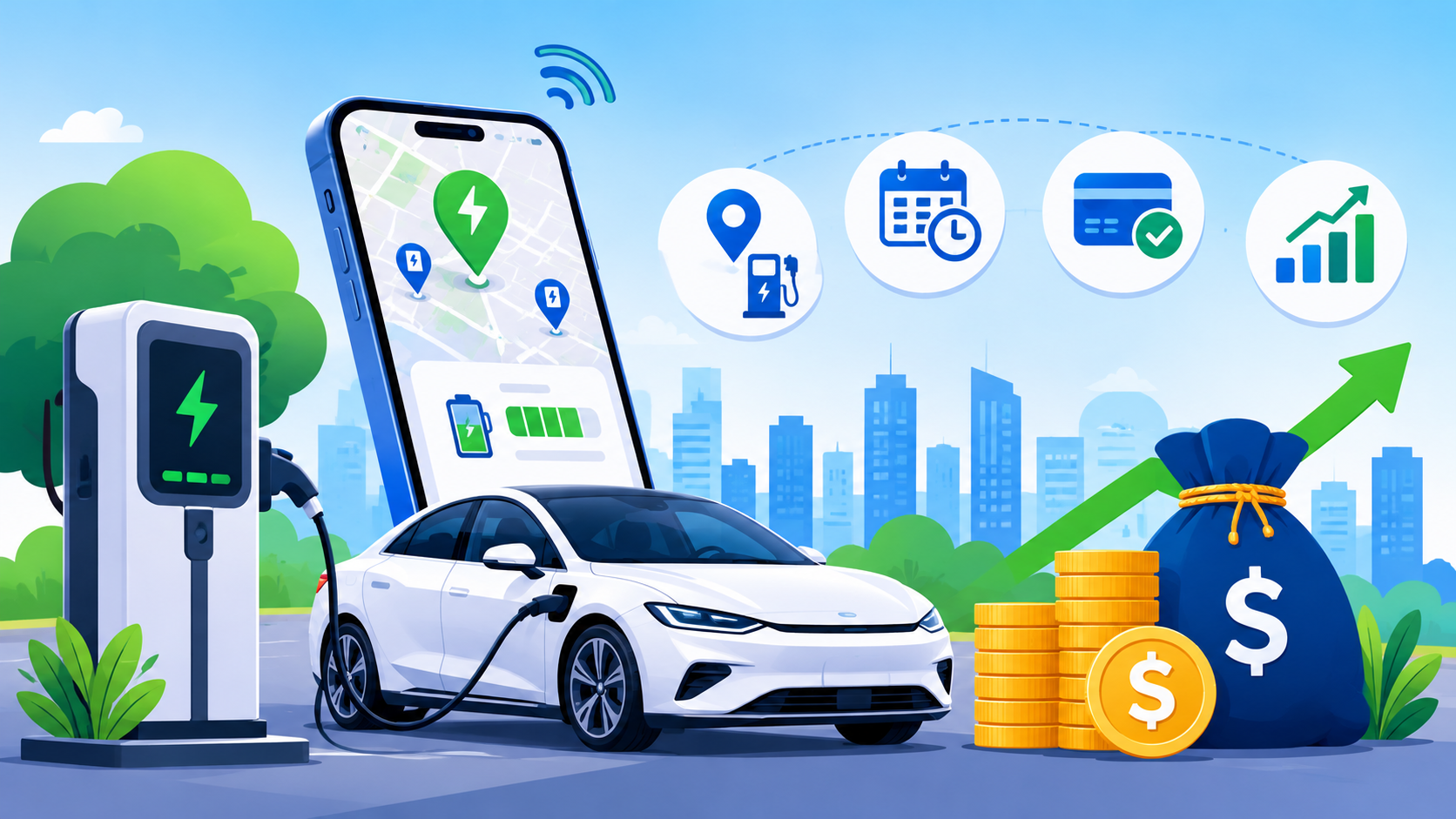
Key Takeaways:
- EV charging app development can cost $8,000 to $90,000+, depending on features, integrations, and platform complexity.
- Core features include station discovery, real-time availability, secure payments, reservations, and charging session tracking.
- OCPP, OCPI, GPS APIs, and payment gateways help connect charging stations, networks, and drivers.
- Businesses can earn through charging fees, subscriptions, fleet management, reservation fees, and white-label solutions.
- Choose an experienced development company with strong security practices, charger integration skills, ongoing support, and clear NDA terms.
Running out of battery with no nearby charger? EV drivers face this problem more often than they should.
For businesses, a poorly designed charging app can mean lost customers, failed payments, and wasted time. EV charging app development in 2027 offers a practical solution.
It connects drivers with charging stations, real-time availability, secure payments, and reservations in one place. But building a reliable app takes the right features and technology.
In this blog, we’ll cover key features, the development process, technology choices, costs, and ways businesses can earn revenue.
What Is EV Charging App Development? And How Does It Work?
EV charging app development is the process of building a mobile app that helps electric vehicle (EV) drivers find charging stations, check charger availability, pay for charging, and reserve charging slots.
It connects drivers with charging networks through maps, payment gateways, and charging station software.
How Does an EV Charging App Work?
An EV charging app connects the driver, the charging station, and the charging network through a few key steps:
- Find nearby stations: GPS and mapping APIs show charging locations, distances, connector types, and charging speeds.
- Check charger availability: The app gets station status from connected charging networks or charger management systems when supported.
- Start a charging session: Users connect their vehicle and authenticate through the app, a QR code, or RFID, depending on the station.
- Pay for charging: The app calculates the session cost based on energy used, pricing rules, and any extra fees, then processes payment through a supported gateway.
- Track and finish charging: Drivers can view session progress, energy use, and costs. The app may send a notification when charging ends and save the receipt in their account.
Benefits of EV Charging App Development for Businesses
EV charging apps help businesses attract more drivers, simplify charging operations, and create new revenue streams as electric vehicle use grows across the U.S.
1. Generate New Revenue Streams
Earn through charging fees, subscriptions, reservation charges, and fleet plans. Flexible pricing can help charging network operators grow revenue as station usage increases.
2. Improve Customer Experience
Help drivers find nearby chargers, check real-time availability, compare charging rates, and pay in-app. A smooth experience can encourage repeat visits and build customer trust.
3. Manage Charging Stations More Efficiently
Use a central dashboard to monitor charger status, track energy use, review transactions, and spot faults. Remote monitoring can reduce manual work and support faster maintenance.
4. Make Better Business Decisions
Use charging session data, peak-hour demand, and station usage reports to identify busy locations and plan expansion. These insights help businesses make informed choices about pricing and capacity.
5. Support Business Growth With Smart Integrations
Connect charging hardware, payment systems, fleet tools, and customer apps as your network expands. Experienced teams offering automotive software development services can help build a platform that fits your business needs and supports future growth.
Market Statistics & Overview
The U.S. EV charging market is growing, creating new opportunities for businesses to build smarter charging apps and networks.
- The EV charging management software market was valued at USD 1.6 billion in 2025 and is projected to reach USD 8.4 billion by 2033, growing at a CAGR of 23.6% from 2026 to 2033.
- The global EV charging app market was valued at USD 13.14 billion in 2024 and is projected to reach USD 137.77 billion by 2031, growing at a CAGR of 40.5%.
Key Features of an EV Charging App
A well-built EV charging app helps drivers find chargers, pay easily, plan trips, and manage charging sessions without hassle.
1. Station Discovery and Real-Time Charger Availability
Help drivers find nearby EV charging stations using GPS, interactive maps, connector types, charging speeds, and live availability. Accurate station details save time and help users avoid arriving at a busy or out-of-service charger.
2. In-App Payments and Billing
Let drivers pay through credit cards, debit cards, digital wallets, or other supported payment methods. Show charging rates, session costs, taxes, and digital receipts clearly. Planning the payment flow also helps estimate the mobile payment app development cost.
3. Charging Station Reservations
Allow users to reserve available charging slots before they arrive. Show booking times, reservation fees, cancellation rules, and slot status. This feature can reduce waiting time at busy stations and help charging operators manage demand during peak hours.
4. Charging Session Tracking and Notifications
Show charging progress, energy consumed in kWh, estimated cost, session duration, and charging status in real time. Push notifications can alert drivers when charging starts, finishes, or stops unexpectedly, so they can plan their next move.
5. Admin Dashboard for Charging Network Operators
Give operators one dashboard to monitor charger status, station usage, payments, energy consumption, and customer issues. Reports can reveal busy locations, failed transactions, and maintenance needs, helping teams manage their charging network more effectively.
6. User Profiles and Charging History
Let drivers save their vehicles, preferred connector types, payment methods, and favorite stations. A charging history with past sessions, energy usage, and receipts makes it easier to track spending and manage regular charging needs.
7. Charger Status Monitoring and Fault Alerts
Connect the app with compatible charger management systems to detect faults, offline stations, and interrupted sessions. Alerts help operators respond faster, while clear status updates prevent drivers from making unnecessary trips to chargers that are not working.
8. Route Planning and Navigation
Helps EV drivers plan trips around compatible charging stations. Use GPS navigation, driving distance, battery range, charging speed, and estimated charging stops to suggest practical routes. The GPS tracking app development cost may vary based on mapping APIs, live traffic data, and route-planning needs.
How to Develop an EV Charging App in 2027
Follow these seven steps to turn your idea into a working app.
Step 1: Research and Planning
Start by understanding your target users and the charging market in the U.S. Study competing apps, such as public charging network apps, and look for gaps in station coverage, pricing, reservations, or payment options.
Next, define your business model. Will you run a charging network, build an app for existing operators, or serve EV fleets? Choose your core features based on that goal, then create a roadmap for future updates.
- Market and competitor analysis: Compare features, charging rates, coverage, and user reviews.
- Business model: Decide how the app will earn revenue through charging fees, subscriptions, or fleet plans.
- Feature roadmap: Prioritize station discovery, payments, reservations, and session tracking before advanced features.
Step 2: Choose Your Tech Stack
|
Component |
Common Technologies |
Purpose |
|
Frontend and Mobile |
Swift, Kotlin, Flutter, React Native |
Build iOS and Android apps |
|
Backend |
Node.js, Python, Java |
Manage app logic, APIs, users, and charging sessions |
|
Database |
PostgreSQL, MySQL, MongoDB |
Store user profiles, station data, bookings, and transactions |
|
Cloud Hosting |
AWS, Microsoft Azure, Google Cloud |
Host the app and support scaling |
|
Protocols |
OCPP, OCPI |
Connect charging stations and support network roaming |
|
Maps and Navigation |
Google Maps Platform, Mapbox |
Show nearby chargers and plan routes |
|
Payment Integration |
Stripe, Braintree, PayPal |
Process charging payments and refunds |
|
Notifications |
Firebase Cloud Messaging, Apple Push Notification service |
Send charging updates and booking alerts |
Your final stack will depend on charger compatibility, expected traffic, security needs, and third-party service fees. These choices also influence the energy software development cost, so plan the budget before development begins.
Step 3: Design the UI/UX
Keep the app simple enough for drivers to use while parked or planning a trip. They should be able to find a charger, check its connector type, see the price, and start a session without digging through menus.
Start with wireframes and clickable prototypes. Test the main screens before development, especially the map, station details, booking flow, and payment screen.
Focus on three things:
- Driver-friendly maps: Make nearby stations, charger status, and charging speeds easy to spot.
- Accessibility: Use readable text, clear buttons, and strong color contrast.
- Localization: Support relevant U.S. units, currency, time formats, and accessible language options.
Step 4: Build Core Features
Develop the essential features first. Start with station discovery, user accounts, payments, reservations, and charging session tracking.
Build each feature around the needs of your target users rather than adding every possible function at launch.
The app must also communicate with supported charging stations or their management systems.
Use compatible APIs and protocols to retrieve charger status and handle session actions. Test these connections with real hardware or suitable test systems before launch.
Step 5: Add Smart and AI Features
Once the core app works reliably, add smart features that solve real problems. AI can help drivers plan trips and help operators manage charging demand, but it depends on accurate data and suitable integrations.
Consider these options:
- Predictive availability: Estimate when chargers may become free using past usage and current session data.
- Smart load balancing: Distribute power across connected chargers based on site capacity and demand.
- Route and trip planning: Suggest charging stops based on distance, battery range, charger speed, and vehicle compatibility.
Start with features that offer clear value. Advanced analytics and energy management can increase development and operating costs, so weigh them against your business goals.
Step 6: Test and Secure
A charging app must do more than open without errors. It needs to show accurate station information, process payments correctly, and handle charger failures without confusing drivers.
Test the app across different phones, network conditions, payment scenarios, and supported charger models. Also check how it performs during busy periods.
Key testing areas include:
- Functional and load testing: Check booking flows, session updates, payment processing, and performance under heavy traffic.
- Charger compatibility testing: Verify communication with supported hardware and charging management systems.
- Security and compliance: Protect personal and payment data, apply access controls, and follow relevant privacy and payment security requirements.
For U.S. deployments, review applicable state privacy laws and PCI DSS requirements for payment card data. The exact obligations depend on how your app collects, processes, and stores information.
Step 7: Launch and Maintain
Before launch, prepare the app for release on the Apple App Store and Google Play. Set up crash reporting, analytics, customer support, and monitoring for charger connections and payment failures.
After launch, track useful metrics such as completed charging sessions, failed payments, active users, station uptime, and repeat bookings. Use this data to fix problems and guide updates.
As the network grows, you may need more cloud capacity, new charger integrations, or stronger energy management tools. Working with an experienced energy software development company can help you plan these upgrades and maintain the platform as business needs change.
How Much Does EV Charging App Development Cost in 2027?
EV charging software development costs in 2027 range from $8,000 to $90,000+, based on features, complexity, and timeline.
|
App Level |
Estimated Development Cost (USD) |
Estimated Timeline |
|
Basic |
$8,000–$15,000 |
2–3 months |
|
Standard |
$15,000–$30,000 |
3–4 months |
|
Advanced |
$30,000–$50,000 |
4–6 months |
|
Multi-Location / Complex |
$50,000–$70,000 |
6–8 months |
|
Enterprise-Level |
$70,000–$90,000+ |
8–12+ months |
Challenges in EV Charging App Development
EV charging apps face challenges with live charger data, hardware compatibility, payment security, and network reliability. Smart planning helps reduce these risks.
1. Real-Time Charger Data
Challenge: Outdated charger status can send drivers to busy or broken stations, causing delays and frustration.
Solution: Use reliable charger APIs and OCPP integrations to update availability, session status, and fault alerts.
2. Charger Hardware Compatibility
Challenge: Different charger brands and models may use different systems, making smooth integration harder.
Solution: Support suitable OCPP versions and test connections across the charger models your network uses.
3. Payment Failures and Security
Challenge: Failed transactions, billing errors, and exposed payment data can damage user trust and disrupt charging sessions.
Solution: Use secure payment gateways, encryption, access controls, and PCI DSS-aligned payment practices.
4. Accurate GPS and Route Planning
Challenge: Incorrect station locations, connector details, or route estimates can leave EV drivers searching for a working charger.
Solution: Use trusted mapping APIs and validate station data, connector types, charging speeds, and route information.
5. Scaling and Network Reliability
Challenge: More drivers and charging stations can strain backend systems, slow updates, and interrupt charging services.
Solution: Use scalable cloud hosting, load testing, monitoring, and backup systems to support growing traffic and uptime.
EV Charging App Monetization Models
EV charging apps can earn revenue through charging fees, subscriptions, fleet services, and partnerships while offering drivers flexible payment options.
- Pay-per-session fees: Earn revenue from each charging session based on energy used or charging time.
- Subscription plans: Offer monthly plans with discounts, premium features, or charging network benefits.
- Reservation fees: Charge users for booking charging slots at busy stations.
- Fleet management services: Sell fleet charging dashboards, usage reports, and billing tools to businesses.
- Partner commissions: Earn commissions by directing drivers to partner charging networks or nearby services.
- White-label solutions: License your EV charging software to operators that want their own branded app.
How to Choose an EV Charging App Development Company
Choosing the right EV charging app development company helps you build a secure, reliable app that fits your business goals and budget.
- EV Charging Experience: Check their experience with OCPP, OCPI, charger integrations, station discovery, and real-time availability.
- Technical Expertise: Review their skills in iOS, Android, cloud platforms, payment gateways, GPS mapping, and backend development.
- Security and Compliance: Ask how they protect user data, secure payments, manage access controls, and follow relevant U.S. privacy laws and PCI DSS requirements.
- Portfolio and Support: Review past EV charging or energy software projects, client feedback, testing methods, maintenance plans, and post-launch support.
- NDA and Project Ownership: Sign a Non-Disclosure Agreement (NDA) before sharing sensitive ideas, and clarify source-code ownership, intellectual property rights, and contract terms.
Conclusion
EV charging app development in 2027 gives businesses a practical way to serve EV drivers and grow in the expanding U.S. charging market. The key is to build an app that makes station discovery, real-time availability, secure payments, and reservations simple.
Start with the features your users need most, then add smart route planning, charger monitoring, and fleet management as your business grows.
Set a realistic budget, test hardware integrations, and work with an experienced development team to build a reliable charging platform that can grow with demand.
FAQ's
EV charging app development can cost $8,000 to $90,000+, depending on features, charger integrations, payment systems, and app complexity.
A basic app may take 2–3 months. Advanced platforms with reservations, live charger data, and fleet tools can take 4–12 months or longer.
Key features include station discovery, real-time availability, route planning, in-app payments, reservations, charging session tracking, user profiles, and an admin dashboard.
Common choices include Swift, Kotlin, Flutter, Node.js, cloud platforms, mapping APIs, payment gateways, and protocols such as OCPP and OCPI.
OCPP stands for Open Charge Point Protocol. It supports communication between compatible EV charging stations and central management systems.
Yes. With suitable integrations and OCPI support, an app can connect with participating charging networks and display station details, tariffs, and availability.
They can earn through charging fees, subscriptions, reservation charges, fleet management services, partner commissions, and white-label software licensing.
Review its charging software experience, OCPP and OCPI knowledge, security practices, portfolio, support plans, and contract terms. Sign an NDA before sharing confidential ideas.

CrinPro
CrinPro Solutions is a leading IT company that helps startups and enterprises build innovative digital products. From intuitive mobile applications and high-performance websites to AI-powered solutions and enterprise software, our team delivers scalable, secure, and user-focused products tailored to unique business needs. With expertise across multiple industries, we transform ideas into digital experiences that drive growth, improve efficiency, and create long-term business value.