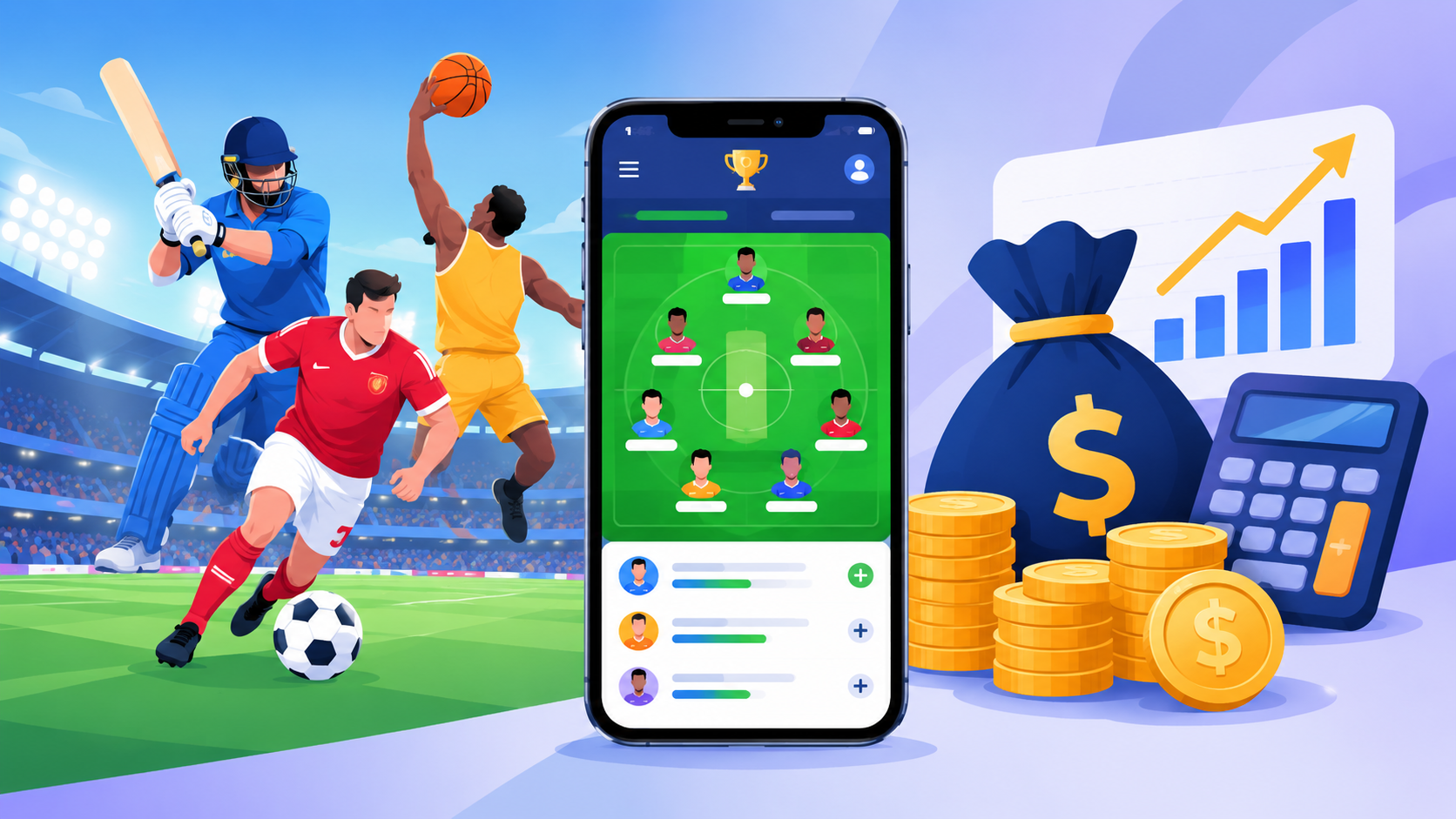
Key Takeaways:
- Costs vary dramatically by model: free-to-play platforms cost significantly less than real-money contests requiring payment processing and compliance work.
- Hidden costs add up fast: data API fees, scaling infrastructure, and legal reviews often exceed initial development estimates if not planned for early.
- Starting focused reduces risk: a single-sport, free-to-play MVP validates demand before you invest in expensive, complex features.
- Technology choices matter significantly: cross-platform frameworks and established data providers reduce cost without sacrificing core functionality.
- Smart budgeting beats cutting corners: phased expansion and prioritizing core features let you optimize spend while still building a quality platform.
"How much will this actually cost?" is usually the first question founders ask once the excitement of a fantasy sports app idea meets the reality of actually building one.
The honest answer depends on more than most people expect; whether you're building free-to-play contests or a full real-money platform changes the number dramatically.
Fantasy sports app development cost isn't a single figure you can plug into a spreadsheet and walk away with confidence.
It's shaped by real-time data integration, payment infrastructure, regulatory compliance, and feature complexity, each pulling the budget in different directions.
This guide breaks down exactly what drives that number, from core cost factors to a realistic, stage-by-stage breakdown, so you can plan with genuine clarity instead of guesswork.
Understanding Fantasy Sports App Pricing: The Basics
Before diving into specific numbers, it helps to understand the baseline reality: cost to build a fantasy sports app varies enormously depending on scope.
These four fundamentals shape how pricing actually works before any custom features enter the conversation.
1. There's No Single "Average" Price
Unlike simpler apps with fairly predictable pricing ranges, fantasy sports platforms span an unusually wide cost spectrum.
A basic, free-to-play MVP can cost a fraction of what a full real-money platform requires, since the underlying complexity, especially around compliance and payments, differs dramatically between these two models.
2. Market Growth Is Fueling More Competitive Builds
Pricing pressure comes partly from a genuinely crowded, fast-growing market.
The global fantasy sports market is projected to reach $80.31 billion by 2031, growing at a CAGR of 13.66%, pushing businesses to invest in more polished, feature-rich platforms just to stay competitive against well-funded incumbents.
3. Real-Money Functionality Is the Biggest Price Driver
Whether a platform involves actual cash prizes fundamentally changes fantasy sports app development scope.
Free-to-play apps skip complex payment processing, fraud prevention, and regulatory compliance work entirely, while real-money platforms require all three, often more than doubling the total development investment required.
4. Mobile-First Development Dominates Budget Allocation
Since 78.1% of the fantasy sports market operates through application-based platforms rather than desktop, most development budgets concentrate heavily on mobile app quality, real-time performance, and responsive design, rather than treating mobile as a secondary consideration after a primary desktop build.
What Drives the Cost Up or Down?
Two businesses building seemingly similar platforms can end up with very different price tags. The specific mix of fantasy sports app features you choose, and how you implement them, shifts pricing significantly in either direction.
1. Real-Money vs. Free-to-Play Model
This single decision affects cost more than almost any other factor.
Sports betting app development cost climbs substantially once you add real-money contests, since payment processing, fraud prevention, and regulatory compliance all become mandatory rather than optional additions to the core platform.
2. Sport Type and Data Complexity
Some sports require more complex scoring logic and data feeds than others.
Fantasy football app development cost, for instance, involves intricate scoring rules across multiple player positions, while simpler formats with fewer variables cost less to build and maintain over time.
3. Number of Supported Sports and Leagues
Building for a single sport costs significantly less than supporting multiple leagues simultaneously.
Fantasy sports platform development that spans football, basketball, and cricket requires separate data integrations and scoring logic for each, multiplying both development time and ongoing data provider costs.
4. Contest Format Variety
Offering only season-long leagues costs less than supporting daily contests, head-to-head matchups, and auction-style drafts simultaneously.
Each additional format requires its own logic and testing, adding meaningfully to overall development time compared to a single, simpler contest structure.
5. Third-Party Data and Payment Integrations
Connecting to sports data providers and payment gateways adds licensing fees and integration time.
Each additional third-party service increases both development cost and ongoing operational expenses, since most providers charge based on usage volume rather than a flat one-time fee.
6. Development Team Location and Expertise
Rates vary significantly based on whether you hire local developers, offshore teams, or a specialized agency.
Teams with proven fantasy sports app development experience typically charge more per hour but reduce the risk of costly compliance or scoring accuracy mistakes later.
A Realistic Cost Breakdown, Stage by Stage
Numbers mean more when you can see exactly where they come from. Whether you're scoping a general platform or specifically fantasy football app development cost, overall investment typically lands between $8,000 and $60,000, and the ten stages below show precisely how that range gets built up in practice.
1. Discovery and Legal Feasibility
This stage covers understanding the target audience, sport selection, and mapping which jurisdictions the platform can legally operate in.
Fantasy sports app development cost starts taking shape here, since regulatory findings often shape the entire technical and business approach that follows.
|
Item |
Description |
Cost |
|
Market & Audience Research |
Identifying target users and sport focus |
$500-$600 |
|
Regulatory Mapping |
Assessing legal requirements by jurisdiction |
$700-$800 |
|
Feasibility Assessment |
Confirming technical and business viability |
$500-$600 |
2. UI/UX Design and Prototyping
Design happens before development begins, with wireframes and prototypes letting stakeholders test the draft and scoring experience.
Getting this right early keeps the overall cost to build a fantasy sports app on track, since design changes made late in development cost far more to implement properly.
|
Item |
Description |
Cost |
|
Wireframes |
Basic layout and user flow structure |
$500-$600 |
|
Interactive Prototypes |
Clickable mockups for stakeholder testing |
$700-$800 |
|
Final UI Design |
Polished, branded visual design |
$900-$1,000 |
3. Frontend Development
Developers build the user-facing interface, connecting it to backend systems built later in the process.
This stage focuses heavily on responsiveness and load speed, an area where real-money fantasy sports app development demands extra polish, since users expect flawless performance during live, high-stakes games.
|
Item |
Description |
Cost |
|
Core App Screens |
Home, team creation, and contest screens |
$900-$1,000 |
|
Draft Interface |
Team-building and player selection tools |
$700-$800 |
|
Live Scoring Display |
Real-time score and leaderboard views |
$700-$800 |
4. Backend and Database Architecture
This stage builds the engine handling contest logic, user accounts, and data processing reliably.
Careful architecture planning here prevents slowdowns or errors as user numbers and contest volume grow, a core driver of overall mobile app development cost across the entire project.
|
Item |
Description |
Cost |
|
Server Architecture |
Core infrastructure for data processing |
$900-$1,000 |
|
Database Design |
Structured storage for users and contests |
$900-$1,000 |
|
API Development |
Connections between frontend and backend |
$700-$800 |
5. Real-Time Sports Data Integration
Accurate, low-latency data feeds power the entire scoring experience.
This stage integrates with established sports data providers, and custom fantasy sports app development often invests heavily here, since verified, real-time statistics directly determine whether users trust the platform's scoring.
|
Item |
Description |
Cost |
|
Data Provider Integration |
Connecting to sports statistics APIs |
$700-$800 |
|
Scoring Engine Development |
Building accurate, real-time point calculation |
$900-$1,000 |
|
Data Sync Testing |
Verifying accuracy across live scenarios |
$700-$800 |
6. Payment and Prize Distribution System
For real-money contests, secure payment processing, entry fee collection, and automated prize distribution get built here.
This stage directly supports fantasy sports app monetization, since reliable payment handling is what actually turns entry fees and subscriptions into sustainable revenue.
|
Item |
Description |
Cost |
|
Payment Gateway Setup |
Secure entry fee and deposit processing |
$700-$800 |
|
Prize Distribution Logic |
Automated payout calculations and transfers |
$700-$800 |
|
Multi-Currency Support |
Handling different regional payment methods |
$500-$600 |
7. Security and Compliance Implementation
This stage covers encryption, identity verification, and anti-fraud monitoring, along with age verification and responsible gaming tools where required.
Choices made about the fantasy sports app technology stack here directly affect how robust these protections end up being.
|
Item |
Description |
Cost |
|
Data Encryption |
Securing user and transaction data |
$500-$600 |
|
Identity Verification |
Age and identity confirmation systems |
$700-$800 |
|
Anti-Fraud Monitoring |
Detecting suspicious account activity |
$700-$800 |
8. Third-Party and Social Integrations
Connecting the app to notification services, analytics tools, and social sharing features happens here. Getting these integrations right the first time prevents operational headaches once real users start relying on the platform daily.
|
Item |
Description |
Cost |
|
Push Notification Setup |
Real-time alerts for scores and deadlines |
$500-$600 |
|
Analytics Integration |
Tracking user behavior and engagement |
$500-$600 |
|
Social Sharing Features |
League chat and social engagement tools |
$500-$600 |
9. Quality Assurance and Load Testing
Before launch, the platform undergoes rigorous testing, including simulating high-traffic scenarios during major games.
This stage mirrors broader on-demand app development cost patterns, where thorough load testing prevents crashes during exactly the peak moments when the most users are active.
|
Item |
Description |
Cost |
|
Functional Testing |
Verifying features work as intended |
$500-$600 |
|
Load Testing |
Simulating high-traffic game-day scenarios |
$700-$800 |
|
Security Testing |
Checking for vulnerabilities and gaps |
$700-$800 |
10. Deployment and Post-Launch Support
Launch involves final deployment and go-live monitoring. Ongoing support afterward covers bug fixes and updates, and businesses budgeting fantasy cricket app development cost specifically should factor this recurring expense in from the start, not just the one-time launch cost.
|
Item |
Description |
Cost |
|
App Store Submission |
Deployment to iOS and Android platforms |
$500-$600 |
|
Go-Live Monitoring |
Launch day performance tracking |
$500-$600 |
|
Post-Launch Support |
Ongoing bug fixes and updates |
$500-$600/month |
Cost Comparison: MVP vs. Business vs. Enterprise Platforms
Not every fantasy sports app needs the same investment, and this holds true whether you're building a general platform or focused specifically on fantasy cricket app development.
Comparing these three tiers side by side across the features that actually drive cost helps you figure out which one realistically matches your budget and business goals.
|
Feature/Aspect |
MVP ($8,000–$15,000) |
Business ($15,000–$35,000) |
Enterprise ($35,000–$60,000) |
|
Contest Model |
Free-to-play only |
Free-to-play + real-money contests |
Multiple real-money contest formats |
|
Sports Supported |
Single sport |
2–3 sports |
Multiple sports and leagues |
|
Real-Time Data |
Basic scoring updates |
Live, low-latency scoring |
Advanced real-time analytics |
|
Payment System |
Not included |
Single payment gateway |
Multiple gateways, multi-currency |
|
Draft Formats |
Simple team selection |
Live draft + auction formats |
All formats + custom rule sets |
|
Compliance Features |
Minimal (free-play focus) |
Age verification, basic KYC |
Full regulatory compliance suite |
|
Security |
Standard encryption |
Encryption + fraud monitoring |
Advanced anti-fraud and AI monitoring |
|
Social Features |
Basic leaderboards |
League chat, social sharing |
Full community and engagement tools |
|
Scalability |
Suited for smaller user base |
Moderate traffic handling |
Built for high-volume, peak traffic |
|
Post-Launch Support |
Limited bug fixes |
Regular updates and monitoring |
Dedicated ongoing support team |
Costs Businesses Often Forget to Budget For
Most businesses budget for design and development, then get blindsided by expenses that surface later.
Fantasy sports app development cost estimates often miss these eight recurring or hidden expenses, ones that quietly inflate the total budget well past the initial quote.
1. Sports Data API Licensing Fees
Live scoring depends on data providers who charge ongoing fees based on usage volume, not a one-time setup cost.
As user numbers grow, fantasy sports app development budgets need to account for these recurring, usage-based charges that scale directly with platform activity and traffic.
2. Scaling Infrastructure Costs
What works fine during testing can strain under real game-day traffic. Businesses often underestimate how much their fantasy sports app technology stack will cost to scale, since cloud infrastructure bills climb significantly once thousands of users check live scores simultaneously.
3. Ongoing Legal and Compliance Reviews
Regulations shift, and platforms operating across multiple regions need periodic legal reviews to stay compliant.
Fantasy sports platform development budgets frequently miss this recurring legal consultation cost, treating compliance as a one-time task rather than an ongoing operational expense.
4. Payment Processing and Transaction Fees
Beyond the initial payment gateway setup, every transaction carries a percentage-based fee that scales with revenue.
Real money fantasy sports app development businesses often forget to factor these ongoing processing costs into their long-term financial projections, focusing only on upfront integration.
5. Customer Support Infrastructure
Users need help when scoring disputes, payment issues, or account problems arise.
A fantasy sports app development company will typically flag this, but many founders underestimate the ongoing cost of staffing support during peak game days when ticket volume spikes.
6. Marketing and User Acquisition
A well-built platform means nothing without users, and acquiring both casual and paying players requires ongoing ad spend.
Custom fantasy sports app development gets the technical side right, but marketing budgets are frequently underestimated separately, especially in an increasingly competitive market.
7. Security Audits and Penetration Testing
A one-time security review during development isn't enough to protect against evolving threats, especially for platforms handling real money.
Regular penetration testing catches new vulnerabilities before they're exploited, an ongoing cost businesses often skip to save money upfront.
8. Feature Updates Based on User Feedback
Launching the app isn't the end of spending. Real users surface bugs, request new contest formats, and reveal usability issues internal testing missed.
Budgeting for continuous updates, not just a single post-launch fix cycle, keeps the platform competitive long-term.
How to Optimize Your Budget Without Cutting Corners?
Smart budgeting isn't about spending less; it's about spending on the right things at the right time.
Whether you're evaluating fantasy football app development services or building for another sport entirely, these eight strategies help you optimize spend without sacrificing quality.
1. Start With a Focused MVP
Rather than building every planned feature upfront, launch with core functionality only, team creation, basic scoring, and one contest format.
This approach lets real users validate demand before you invest heavily in advanced features that may not actually match what your audience wants.
2. Choose One Sport Before Expanding
Supporting multiple sports simultaneously multiplies data integration and scoring logic costs significantly.
Launching with a single sport first lets you prove the platform works reliably, then expand to additional sports once revenue and user data justify the added investment.
3. Use Established Sports Data Providers
Building custom data infrastructure from scratch costs far more than integrating with proven providers like Sportradar.
Established providers handle the complexity of accurate, real-time data feeds, letting your development budget focus on the actual user experience instead of reinventing data infrastructure.
4. Delay Real-Money Contests Until Demand Is Proven
Launching free-to-play first avoids the high added cost of payment processing, fraud prevention, and compliance work upfront.
Once you've validated genuine user engagement, introducing real-money contests becomes a lower-risk investment backed by actual usage data rather than assumptions.
5. Choose Cross-Platform Development Frameworks
Building separate native apps for iOS and Android roughly doubles frontend development cost.
Cross-platform frameworks like React Native or Flutter let you build once and deploy to both platforms, significantly reducing development time without meaningfully compromising performance or user experience.
6. Prioritize Core Features Over Nice-to-Haves
Social features, advanced analytics, and custom rule sets add real value but aren't essential for proving your core concept works.
Building these later, once the platform has active users and revenue, avoids tying up initial budget in features that may not get used.
7. Plan for Phased Geographic Expansion
Launching in a single, well-understood market first avoids the compounding legal and compliance costs of supporting multiple jurisdictions simultaneously.
Expanding geography gradually, market by market, lets you fund each expansion with revenue from your existing user base.
8. Build Scalability Into Architecture From Day One
While this adds some upfront cost, designing for scalability early costs far less than retrofitting a poorly architected system after it's already struggling under real traffic.
This upfront investment prevents the much larger expense of an emergency rebuild later.
Final Thoughts
Fantasy sports app development cost isn't a single number; it's the sum of dozens of decisions: sport selection, real-money functionality, technology stack, and how much you invest in compliance and scalability from the start.
Understanding what actually drives that cost gives you real control over your budget instead of being surprised by expenses halfway through the project.
Whether you're launching a lean, free-to-play MVP or a full-featured real-money platform, the breakdown covered here gives you a realistic starting point for planning.
Businesses that budget thoughtfully, accounting for both obvious development costs and easily overlooked ongoing expenses, are the ones that build platforms capable of scaling smoothly instead of running into financial surprises down the road.
FAQ's
Costs typically range from $8,000 for a basic, free-to-play MVP to $60,000 or more for a full-featured, real-money platform with advanced compliance and scalability.
Starting with a single sport, free-to-play contests, and a focused MVP feature set keeps upfront costs lowest. You can expand features as revenue grows.
Yes. Real-money functionality requires payment processing, fraud prevention, and regulatory compliance work that free-to-play platforms can skip entirely, often adding substantial cost.
Most fantasy sports apps take four to nine months to build, depending on complexity, real-money functionality, and how many sports or contest formats are supported.
Ongoing sports data API fees and scaling infrastructure costs are the most commonly underestimated expenses, since both scale directly with user growth and traffic.
Starting with one sport keeps costs lower and lets you validate the platform before expanding. Multiple sports multiply data integration and scoring logic costs significantly.
Plan for 15-20% of your original development cost annually, covering data fees, hosting, security updates, and feature improvements based on real user feedback.
Yes. Many successful platforms launch free-to-play first, then introduce real-money contests once user engagement and retention data justify the added investment and complexity.
Yes. Building with frameworks like React Native or Flutter instead of separate native apps for iOS and Android can meaningfully reduce frontend development costs.
Get itemized quotes from multiple providers, compare what's actually included rather than just the total price, and start with a focused MVP before adding advanced features.

CrinPro
CrinPro Solutions is a leading IT company that helps startups and enterprises build innovative digital products. From intuitive mobile applications and high-performance websites to AI-powered solutions and enterprise software, our team delivers scalable, secure, and user-focused products tailored to unique business needs. With expertise across multiple industries, we transform ideas into digital experiences that drive growth, improve efficiency, and create long-term business value.