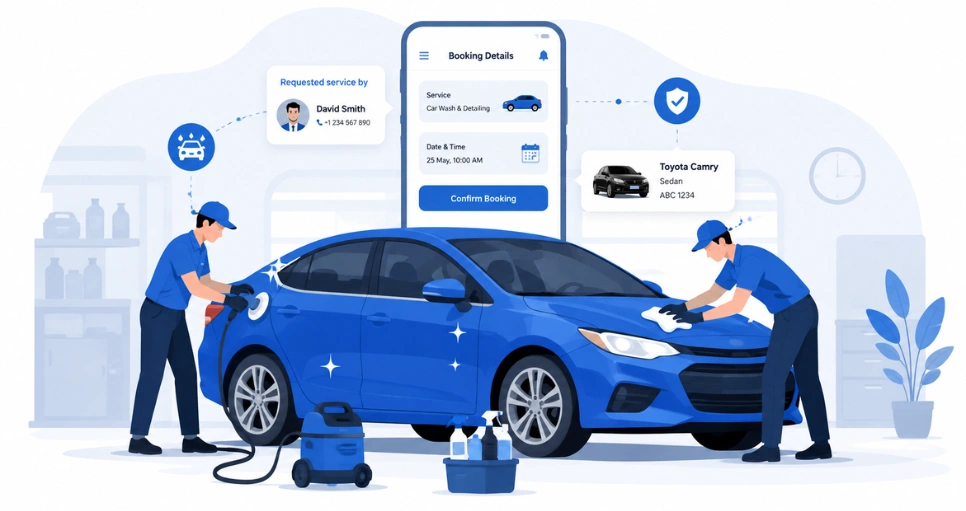
Key Takeaways :
- Car wash booking app development costs typically range from $8,000 to $80,000, depending on features and platform complexity.
- Real-time booking, secure payments, and reliable scheduling logic are core, non-negotiable features for a competitive platform.
- Most builds take 3-6 months, covering planning, core development, integrations, and thorough testing before launch.
- On-demand mobile wash support and subscription memberships significantly boost revenue potential but also increase overall development complexity.
- Partnering with a car wash-experienced development team reduces costly rework and speeds up time to a competitive launch.
Car wash businesses relying on walk-ins and phone bookings often struggle with unpredictable demand, no-shows, and scheduling gaps that leave staff idle during slow periods.
As customer expectations shift toward on-demand convenience, more car wash operators are exploring car wash booking app development as a way to fill schedules, reduce no-shows, and reach customers who'd rather book from their phone than call ahead.
A well-built booking app does more than digitize appointments. It gives customers real-time slot availability, service customization, and secure payment options, while giving operators better visibility into daily capacity and revenue.
Getting the features and budget right from the start matters just as much as the technology itself.
This guide breaks down the core features, realistic development costs, and business benefits of launching a competitive car wash booking app in 2026.
What Is a Car Wash Booking App, and Why Are Businesses Investing in One?
A car wash booking app lets customers schedule appointments, choose services, and pay directly from their phones instead of calling or waiting in line.
Growing demand for digital scheduling is fueling rising interest in car wash app development across independent shops and larger chains alike.
1. Customers Now Expect On-Demand, App-Based Scheduling
More drivers prefer booking a wash through an app rather than calling ahead or hoping for a short wait at a physical location.
This shift toward instant, mobile-first scheduling is pushing operators to prioritize digital booking over walk-in-only models.
2. Strong, Sustained Global Market Growth Through 2026
The global car wash service market is projected to grow from $36.29 billion in 2025 to $38.43 billion in 2026, reaching $54.48 billion by 2033 at a 5.1% CAGR.
3. Digital Scheduling and Memberships Are Reshaping the Industry
App-based booking platforms are already improving customer accessibility by around 41%, while a 42% surge in subscription-based car care memberships shows how digital tools are reshaping customer engagement heading into 2027.
Must-Have Features for a Competitive Car Wash Booking App
The right car wash app features determine whether your platform genuinely fills schedules or gets abandoned after a single confusing booking attempt.
From real-time availability to secure payments, each functionality directly shapes customer trust and repeat bookings.
1. Real-Time Slot Booking and Availability
Customers need instant visibility into available time slots based on location, service type, and staff capacity.
Fast, accurate scheduling reduces booking friction and prevents the double bookings that frustrate both customers and staff.
2. Service Customization and Package Selection
Allowing customers to choose specific services, from basic exterior washes to full detailing packages, gives them control over cost and time.
A well-built mobile car wash app development project treats this flexibility as a core expectation.
3. Location-Based Search and Directions
For businesses with multiple locations, GPS-based search helps customers find the nearest available option quickly.
Integrated map directions reduce confusion and improve the overall experience from booking through arrival at the wash site.
4. Mobile and On-Demand Wash Requests
Supporting on-demand car wash app development for mobile or at-home services gives customers added convenience beyond fixed-location bookings.
This flexibility appeals particularly to busy professionals who value time savings over travel.
5. Secure Payment and Membership Management
Integrated payment processing supporting one-time purchases and recurring subscription memberships streamlines transactions significantly.
Reliable billing systems reduce disputes and support the growing popularity of subscription-based car care models.
6. Automated Reminders and Rebooking
Push notifications reminding customers of upcoming appointments, along with easy rebooking for recurring washes, improve retention.
This automation reduces no-shows while making it effortless for satisfied customers to schedule their next visit.
Business Benefits of Launching a Car Wash Booking App
Beyond convenience for customers, a well-built app delivers measurable business advantages for operators.
Reliable booking app development helps car wash businesses fill schedule gaps, reduce no-shows, and build stronger, more predictable revenue streams over time.
1. Reduced No-Shows and Schedule Gaps
Automated reminders and easy rebooking significantly reduce missed appointments compared to phone-based scheduling alone.
This predictability helps staff plan capacity more accurately and reduces idle time during traditionally slower business periods.
2. Increased Revenue Through Upselling
Displaying service add-ons and package upgrades directly within the booking flow encourages customers to spend more per visit.
Strong car wash service app development treats this upselling opportunity as a genuine revenue driver, not an afterthought.
3. Improved Customer Retention Through Memberships
Supporting subscription-based wash memberships encourages repeat visits and creates predictable, recurring revenue.
This model aligns with the broader industry shift toward subscription-driven customer engagement seen across the car wash sector.
4. Better Capacity Planning and Staffing
Real-time visibility into booking volume, powered by reliable car wash booking software, helps managers schedule staff more efficiently based on actual demand rather than guesswork or historical averages alone.
5. Valuable Customer Data and Insights
Tracking booking patterns, popular services, and customer preferences helps operators make informed decisions about pricing, promotions, and service offerings.
This data-driven approach supports smarter, more targeted business decisions over time.
6. Streamlined Multi-Location Operations
For businesses with several locations, centralized car wash management software simplifies oversight, standardizes service offerings, and provides consistent reporting across every site from a single, unified dashboard.
Step-By-Step Guide to Develop a Car Wash Booking App
Building a successful car wash booking app development requires a structured process that balances scheduling logic, payments, and usability.
Here's exactly how this process moves from initial concept through a fully functional, market-ready platform.
1. Define Your Business Model and Service Scope
Decide whether you're building a fixed-location booking tool, an on-demand mobile wash service, or a hybrid model.
Clarifying this focus early shapes every decision throughout custom car wash app development, from features to backend architecture.
2. Conduct Market and Competitor Research
Studying existing platforms helps identify service gaps and pricing benchmarks relevant to your region.
Understanding successful automotive software development approaches gives useful context for positioning your app competitively against established booking platforms.
3. Choose the Right Development Partner
Selecting an experienced car wash app development company familiar with scheduling systems and payment processing reduces project risk significantly.
Their expertise speeds up development while ensuring reliable booking functionality from launch.
4. Design Wireframes and User Interface
Creating intuitive wireframes for service selection, scheduling, and checkout ensures smooth navigation before development begins.
Any well-designed car wash scheduling app prioritizes quick booking flows with minimal friction for busy customers.
5. Choose the Right Technology Stack
Selecting appropriate programming languages, mapping APIs, and cloud infrastructure depends on your app's scale and features.
Many mobile app development companies rely on scalable cloud architecture to support real-time availability updates reliably.
6. Build Core Booking and Scheduling Functionality
This stage involves developing service listings, time slot selection, and reservation logic central to any car wash app development project.
Reliable scheduling logic prevents double-bookings and keeps availability accurate in real time.
7. Integrate Secure Payment and Membership Systems
Building encrypted payment gateways alongside subscription membership options streamlines transactions for customers.
Understanding car wash booking app development cost at this stage ensures resources are allocated efficiently for this critical functionality.
8. Add Automated Reminders and Personalization
Partnering with experienced AI app development companies can enhance reminder timing and personalized service recommendations based on customer history and preferences, improving retention and repeat booking rates significantly.
9. Enable Location-Based and On-Demand Options
Building GPS-based search alongside on-demand car wash app development for mobile or at-home services gives customers added flexibility beyond fixed-location bookings, appealing to time-conscious users.
10. Test, Launch, and Monitor Performance
Rigorous testing across booking scenarios, payment flows, and location accuracy prevents costly post-launch issues.
Ongoing refinement of the car wash scheduling app based on real user feedback ensures continued reliability after launch.
Car Wash Booking App Development Cost Breakdown
Understanding realistic mobile app development cost benchmarks helps businesses plan accurately for a car wash booking app project.
Pricing typically ranges from $8,000 to $80,000, depending on features, integrations, and platform complexity. Here's a detailed breakdown.
|
Development Stage |
Description |
Estimated Cost |
|
UI/UX Design |
Wireframes, prototypes, and interface design |
$800-$950 |
|
Real-Time Booking & Scheduling |
Slot availability and reservation logic |
$2,600-$3,900 |
|
Service Customization Module |
Package selection and add-on options |
$1,600-$2,400 |
|
Location-Based Search & Maps |
GPS search and directions integration |
$1,900-$2,900 |
|
On-Demand Mobile Wash Support |
At-home or mobile service booking logic |
$2,200-$3,300 |
|
Payment & Membership System |
Secure processing and subscription billing |
$2,000-$2,900 |
|
Automated Reminders & Notifications |
Push alerts and rebooking prompts |
$1,300-$2,000 |
|
Backend & Database Architecture |
User data, bookings, and scalability setup |
$2,200-$3,300 |
|
Third-Party API Integrations |
Maps, payment gateways, and analytics tools |
$900-$1,600 |
|
QA Testing & Post-Launch Support |
Cross-device testing and ongoing maintenance |
$1,800-$2,700 |
Factors That Can Increase or Reduce Your Development Budget
Several variables influence the total cost of car wash booking app development, from feature complexity to platform choice.
Understanding these factors upfront helps businesses plan realistic budgets and avoid unexpected expenses partway through development.
1. App Complexity and Feature Scope
A basic scheduling tool costs far less than one packed with subscription billing, upselling features, and advanced analytics.
Overall software development cost climbs quickly as custom functionality and third-party integrations increase in number.
2. On-Demand vs. Fixed-Location Models
Supporting mobile car wash app development for at-home or on-location services requires more complex routing and scheduling logic than apps built solely for fixed-location bookings, increasing overall development complexity.
3. Multi-Location Management Requirements
Businesses operating multiple sites need centralized car wash management software to standardize service offerings and reporting.
This added backend complexity significantly increases both development time and overall project cost.
4. Platform Choice: Web, iOS, or Android
Following a solid web application development guide alongside native mobile builds helps businesses plan realistically for launching across multiple platforms simultaneously, rather than underestimating combined development effort.
5. Level of Design Customization
Choosing custom car wash app development over template-based solutions increases upfront costs but delivers greater scalability and brand differentiation compared to generic, pre-built scheduling frameworks.
6. Payment and Membership Complexity
Supporting subscription memberships, tiered pricing, and multiple payment methods adds technical complexity to car wash service app development projects, particularly when handling recurring billing and membership management together.
7. Development Team Location and Expertise
Where you hire significantly affects pricing. Agencies in North America and Western Europe typically charge more per hour than teams in South Asia or Eastern Europe, though quality varies.
8. Choice of Development Partner
Selecting an experienced car wash app development company familiar with scheduling and payment-specific challenges can reduce costly rework.
Generalist agencies unfamiliar with these requirements often require more revisions, extending both budget and timeline.
Final Thoughts
Building a car wash booking app in 2026 comes down to smart planning around scheduling, payments, and the right development partner from the very start.
As this guide shows, development costs typically range from $8,000 to $80,000, depending on features, integrations, and platform complexity.
Prioritize real-time booking, secure payment processing, and reliable scheduling logic before investing in advanced extras like on-demand mobile wash support.
Choosing between a fixed-location tool and a broader, multi-location platform significantly affects both cost and long-term scalability.
With careful budgeting and a clear development roadmap, car wash businesses can launch a competitive app that reduces no-shows, improves capacity planning, and builds stronger customer relationships while positioning the business for sustainable growth.
FAQ's
Development costs typically range from $8,000 to $80,000, depending on features, platform choice, integrations, and the development team you hire.
Most car wash booking apps take 3-6 months to develop, factoring in planning, core development, integrations, and thorough testing before launch.
Yes, starting with a basic MVP focused on scheduling and payments keeps initial costs closer to $8,000-$18,000.
It depends on your business model. Fixed-location bookings are simpler to launch, while on-demand services add complexity but expand your customer base.
Yes, subscription memberships align with the industry's growing shift toward recurring revenue and significantly improve customer retention over time.
On-demand mobile wash support, subscription billing, and multi-location management typically add the most to your overall development budget.
Yes, launching on either iOS or Android alone reduces development and testing costs significantly compared to building for both platforms simultaneously.
Plan for server maintenance, security updates, and feature enhancements, which typically add $1,800-$2,700 annually depending on your app's scale and usage.
Yes, common revenue streams include subscription memberships, premium service upgrades, and add-on packages like detailing or protective coatings.
Yes, a specialized company understands scheduling logic, payment processing, and industry-specific challenges, reducing costly errors compared to a generalist development team.

CrinPro
CrinPro Solutions is a leading IT company that helps startups and enterprises build innovative digital products. From intuitive mobile applications and high-performance websites to AI-powered solutions and enterprise software, our team delivers scalable, secure, and user-focused products tailored to unique business needs. With expertise across multiple industries, we transform ideas into digital experiences that drive growth, improve efficiency, and create long-term business value.