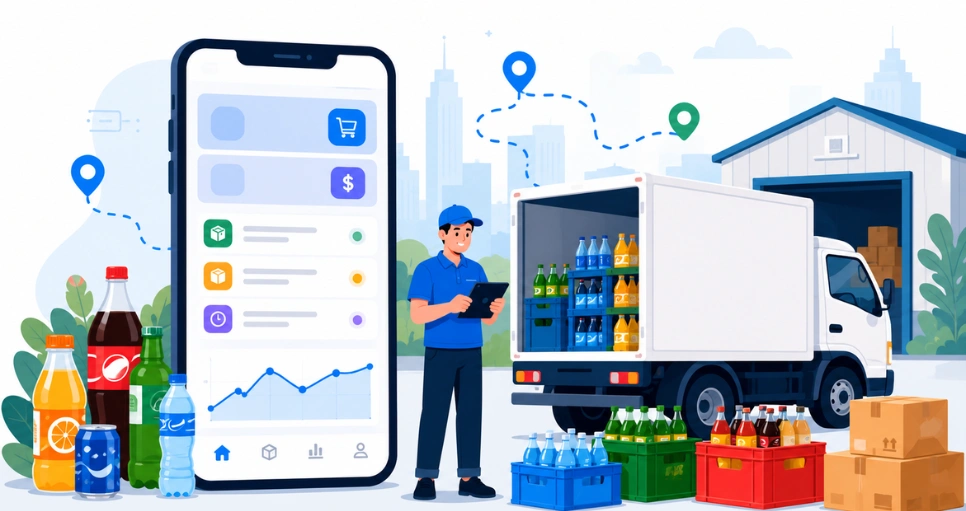
Key Takeaways:
- Beverage distribution app development costs typically range from $6,000 to $80,000, depending on features and integration complexity.
- Real-time inventory tracking, streamlined sales orders, and accurate delivery tracking are core, non-negotiable features for a competitive platform.
- Most builds take 4-7 months, covering design, core inventory and order features, delivery integration, and thorough testing.
- Batch and expiration tracking are essential given the perishable nature of many beverage products, protecting quality and simplifying recalls.
- Partnering with a development team experienced in beverage logistics reduces costly rework and speeds up time to launch.
Beverage distributors face a unique operational challenge: managing perishable and high-volume inventory, processing constant sales orders, and coordinating delivery routes, often all at once and often still using spreadsheets or paper-based systems.
As competition intensifies and margins tighten, more distributors are turning to beverage distribution app development to bring these disconnected processes together into one reliable, real-time platform.
A well-built distribution app does more than digitize paperwork. It gives businesses accurate inventory visibility, faster order processing, and live delivery tracking, all of which directly reduce waste, missed deliveries, and lost revenue.
Getting these three core functions right requires careful planning around features, technology, and cost.
This guide breaks down everything distributors need to know, from essential features and realistic costs to the development process for building a competitive app in 2026.
What Is a Beverage Distribution App, and Why Do Distributors Need One?
A beverage distribution app is a digital platform that helps distributors manage inventory, process sales orders, and track deliveries from one centralized system.
Growing operational complexity is driving rising interest in beverage delivery app development across wholesalers and regional distributors alike.
1. Manual Systems Can't Keep Up With Growing Complexity
Spreadsheets and paper-based processes break down quickly as product lines, delivery zones, and order volumes expand.
This shift toward digital, real-time systems is pushing beverage businesses to prioritize centralized platforms over disconnected manual tracking methods.
2. Strong, Sustained Growth in Beverage-Specific Software
The wine, beer, and spirits software market is projected to grow from $15.01 billion in 2025 to $16.38 billion in 2026, reaching $23.05 billion by 2030 at an 8.9% CAGR.
3. Inventory Management Leads Software Adoption Priorities
Inventory management functionality dominated the beverage software market with a 34.2% revenue share in 2025, reflecting how central real-time stock visibility has become for beverage producers and distributors.
Must-Have Features: Inventory, Sales Orders & Delivery Tracking
The right beverage distribution app features determine whether your platform genuinely improves daily operations or adds unnecessary complexity.
From real-time stock visibility to live delivery updates, each functionality directly shapes efficiency, accuracy, and customer satisfaction.
1. Real-Time Inventory Tracking
Live stock visibility across warehouses and delivery vehicles prevents overselling and stockouts on high-demand products.
Accurate, real-time counts help distributors make faster restocking decisions and avoid costly fulfillment delays during peak demand periods.
2. Batch and Expiration Date Management
Given the perishable nature of many beverages, tracking batch numbers and expiration dates is essential for reliable beverage logistics app development.
This feature prevents distributing expired stock and simplifies recall management when quality issues arise.
3. Automated Sales Order Processing
Streamlined order entry, approval workflows, and automatic inventory deduction reduce manual errors and speed up fulfillment.
Reliable beverage supply chain software ensures sales reps and customers can place orders quickly without back-and-forth phone calls or paperwork.
4. Customer-Specific Pricing and Order History
Supporting tiered pricing, volume discounts, and order history by customer account helps sales teams manage relationships more effectively.
This feature improves accuracy for repeat orders and reduces disputes over pricing agreements or past transactions.
5. Real-Time Delivery Tracking and Route Optimization
Live GPS tracking combined with smart routing algorithms minimizes delivery delays and fuel costs across multiple stops.
Accurate ETAs and route efficiency directly improve customer satisfaction and reduce operational costs for delivery fleets.
6. Proof of Delivery and Digital Signatures
Photo confirmation, digital signatures, and delivery timestamps protect both distributors and customers from disputes over missing or damaged shipments.
This accountability feature is especially valuable for high-volume, recurring beverage delivery routes.
Key Benefits of a Beverage Distribution App for Your Business
Beyond digitizing daily tasks, a well-built app delivers measurable business advantages. Improved beverage sales order management reduces errors and speeds up fulfillment, while better visibility across operations helps distributors make smarter, faster business decisions overall.
1. Reduced Manual Errors and Data Entry Mistakes
Automating order entry, inventory updates, and delivery confirmations significantly reduces human error compared to manual spreadsheet-based processes.
Fewer mistakes mean fewer costly disputes, returns, and customer complaints over incorrect orders or shipments.
2. Faster Order-to-Delivery Cycle Times
Streamlined workflows from order placement through fulfillment and delivery significantly reduce turnaround times.
Efficient beverage distribution software development helps businesses fulfill orders faster, improving customer satisfaction and increasing overall delivery capacity without adding staff.
3. Improved Cash Flow Through Faster Invoicing
Automated invoicing tied directly to completed deliveries speeds up billing cycles and reduces payment delays.
This improved cash flow visibility helps distributors manage working capital more effectively across seasonal demand fluctuations.
4. Better Customer Relationships Through Reliable Service
Accurate order fulfillment, on-time deliveries, and transparent communication build stronger, longer-lasting customer relationships.
Reliable service differentiates distributors in a competitive market where switching suppliers is often just one phone call away.
5. Data-Driven Decision Making
Centralized reporting on sales trends, inventory turnover, and delivery performance helps distributors identify opportunities and inefficiencies quickly.
This visibility supports smarter purchasing decisions and more accurate demand forecasting across product lines.
6. Reduced Waste From Expired or Overstocked Products
Real-time visibility into stock levels and expiration dates, powered by solid inventory management software development, helps distributors minimize waste from unsold or expired perishable beverage products. This directly protects profit margins over time.
How Will You Create Beverage Inventory Using an Inventory App?
Setting up inventory correctly from day one determines how smoothly the rest of your distribution operations run.
Strong logistics software development practices make this initial setup process straightforward, even for distributors managing hundreds of product variations and SKUs.
1. Import Existing Product Data
Most inventory apps let you bulk upload existing product catalogs, including SKUs, pricing, and supplier details, directly from spreadsheets.
This saves significant setup time compared to manually entering each product individually into the new system.
2. Organize Products by Category and Attributes
Grouping beverages by type, brand, package size, and supplier makes navigation and reporting easier down the line.
Thoughtful custom beverage distribution app development ensures this categorization structure supports both daily operations and long-term scalability.
3. Set Up Batch and Expiration Tracking
Assigning batch numbers and expiration dates to each inventory entry ensures accurate tracking of perishable stock from receipt through delivery.
This setup step is essential for maintaining product quality and simplifying recall management if needed.
4. Configure Warehouse and Storage Locations
Mapping specific storage locations, whether by warehouse, zone, or shelf, helps staff locate products quickly during picking and fulfillment.
Accurate location data reduces search time and improves overall warehouse efficiency significantly.
5. Establish Reorder Points and Alerts
Setting minimum stock thresholds triggers automatic reorder alerts before products run out completely.
This proactive approach prevents stockouts on high-demand items while avoiding the excess capital tied up in overstocked inventory.
6. Sync Inventory Across Sales Channels
Connecting inventory data across direct sales, e-commerce, and wholesale channels ensures accurate stock counts everywhere simultaneously.
Reliable beverage wholesale distribution software prevents overselling when the same products are available through multiple ordering channels at once.
Step-by-Step Development Process for a Beverage Distribution App
Building a successful beverage distribution app requires a structured process that balances inventory accuracy, order management, and delivery logistics.
Here's exactly how this process moves from initial concept through a fully functional, market-ready platform.
1. Define Your Business Requirements and Scope
Start by identifying which core functions matter most, whether inventory management, sales orders, or delivery tracking.
Clarifying this scope early shapes every decision throughout beverage delivery app development, from feature priorities to backend architecture.
2. Conduct Market and Competitor Research
Studying existing distribution platforms helps identify feature gaps and pricing benchmarks relevant to your business size.
Understanding successful enterprise web application development approaches gives useful context for positioning your platform competitively against established distribution software.
3. Design Wireframes and User Interface
Creating intuitive wireframes for inventory dashboards, order entry, and delivery tracking ensures smooth navigation before development begins.
Solid beverage distribution software development principles prioritize simplicity, since warehouse and delivery staff need quick, error-free daily use.
4. Choose the Right Technology Stack
Selecting appropriate programming languages, cloud infrastructure, and mapping APIs depends on your platform's scale and delivery volume.
Any serious beverage sales order management project requires infrastructure capable of handling real-time inventory and order synchronization.
5. Build Core Inventory Management Features
This stage involves developing stock tracking, batch management, and reorder alert systems.
Reliable beverage supply chain software ensures accurate, real-time visibility across warehouses and delivery vehicles, preventing costly stockouts or overstocking issues.
6. Develop Sales Order and Pricing Systems
Building order entry, customer-specific pricing, and approval workflows streamlines the fulfillment process significantly.
Understanding realistic software development cost at this stage helps businesses budget accurately for this core revenue-generating functionality.
7. Integrate Delivery Tracking and Route Optimization
Connecting GPS tracking and smart routing algorithms minimizes delivery delays and fuel costs across multiple stops.
Robust beverage wholesale distribution software requires this functionality to handle complex, multi-stop delivery routes efficiently and reliably.
8. Build Admin Dashboard and Reporting Tools
Creating centralized reporting on sales trends, inventory turnover, and delivery performance helps distributors make informed decisions quickly.
A comprehensive beverage distribution management system treats these analytics as essential, not optional, for long-term business growth.
9. Conduct Rigorous Testing and Quality Assurance
Testing across inventory scenarios, order flows, and delivery tracking prevents costly post-launch issues.
This stage is especially critical for beverage logistics app development, since errors could directly disrupt fulfillment and damage customer relationships.
10. Launch, Monitor, and Optimize Based on Feedback
After launch, continuous monitoring identifies performance issues and usage patterns among staff and drivers.
Partnering with experienced AI app development companies can further enhance demand forecasting and route optimization based on real operational data.
Beverage Distribution App Development Cost Breakdown
Understanding realistic mobile app development cost benchmarks helps distributors plan accurately for a beverage distribution app project.
Pricing typically ranges from $6,000 to $80,000, depending on features, integrations, and platform complexity.
|
Development Stage |
Description |
Estimated Cost |
|
UI/UX Design |
Wireframes, prototypes, and interface design |
$700-$950 |
|
Inventory Management System |
Real-time stock tracking and batch management |
$2,600-$3,900 |
|
Sales Order Processing |
Order entry, pricing, and approval workflows |
$2,200-$3,300 |
|
Delivery Tracking & Route Optimization |
GPS tracking and smart routing algorithms |
$3,200-$4,800 |
|
Warehouse & Location Management |
Storage mapping and multi-location syncing |
$1,600-$2,400 |
|
Admin Dashboard & Reporting |
Sales, inventory, and delivery analytics |
$1,900-$2,900 |
|
Backend & Database Architecture |
User data, inventory, and scalability setup |
$2,200-$3,300 |
|
Customer & Pricing Management |
Tiered pricing and account-specific order history |
$1,300-$2,100 |
|
Third-Party API Integrations |
Maps, notifications, and accounting software |
$900-$1,600 |
|
QA Testing & Post-Launch Support |
Cross-device testing and ongoing maintenance |
$1,600-$2,400 |
The Right Technology Stack for a Beverage Distribution App
Choosing the right technology stack directly affects performance, scalability, and reliability for daily operations.
Successful beverage distribution app development depends on selecting tools suited to real-time inventory tracking, order processing, and delivery logistics at scale.
1. Programming Languages for Native Performance
Swift for iOS and Kotlin for Android deliver fast, reliable performance for warehouse staff and drivers using the app throughout busy delivery days.
Native development ensures smoother offline functionality and better device hardware access.
2. Cloud Infrastructure and Real-Time Syncing
Scalable cloud platforms like AWS or Google Cloud power real-time updates across a beverage inventory management app, ensuring stock levels stay accurate across warehouses, delivery vehicles, and multiple sales channels simultaneously.
3. Database Architecture for High-Volume Transactions
PostgreSQL or MySQL databases paired with efficient schema design handle high transaction volumes typical of daily order processing.
A reliable beverage distribution management system depends on this foundation to prevent slowdowns during peak ordering periods.
4. Barcode and Batch Scanning Integration
Barcode scanning libraries and hardware integration streamline inventory receiving, picking, and batch tracking processes.
Any serious custom beverage distribution app development project should support common scanning hardware used across warehouse operations.
5. Mapping and Route Optimization APIs
Google Maps or Mapbox APIs power live GPS tracking and smart routing algorithms that minimize delivery delays and fuel costs.
Accurate mapping data directly improves delivery efficiency across multi-stop routes.
6. Backend Framework for Business Logic
Node.js or Python-based backends handle complex business logic, including pricing rules, order approvals, and inventory deductions.
This architecture supports growth as product lines and delivery volume expand over time.
7. Offline Functionality for Field Operations
Reliable mobile app development services ensure the app functions even in areas with poor connectivity, common in rural delivery routes or warehouse basements. Offline data syncs automatically once connectivity resumes.
8. Third-Party Integrations for Accounting and CRM
Connecting with existing accounting software and CRM systems through APIs prevents duplicate data entry and keeps financial records synchronized.
This integration reduces administrative overhead and improves overall data accuracy across systems.
Conclusion
Building a successful beverage distribution app in 2026 means bringing inventory, sales orders, and delivery tracking together into one reliable system that actually keeps pace with daily operations.
As this guide shows, development costs typically range from $6,000 to $80,000, depending on features, integrations, and platform complexity.
Prioritize real-time inventory visibility, streamlined order processing, and accurate delivery tracking before investing in advanced extras like AI-driven demand forecasting.
Choosing the right technology stack and partnering with an experienced development team significantly reduces technical risk and costly rework.
With careful planning, distributors can replace fragmented spreadsheets and manual processes with a scalable platform that reduces waste, improves cash flow, and strengthens customer relationships for the long run.
FAQ's
Development costs typically range from $6,000 to $80,000, depending on features, integrations, platform choice, and the development team you hire.
Most beverage distribution apps take 4-7 months to develop, depending on feature complexity, integrations, and the extent of testing required before launch.
Yes, starting with a basic MVP focused on inventory tracking and order processing keeps initial costs closer to $6,000-$16,000.
Yes, given the perishable nature of many beverages, tracking batch numbers and expiration dates is essential for quality control and recall management.
Yes, real-time delivery tracking and route optimization significantly reduce fuel costs and delays, making it a high-value feature worth prioritizing early.
Yes, most modern distribution apps integrate with popular accounting and CRM platforms through APIs, preventing duplicate data entry and improving accuracy.
Real-time delivery tracking, route optimization algorithms, and multi-channel inventory syncing typically add the most to your overall development budget.
Reliable apps include offline functionality for warehouse and delivery staff working in areas with poor connectivity, syncing data automatically once reconnected.
Plan for server maintenance, security updates, and feature enhancements, which typically add $1,600-$2,400 annually depending on your app's scale and usage.
Yes, a specialized company understands inventory perishability, batch tracking, and delivery logistics challenges, reducing costly errors compared to a generalist development team.

CrinPro
CrinPro Solutions is a leading IT company that helps startups and enterprises build innovative digital products. From intuitive mobile applications and high-performance websites to AI-powered solutions and enterprise software, our team delivers scalable, secure, and user-focused products tailored to unique business needs. With expertise across multiple industries, we transform ideas into digital experiences that drive growth, improve efficiency, and create long-term business value.