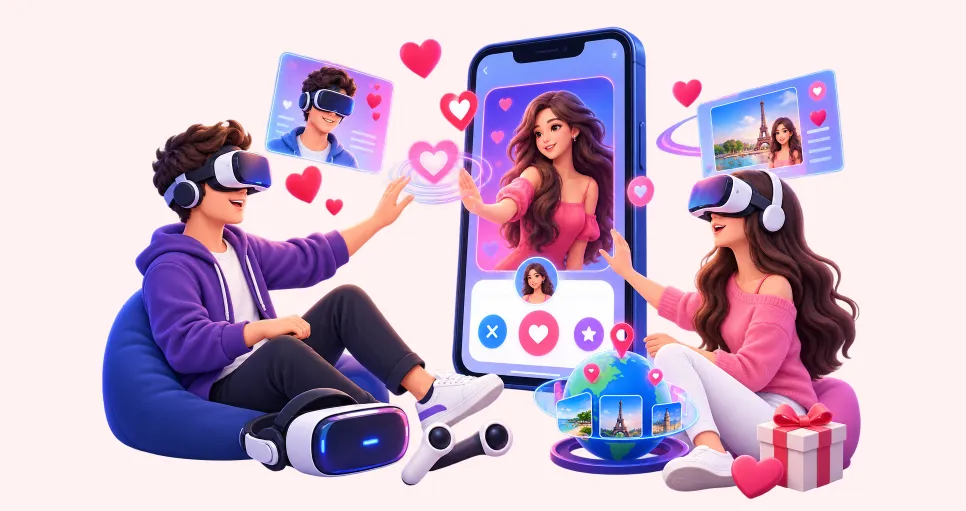
Key Takeaways
-
Build AR or VR around a real dating problem, not simply because immersive technology looks innovative.
-
Start with focused features such as AR icebreakers, virtual date rooms, avatars, and AI powered matchmaking.
-
Choose AR for wider smartphone adoption and VR for deeper immersive dating experiences.
-
Treat privacy, identity verification, moderation, device compatibility, and performance as core product requirements.
-
Validate the MVP first, measure engagement and retention, then expand immersive features based on user demand.
Swipe. Match. “Hey.” Then silence.
That cycle is getting old. Dating apps can help two people find each other, but keeping the conversation alive is a different problem. Users want something more natural than another profile grid and another empty chat window.
I have seen founders make the same mistake here. They add AR filters or build impressive VR spaces because the technology looks exciting, then realize the feature does little for the actual dating experience.
That is where AR/VR dating app development needs a different approach. The technology should help people break the ice, build trust, share experiences, and feel closer before meeting in person.
In this guide, I will explain how AR and VR dating apps work, which features are worth building, the development process and tech stack, security and privacy considerations, development costs, monetization options, common mistakes, and how to decide whether AR or VR actually makes sense for your dating product.
What Is an AR/VR Dating App, and How Does It Actually Work?
Let us keep this simple.
A normal dating app works like this. You make a profile. You match. You chat. Maybe a video call. Then, if things go well, a real date.
An AR dating app adds a small twist. You still use your phone. But now the camera adds digital layers on top of the real world. Think of a shared AR icebreaker at a coffee shop or a filter that helps two matched people find each other in a crowd.
A VR dating app goes further. You put on a headset, meet your match through an avatar, and interact inside a shared virtual space. This is where virtual dating app development moves beyond profiles and chats to create immersive social experiences.
I want to be honest here. Not every app that talks about AR or VR is actually doing it well.
Flirtual is a good real example. It lets people build avatars and go on dates inside virtual environments, and it has kept a loyal user base of tech-comfortable singles since it launched.
Nevermet works on a similar idea, matching people through avatars and virtual reality-style spaces before they ever see a real photo.
Planet Theta has also explored immersive virtual reality dates and shared virtual rooms.
Bondee is a slightly different case. It is more of an avatar-based social app than a dedicated dating platform, so I would not put it in the same basket as Flirtual.
And one more thing I always tell founders. If you work with dating app development companies, make sure the team understands AR, VR, real-time interaction, and immersive UX rather than simply adding an AR filter and calling it innovation.
What you can honestly say is this: if you’re planning to develop a dating app like Hinge, Tinder, or Bumble, the opportunity is no longer limited to profiles, prompts, and matching. These established platforms have built their experiences around familiar dating mechanics, while newer AR/VR and avatar-based apps are pushing the idea further making interaction feel more immersive and personal.
Why Should You Invest in AR/VR Matchmaking App Development?
The online dating world is bigger than most people realize. The global online dating services market was valued near 7.79 billion dollars in 2026, and it is expected to climb to about 13.57 billion dollars by 2031, growing at close to 11.76 percent every year. That is not a small niche anymore.
Now let us talk about why this matters for your product, not just the market.
Move beyond the swipe
Swiping tells you who might be interesting. It does not tell you if two people actually click. AR and VR give you a way to test that spark before someone ever leaves their house.
Create richer first interactions
A shared AR object, a small VR game, a virtual walk on a beach. These are small things. But small things build comfort fast.
Support long distance connections
This one is close to my heart honestly. I have seen long distance couples struggle with nothing but video calls for months. VR dates will never replace being there in person, but they narrow that gap in a way phone calls cannot.
Stand apart from the big players
You probably will not beat Tinder by building another Tinder clone. But you might win users by creating an experience that feels genuinely different and worth coming back to.
Open new ways to earn
Premium virtual rooms, virtual gifts, ticketed virtual events. These are revenue paths that traditional swipe apps do not really have.
Build a stronger loop
Match, then activity, then talk, then virtual date, then real date. That is a much stickier funnel than match and chat alone.
My take, and I say this to almost every founder who asks me about immersive dating app development. I would never build AR or VR just because a competitor mentioned it in a press release. Tie the tech to one real problem first, low reply rates, weak retention, or poor long distance engagement. If you cannot name the problem, you are not ready to build the solution.
Key AR/VR Dating App Development Features to Consider
Do not try to build twenty features at once. I have watched teams burn through their whole budget trying to do that, and the app still launches feeling empty.
Group your features instead. It keeps your roadmap sane.
AR Icebreakers and Interactive Profiles
AR filters, virtual gifts, 3D objects, and interactive profiles can make first interactions feel less repetitive than traditional swiping.
VR Date Rooms and 3D Avatars
Virtual cafes, games, 3D avatars, spatial audio, and shared activities can turn long distance dating into a more social experience.
Location-Based AR and Shared Experiences
Location-based discovery can connect opted in users around venues, events, or virtual objects using ARKit, ARCore, and location anchors.
AI-Powered Dating and Safety
AI matchmaking, conversation prompts, liveness detection, deepfake detection, and content moderation can personalize matches while strengthening trust and user safety.
Here is a simple way to prioritize what actually goes into your first build.
|
Feature |
AR or VR |
User value |
Complexity |
MVP priority |
|
AR icebreakers |
AR |
High |
Medium |
High |
|
3D avatars |
VR |
High |
Medium |
High |
|
Virtual date rooms |
VR |
Very high |
High |
Medium |
|
Location based AR |
AR |
High |
High |
Medium |
|
Spatial audio |
VR |
High |
Medium |
Medium |
|
AI conversation prompts |
Both |
Medium |
Medium |
Medium |
How to Develop an Augmented/Virtual Reality Dating App?
This is the part most articles rush through. I will not.
Step 1. Define the real dating problem
Before touching any code, figure out who your user is, what they struggle with, and where AR or VR actually helps.
Here is an example. If users match a lot but rarely start real conversations, an AR icebreaker probably solves that better than building an entire VR world from scratch.
Step 2. Choose AR, VR, or both
|
Requirement |
Better fit |
|
Smartphone first experience |
AR |
|
Real world discovery |
AR |
|
Lightweight interaction |
AR |
|
Immersive virtual dates |
VR |
|
Long distance interaction |
VR |
|
Shared virtual environments |
VR |
|
Broad user adoption |
AR |
|
Premium immersive experience |
VR |
Step 3. Design the core user journey
Signup leads to profile, then verification, then discovery, then a match, then the AR or VR interaction, then messaging, then a virtual date, and finally a real world date if things go well.
This flow matters because it stops your immersive feature from feeling bolted on. It becomes part of the actual dating story.
Step 4. Pick your technology stack
The right stack depends on your platform choice. There is no single best answer here, no matter what a sales pitch tells you.
|
Layer |
Technologies |
|
iOS AR |
ARKit, RealityKit, Swift, SwiftUI |
|
Android AR |
ARCore, Kotlin, Jetpack |
|
VR engine |
Unity, Unreal Engine, OpenXR |
|
Apple spatial |
visionOS, RealityKit, Apple Vision Pro |
|
Browser based |
WebXR |
|
3D assets |
Blender, Reality Composer Pro |
|
Real time communication |
WebRTC |
|
Backend |
Node.js, Python, or Go |
|
Database |
PostgreSQL, Redis |
|
Cloud |
AWS, Google Cloud, or Azure |
|
AI layer |
Core ML, computer vision models |
|
Authentication |
OAuth, MFA, biometric login |
|
Analytics |
Firebase, Amplitude |
If you want iOS first AR features, Apple ARKit and RealityKit are strong starting points, and Apple keeps solid public documentation for both.
For Android, ARCore fills the same role. For a headset first product, Unity and Unreal are the usual choices, and if you want something that works right in a browser without an app download, WebXR is worth testing.
If you are still weighing your team options at this stage, working with an experienced dating app development company can save you from expensive early mistakes, since they have already seen where these builds usually go wrong.
Step 5. Build safety and privacy in from day one
AR and VR dating apps touch camera data, location data, sometimes even facial and body data. That is sensitive stuff.
Cover identity verification, liveness detection, biometric data handling, camera permissions, location privacy, age verification, content moderation, reporting, blocking, and encryption. You also need to plan around GDPR, CCPA, BIPA, and COPPA depending on where your users live.
|
Risk |
Possible solution |
|
Catfishing |
Identity verification and liveness checks |
|
Deepfake profiles |
Media verification tools |
|
Location exposure |
Approximate location, temporary visibility |
|
Harassment |
Reporting and blocking flows |
|
Unsafe content |
Automated plus human moderation |
|
Biometric risk |
Minimize collection and retention |
|
Underage users |
Age assurance and age gating |
Step 6. Build the MVP
Keep your first version lean. User registration, profile creation, matching, messaging, basic verification, one AR interaction, one VR experience, reporting tools, and analytics.
Save the rest for later. Big virtual worlds, deep avatar systems, huge 3D asset libraries, and multiplayer events can all wait.
If I were validating this idea today, I would rather ship one excellent immersive moment than five half-finished AR and VR features nobody fully trusts yet.
Step 7. Test across real devices
This step gets skipped way too often. Test frame rate, battery drain, thermal throttling, network lag, and how your 3D assets behave on weaker devices.
For AR, check iPhone compatibility, LiDAR versus non-LiDAR devices, and ARCore-supported Android phones. For VR, test on Meta Quest, Apple Vision Pro, and PC VR setups if that applies to your product.
Also do not ignore motion sickness and accessibility. These get forgotten constantly, and they quietly kill retention.
Step 8. Launch, measure, and improve
Track activation rate, match to conversation rate, AR feature adoption, virtual date completion rate, day 7 and day 30 retention, premium conversion, revenue per paying user, and report rate.
Numbers do not lie, even when your gut feeling does.
How Much Does AR/VR Dating App Development Cost?
There is no single fixed number here. The truth is, the biggest dating app development cost driver is how deep you want the immersion to go.
|
Product scope |
Estimated cost |
Typical timeline |
|
Basic AR dating MVP |
$8,000 to $20,000 |
2 to 3 months |
|
AR-enhanced dating app |
$20,000 to $35,000 |
3 to 4 months |
|
AR dating app with AI features |
$35,000 to $50,000 |
4 to 5 months |
|
VR dating MVP |
$50,000 to $70,000 |
5 to 7 months |
|
AR plus VR dating platform |
$70,000 to $90,000+ |
6 to 9 months |
|
Advanced enterprise platform |
$90,000+ |
9 months plus |
Revenue Strategies for VR/AR Dating App Development
There are a few solid paths here, and most successful apps combine more than one. You can recover the complete mobile app development cost, such as the cost of developing an AR/VR dating app, through effective monetization strategies.
-
Subscription plans for premium immersive experiences or unlimited virtual dates.
-
Virtual goods like gifts, environments, outfits, and avatar accessories.
-
Paid virtual dates through hosted or premium event rooms.
-
Freemium access, where the core dating features stay free but immersive features sit behind a paywall.
-
Sponsored experiences, where brands fund virtual events or themed spaces.
-
Ticketed events, like virtual singles nights or themed meetups.
Common Mistakes in Virtual/Augmented Reality Dating App Development
I have seen most of these play out more than once, so let me save you the pain.
1. Building AR or VR Just Because It Looks Innovative
Mistake: Adding augmented reality or virtual reality without solving a real dating problem such as weak engagement or poor interaction.
Solution: Start with user research and define whether ARKit, ARCore, or VR actually improves matching, communication, trust, or retention.
2. Cramming Too Many Features Into Version One
Mistake: Launching AR filters, virtual date rooms, avatars, spatial audio, AI matchmaking, and social events together can overwhelm the MVP.
Solution: Prioritize one or two high value features, measure user engagement, then expand the AR/VR roadmap around proven demand.
3. Ignoring Device Compatibility
Mistake: Designing advanced AR experiences without considering camera capability, LiDAR support, ARKit versions, ARCore devices, or VR hardware.
Solution: Define device tiers early and provide graceful fallbacks so users can still access core dating features without compatible hardware.
4. Treating 3D Content as a One-Time Job
Mistake: A few attractive 3D avatars or virtual environments may launch well but quickly become repetitive for returning users.
Solution: Plan an ongoing 3D content pipeline covering USDZ assets, avatars, virtual spaces, animations, seasonal experiences, and performance optimization.
5. Leaving Moderation Until Later
Mistake: User-generated AR objects, avatars, virtual rooms, and conversations can create safety risks if moderation is added after launch.
Solution: Build AI moderation, reporting, blocking, age controls, and human review into the dating app architecture from the first release.
AI Dating App Development: Does Your App Actually Need AR or VR?
Ask yourself these questions honestly before you commit any budget.
-
Does AR or VR solve a problem your current users already complain about?
-
Can users understand the value without a long explanation?
-
What happens if you remove AR or VR completely, and could AI app development Companies help you solve the same user problem with smarter personalization?
If nothing really changes, you may not need it yet.
|
Situation |
Recommended approach |
|
New dating startup |
Start with lightweight AR |
|
Existing iOS dating app |
Test one AR feature first |
|
Long distance dating focus |
Consider VR |
|
Social dating platform |
AR plus virtual events |
|
Premium dating product |
Consider VR |
|
Large existing user base |
Run an AR feature experiment |
|
Low device compatibility |
Avoid VR first |
What the Future of Custom AR/VR Dating App Development Looks Like?
The next wave of dating will blend AI, spatial computing, AR, and VR to make digital connections feel more personal and natural.
-
Near term: AI matchmaking, AR identity verification, 3D profiles, and AR icebreakers will make dating apps more interactive without overwhelming users.
-
Medium term: Spatial audio, realistic avatars, shared virtual date rooms, and cross-platform XR support will make immersive dating feel more natural.
-
Long term: Persistent virtual dating spaces, AI-generated environments, and wearable technology could turn dating into an always-available social experience.
-
The real shift: ARKit, ARCore, spatial computing, and AI should remove dating friction, not create another complicated layer between two people trying to connect.
-
My prediction: The winners will not pack in every XR feature. They will use immersive technology, personalization, and virtual interaction only where it genuinely improves connection.
Conclusion
AR/VR dating app development is not about chasing trends.
It is about deciding, honestly, AR/VR dating app development is not really about adding flashy virtual worlds to another dating platform. It is about using augmented reality, virtual reality, AI matchmaking, 3D avatars, spatial audio, and immersive experiences to make human connection easier.
I have seen technology work best when it quietly removes friction rather than becoming the product itself.
The strongest dating apps will start with trust, privacy, meaningful interaction, and a clear user problem, then use ARKit, ARCore, and XR capabilities where they genuinely add value.
This is where next-generation dating app development starts to become more meaningful.
FAQ's
AR/VR dating app development creates immersive dating experiences using augmented reality, virtual reality, 3D avatars, spatial audio, AI, and interactive virtual environments.
AR/VR dating app development can cost about $8,000 to $90,000+, depending on features, AR or VR depth, AI integration, platforms, and development complexity.
Choose AR for smartphone based experiences and broader adoption. VR works better for immersive virtual dates, long distance connections, and premium experiences.
Core features can include AR icebreakers, 3D avatars, virtual date rooms, AI matchmaking, spatial audio, identity verification, moderation, and interactive virtual activities.
Common technologies include ARKit, ARCore, RealityKit, Unity, Unreal Engine, OpenXR, WebXR, WebRTC, Node.js, PostgreSQL, AWS, and AI models.
A basic AR dating MVP may take 2 to 3 months, while advanced AR and VR platforms can require 6 to 9 months or longer.
Common monetization models include subscriptions, virtual gifts, premium date rooms, paid events, sponsored experiences, avatar accessories, and freemium features.
Use identity verification, liveness checks, age assurance, encryption, reporting, blocking, content moderation, privacy controls, and minimal collection of biometric and location data.

CrinPro
CrinPro Solutions is a leading IT company that helps startups and enterprises build innovative digital products. From intuitive mobile applications and high-performance websites to AI-powered solutions and enterprise software, our team delivers scalable, secure, and user-focused products tailored to unique business needs. With expertise across multiple industries, we transform ideas into digital experiences that drive growth, improve efficiency, and create long-term business value.