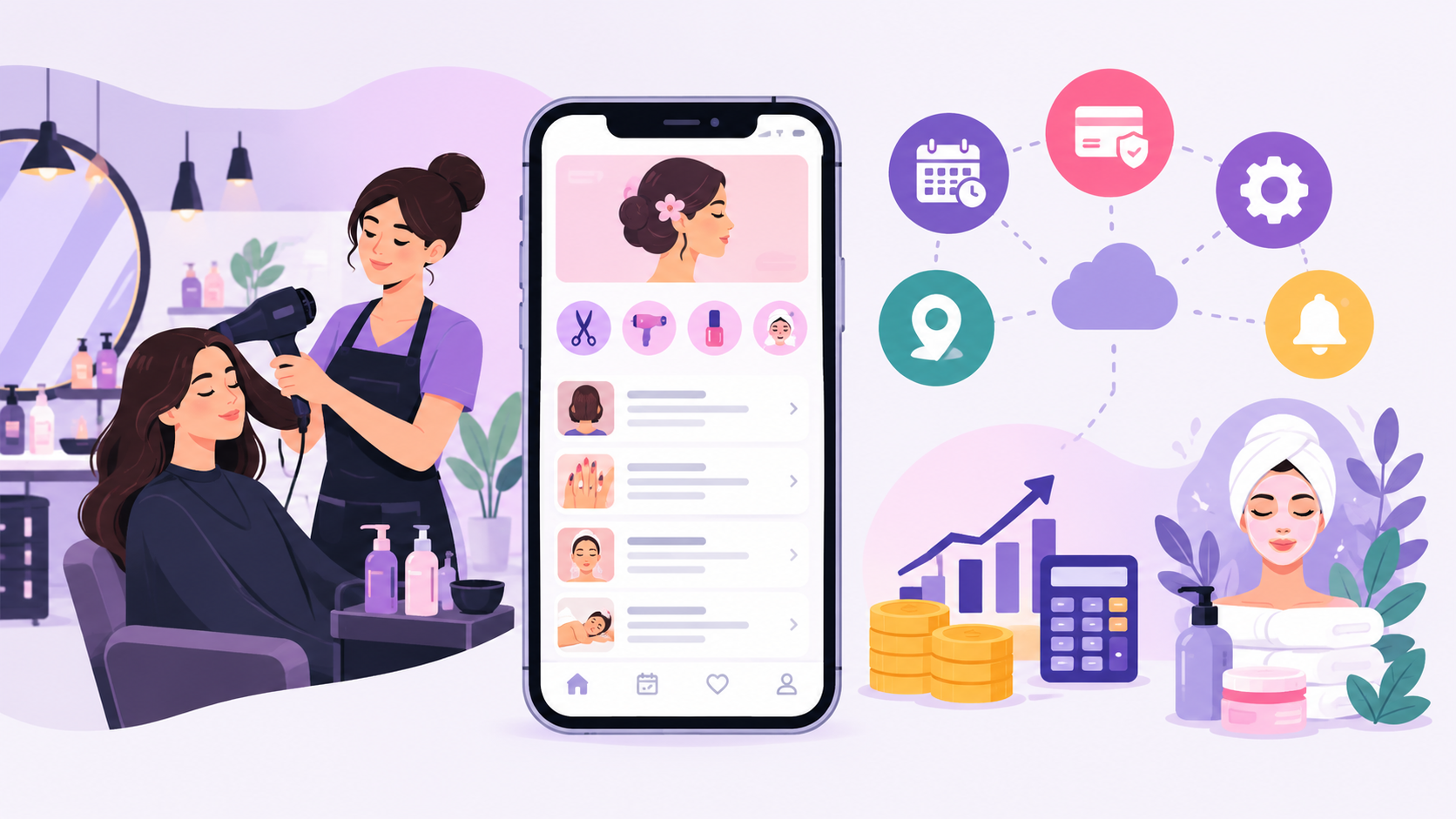
Key Takeaways:
- Salon app development costs range from $8,000 to $90,000+, depending on features, complexity, and business needs.
- Core features like online booking, staff scheduling, payments, and reminders help salons manage daily operations.
- AI tools, CRM integrations, and multi-location support increase development costs but can support business growth.
- Budget for ongoing expenses, including hosting, payment processing, maintenance, security updates, and third-party API fees.
- Start with essential features, choose the right development team, and add advanced tools as your salon grows.
Losing salon bookings because scheduling is messy or customers can’t book online?
Missed appointments, double bookings, and manual staff schedules can cost your salon time and revenue.
A well-planned salon app can fix these problems, but development costs can climb fast without a clear plan. Salon app development costs in 2027 range from $8,000 to $90,000+, depending on the features, platforms, and integrations you need.
In this guide, we’ll break down average development costs, staff management tools, integrations, hidden expenses, common mistakes, and monetization strategies to help you plan a salon app that fits your business goals.
What Is a Salon App And Why Should You Invest in It?
A salon app is a mobile or web application that helps beauty businesses manage appointment bookings, staff schedules, customer profiles, payments, and daily operations in one place.
Why Invest in a Salon App?
The salon software market is projected to grow from USD 0.84 billion in 2025 to USD 1.29 billion by 2030 at a CAGR of 8.90%, while the spa and salon software market is expected to reach USD 3.501 billion by 2035, growing at a CAGR of 11.1%.
- Simplify bookings: Let customers book appointments online without calling your salon.
- Reduce no-shows: Send automated SMS reminders and booking confirmations.
- Manage staff: Track stylist schedules, shifts, leave, and service assignments.
- Accept online payments: Collect deposits and process payments securely.
- Build customer loyalty: Offer rewards, memberships, and personalized promotions.
- Improve business insights: Use booking reports and sales analytics to spot growth opportunities.
How Much Does It Cost to Develop a Beauty Salon App?
The software development cost of a beauty salon app ranges from $8,000 to $90,000+, depending on its features, complexity, integrations, and timeline.
|
App Type |
Estimated Development Cost (USD) |
Development Timeline |
Key Features |
|
Basic Salon App |
8,000–15,000 |
4–8 weeks |
Service listings, appointment booking, and booking confirmations |
|
Standard Salon Booking App |
15,000–30,000 |
8–12 weeks |
Online payments, push notifications, customer profiles, and booking history |
|
Advanced Salon Management App |
30,000–50,000 |
12–18 weeks |
Staff scheduling, customer loyalty programs, service management, and automated reminders |
|
Multi-Location Salon App |
50,000–70,000 |
16–24 weeks |
Multiple salon branches, shared customer profiles, and location-based booking |
|
Enterprise AI-Powered Salon App |
70,000–90,000+ |
20–32+ weeks |
AI-powered service recommendations, personalized offers, and advanced business analytics |
What Features Impact Salon App Development Costs the Most?
Advanced booking tools, AI features, payment systems, and staff management can raise salon app development costs. The final price depends on how deeply each feature needs to work.
1. AI-Powered Service Recommendations
AI can suggest haircuts, skincare treatments, and beauty services based on customer preferences, past bookings, and service history. Custom recommendation models cost more than basic filters.
Cost: $5,000–$12,000 extra
2. Smart Appointment Scheduling
Automated scheduling can match customers with available stylists, prevent double bookings, and suggest open time slots. AI-based scheduling that considers service duration and staff workload adds complexity.
Cost: $3,000–$8,000 extra
3. Online Payments and Digital Wallets
Card payments, deposits, refunds, digital wallets, and cancellation fees make checkout easier. The cost increases with multiple payment providers, saved payment methods, and complex transaction flows. See our guide to mobile payment app development costs for more details.
Cost: $3,000–$7,000 extra
4. Advanced Staff and Salon Management
Staff dashboards can handle shift planning, stylist availability, commissions, leave requests, and performance reports. Multi-branch access and custom payroll or POS integrations add more development work.
Cost: $4,000–$10,000 extra
5. AI Chatbots and Automated Customer Support
An AI chatbot can answer questions about services, prices, opening hours, and bookings around the clock. Connecting it to live appointment data and customer records raises the cost.
Cost: $3,000–$8,000 extra
6. CRM, Loyalty Programs, and Predictive Analytics
CRM integrations, loyalty points, personalized offers, and customer retention reports help salons encourage repeat visits. Predictive analytics can also estimate busy periods and identify customers who may stop booking.
Cost: $4,000–$10,000 extra
Ready-Made Salon Software vs Custom Salon App Development
Choosing between ready-made salon software and custom salon app development depends on your budget, business needs, and growth plans. Here’s how they compare.
|
Factor |
Ready-Made Software |
Custom Development |
|
Initial expenditure |
Usually lower |
Usually higher |
|
Time to start |
Generally faster |
Requires planning and development |
|
Custom workflows |
Limited to available features |
Built around your business needs |
|
Ownership and control |
Depends on vendor terms |
Depends on the contract and architecture |
|
Integrations |
Depends on available connectors |
Custom integrations are possible |
|
Ongoing costs |
Subscriptions and add-ons |
Hosting, support, and maintenance |
|
Scalability |
Depends on product capabilities |
Depends on the planned architecture |
What Drives the Cost of Building a Salon App?
The final cost depends on more than the features you choose. Your platform, design, backend, developer rates, and ongoing support all affect the budget. Here’s how each factor changes the cost of a salon app.
1. Platform Choice: iOS, Android, or Both
|
Platform Option |
Estimated Cost (USD) |
Best For |
|
iOS app |
$8,000–$20,000 |
Salons targeting iPhone users |
|
Android app |
$8,000–$20,000 |
Salons targeting Android users |
|
Cross-platform app |
$12,000–$30,000 |
Businesses targeting both platforms with shared code |
|
Separate native iOS and Android apps |
$20,000–$40,000 |
Businesses needing platform-specific experiences |
|
Web-based booking portal |
$3,000–$10,000 |
Customers who prefer booking through a browser |
2. UI/UX Design and Customer Experience
|
Design Level |
Estimated Cost (USD) |
What’s Included |
|
Basic design |
$1,000–$3,000 |
Ready-made layouts, simple navigation, standard booking screens |
|
Standard custom design |
$3,000–$6,000 |
Custom colors, branded screens, user flows, clickable prototype |
|
Advanced UI/UX design |
$6,000–$10,000 |
Detailed user journeys, interactive prototypes, custom components, usability testing |
|
Premium design system |
$10,000–$15,000+ |
Design system, advanced animations, personalized interfaces, accessibility reviews, multi-platform design |
3. Backend Development and Database Architecture
|
Backend Component |
Common Technology Stack |
Estimated Cost (USD) |
Cost Impact |
|
Basic backend |
Node.js, Express, PostgreSQL |
$3,000–$7,000 |
Supports user accounts, services, and basic bookings |
|
Scalable backend |
Node.js, PostgreSQL, Redis |
$7,000–$15,000 |
Adds faster queries, caching, and more complex scheduling |
|
Cloud infrastructure |
AWS, Google Cloud, or Azure |
$500–$2,000 initial setup |
Supports deployment, storage, and app scaling |
|
Advanced database architecture |
PostgreSQL, Redis, database optimization |
$3,000–$8,000 |
Helps manage high booking volumes and complex business rules |
|
Enterprise backend |
Microservices, cloud monitoring, automated scaling |
$10,000–$20,000+ |
Supports multi-location operations and more demanding workloads |
4. Third-Party Integrations and APIs
Third-party tools save development time, but setup and usage fees can raise your budget. Common options include Stripe for payments, Twilio for SMS reminders, Google Calendar for scheduling, and Mailchimp for email marketing.
Cost:
- Payment gateway integration: $1,000–$3,000
- SMS and email notifications: $500–$2,000
- Calendar integration: $500–$2,000
- CRM or POS integration: $1,500–$5,000
- Maps and location services: $500–$2,000
Note: These estimates cover development and setup. Subscription fees, transaction charges, and API usage costs are usually separate.
5. Development Team Location and Expertise
Developer rates vary by region, experience, and project complexity. A lower hourly rate may reduce upfront spending, but communication, technical skills, and project management also matter.
|
Development Region |
Typical Hourly Rate |
Estimated Cost for a 500-Hour Project |
|
United States |
$100–$200 |
$ 50,000–$ 100,000 |
|
Canada |
CAD 70– CAD140 |
CAD 35,000–CAD 70,000 |
|
United Kingdom |
GBP 70– GBP 130 |
GBP 25,000–GBP 65,000+ |
|
Western Europe |
EUR 70– EUR 140 |
EUR 15,000–EUR 70,000+ |
|
India |
INR 1500– INR 3,000 |
INR 5,000–INR 1,75,000+ |
6. Data Security, Privacy, and Compliance
Salon apps store customer contact details, appointment histories, and payment-related data. Encryption, secure login, role-based access, and regular security checks help protect this information and support applicable privacy requirements.
Cost:
- Basic security setup: $1,000–$3,000
- Advanced security and access controls: $3,000–$7,000
- Compliance support and security audits: $2,000–$8,000+
7. Testing, Quality Assurance, and App Launch
Testing catches booking errors before customers run into them. QA teams check appointment conflicts, payment failures, device compatibility, notifications, and app performance. Launch work may also include app store listings and release preparation.
Cost:
- Basic functional testing: $1,000–$3,000
- Cross-device and payment testing: $3,000–$6,000
- Advanced performance and security testing: $5,000–$10,000
8. Maintenance, Updates, and Ongoing Support
A salon app needs care after launch. Operating system updates, API changes, bug fixes, cloud monitoring, and security patches help keep bookings running smoothly. Set aside a maintenance budget instead of treating launch as the finish line.
Cost:
- Basic maintenance: $200–$800 per month
- Regular updates and technical support: $800–$2,000 per month
- Advanced support for complex apps: $2,000–$5,000+ per month
What Hidden Expenses Affect Salon App Development Costs?
The initial development quote rarely covers everything. Hosting, third-party services, security updates, and staff training can add ongoing expenses after your salon app launches.
1. Cloud Hosting
Cloud hosting keeps your salon app online and stores booking data, customer profiles, and service records. Providers like AWS and Google Cloud charge based on usage, storage, and server needs.
Estimated cost: $50–$500+ per month.
2. API Subscription Fees
Payment gateways, SMS reminders, email platforms, and calendar APIs may charge monthly fees or usage-based rates. If your app uses AI automation software development, AI model usage can add another recurring expense.
Estimated cost: $50–$500+ per month, depending on usage and providers.
3. Payment Processing Fees
Payment providers such as Stripe charge transaction fees for processing customer payments. Online deposits, refunds, and cancellation charges can affect your operating costs, so include these fees in your salon app budget.
Estimated cost: Often around 2.9% + $0.30 per successful domestic card transaction with standard U.S. online pricing; check your provider's current rates.
4. App Store Fees
Publishing an iOS or Android app may involve developer account fees. Apple and Google also have rules and fees for certain digital purchases, so review their current policies before launch.
Estimated cost: Apple Developer Program: typically $99 per year; Google Play Console: typically a $25 one-time registration fee.
5. Security Updates
Security patches protect customer profiles, login details, and booking records from known threats. Budget for dependency updates, access-control reviews, encrypted data handling, and periodic security checks as your app grows.
Estimated cost: $500–$3,000+ per year for routine updates; larger audits may cost more.
6. Bug Fixes
A booking conflict or failed payment can frustrate customers and cost your salon revenue. Ongoing QA, error monitoring, and developer support help fix issues before they disrupt daily operations.
Estimated cost: $200–$1,000+ per month, depending on support hours and app complexity.
7. Data Migration
Moving customer profiles, appointment history, service menus, and staff records from spreadsheets or an old booking system takes time. Data cleanup and field mapping can increase the cost, especially when records are inconsistent.
Estimated cost: $500–$3,000+ as a one-time expense.
8. Staff Training
Your team needs to learn how to manage bookings, update stylist schedules, process payments, and handle cancellations. Professional mobile app development services may include onboarding guides and training sessions, but extra sessions can cost more.
Estimated cost: $300–$1,500+ for initial training, depending on team size and training format.
Salon App Development: Costly Mistakes and Smart Cost-Saving Tips
Small planning mistakes can push salon app development costs far beyond your budget. Avoid these six common errors to control spending without cutting the features your customers and staff need.
1. Building Too Many Features
Adding AI tools, loyalty programs, and advanced analytics before validating demand can inflate development costs.
Start with essential booking features, test them with real users, and add extras as your business grows.
This phased approach can reduce initial costs by 20–30%, depending on scope.
A phased booking app development plan lets you launch essential features first, gather customer feedback, and invest in advanced tools when they deliver real value.
2. Ignoring User Experience
A confusing booking flow leads to abandoned appointments and expensive redesigns.
Invest in simple navigation, clear service details, and easy checkout before launch. Early wireframes and usability tests can help avoid costly changes later.
3. Choosing the Cheapest Team
Hiring developers based on hourly rates alone can lead to poor code, missed deadlines, and rework.
Compare portfolios, technical skills, and support plans before choosing a salon app development company. A capable team may save money over the full project.
4. Skipping Project Planning
Unclear requirements often cause scope creep, extra features, and repeated revisions.
Define your target users, booking rules, staff roles, and budget before development begins. A clear project plan can help prevent unexpected costs and delays.
5. Overlooking Third-Party Costs
Payment gateways, SMS services, cloud hosting, and external APIs can add recurring expenses.
Estimate both setup and usage fees before choosing providers. Start with essential integrations, then add tools when customer demand justifies the expense.
6. Building Separate Apps Too Soon
Developing separate native apps for iOS and Android can increase costs, especially for an early-stage salon business.
Consider cross-platform development if your requirements allow it.
You can launch faster, share much of the code, and invest savings in features customers value most.
Revenue-Generating Strategies for Salon App Development
A salon app can do more than manage bookings. It can generate repeat business through memberships, product sales, premium services, and targeted offers.
- In-App Service Bookings: Earn revenue through haircuts, coloring, facials, nail treatments, and premium beauty packages.
- Subscription Memberships: Offer monthly plans with discounted services, priority booking, exclusive perks, and recurring membership revenue.
- Product Sales: Sell shampoos, skincare products, styling tools, and beauty essentials through an in-app store.
- Loyalty and Referral Programs: Reward repeat visits and successful referrals to improve customer retention and increase booking frequency.
- Featured Salon Listings: Let salons pay for sponsored placements, promoted profiles, and better visibility in local search results.
- Cancellation and No-Show Fees: Collect clearly disclosed booking deposits or cancellation fees to reduce missed appointments and protect salon revenue.
Conclusion
The salon app development cost in 2027 can range from $8,000 to $90,000+, depending on your features, platform, integrations, and business goals.
You don’t need every advanced tool from day one. Start with online booking, staff scheduling, secure payments, and automated reminders.
Add CRM software, loyalty programs, and AI-powered features as your salon grows. Remember to budget for hosting, maintenance, testing, and third-party API fees.
A clear plan and the right salon app development company can help you control costs while building a reliable app that improves customer retention and supports long-term revenue growth.
FAQ's
A salon app can cost $8,000 to $90,000+, depending on features, platform, integrations, design, and development complexity.
A salon booking app may take 4–32 weeks or longer, depending on its features, integrations, and technical requirements.
Core features include online booking, staff scheduling, customer profiles, payment processing, appointment reminders, and booking history.
Building for one platform usually costs less than developing separate native iOS and Android apps. Cross-platform development can also reduce costs.
Features, UI/UX design, backend architecture, third-party APIs, developer rates, security, testing, and maintenance all affect the total cost.
Salon app maintenance may cost 200–5,000+ per month, depending on app complexity, support needs, hosting, and update frequency.
Yes. Start with essential booking, staff scheduling, and payment features. Add advanced tools as your salon grows and customer needs change.
A salon app can earn revenue through service bookings, memberships, product sales, loyalty programs, featured listings, and disclosed cancellation fees.

CrinPro
CrinPro Solutions is a leading IT company that helps startups and enterprises build innovative digital products. From intuitive mobile applications and high-performance websites to AI-powered solutions and enterprise software, our team delivers scalable, secure, and user-focused products tailored to unique business needs. With expertise across multiple industries, we transform ideas into digital experiences that drive growth, improve efficiency, and create long-term business value.