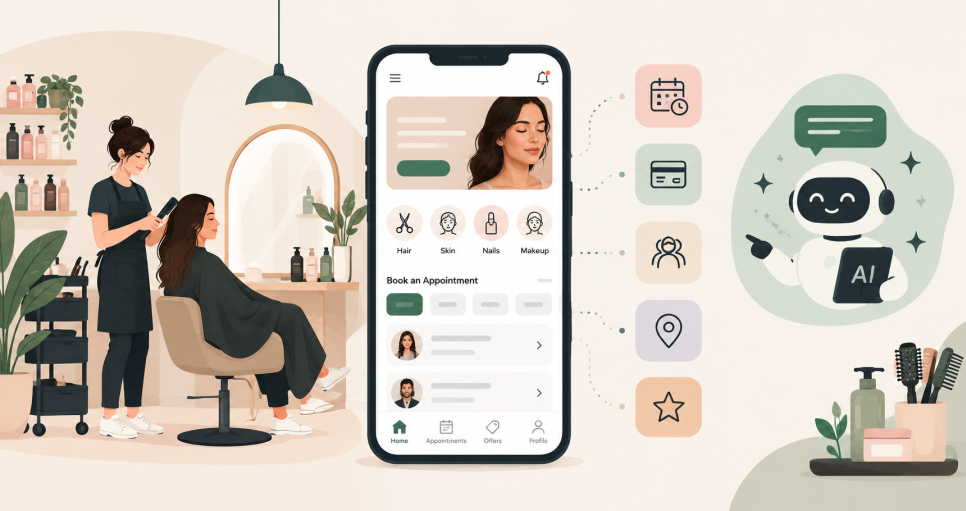
Key Takeaways:
-
Salon apps go beyond appointment booking: modern platforms can combine scheduling, staff management, payments, loyalty, customer profiles, and business analytics.
-
Real-time management improves operations: live staff availability, automated reminders, rescheduling, and multi-branch management can reduce scheduling conflicts and administrative work.
-
AI can personalize customer experiences: AI-powered recommendations, virtual assistants, demand forecasting, and personalized marketing can help salons improve engagement and retention.
-
Development costs depend on complexity: Salon app development can cost approximately $8,000 to $90,000+, depending on features, platforms, integrations, AI capabilities, and scalability requirements.
-
Scalable architecture matters: secure payments, real-time booking, cloud infrastructure, analytics, and third-party integrations should be planned carefully to support future business growth.
The salon industry is becoming increasingly digital as customers expect convenient booking, quick payments, personalized services, and seamless communication with their preferred salons. A well-designed salon app can bring these experiences together while helping businesses manage appointments, staff schedules, customer relationships, payments, and loyalty programs from a single platform.
Modern salon applications are no longer limited to online appointment booking. They can support real-time staff availability, service selection, automated reminders, digital payments, membership plans, loyalty rewards, customer feedback, and AI-powered recommendations. These capabilities can help salons reduce administrative work while creating more personalized customer experiences.
For businesses, a mobile app can also provide valuable operational insights. Owners can monitor bookings, staff performance, service demand, revenue, customer retention, and other key metrics through an integrated dashboard.
This guide explores the major features, technologies, development process, challenges, and salon app development costs businesses should consider when planning a salon application in 2027.
Why Salons Are Investing in Mobile Apps for Better Business Growth?
Customer expectations are changing the way salons manage appointments and deliver services. Phone calls and manual scheduling can make it difficult to manage busy periods, staff availability, cancellations, and customer follow-ups. Mobile apps provide a more convenient way to connect these activities through a single digital platform.
Convenient Appointment Booking
Customers can browse services, choose preferred staff, view available time slots, and book appointments without calling the salon. Automated confirmations and reminders can also reduce missed appointments.
Better Staff Utilisation
Salon owners can manage employee schedules, working hours, leave, and appointments through a centralized system. This can make it easier to balance workloads and reduce scheduling conflicts.
Stronger Customer Retention
Apps can store customer preferences, service history, memberships, and loyalty information. Salons can use these insights to send personalized offers, reminders, and recommendations that encourage repeat visits.
Faster Payments
Integrated digital payments can simplify checkout and reduce dependence on cash transactions. Customers can pay for services, packages, memberships, or products directly through the application.
More Effective Business Management
A salon app can provide dashboards for bookings, revenue, staff performance, popular services, customer activity, and other business metrics. This gives owners better visibility into daily operations and helps them make informed decisions.
Businesses can also use Booking app development approaches to create flexible scheduling experiences that support multiple services, employees, locations, and appointment types.
What Can a Modern Salon App Do for Businesses and Customers?
A modern salon app can connect customers, staff, and business owners through a shared digital platform. Instead of focusing only on appointment scheduling, the application can support the complete customer journey and several day-to-day salon operations.
Customer Experience
Customers can create profiles, browse services, check prices, select preferred professionals, view available slots, book appointments, make payments, and receive reminders. They can also access booking history, invoices, loyalty points, memberships, and personalized recommendations.
Staff Management
Staff members can view their schedules, manage appointments, update availability, record service status, and access relevant customer information. This can help employees manage their workload while reducing scheduling conflicts.
Salon Administration
Owners and managers can use an administrative dashboard to manage services, employees, branches, pricing, promotions, appointments, customers, and business reports. Multi-location salons can manage different branches from a centralized system.
Customer Engagement
The app can support push notifications, promotional campaigns, loyalty rewards, membership plans, feedback, ratings, and personalized offers. These features can help salons maintain ongoing relationships with customers rather than interacting only when an appointment is booked.
Business Intelligence
Analytics dashboards can provide information about revenue, booking trends, popular services, staff performance, customer retention, cancellations, and peak operating hours. These insights can help owners make better decisions about staffing, promotions, and service offerings.
A business mobile app development cost assessment should therefore consider both the customer-facing features and the operational tools required by salon owners and staff. The broader the platform's functionality, the greater the development effort and infrastructure requirements.
Core Features for Customers, Staff, and Salon Owners in a Modern Salon App
A successful salon app should provide different functionality for customers, employees, and business administrators. Separating these experiences helps each user group access the tools they need without making the application unnecessarily complicated.
Customer Features
-
User Registration and Profiles: Sign up using email, phone number, or supported social accounts and manage personal preferences.
-
Service Browsing: View services, pricing, duration, descriptions, offers, and available professionals.
-
Appointment Booking: Select a service, preferred staff member, date, and available time slot.
-
Booking Management: Reschedule, cancel, or review upcoming and previous appointments.
-
Digital Payments: Pay securely for appointments, packages, memberships, and products.
-
Ratings and Reviews: Share feedback about services and staff after appointments.
-
Loyalty and Memberships: Earn rewards, redeem points, and manage membership benefits.
-
Notifications: Receive booking confirmations, reminders, promotional offers, and service updates.
Staff Features
-
Staff Dashboard: View daily appointments, schedules, customer details, and assigned services.
-
Availability Management: Update working hours, breaks, leave, and available booking slots.
-
Appointment Management: Accept, update, complete, or reschedule assigned appointments.
-
Customer History: Access relevant service history and preferences to provide more personalized experiences.
-
Performance Tracking: Monitor completed services, ratings, bookings, and other relevant performance metrics.
Salon Owner and Admin Features
-
Admin Dashboard: Manage the overall salon operation from a centralized interface.
-
Staff Management: Add employees, assign services, manage schedules, and track performance.
-
Service and Pricing Management: Create or update services, packages, pricing, and promotional offers.
-
Branch Management: Manage multiple salon locations, employees, services, and appointment calendars.
-
Customer Management: Review customer profiles, booking history, preferences, memberships, and loyalty activity.
-
Reports and Analytics: Track revenue, bookings, popular services, cancellations, retention, and business performance.
-
Role-Based Access: Control which employees or managers can access specific administrative functions.
Combining these features allows a salon app to serve as both a convenient customer platform and a practical business management system.
Booking, Staff Scheduling, and Salon Management in One Platform
Appointment management is at the centre of a salon application, but an effective platform should also connect bookings with staff availability and daily operations. This helps salons reduce scheduling conflicts while giving customers greater control over their appointments.
Smart Appointment Scheduling
Customers should be able to select a service, preferred professional, date, and available time slot. The system can automatically display only suitable slots based on service duration, staff availability, working hours, and existing bookings.
Real-Time Staff Availability
Staff schedules can be managed through a centralized calendar where employees update their working hours, breaks, holidays, and leave. Customers can then see accurate availability instead of booking unavailable professionals.
Automated Reminders
Push notifications, SMS, or email reminders can notify customers about upcoming appointments. Automated confirmations and cancellation alerts can also help reduce missed appointments and improve schedule management.
Rescheduling and Cancellation
Customers and authorized staff should be able to reschedule or cancel appointments according to defined business policies. The system can automatically update the staff calendar and make released time slots available for other customers.
Multi-Staff and Multi-Service Bookings
Some appointments may require multiple professionals or several services during the same visit. The booking engine should handle these combinations without creating overlapping schedules.
Staff Performance Management
Salon owners can monitor individual employees' completed bookings, working hours, customer ratings, revenue contribution, and service demand. These insights can help managers make better staffing and scheduling decisions.
Multi-Branch Management
For businesses operating multiple locations, administrators can manage branches, staff, services, pricing, and appointment calendars from one system. Customers can choose a preferred salon location based on availability and convenience.
A well-designed scheduling system creates a smoother experience for both customers and employees while giving salon owners better control over daily operations. More advanced requirements may also influence the overall On-Demand App Development Services effort, particularly when the application needs real-time availability, automated assignment, and complex scheduling workflows.
Payments, Loyalty, and Customer Retention in Modern Salon Apps
A salon app can turn routine appointments into an ongoing customer relationship by combining convenient payments with loyalty programs, memberships, and personalized engagement. These features can help salons improve the customer experience while encouraging repeat visits.
Secure Digital Payments
Customers can pay for appointments, packages, memberships, and salon products through cards, digital wallets, bank-based payment methods, or other supported gateways. Payment confirmations and digital invoices can be generated automatically after successful transactions.
Packages and Memberships
Salons can offer prepaid service packages, monthly memberships, or recurring plans through the app. Customers can view their remaining benefits, renewal dates, and eligible services from their profiles.
Loyalty and Rewards
A points-based loyalty system can reward customers for bookings, purchases, referrals, or repeat visits. Points can then be exchanged for discounts, complimentary services, or other benefits.
Personalized Offers
The application can use customer preferences and service history to deliver relevant promotions. For example, a salon could send a reminder for a regularly booked service or provide an offer based on a customer's previous appointments.
Referral Programs
Customers can receive rewards for introducing new users to the salon. Referral tracking can be integrated into the application so both the existing customer and the new customer can receive eligible benefits.
Digital Invoices and Payment History
Customers can access previous invoices, transaction details, refunds, and payment records directly through the application. This creates a more transparent experience and reduces the need for manual receipts.
The cost of implementing these capabilities depends on the selected payment gateways, transaction workflows, security requirements, subscription features, and regional payment methods. Businesses should evaluate mobile payment app development cost separately when payment functionality becomes a major component of the overall application.
How AI Is Transforming Customer Experiences in Salon Apps
AI can help salon applications move beyond basic booking and introduce more personalized, automated, and data-driven experiences. From recommending services to supporting salon staff, AI can be integrated across several parts of the customer and business journey.
Personalized Service Recommendations
AI can analyze customer preferences, previous bookings, selected services, and feedback to suggest relevant treatments or products. Recommendations can become more useful as the system learns from ongoing interactions.
AI-Powered Virtual Assistants
A conversational assistant can answer common questions about services, pricing, availability, salon policies, and appointments. Customers can also use the assistant to find suitable services without navigating multiple screens.
Intelligent Appointment Management
AI can help identify booking patterns, predict busy periods, and support appointment scheduling. Salons can use these insights to plan staff availability and manage demand more efficiently.
Customer Retention Predictions
AI models can identify patterns associated with declining customer engagement. Salons can then create targeted reminders, loyalty offers, or re-engagement campaigns for customers who may be less likely to return.
Demand and Revenue Forecasting
Historical booking data can be analyzed to identify peak hours, popular services, seasonal demand, and potential staffing requirements. These insights can support better operational and promotional planning.
AI-Assisted Marketing
AI can help generate personalized campaign content, promotional messages, appointment reminders, and customer segments. Businesses can use these capabilities to reduce manual marketing work while maintaining more relevant communication.
Staff and Service Insights
AI-powered analytics can help identify service trends, staff performance patterns, customer preferences, and operational bottlenecks. These insights can support data-driven decisions by salon managers.
The complexity of these capabilities will influence the overall AI app development cost. Businesses should consider model usage, data requirements, integration complexity, personalization, and ongoing AI infrastructure expenses when planning an AI-enabled salon platform.
Choosing the Right Technology Stack for Salon App Development
A salon application needs a technology stack that can support real-time bookings, staff scheduling, secure payments, customer data, loyalty programs, AI features, and business analytics. The right combination should also allow the platform to scale as the salon adds users, services, or locations.
|
Technology Layer |
Common Technologies |
Purpose |
Indicative Development Cost |
|
Mobile App |
Flutter, React Native, Swift, Kotlin |
Build customer and staff applications for iOS and Android. |
5,000–15,000 |
|
Web & Admin Panel |
React.js, Next.js |
Manage bookings, staff, services, customers, and reports. |
3,000–10,000 |
|
Backend |
Node.js, Python, Java |
Handle business logic, bookings, users, APIs, and integrations |
5,000–15,000 |
|
Database |
PostgreSQL, MySQL, MongoDB |
Store customer profiles, appointments, payments, and loyalty data. |
2,000–7,000 |
|
Real-Time Booking |
WebSockets, Socket.IO, Firebase |
Synchronize availability, bookings, and schedule changes. |
2,000–7,000 |
|
Payment Integration |
Stripe, PayPal, Razorpay |
Process appointments, memberships, packages, and product payments |
2,000–6,000 |
|
AI/ML |
OpenAI, Gemini, Python, TensorFlow |
Recommendations, virtual assistants, forecasting, and personalization |
4,000–15,000 |
|
Cloud Infrastructure |
AWS, Microsoft Azure, Google Cloud |
Hosting, storage, backups, scaling, and application infrastructure |
3,000–10,000 |
|
Notifications |
Firebase Cloud Messaging, Twilio, SendGrid |
Send booking reminders, promotions, and service notifications. |
1,500–5,000 |
|
Authentication & Security |
OAuth 2.0, OpenID Connect, MFA |
Secure user accounts and administrative access |
2,000–7,000 |
|
Analytics |
Firebase Analytics, Google Analytics 4 |
Track bookings, retention, revenue, and user behaviour |
1,500–6,000 |
These figures represent indicative development and integration effort rather than software licensing or usage charges. AI APIs, cloud infrastructure, payment processing, SMS, email, and other third-party services may create recurring expenses after launch.
A mobile app development company can help businesses select technologies according to their required platforms, expected user volume, security requirements, integrations, and long-term expansion plans. A scalable architecture also makes it easier to introduce additional AI, loyalty, and multi-location capabilities later.
Salon App Development Process: From Planning to Launch
Building a salon app requires coordination between customer-facing features, staff workflows, business management tools, payment systems, and AI capabilities. A structured development process helps ensure that these components work together effectively.
1. Market Research and Requirement Analysis
The process begins by identifying the target customers, salon business model, competitors, services, operating locations, and required features. The team also defines whether the platform will support a single salon, multiple branches, or a marketplace model.
2. Feature Planning and Technical Architecture
The required customer, staff, and admin features are prioritized before development begins. Developers then define the application architecture, APIs, database structure, integrations, security requirements, and technology stack.
3. UI/UX Design
Designers create user flows and interfaces for service discovery, appointment booking, staff selection, payments, loyalty programs, profiles, dashboards, and notifications. The interface should remain simple enough for customers while providing comprehensive controls for salon administrators.
4. Backend and Database Development
The backend is developed to manage users, services, appointments, staff schedules, payments, loyalty points, notifications, and business data. APIs are created to connect the mobile application with the backend and third-party services.
5. Mobile and Admin App Development
Developers build the customer and staff applications along with the web-based administration panel. Core features such as booking, scheduling, customer management, service configuration, and reporting are implemented according to the approved designs.
6. Payment, AI and Third-Party Integrations
Payment gateways, notification services, analytics tools, authentication systems, and other required integrations are connected. AI capabilities such as recommendations, virtual assistants, demand forecasting, or personalized marketing can also be incorporated at this stage.
7. Testing and Quality Assurance
The application is tested for booking accuracy, schedule conflicts, payment processing, security, performance, AI responses, notifications, and usability. Testing across supported devices and operating systems helps identify issues before launch.
8. Deployment and Continuous Improvement
After final testing and approval, the application is deployed to the required app stores and cloud infrastructure. Post-launch monitoring helps identify technical issues and user behaviour, while regular updates can introduce new features and improve performance.
Following this process allows a salon app development company to build the platform in stages while maintaining a clear connection between customer experience, salon operations, and long-term business objectives.
Salon App Development Cost and Timeline in 2027: Key Factors
The Salon app development cost can range from approximately $8,000 to $90,000+, depending on the application's features, number of platforms, staff-management requirements, payment integrations, AI capabilities, and overall complexity.
|
Salon App Type |
Estimated Cost |
Development Timeline |
|
Basic Salon App |
8,000–20,000 |
2–3 months |
|
Mid-Level Salon Management App |
20,000–40,000 |
3–5 months |
|
AI-Powered Salon App |
40,000–65,000 |
5–7 months |
|
Advanced Multi-Branch Platform |
65,000–90,000+ |
7–10+ months |
Key Factors That Influence Salon App Development Cost
The cost of developing a salon application depends on more than the number of screens or features. Technology decisions, integrations, business requirements, and long-term scalability can all affect the final investment.
Feature Complexity
A basic booking application requires less development than a complete salon management platform with staff scheduling, memberships, loyalty programs, analytics, payments, and AI capabilities. More advanced workflows require additional design, development, testing, and maintenance.
Number of Platforms
Developing separate native applications for iOS and Android can require more resources than using a cross-platform framework. Adding a web application or dedicated staff app can further increase the project scope.
AI Capabilities
AI-powered recommendations, virtual assistants, demand forecasting, customer segmentation, and automated marketing require additional integration and data-processing work. The complexity of these features can significantly influence the overall budget.
Payment and Third-Party Integrations
Payment gateways, SMS providers, email services, analytics platforms, calendars, CRM systems, and other external APIs require integration and testing. The number of integrations and their technical complexity can increase development effort.
Multi-Branch Requirements
A single-salon application is generally simpler than a platform supporting multiple locations. Multi-branch systems may require separate calendars, staff management, location-based services, pricing, inventory, reporting, and administrative permissions.
UI/UX Design
Custom interfaces, interactive calendars, service discovery, loyalty dashboards, animated elements, and personalized customer journeys require additional design and frontend development. A highly customized experience can therefore increase the project cost.
Security and Compliance
Salon applications may store personal profiles, payment information, appointment history, and other customer data. Strong authentication, encryption, role-based access, secure payment handling, and monitoring can add to the development effort.
Development Team and Location
The experience and location of the development team can influence project pricing. Specialized teams with expertise in mobile development, real-time systems, AI, and payment integrations may charge more but can also help reduce technical risks.
Maintenance and Scalability
The initial development budget should not be the only consideration. Businesses should also plan for bug fixes, operating-system updates, security improvements, cloud infrastructure, AI usage, third-party API changes, and future feature development.
Key Challenges to Consider When Building a Modern Salon App
Building a salon app involves several operational and technical challenges. Addressing them early can help businesses create a platform that remains reliable as bookings, customers, staff, and locations increase.
Managing Real-Time Availability
Keeping appointment slots synchronized across customers, staff, and multiple branches can be challenging. The system needs to prevent double bookings and immediately reflect cancellations, rescheduling, and availability changes.
Handling Complex Staff Schedules
Salons may have different working hours, breaks, leave periods, service qualifications, and appointment durations for each employee. The scheduling system needs to account for these conditions when displaying available slots.
Protecting Customer and Payment Data
Applications can handle personal information, appointment history, and payment-related data. Strong authentication, encryption, access controls, and secure payment integrations are necessary to reduce security risks.
Maintaining Consistent User Experience
Customers, staff, and salon managers have different requirements. Designing separate but connected experiences without making the application confusing requires careful UI/UX planning.
Integrating Multiple Services
Payment gateways, notification providers, calendars, analytics platforms, CRM systems, AI APIs, and other external services can introduce compatibility and maintenance challenges. Changes to third-party APIs can also require updates to the application.
Controlling AI Reliability and Costs
AI-generated recommendations or responses need appropriate testing and monitoring. Businesses also need to manage model usage and infrastructure expenses as the number of AI interactions increases.
Supporting Multiple Locations
Multi-branch salons require location-specific services, staff, schedules, pricing, promotions, and reporting. Building these capabilities into the architecture from the beginning can help avoid expensive restructuring later.
Maintaining Performance at Scale
As customer accounts, bookings, transactions, and analytics data grow, the application needs scalable backend services and databases. Cloud infrastructure, caching, monitoring, and performance optimization can help maintain a responsive experience.
Conclusion
A modern salon app can bring appointment booking, staff management, payments, loyalty programs, customer engagement, and business analytics into one connected platform. With AI capabilities, salons can also provide more personalized recommendations, automate routine interactions, and gain deeper insights into customer and operational data.
The Salon app development cost can range from approximately $8,000 to $90,000+, depending on the application's features, platforms, integrations, AI requirements, and scalability. Businesses should define their core requirements and prioritize features before development to maintain a realistic budget and timeline.
A well-planned salon application should not only provide a convenient booking experience but also support the salon's broader business operations. With the right technology stack, secure architecture, and scalable development approach, businesses can create a digital platform that improves customer experience while supporting long-term growth.
FAQ's
A salon app can cost approximately $8,000 to $90,000+, depending on features, platforms, integrations, AI capabilities, and complexity.
A basic salon app may take around 2–3 months, while an advanced multi-branch or AI-powered platform can take 7–10+ months.
Key features include appointment booking, staff scheduling, digital payments, loyalty programs, customer profiles, notifications, reviews, analytics, and admin management.
Yes. AI can support service recommendations, virtual assistants, customer segmentation, demand forecasting, and personalized marketing.
Loyalty rewards, memberships, personalized offers, appointment reminders, service recommendations, and convenient rebooking can encourage customers to return.
Yes. A multi-location platform can manage individual branches, staff, services, pricing, schedules, customers, and performance reports from a centralized system.
Depending on the target market, businesses can integrate cards, digital wallets, bank-based payment methods, and other supported payment gateways.

CrinPro
CrinPro Solutions is a leading IT company that helps startups and enterprises build innovative digital products. From intuitive mobile applications and high-performance websites to AI-powered solutions and enterprise software, our team delivers scalable, secure, and user-focused products tailored to unique business needs. With expertise across multiple industries, we transform ideas into digital experiences that drive growth, improve efficiency, and create long-term business value.