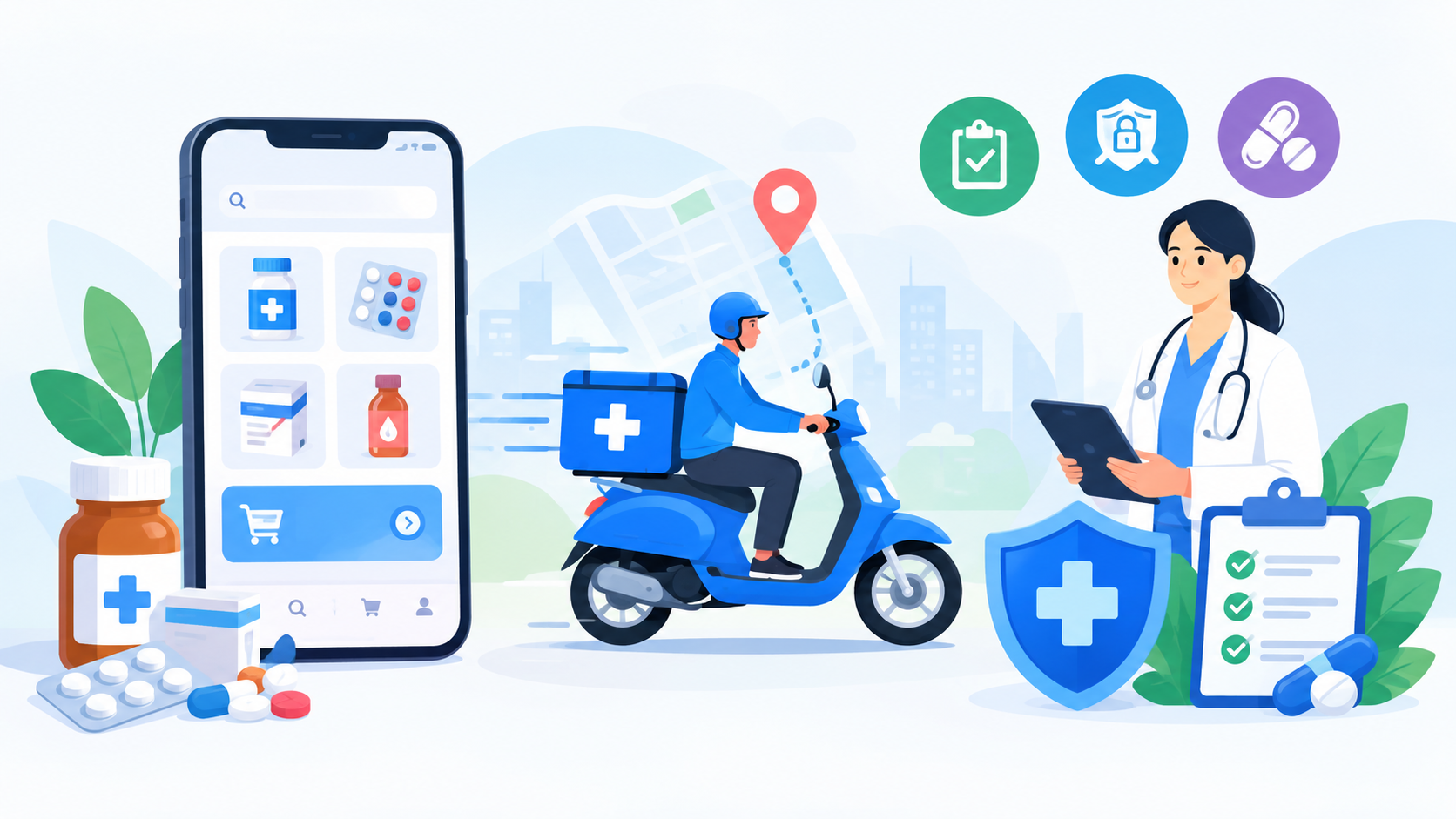
Key Takeaways:
- Medicine delivery apps combine e-commerce, pharmacy management, prescription workflows, payments, and delivery operations in one digital platform.
- Prescription verification, pharmacy inventory, secure payments, delivery tracking, and data protection are important components of a reliable medicine delivery solution.
- The medicine delivery app development cost can range from $8,000 to $90,000+, depending on features, integrations, platforms, security, and scalability requirements.
- Revenue opportunities include delivery fees, pharmacy commissions, subscriptions, featured listings, advertising, and B2B pharmacy software services.
- AI, automated prescription processing, real-time inventory, predictive delivery, and connected pharmacy ecosystems are likely to shape the future of digital medicine delivery.
Medicine delivery apps are becoming an important part of digital healthcare, allowing customers to search for medicines, upload prescriptions, place orders, make payments, and receive deliveries without visiting a pharmacy. For pharmacies and healthcare businesses, these platforms can also create new digital sales channels and improve order management.
However, building a medicine delivery app involves more than creating an online pharmacy catalogue. The platform needs to support prescription verification, pharmacy workflows, secure payments, delivery coordination, customer data protection, and integrations with relevant healthcare and business systems.
As demand for convenient healthcare services continues to grow, businesses are exploring custom medicine delivery platforms that can support multiple pharmacies, delivery partners, locations, and order types.
This guide explains the key components of a medicine delivery app, pharmacy and third-party integrations, compliance considerations, the development process, revenue models, and the Medicine Delivery App Development Cost in 2027.
The Growing Demand for Medicine Delivery Apps in Healthcare
The shift toward digital healthcare has changed how customers discover and purchase medicines. Instead of relying entirely on physical pharmacy visits, customers increasingly expect convenient ordering, digital prescriptions, transparent pricing, and doorstep delivery.
1. Convenience for Customers
Medicine delivery platforms allow users to search for products, compare available options, upload prescriptions, place orders, and track deliveries from a single application. This convenience can make medication access easier for customers who have limited time or mobility.
2. New Sales Channels for Pharmacies
A digital platform can help pharmacies reach customers beyond their physical locations. Independent pharmacies can use delivery applications to manage online orders, communicate with customers, and expand their service areas.
3. Growing Demand for On-Demand Healthcare
Consumers are becoming more familiar with on-demand healthcare services, creating opportunities for platforms that combine medicine ordering with delivery and other digital health services. Businesses offering On-Demand App Development Services can build customised platforms around specific pharmacy and healthcare workflows.
4. Better Order and Delivery Management
Digital systems can centralise orders, prescription records, payment information, delivery status, and customer communications. This can reduce manual coordination and give pharmacies and administrators better visibility into daily operations.
5. Opportunities for Scalable Platforms
Businesses can develop medicine delivery solutions for a single pharmacy, a regional pharmacy network, or a multi-vendor marketplace. The platform can then expand with additional pharmacies, delivery partners, locations, integrations, and features as demand increases.
What Makes a Medicine Delivery Platform Different from Traditional Pharmacies?
A medicine delivery app has many similarities to other e-commerce and delivery platforms, but healthcare-related workflows introduce additional requirements. The application must handle sensitive information, prescription-based products, pharmacy verification, accurate order fulfilment, and secure delivery.
1. Prescription-Based Ordering
Some medicines may require a valid prescription before an order can be processed. The platform therefore needs workflows for prescription uploads, verification, approval, and secure storage.
2. Pharmacy-Driven Fulfilment
Unlike a standard e-commerce platform, medicine delivery may depend on pharmacy inventory, product availability, pharmacist approval, and substitutions. The application needs to coordinate these processes before an order reaches the delivery stage.
3. Product and Dosage Accuracy
Medicine names, strengths, quantities, and product information need to be presented accurately. Search and catalogue systems should minimise confusion between similar medicines and support appropriate product information.
4. Healthcare Data Protection
Medicine orders and prescription records can involve sensitive customer information. Secure authentication, encryption, access controls, audit trails, and appropriate data-handling practices should therefore be incorporated into the platform.
5. Coordinated Delivery
The delivery workflow needs to account for pharmacy preparation, order verification, pickup, tracking, and final delivery. Real-time status updates can help customers and pharmacy teams understand where an order stands.
6. Compliance-Aware Design
Healthcare and pharmaceutical requirements can vary by market and product category. The platform should be designed so that relevant business rules, verification processes, and compliance controls can be incorporated into the application.
Key Stakeholders That Power a Modern Medicine Delivery Ecosystem
A medicine delivery platform typically connects several user groups rather than serving customers alone. Each stakeholder needs a dedicated workflow and set of permissions to keep ordering, verification, fulfilment, and delivery coordinated.
1. Customers and Patients
Customers use the application to search for medicines, view product information, upload prescriptions when required, add products to their cart, select delivery options, make payments, and track orders. They can also manage addresses, order history, and notifications from their accounts.
2. Pharmacies
Pharmacy partners manage medicine catalogues, inventory, pricing, prescription verification, incoming orders, substitutions, and fulfilment. A pharmacy panel can give staff a central place to review and process customer orders.
3. Delivery Partners
Delivery personnel receive assigned orders, view pickup and delivery information, navigate to relevant locations, update delivery status, and confirm successful handovers. GPS and real-time tracking can improve visibility throughout the delivery process.
4. Administrators
Administrators oversee the wider platform, including users, pharmacies, delivery partners, products, orders, payments, commissions, reports, and platform policies. Role-based access can ensure that each administrator only accesses the information and functions required for their responsibilities.
5. Healthcare and Business Integrations
The platform may also interact with external systems such as payment gateways, pharmacy inventory systems, maps, notification services, accounting software, and healthcare-related APIs.
Key Capabilities That Define a Successful Medicine Delivery App
A medicine delivery app needs features that support the complete journey from product discovery to prescription verification, payment, fulfilment, and delivery. The exact feature set can vary depending on whether the platform serves a single pharmacy or operates as a multi-vendor marketplace.
1. Medicine Search and Catalogue
Users should be able to search medicines by name, category, brand, or other relevant attributes. Product pages can display pricing, availability, basic information, dosage details where appropriate, and prescription requirements.
2. Prescription Upload
Customers can upload prescriptions through the application when required. Pharmacy staff should be able to review submitted documents and approve or reject orders according to applicable business rules.
3. Pharmacy and Product Management
Pharmacy partners need tools to manage products, prices, inventory, availability, and order status. Administrators can oversee pharmacy accounts and maintain platform-wide catalogue information.
4. Cart and Order Management
Customers should be able to add products to their cart, review quantities, select delivery addresses, apply eligible offers, and confirm orders. Pharmacies need corresponding tools to accept, prepare, update, or cancel orders.
5. Secure Payments
The platform can support appropriate payment methods such as cards, digital wallets, bank-based payments, or other locally supported options. Payment status should be synchronised with order status to reduce fulfilment errors.
6. Delivery Tracking
Customers can view order progress from confirmation through pharmacy preparation, pickup, and delivery. Delivery partners can update statuses, while location services can support navigation and tracking where appropriate.
7. Notifications
Push notifications, SMS, and email can keep customers informed about prescription approval, order confirmation, payment status, dispatch, delivery updates, and other important events.
8. Ratings and Support
Customers can provide feedback about delivery and service quality where appropriate. In-app support tools can also help users resolve issues related to orders, payments, prescriptions, or delivery.
Prescription Handling and Pharmacy Workflows in Medicine Delivery Apps
Prescription management is one of the most important workflows in a medicine delivery platform. The application needs to make it easy for customers to submit required information while giving authorised pharmacy staff the tools to review and process orders appropriately.
1. Prescription Upload and Verification
Customers can upload prescription images or documents during or before checkout. Pharmacy staff can review the submitted information and verify whether the order can be processed according to applicable requirements.
2. Prescription Status Tracking
The platform can show statuses such as pending review, approved, rejected, or requiring additional information. Clear status updates help customers understand why an order may be waiting for verification.
3. Pharmacy Review Panel
Pharmacy staff should have a dedicated interface for viewing prescriptions, checking associated orders, confirming product availability, and communicating when clarification is required.
4. Medicine Substitution Workflows
If a requested medicine is unavailable, the pharmacy may need to communicate available alternatives according to applicable policies. The platform can support approval workflows so customers are informed before relevant changes are made to an order.
5. Prescription Record Management
Prescription-related records should be stored and accessed securely, with appropriate permissions and retention practices. Audit trails can help organisations track important actions involving prescription information.
6. Order and Prescription Linking
The system should connect prescriptions with the relevant customer and order while avoiding unnecessary duplication of sensitive information. This allows pharmacy teams to review the information required to fulfil an order without creating disconnected records.
Prescription Handling and Pharmacy Workflows for Medicine Delivery Apps
Prescription management is one of the most important workflows in a medicine delivery platform. The application needs to make it easy for customers to submit required information while giving authorised pharmacy staff the tools to review and process orders appropriately.
1. Prescription Upload and Verification
Customers can upload prescription images or documents during or before checkout. Pharmacy staff can review the submitted information and verify whether the order can be processed according to applicable requirements.
2. Prescription Status Tracking
The platform can show statuses such as pending review, approved, rejected, or requiring additional information. Clear status updates help customers understand why an order may be waiting for verification.
3. Pharmacy Review Panel
Pharmacy staff should have a dedicated interface for viewing prescriptions, checking associated orders, confirming product availability, and communicating when clarification is required.
4. Medicine Substitution Workflows
If a requested medicine is unavailable, the pharmacy may need to communicate available alternatives according to applicable policies. The platform can support approval workflows so customers are informed before relevant changes are made to an order.
5. Prescription Record Management
Prescription-related records should be stored and accessed securely, with appropriate permissions and retention practices. Audit trails can help organisations track important actions involving prescription information.
6. Order and Prescription Linking
The system should connect prescriptions with the relevant customer and order while avoiding unnecessary duplication of sensitive information. This allows pharmacy teams to review the information required to fulfil an order without creating disconnected records.
Connecting Pharmacies, Payments, and Delivery Services in One Platform
A medicine delivery platform often depends on several external systems to complete an order. Connecting these services through secure APIs and webhooks can reduce manual work and keep pharmacy, payment, and delivery information synchronised.
1. Pharmacy and Inventory Integrations
Pharmacy systems can provide product availability, pricing, inventory levels, order information, and fulfilment updates. Integration allows the application to reduce discrepancies between the digital catalogue and actual pharmacy stock.
2. Payment Gateway Integration
Payment gateways can process transactions, refunds, payment confirmations, and other financial events. Businesses should design the integration to handle successful, failed, pending, and reversed transactions without creating incorrect order statuses.
Companies planning advanced digital payment functionality can also review the mobile payment app development cost when estimating the broader investment required for payment-related features and integrations.
3. Delivery and Logistics APIs
Delivery integrations can support driver assignment, shipment creation, location tracking, estimated delivery times, and status updates. Businesses can connect with third-party logistics providers or develop their own delivery network depending on their operating model.
4. Maps and Location Services
Mapping APIs can help customers select delivery locations and allow delivery partners to navigate to pharmacies and customer addresses. Location services can also support delivery tracking and estimated arrival times.
5. Notification Services
SMS, email, and push-notification services can keep users informed about prescription approval, order confirmation, payment status, dispatch, and delivery progress.
6. Accounting and Business Systems
Larger pharmacy networks may connect the platform with accounting, CRM, ERP, or business intelligence systems. These integrations can help synchronise transactions, customer information, inventory data, and operational reports.
Compliance, Privacy, and Security Considerations for Medicine Delivery Apps
Medicine delivery platforms handle sensitive health-related information, prescription records, customer details, payment information, and pharmacy data. Compliance and security should therefore be considered from the beginning of development rather than treated as a final-stage requirement.
1. Prescription and Medicine Regulations
The platform should support workflows that reflect the pharmaceutical and healthcare regulations applicable to its target market. Requirements can vary by jurisdiction and by the type of medicine being ordered.
2. Data Privacy
Customer profiles, prescriptions, order histories, and other sensitive information should be collected and processed according to applicable privacy requirements. Businesses should define appropriate data-retention and deletion practices for the information their platform stores.
3. Authentication and Access Control
Secure authentication can protect customer, pharmacy, delivery, and administrator accounts. Role-based access controls should ensure that users only see the information and functions necessary for their responsibilities.
4. Data Encryption
Sensitive information should be protected during transmission and, where appropriate, while stored. Secure APIs, encryption, and appropriate key-management practices can reduce the risk of unauthorised access.
5. Audit Trails
The platform can maintain records of important actions such as prescription reviews, order changes, refunds, account updates, and administrative activities. Audit trails can support investigations and operational accountability.
6. Payment Security
Payment processing should use established payment providers and appropriate security practices rather than storing unnecessary payment credentials within the application. Businesses should also consider applicable payment-industry requirements.
7. Regular Security Testing
Security assessments, vulnerability testing, dependency updates, monitoring, and incident-response procedures can help identify and address risks as the platform evolves.
Building a Reliable Medicine Delivery App: Development Process
Developing a medicine delivery app requires more than implementing customer-facing features. The development process should address pharmacy operations, prescription workflows, integrations, security, compliance, and delivery management from the beginning.
1. Research the Market and Target Users
Start by analysing the target market, customer expectations, pharmacy operations, competitors, regulatory requirements, and potential business opportunities. This helps determine whether the platform should support a single pharmacy, multiple pharmacies, or a broader marketplace.
2. Define the Product Scope
Establish the core features, user roles, supported medicine categories, delivery model, payment methods, integrations, and business rules. A clearly defined scope helps control development complexity and budget.
3. Design the User Experience
Create the customer, pharmacy, delivery partner, and admin experiences. Design intuitive workflows for medicine search, prescription upload, checkout, pharmacy verification, order processing, and delivery tracking.
4. Plan the Technical Architecture
Define the backend architecture, databases, APIs, authentication, cloud infrastructure, integrations, notification systems, and data flows. The architecture should support scalability and secure communication between platform components.
5. Develop the Backend and Core Modules
Build APIs, databases, user management, medicine catalogues, prescription workflows, order management, payment processing, pharmacy operations, and delivery logic.
6. Integrate External Services
Connect payment gateways, pharmacy systems, maps, logistics providers, notification services, analytics platforms, and other required APIs. Integration testing should verify that data moves correctly between systems.
7. Implement Security and Compliance Controls
Add authentication, role-based access, encryption, audit logs, secure APIs, data-protection controls, and relevant compliance workflows. Sensitive prescription and customer information should receive appropriate protection throughout the application.
8. Test the Application
Conduct functional, integration, usability, performance, security, and compatibility testing. Prescription verification, payment processing, order status changes, inventory synchronisation, and delivery workflows should receive particular attention.
9. Launch and Monitor
Deploy the platform to the appropriate production environments and monitor application performance, integrations, security events, and user activity. Early feedback can help identify operational issues that were not visible during development.
10. Maintain and Scale
Continue improving the platform through bug fixes, security updates, performance optimisation, new integrations, and feature enhancements. As the customer and pharmacy network grow, infrastructure and application components can be scaled accordingly.
Working with a medicine delivery app development company can help businesses manage the specialised architecture, integrations, security requirements, and ongoing technical maintenance involved in building a healthcare-focused delivery platform.
Technology Architecture Behind a Scalable Medicine Delivery Platform
A medicine delivery platform needs a technology architecture that can support secure customer accounts, pharmacy operations, prescription workflows, payments, real-time delivery tracking, and third-party integrations. The final stack depends on the platform's scale, supported devices, security requirements, and business model.
|
Technology Layer |
Common Technologies |
Purpose |
Indicative Development Cost |
|
Frontend |
React.js, Next.js, Angular |
Customer and pharmacy web interfaces |
3,000–10,000 |
|
Mobile App |
Flutter, React Native, Swift, Kotlin |
Customer and delivery applications |
5,000–15,000 |
|
Backend |
Node.js, Python, Java, Go |
APIs, business logic, orders, workflows, and integrations |
5,000–15,000 |
|
Database |
PostgreSQL, MySQL, MongoDB |
User, medicine, order, prescription, and inventory data |
2,000–7,000 |
|
Cloud Infrastructure |
AWS, Microsoft Azure, Google Cloud |
Hosting, storage, scaling, backups, and deployment |
3,000–12,000 |
|
Payment Integration |
Stripe, PayPal, Razorpay, regional gateways |
Payments, refunds, transaction status, and checkout |
2,000–7,000 |
|
Maps & Location |
Google Maps Platform, Mapbox |
Address selection, navigation, tracking, and delivery estimates |
2,000–6,000 |
|
Notifications |
Firebase Cloud Messaging, Twilio, SendGrid |
Push notifications, SMS, and email communication |
1,500–5,000 |
|
API & Integration Layer |
REST APIs, GraphQL, webhooks |
Pharmacy, logistics, payment, and business-system connectivity |
3,000–10,000 |
|
Authentication & Security |
OAuth 2.0, OpenID Connect, MFA |
Secure login, identity management, and access control |
2,000–7,000 |
|
Analytics |
Firebase Analytics, Google Analytics, Power BI |
User behaviour, orders, pharmacy performance, and business reporting |
1,500–6,000 |
|
Monitoring |
Prometheus, Grafana, OpenTelemetry |
Application health, performance, and infrastructure monitoring |
2,000–6,000 |
For businesses planning a broader healthcare platform, the healthcare app development cost should also be evaluated alongside the medicine delivery application's specific features, compliance requirements, and integration needs.
Medicine Delivery App Development Cost and Timeline in 2027
The Medicine Delivery App Development Cost can range from $8,000 to $90,000+ in 2027, depending on the platform's features, pharmacy integrations, prescription workflows, delivery capabilities, security requirements, and scalability. A single-pharmacy application will generally require less investment than a multi-vendor platform with advanced healthcare integrations and real-time logistics.
|
Medicine Delivery App Type |
Estimated Cost |
Development Timeline |
|
Basic Medicine Delivery App |
8,000–20,000 |
2–3 months |
|
Mid-Level Pharmacy Delivery Platform |
20,000–40,000 |
3–5 months |
|
Advanced Multi-Pharmacy App |
40,000–65,000 |
5–7 months |
|
Enterprise Medicine Delivery Platform |
65,000–90,000+ |
7–10+ months |
Businesses should also consider the broader software development cost when budgeting for infrastructure, third-party APIs, cloud services, maintenance, security monitoring, payment processing, and post-launch improvements.
What Influences the Cost of Medicine Delivery App Development?
The final cost of a medicine delivery platform depends on more than the number of screens or features. Architecture, integrations, compliance requirements, supported platforms, and operational complexity can all influence the development budget.
1. Number of User Panels
A platform with only a customer app requires less development than one that includes separate interfaces for customers, pharmacies, delivery partners, and administrators. Each panel requires its own workflows, permissions, and testing.
2. Prescription and Pharmacy Workflows
Basic prescription uploads are relatively straightforward, while automated verification, pharmacy approval workflows, substitutions, prescription history, and multi-pharmacy coordination require additional backend logic and testing.
3. Third-Party Integrations
Payment gateways, pharmacy systems, inventory platforms, maps, logistics APIs, notification services, healthcare systems, and analytics tools can increase development effort. The complexity of each integration also depends on API availability and documentation.
4. Platform and Device Support
Developing for both iOS and Android can increase the budget compared with supporting a single platform. Adding web-based pharmacy or administration panels introduces additional development and testing requirements.
5. Delivery and Location Features
Basic delivery status updates require less infrastructure than real-time driver tracking, automated assignment, route optimisation, estimated arrival times, and multi-location delivery management.
6. Security and Compliance
Healthcare data protection, authentication, encryption, audit trails, access controls, security testing, and market-specific compliance requirements can add significant development and maintenance work.
7. AI and Advanced Analytics
AI-based recommendations, demand forecasting, intelligent inventory insights, automated document processing, and advanced business analytics can increase the project's complexity and require additional data infrastructure.
How Medicine Delivery Apps Make Money Through Different Revenue Models
A medicine delivery platform can generate revenue through multiple channels depending on whether it operates as a single-pharmacy service, multi-vendor marketplace, or broader healthcare platform. Combining several revenue streams can create a more sustainable business model.
1. Delivery Fees
The platform can charge customers a delivery fee based on distance, order value, delivery speed, or location. Businesses may also offer free delivery above a specific order threshold to encourage larger purchases.
2. Pharmacy Commissions
Multi-pharmacy marketplaces can charge partner pharmacies a commission on orders generated through the platform. Commission rates can vary based on product categories, order volume, and partnership agreements.
3. Subscription Plans
Businesses can offer monthly or annual memberships that provide benefits such as free deliveries, priority service, exclusive offers, or other platform features. Subscription models can create recurring revenue and encourage repeat purchases.
4. Featured Pharmacy Listings
Pharmacies can pay for greater visibility within search results, promotional placements, or featured sections. These placements should be clearly identified and managed according to applicable policies.
5. Advertising and Promotions
Relevant healthcare and wellness businesses may use the platform to promote eligible products or services. Advertising should be carefully managed to comply with applicable healthcare and pharmaceutical advertising requirements.
6. B2B Pharmacy Solutions
A software provider can also licence pharmacy management, inventory, order-processing, or delivery-management capabilities to pharmacies and healthcare businesses. This creates an opportunity to generate recurring software revenue alongside transaction-based income.
Common Challenges in Medicine Delivery App Development and How to Address Them
Medicine delivery platforms combine e-commerce, healthcare workflows, payments, pharmacy operations, and logistics. This makes them more complex than standard delivery applications and creates several challenges during development and operation.
1. Maintaining Accurate Medicine Data
Medicine names, strengths, forms, pricing, and availability can change across pharmacies. A structured catalogue and reliable inventory synchronisation can help reduce incorrect product information.
2. Managing Prescription Verification
Prescription-based orders require appropriate review workflows. The platform should clearly separate orders that require verification from those that can be processed without additional approval.
3. Synchronising Pharmacy Inventory
Inventory discrepancies can result in cancelled orders or customer dissatisfaction. Integrating pharmacy inventory systems and providing timely stock updates can improve fulfilment accuracy.
4. Coordinating Multiple Delivery Partners
Platforms working with multiple logistics providers need consistent delivery statuses, assignment rules, tracking, and exception handling. A central delivery layer can help standardise information from different providers.
5. Protecting Sensitive Information
Prescription records and customer information require strong security controls. Access restrictions, encryption, secure APIs, audit logs, and continuous monitoring should be part of the platform architecture.
6. Handling Failed Payments and Orders
Payment failures, refunds, cancelled orders, unavailable medicines, and delivery exceptions need clearly defined workflows. Automated status management can reduce manual intervention and prevent inconsistent records.
7. Supporting Regulatory Changes
Healthcare and pharmaceutical requirements can change depending on the market. Building configurable workflows and maintaining a process for regulatory review can make the platform easier to adapt.
8. Scaling the Platform
As pharmacies, customers, orders, and delivery locations increase, the platform needs to handle higher traffic and data volumes without affecting performance. Scalable cloud infrastructure and modular architecture can support long-term growth.
Conclusion
Medicine delivery apps are becoming an important digital channel for pharmacies and healthcare businesses that want to provide convenient, technology-enabled access to medicines. However, successful platforms need to go beyond basic e-commerce functionality by supporting prescription workflows, pharmacy operations, secure payments, inventory management, and reliable delivery coordination.
The development cost can vary significantly depending on the number of user panels, integrations, compliance requirements, platforms, and advanced capabilities included in the solution.
With the right architecture, security controls, pharmacy integrations, and scalable infrastructure, a medicine delivery platform can support efficient operations while creating opportunities for recurring revenue and future healthcare services.
FAQ's
It can cost around 8,000–90,000+, depending on features, integrations, platforms, and complexity.
A basic app may take 2–3 months, while an enterprise platform can take 7–10+ months.
Medicine search, prescription uploads, pharmacy management, payments, order tracking, delivery tracking, notifications, and admin controls are key features.
Yes, when applicable. The platform should provide appropriate prescription submission and pharmacy review workflows.
Yes. APIs can connect pharmacy inventory, product catalogues, pricing, orders, and fulfilment systems.
Common models include delivery fees, pharmacy commissions, subscriptions, featured listings, advertising, and B2B software licensing.

CrinPro
CrinPro Solutions is a leading IT company that helps startups and enterprises build innovative digital products. From intuitive mobile applications and high-performance websites to AI-powered solutions and enterprise software, our team delivers scalable, secure, and user-focused products tailored to unique business needs. With expertise across multiple industries, we transform ideas into digital experiences that drive growth, improve efficiency, and create long-term business value.