Key Takeaways:
- Fintech app development combines secure architecture, financial APIs, compliance, and user-focused features to build trusted financial products.
- Choosing the right fintech app type, MVP scope, technology stack, and financial partners can prevent expensive rebuilds.
- Core fintech features include secure authentication, account management, payment processing, fraud detection, analytics, notifications, and customer support.
- Fintech app development costs vary by complexity, features, integrations, security requirements, compliance needs, and development timeline.
- Regulatory complexity, cybersecurity, fraud, third-party APIs, legacy systems, and scalability remain major challenges for fintech app development.
Money moves fast now. One tap and rent is paid. One scan and a coffee is bought. Behind every one of those taps sits months of planning, testing, and hard decisions.
If your app crashes during a payment, users leave, and they tell their friends too. That is the real cost of getting it wrong.
The good news? Fintech app development is not some locked door only banks can open. Founders, small teams, and even solo builders are shipping wallets, lending tools, and budgeting apps right now.
This blog walks you through the architecture, the app types, the features, the cost, and the challenges you will run into along the way.
What Is Fintech App Development? And How Does Its Architecture Work?
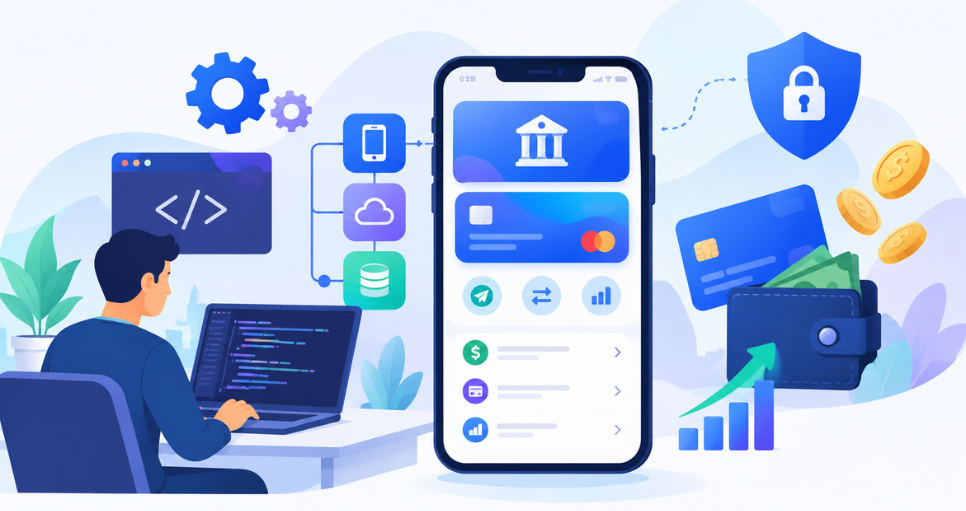
Fintech app development means building mobile or web applications that let people manage money, pay bills, invest, borrow, or transfer funds digitally and securely.
The global financial app market is projected to grow from $1.81B in 2026 to $2.77B by 2030, expanding at an 11.2% CAGR. Asia-Pacific was the largest regional market in 2025.
It matters because financial trust is fragile, and one weak layer in your app can break it in seconds for good.
So how does the architecture actually hold together? Think of it like a building. Each floor has one job, and none of them can skip steps.
Here is a simple way to picture it.
Mobile/Web App → API Gateway → Authentication and Identity → Core Financial Services → Payment and Banking Integrations → Fraud and Risk Engine → Database → Analytics and Reporting → Cloud Infrastructure
Let's break each layer down in plain language, no jargon overload.
- Mobile or web app: This is the screen your user actually touches. Built with React Native, Flutter, Swift, or Kotlin depending on the platform.
- API Gateway: Every request from the app passes through here first. It checks traffic, blocks junk requests, and routes data to the right service.
- Authentication and identity: This confirms the person is really who they say they are. Passwords, biometric authentication, and multi-factor authentication all live here.
- Core financial services: This is the engine room. Account balances, transaction logic, and the core business rules of your product sit in this layer.
- Payment and banking integrations: Here your app talks to banks, card networks, and payment gateways through financial APIs to move real money.
- Fraud and risk engine: This layer watches every transaction in real time, flags anything strange, and stops fraud before it becomes a headline.
- Database: All the user data, transaction history, and account records get stored here using PostgreSQL, MongoDB, or similar systems.
- Analytics and reporting: This turns raw data into a financial dashboard that shows spending patterns, risk scores, and business health.
- Cloud infrastructure: AWS, Azure, or Google Cloud host everything above, giving you scalable infrastructure that grows as your user base grows.
Honestly, this is the part most competitor blogs skim over. Understanding how these layers connect is what separates a real product team from a copy-paste tutorial. That is quiet, practical proof of technical depth, not a developer manual dressed up with buzzwords. Most established FinTech software development companies design their entire process around getting this layered structure right before a single screen is built.
What Type of App Can You Build with Custom Fintech App Development?
Pick wrong here, and you will rebuild your entire product later, so read this table slowly.
|
App Type |
What It Does |
|
Digital banking apps |
Neobank-style apps offering accounts, cards, and daily banking without a physical branch. |
|
Digital wallet and payment apps |
Store cards, send money, and pay merchants instantly using a digital wallet setup. |
|
Lending and BNPL apps |
Offer instant loans or buy now pay later credit lines with automated approval. |
|
Investment and wealth management apps |
Let users trade stocks, track portfolios, and get robo-advisory-style guidance. |
|
Insurance and InsurTech apps |
Handle policy quotes, claims, and payouts through a simple digital experience. |
|
RegTech applications |
Automate compliance monitoring, audit trails, and regulatory reporting for firms. |
|
Embedded finance platforms |
Add banking or payment features inside non-financial apps like retail or travel. |
|
Personal finance applications |
Help users budget, track spending, and build savings habits with smart nudges. |
What Are the Benefits of a Fintech App?
Beyond profit, a fintech app builds daily habits and trust that keep users coming back.
- It gives users 24-hour access to their money without needing a branch visit, which fits real modern life.
- Automation cuts manual errors in transaction processing, which protects both your users and your reputation.
- Real-time notifications keep customers alert to fraud, spending, and account activity as it happens.
- AI-powered risk scoring and predictive analytics help you spot bad actors before damage is done.
- Digital onboarding shortens signup time, which lowers drop-off during customer onboarding.
- Cloud infrastructure keeps costs lean while still supporting a growing banking ecosystem.
- Data-driven dashboards give founders clear visibility into user behavior and financial health.
- Open banking-style fintech app integrations let your app plug into a wider financial infrastructure fast.
This is exactly why money transfer app development has grown so fast globally, since users now expect instant, low-fee transfers instead of waiting days for a bank to process one.
What Fintech App Features Should Your App Have?
Features are where trust is either built or broken, one screen at a time.
1. Secure authentication and identity verification
This is your front door, so it needs to be strong. Combine biometric authentication, multi-factor authentication, and KYC checks to confirm real users.
A weak login page is often the first thing attackers test, so treat this layer as core infrastructure, not a checkbox feature.
Good identity verification also speeds up customer onboarding without cutting corners on security or compliance monitoring.
2. Financial dashboard and account management
Users want one clean screen showing balances, transaction history, and account activity together.
A good financial dashboard reduces support tickets because people can self-serve their own answers. Pair this with account and transaction management tools so users can update details, freeze cards, or set limits without calling anyone.
3. Payment processing and real-time notifications
This is the heartbeat of any fintech app. A reliable payment gateway handles transaction processing smoothly across cards, wallets, and bank transfers.
Real-time notifications tell users the moment money moves, which builds confidence fast. Delays here, even a few seconds, feel like a red flag to anyone watching their balance closely.
4. Fraud detection and financial analytics
Real-time fraud detection uses machine learning and risk assessment models to catch strange patterns before money is lost.
Financial analytics then turns that same data into insight, showing spending trends and predictive analytics for smarter decisions. Together, these two features protect the business while also making the product genuinely useful.
5. Customer support and admin dashboard
Even the smoothest app needs a human safety net sometimes. In-app chat, ticketing, and self-help guides reduce friction for everyday questions.
On the backend, an admin dashboard gives your team visibility into user activity, compliance monitoring, and system health, all from one control panel.
6. AI-powered financial assistance
Chatbots and smart assistants now handle budgeting tips, spending alerts, and basic support questions. Artificial intelligence and machine learning also power credit scoring and personalized recommendations.
This feature is quickly becoming standard, not a nice-to-have, especially for apps competing in a crowded digital wallets space. Many teams now bring in specialist AI development companies just to build and train these models properly instead of stretching an in-house team too thin.
How to Build a Fintech App Step by Step?
I have watched teams rush this fintech app development process and pay for it later with expensive rebuilds. Slow down here; it saves money.
1. Define the financial problem and target users
Start by naming the exact financial pain point you are solving, not a vague idea. Identify your target users clearly, then sit with their frustrations for a while. What do they hate about their current bank or app? That answer becomes your core value proposition.
2. Choose the business model and regulatory requirements
Decide early whether you are a lender, a wallet provider, or a RegTech tool, since each path has different rules. Map out KYC, AML, privacy, and licensing requirements based on your specific model. This step protects you from painful legal surprises after launch.
3. Plan the MVP features and product scope
List every feature you want, then cut it down hard. Keep only what proves your core idea works. Write simple user stories, define your initial scope, and push everything else into a later release. A lean, working MVP beats a bloated app that never ships.
4. Design the fintech architecture and technology stack
This is where you lock in your software architecture and pick your stack. Frontend teams often lean on React, React Native, Flutter, Swift, or Kotlin depending on platform needs.
Backend development commonly uses Node.js, Python, Java, or .NET, paired with databases like PostgreSQL, MongoDB, or Redis for speed.
Cloud infrastructure through AWS, Azure, or Google Cloud supports scalability from day one, and this is also where you define your security architecture.
5. Select APIs, financial partners, and design the user experience
Choose your banking APIs, payment APIs, and KYC or AML providers carefully since these partners carry real risk.
Evaluate each one on reliability, not just price. Meanwhile, your design team should build onboarding flows and clickable prototypes so real users can react before code is written.
If you are unsure where to start, many teams bring in a fintech app development company for this exact stage, since API integration mistakes are costly to fix later.
6. Develop the app and implement security controls
Now the real building begins across frontend development, backend development, and API integration.
Encryption, tokenization, MFA, and biometric checks should be built in from the start, not bolted on afterward. Database implementation and secure transaction processing need constant attention here, since this is where fraud prevention logic actually lives.
7. Test transactions, security, and compliance
Run functional testing, transaction testing, and full API integration testing before anything goes live. Add penetration testing and fintech app security testing to catch weak points attackers would find first.
Compliance verification at this stage saves you from regulatory trouble down the road, and bug fixing here is far cheaper than fixing things post-launch.
8. Launch, monitor, and continuously improve
Deploy to production, then push to the App Store and Google Play, where relevant. Infrastructure monitoring and error tracking should run around the clock from day one.
Collect user feedback constantly, patch security issues fast, and keep improving features as your user base and your banking ecosystem both grow.
How Fintech App Compliance Impacts App Development?
Compliance is not one giant rulebook. It changes based on what your app actually does, so let's break it apart honestly.
1. KYC and AML
Know Your Customer and Anti-Money Laundering rules apply mainly to apps handling money transmission, lending, or currency exchange. Not every fintech app needs the same depth of KYC; it depends on your specific business activity.
2. PCI DSS
If your app touches card data in any way, PCI DSS applies. The PCI Security Standards Council maintains the current PCI DSS v4.0.1 documentation, and it is worth reading directly rather than trusting secondhand summaries.
3. Data privacy
Depending on your users and location, laws like GDPR or state privacy rules may apply. Apps handling personal financial data need clear consent flows and strong data protection practices baked into the product.
4. Consumer financial protection
In the United States, the FTC Safeguards Rule requires covered financial institutions under FTC jurisdiction to maintain a written information security program protecting customer data. This applies specifically to certain non-banking financial companies, not every app by default.
5. Regional financial regulations
Money transmission rules vary heavily by country and even by state. The FinCEN MSB guidance explains which activities can bring a business within the money services business definition, along with the registration and reporting duties that follow.
How Much Does Fintech App Development Cost?
Fintech app development cost swings wildly based on complexity, so here is a realistic range rather than a single made-up number.
|
Tier |
Cost Range |
Timeline |
Best For |
|
Simple MVP app |
$8,000 to $20,000 |
2 to 3 months |
Startups testing one core idea |
|
Mid-level app (wallet or payment) |
$20,000 to $45,000 |
4 to 6 months |
Growing fintech businesses |
|
Advanced platform (banking or lending) |
$45,000 to $70,000 |
7 to 10 months |
Funded fintech companies scaling up |
|
Enterprise-grade ecosystem |
$70,000 to $90,000 or more |
10 to 14+ months |
Banks and large financial institutions |
What Are the Biggest Fintech App Development Challenges?
Every fintech team hits walls. Here is what they look like and how experienced teams push through them.
1. Regulatory complexity
Challenge: Rules differ by country, state, and even by the exact financial activity your app performs.
Solution: Bring in legal and compliance expertise early, not after your app is already built and shipping.
2. Data security
Challenge: Financial apps are a constant target for attackers hunting sensitive information.
Solution: Build encryption, access control, and cybersecurity monitoring into your architecture from day one, not as an afterthought.
3. Fraud and financial crime
Challenge: Fraudsters adapt quickly, and static rules stop working fast.
Solution: Use machine learning-based fraud detection with continuous transaction monitoring that learns from new patterns.
4. Third-party API dependency
Challenge: Your app depends on banking APIs, payment providers, and KYC vendors you do not control.
Solution: Always have backup providers ready, and monitor uptime closely so one outage does not sink your whole app.
5. Legacy banking integration
Challenge: Many banks still run on decades-old systems that do not connect easily with modern APIs.
Solution: Work with experienced banking software development partners who already know how to bridge old and new systems safely.
6. Scalability
Challenge: An app that works fine for 1,000 users can completely break at 100,000.
Solution: Design with scalable infrastructure and microservices from the start, so growth does not force a total rebuild later.
Common Fintech Mobile App Development Mistakes
Some of these mistakes I have literally watched happen firsthand, and they are more common than people admit.
- Building too many features before the core use case is even validated with real users.
- Treating compliance as a post-development task instead of baking it into the architecture from day one.
- Choosing a fintech app technology stack and tools before actually designing the software architecture behind them.
- Depending on a single third-party financial provider with no backup plan if it fails.
- Treating security as a nice extra feature instead of a core architecture requirement from the start.
- Ignoring failure scenarios, like what happens when a payment gateway goes down mid-transaction.
- Underestimating how much testing a financial product truly needs before it touches real money.
- Designing onboarding flows without considering KYC requirements, which forces a painful redesign later.
How to Monetize Your Fintech App
Revenue models here need to match your specific app type, not copy a generic SaaS playbook.
1. Transaction fees
Charge a small percentage or flat fee on every payment, transfer, or transaction processed through the platform.
2. Subscription plans
Offer tiered monthly plans with premium features like advanced financial analytics or priority customer support.
3. Interest and lending margins
Lending and BNPL apps earn through interest rates or fees charged on approved credit lines and loans.
4. Interchange and card fees
Digital wallet and card-issuing apps often earn small fees each time a linked card is used for payment. This model is one of the main reasons mobile payment app development has become such a strong business on its own, separate from lending or banking products.
5. Data and API monetization
Some platforms offer their financial APIs or aggregated insights to other businesses through paid API integration access.
Conclusion
Fintech app development is not about chasing trends; it is about earning trust one transaction at a time.
Strong architecture, honest compliance, and real security keep users coming back. Skip a layer, and it shows fast, usually at the worst possible moment.
Whether you are planning a wallet, a lending tool, or a full banking platform, the fundamentals covered here stay the same.
Build slow where it matters, security and compliance, and move fast everywhere else. That balance is what separates apps people trust from apps people quietly delete.
FAQ's
A regular banking app is built by a bank itself. A fintech app can be built by any company using APIs to offer banking, payment, or lending features, often faster and with a better user experience.
Not always. Many fintech apps partner with licensed banks through embedded finance instead of getting their own license, which is faster and cheaper for most early-stage products.
A simple MVP usually takes two to three months. More complex apps with banking or lending features can take six months or longer depending on compliance needs.
KYC means Know Your Customer. It confirms user identity to prevent fraud and money laundering. Most apps handling real money transactions require some level of KYC verification.
React Native and Flutter work well for cross platform mobile apps. Backend teams often choose Node.js, Python, or Java depending on performance and security needs.
Costs usually range from twenty thousand to seventy thousand dollars depending on countries supported, compliance depth, and how many currencies or payment rails are integrated.
It is not mandatory, but AI-powered fraud detection and personalized recommendations have become standard features that users now expect from modern financial apps.
Look for proven fintech experience, strong security practices, and a clear compliance track record. Ask for past projects and how they handled real regulatory requirements before deciding.

CrinPro
CrinPro Solutions is a leading IT company that helps startups and enterprises build innovative digital products. From intuitive mobile applications and high-performance websites to AI-powered solutions and enterprise software, our team delivers scalable, secure, and user-focused products tailored to unique business needs. With expertise across multiple industries, we transform ideas into digital experiences that drive growth, improve efficiency, and create long-term business value.