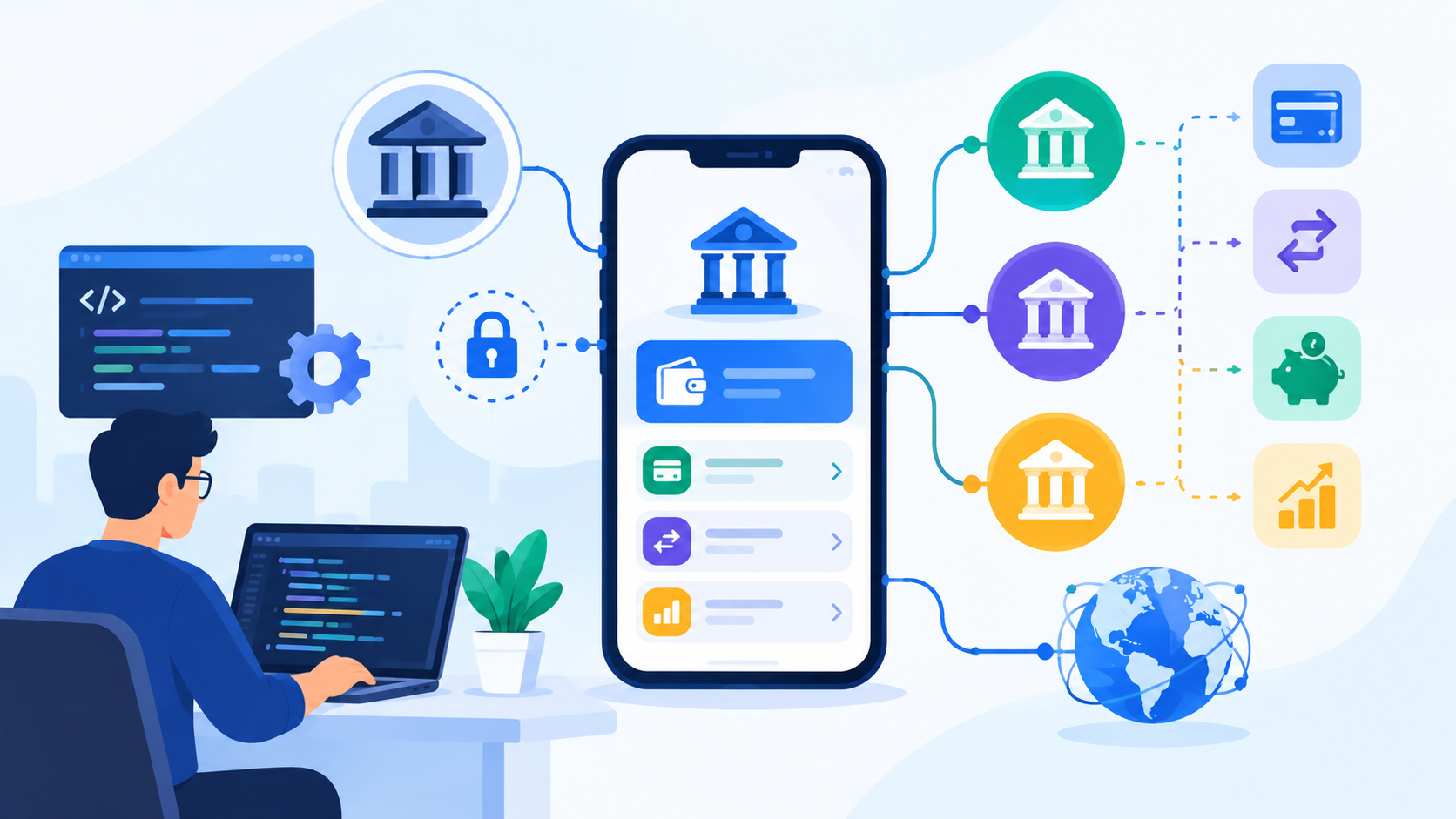
Key Takeaways:
- Consent is the foundation, not a feature. Every data access point depends on scoped, transparent, revocable user consent built into the core architecture.
- Aggregation providers reduce complexity for most teams. Starting with Plaid, TrueLayer, or similar significantly speeds up development versus direct bank integrations.
- Compliance is ongoing, not a launch checklist. PSD2, SCA, and regional regulations require continuous monitoring as both rules and bank APIs evolve.
- Payment initiation costs more than account viewing. Stricter security, authentication, and fraud monitoring requirements apply once money movement is involved.
- Security failures carry outsized regulatory risk. A single vulnerability in financial data handling creates consequences far beyond a typical consumer app bug.
A customer wants to see every account- checking, savings, and a credit card from a different bank in one app, without logging into three separate portals.
That expectation is exactly what open banking exists to solve, and it's reshaping what fintech products need to look like by 2027.
Open banking app development isn't just about connecting to a payments API; it's about building a system around secure data sharing, regulatory compliance, and third-party bank integrations that actually hold up under real financial scrutiny.
Getting this right means understanding the APIs involved, the compliance frameworks that govern them, and what realistically drives development cost.
This guide breaks down exactly what it takes to build an open banking app in 2027, from architecture through launch.
What Is Open Banking and How Does an Open Banking App Work?
Open banking lets customers securely share their financial data across institutions, with their explicit consent, rather than leaving it locked inside a single bank.
Understanding how to build an open banking app starts with understanding exactly how that data actually moves.
1. The User Grants Consent to Share Their Data
The process starts when a customer explicitly authorizes an app to access their financial data at a specific bank, typically through a secure authentication flow hosted by the bank itself.
This consent is scoped, time-limited, and revocable; the user controls exactly what gets shared and for how long.
2. The App Requests Data Through Regulated APIs
Once consent is granted, the app requests account information, transaction history, or payment initiation through standardized, regulated APIs, like those built around PSD2 in Europe or the Open Banking Standard in the UK. These APIs replace older, riskier methods like screen-scraping login credentials.
3. The Bank Authenticates and Returns Authorized Data Only
The bank verifies the request against the user's consent scope and returns only the specific data that was authorized, nothing more.
Strong Customer Authentication (SCA) requirements typically apply here, adding an extra security layer beyond simple API access to the underlying banking data.
4. The App Aggregates and Presents Unified Financial Data
The app combines data from one or more connected banks into a single, unified view, balances, transactions, spending categories, or payment initiation, depending on the app's purpose.
This aggregation is what makes open banking apps genuinely useful, rather than just another single-bank portal.
Key Features of an Open Banking App in 2027
Open banking app features go far beyond simple account viewing. These are the six capabilities users and regulators genuinely expect by 2027, each one built on top of reliable open banking APIs connecting the app to real, authorized financial data.
1. Multi-Bank Account Aggregation
The core feature: pulling balances, transactions, and account details from multiple banks into one unified dashboard.
This depends entirely on stable, well-maintained open banking APIs, since any connection failure or data delay directly breaks the single-view experience users expect from the app.
2. Real-Time Transaction Categorization
Transactions get automatically sorted into categories- groceries, subscriptions, utilities- giving users genuine spending visibility without manual entry.
Accuracy here matters more than speed, since miscategorized transactions quietly erode user trust in the app's broader financial insights over time.
3. Payment Initiation Services
Beyond just viewing data, users can initiate payments directly from the app, moving money between accounts or paying bills without switching to their bank's own portal.
This feature requires stricter regulatory approval than account information access alone, given the direct financial risk involved.
4. Personalized Financial Insights and Budgeting Tools
Using aggregated transaction data, the app can surface spending trends, budget alerts, and savings recommendations tailored to the user's actual financial behavior.
This turns raw transaction data into something genuinely actionable, rather than just another list of numbers to scroll through.
5. Consent Management Dashboard
Users need a clear, accessible view of exactly which banks and data they've authorized, with the ability to revoke access at any time.
This isn't optional; regulatory frameworks like PSD2 require ongoing, transparent consent management, not just a one-time approval at signup.
6. Strong Authentication and Fraud Monitoring
Open banking security depends on Strong Customer Authentication, biometrics, one-time passcodes, or app-based approval, combined with continuous fraud monitoring across connected accounts.
Given the sensitivity of aggregated financial data, this layer needs to be treated as core infrastructure, not an add-on feature.
Open Banking APIs: Integration, Data Access, and Payments
Open banking API integration is the technical backbone the entire app depends on.
Getting this layer right, reliable connections, proper scopes, secure token handling, determines whether every other feature in the app actually works as expected in production.
1. Understanding API Standards and Regulatory Frameworks
Open banking APIs follow regional standards, PSD2 and Open Banking Standard in the UK/EU, and emerging frameworks like the CFPB's Section 1033 rule in the US.
Each framework defines required data scopes, consent rules, and security standards the app's API integration must comply with fully.
2. Connecting to Multiple Bank APIs Reliably
Each bank exposes its own API implementation, even within the same regulatory standard, with subtle differences in authentication, rate limits, and data formatting.
Building a reliable integration layer means handling these inconsistencies gracefully, rather than assuming every bank's API behaves identically out of the box.
3. Handling OAuth 2.0 and Secure Token Exchange
Most open banking APIs use OAuth 2.0 for authentication, issuing scoped, time-limited access tokens after the user completes consent.
Proper token refresh handling and secure storage are essential here, a poorly implemented token flow becomes one of the easiest attack surfaces to exploit.
4. Structuring Data Access Requests by Scope
API requests should only request the specific data scopes actually needed for the app's functionality, account balances without also requesting full transaction history unnecessarily, for example.
Minimal scope requests reduce security risk and also tend to improve user trust during the consent flow itself.
5. Implementing Payment Initiation Securely
Payment initiation APIs require stricter security handling than read-only data access, given the direct financial risk involved.
This typically means additional authentication steps, transaction limits, and real-time fraud checks layered on top of standard open banking API security requirements.
6. Partnering With Experienced Integration Specialists
Given the regulatory and security stakes involved, many businesses work with an open banking app development company that has direct experience integrating multiple bank APIs and navigating compliance requirements, rather than building this specialized integration layer entirely from scratch in-house.
How to Build an Open Banking App: Step-by-Step Development Process
The open banking app development process follows a specific sequence, one where compliance and API integration get planned before a single screen gets designed.
Skipping ahead to UI work before these foundations are settled is how projects end up needing expensive rework later.
1. Define the Use Case and Regulatory Scope
Start by defining exactly what the app does, account aggregation, budgeting, or something closer to money transfer app development, since each use case triggers different regulatory requirements.
A payment-initiation app faces stricter licensing than a read-only account viewer, so this decision shapes everything downstream.
2. Research Licensing and Regulatory Requirements
Determine whether the business needs its own regulatory license or can operate under an existing licensed provider's authorization.
This decision significantly affects open banking app cost and timeline, since obtaining direct licensing typically takes months and involves substantial legal and compliance investment upfront.
3. Choose Between Building or Using an Aggregation Provider
Teams can build direct bank API integrations themselves or use an established open banking aggregation provider, like Plaid or TrueLayer, that's already connected to multiple banks.
Most open banking app development projects start with an aggregator to reduce initial integration complexity and speed up launch.
4. Design the Consent and Data Access Flow
Build the user consent flow carefully, since open banking compliance requires clear, scoped, revocable permissions rather than a single vague "allow access" prompt.
This flow needs to clearly show users exactly what data gets shared, with which institutions, and for how long.
5. Architect the Backend and Data Model
Design the backend to handle multi-bank data aggregation, token management, and transaction categorization, with a data model that can accommodate inconsistent formats across different bank APIs.
Getting this architecture right early prevents painful restructuring once real bank connections start surfacing edge cases.
6. Build Core Account Aggregation Features
Implement the core functionality, connecting accounts, pulling balances and transactions, and presenting a unified view.
Fintech app development cost tends to concentrate heavily in this phase, since reliable aggregation across multiple bank APIs with varying reliability is genuinely difficult engineering work.
7. Implement API Integration and Token Management
Handle open banking API integration across each connected bank, managing OAuth token issuance, refresh cycles, and secure storage throughout.
This step also includes building resilience for when individual bank APIs experience downtime or rate limiting, without breaking the entire app experience for users.
8. Add Security, Fraud Monitoring, and Compliance Controls
Layer in Strong Customer Authentication, encryption, and continuous fraud monitoring across connected accounts.
Open banking security isn't a feature added at the end; it needs to be verified at every stage, since a single vulnerability here creates outsized regulatory and reputational risk.
9. Test Across Real Banking Scenarios and Edge Cases
Testing goes beyond standard QA, it means verifying behavior when a bank API is slow, returns incomplete data, or when a user revokes consent mid-session.
Many teams run structured testing specifically simulating these failure scenarios before considering the app ready for production traffic.
10. Launch, Monitor Compliance, and Iterate
After launch, the team monitors API reliability, consent flow completion rates, and compliance obligations continuously, since regulations and bank API behaviors both evolve.
Regular audits keep the app aligned with current regulatory expectations well beyond the initial launch date.
Open Banking App Development Cost in 2027
Open banking app development cost typically ranges between $8,000 and $60,000, depending on regulatory scope, number of bank integrations, and whether payment initiation is included.
Mobile payment app development cost specifically climbs higher when secure transaction handling and fraud monitoring get added on top of standard account aggregation.
|
Component |
What It Involves |
Estimated Cost Range |
|
Discovery & Regulatory Scoping |
Use case definition, licensing research, compliance framework mapping |
$600 – $700 |
|
UI/UX Design |
Wireframes, prototypes, and final visual design for account and consent screens |
$800 – $900 |
|
Consent Management Flow |
Building scoped, revocable, transparent data-sharing consent screens |
$1,000 – $1,100 |
|
Backend & Data Architecture |
Core backend setup, data model for multi-bank aggregation |
$1,800 – $2,000 |
|
Bank API Integration (Aggregator) |
Connecting via an established provider like Plaid or TrueLayer |
$2,500 – $2,800 |
|
Direct Bank API Integration |
Custom integration with individual bank APIs (per additional bank) |
$1,200 – $1,500 |
|
Payment Initiation Features |
Secure payment flows, transaction limits, real-time fraud checks |
$4,000 – $5,000 |
|
Security & Fraud Monitoring |
Strong Customer Authentication, encryption, continuous fraud detection |
$3,200 – $3,800 |
|
QA & Compliance Testing |
Testing across real banking scenarios, edge cases, and audits |
$2,200 – $2,600 |
|
Launch, Monitoring & Post-Launch Support |
Deployment, compliance monitoring, ongoing iteration (monthly) |
$2,500 – $3,000/month |
Technology Stack for Open Banking App Development
Choosing the right technology stack matters more in open banking than in most app categories, given the regulatory and security stakes involved.
Reliable banking software development services build around proven, auditable components rather than experimenting with unproven tools on financial infrastructure.
1. Frontend Framework
React Native or Flutter typically handle cross-platform mobile development, letting teams ship to iOS and Android from a single codebase while still delivering native performance.
Native development (Swift, Kotlin) becomes more common when biometric authentication or advanced security features need deeper device-level integration.
2. Backend Framework and API Layer
Node.js, Python, or Java commonly anchor the backend, exposing secure REST or GraphQL APIs that handle authentication, data aggregation, and payment initiation.
Java remains particularly common in banking-adjacent projects, given its long track record in regulated financial infrastructure and strong security tooling.
3. Open Banking Aggregation Providers
Plaid, TrueLayer, Tink, or Yapily provide pre-built connections to hundreds of banks, significantly reducing the integration burden compared to building direct bank connections from scratch.
Most teams start here, only building direct integrations later for specific banks an aggregator doesn't yet support.
4. Database and Data Storage
A relational database (PostgreSQL, MySQL) typically stores user accounts, consent records, and transaction data, with encryption applied both at rest and in transit throughout.
Given the sensitivity of financial data, database access controls and audit logging need to be built in from day one.
5. Authentication and Identity Infrastructure
OAuth 2.0 handles token-based authentication with connected banks, while the app's own authentication layer typically adds biometrics or multi-factor authentication for user login.
Identity verification tools may also be required depending on regulatory KYC (Know Your Customer) obligations in the target market.
6. Security and Compliance Tooling
Encryption libraries, tokenization services, and fraud detection platforms form a critical layer that any experienced fintech app development company builds in from the start, not after launch.
Compliance monitoring tools also help track evolving regulatory requirements across the regions the app operates in.
7. Cloud Infrastructure and Hosting
AWS, Azure, or Google Cloud typically host the platform, often within regions specifically chosen to meet data residency requirements tied to financial regulations.
Autoscaling infrastructure matters here too, since transaction volume and API calls can spike significantly during common financial events like payday.
8. Monitoring and Observability Tools
Tools like Datadog, New Relic, or OpenTelemetry track API reliability, transaction success rates, and system performance continuously in production.
Given how critical uptime is for a financial app, this monitoring layer needs to catch degraded bank API performance before it visibly affects users.
Open Banking Compliance, Security, and Data Privacy Requirements
Compliance isn't a checklist completed once before launch; it's an ongoing obligation that shapes architecture decisions continuously.
Even an e-wallet app development company with strong technical skills can face serious regulatory exposure if compliance gets treated as a formality rather than core design.
1. PSD2 and Regional Open Banking Standards
Europe's PSD2 directive, the UK's Open Banking Standard, and similar frameworks elsewhere define required security measures, consent rules, and data access scopes.
Apps operating across multiple regions need to comply with each applicable framework simultaneously, which can mean different technical requirements per market.
2. Strong Customer Authentication (SCA) Requirements
SCA mandates multi-factor authentication for most financial transactions, typically combining something the user knows, has, and is.
Building this correctly means balancing genuine security with usability, since overly cumbersome authentication flows drive users toward abandoning transactions partway through completion.
3. Data Minimization and Purpose Limitation
Regulations generally require apps to request only the data actually necessary for their stated purpose, not broad access "just in case" it's useful later.
This principle should shape API scope requests directly, requesting transaction history only when the app's functionality genuinely depends on it.
4. Consent Transparency and Revocability
Users must be able to clearly see what data they've shared, with which institutions, and revoke that access at any time without unreasonable friction.
Consent that's difficult to find or revoke, even if technically compliant, creates real regulatory and reputational risk over time.
5. Data Encryption at Rest and in Transit
All sensitive financial data needs encryption both while stored and while moving between systems, using current industry-standard protocols.
This isn't optional or a "nice to have" it's a baseline requirement across virtually every applicable financial data protection regulation globally.
6. Third-Party Vendor and API Provider Due Diligence
When using aggregation providers or other third-party services, the app inherits some responsibility for that vendor's security and compliance practices.
Proper due diligence and contractual data protection agreements matter here just as much as the app's own internal security measures.
7. Audit Logging and Regulatory Reporting
Detailed logs of data access, consent changes, and transactions need to be maintained and readily available for regulatory review or audit purposes.
This logging infrastructure should be built in from the start, since retrofitting comprehensive audit trails onto an existing system is genuinely difficult.
8. Incident Response and Breach Notification Obligations
Most regulatory frameworks require timely breach notification to both regulators and affected users if a security incident occurs.
Having a tested incident response plan ready before launch, not improvised during an actual breach, is what separates a manageable incident from a regulatory crisis.
Final Thoughts
Building an open banking app in 2027 means designing around consent, compliance, and secure API integration from the very first architecture decision, not treating them as launch-week formalities.
The apps that succeed aren't the ones with the flashiest aggregation dashboard; they're the ones with reliable bank connections, transparent consent management, and security controls that hold up under real regulatory scrutiny.
Cost scales with regulatory scope and integration depth far more than interface polish, and choosing between an aggregation provider and direct bank integrations shapes both budget and timeline significantly.
Whether you're building account aggregation, payment initiation, or both, the same principle holds: get compliance and security right at the foundation, because retrofitting them into a live financial product is far riskier than building them in from day one.
FAQ's
Open banking apps securely aggregate data across multiple banks with user consent, while traditional apps only access a single institution's own accounts.
Not always. Many apps operate under an existing licensed aggregation provider's authorization instead of obtaining direct regulatory licensing themselves.
Typically 4 to 8 months, depending on regulatory scope, number of bank integrations, and whether payment initiation is included.
Most teams start with an aggregator like Plaid or TrueLayer, since direct integrations require significantly more time and ongoing maintenance.
SCA is multi-factor authentication required for most financial transactions under regulations like PSD2, and it's generally mandatory, not optional.
Through encryption at rest and in transit, scoped consent, tokenized authentication, and continuous fraud monitoring across connected accounts.
Yes, and regulations require it. A clear, accessible consent management dashboard is a compliance requirement, not just a good UX practice.
A well-built app handles this gracefully, showing cached data or a clear status message, rather than breaking the entire user experience.
Typically between $8,000 and $60,000, depending on regulatory scope, number of integrations, and whether payment initiation is included.
Yes, it requires stricter regulatory approval, additional authentication layers, and real-time fraud checks beyond standard read-only data access.

CrinPro
CrinPro Solutions is a leading IT company that helps startups and enterprises build innovative digital products. From intuitive mobile applications and high-performance websites to AI-powered solutions and enterprise software, our team delivers scalable, secure, and user-focused products tailored to unique business needs. With expertise across multiple industries, we transform ideas into digital experiences that drive growth, improve efficiency, and create long-term business value.