Key Takeaways:
- Booking.com-like platforms simplify accommodation discovery and online reservations.
- Real-time availability, secure payments, and intelligent search remain the foundation of successful booking applications.
- Multiple revenue models help create sustainable long-term business growth.
- Development costs generally range from $8,000 to $100,000+, depending on platform complexity.
- AI, cloud computing, and personalisation will continue shaping the future of travel booking applications.
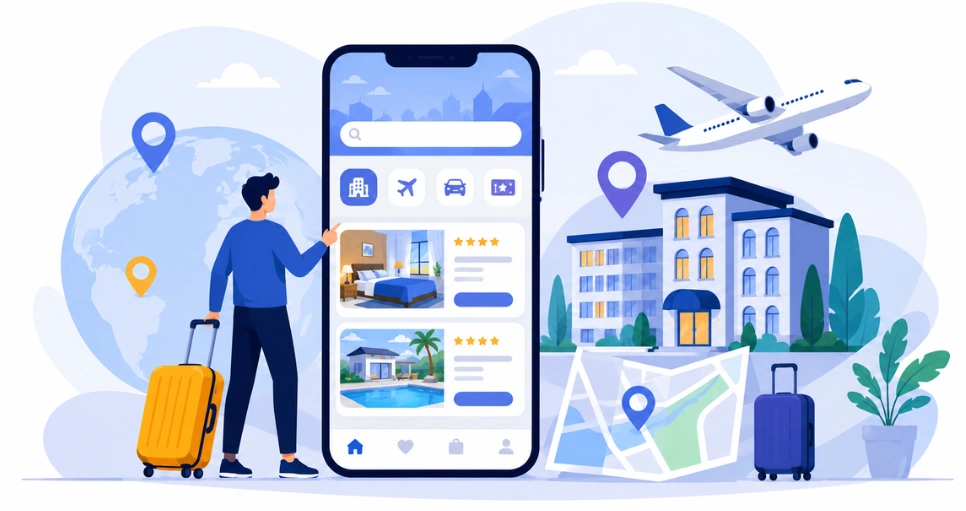
The travel industry has undergone a remarkable digital transformation, with travellers increasingly relying on mobile applications to book hotels, apartments, vacation rentals, flights, and travel experiences in just a few taps. Platforms like Booking.com have simplified the entire reservation process by bringing accommodation providers and travellers together on a single, user-friendly platform.
This growing demand has encouraged startups, travel agencies, hospitality businesses, and entrepreneurs to invest in Booking.com app development to build scalable online reservation platforms. Whether you're planning an app like Booking.com, a comprehensive travel booking app development solution, or a fully customised accommodation booking app development platform, creating a seamless booking experience can unlock significant business opportunities.
Modern travellers expect real-time availability, secure online payments, personalised recommendations, multilingual support, and instant booking confirmations. Building a successful Booking.com clone app development solution requires combining these capabilities with scalable architecture, intuitive design, and high-performance technology.
In this guide, you'll learn everything about travel app development, including essential features, development steps, estimated costs, monetisation strategies, and the technologies required to build a competitive online reservation platform.
Why Invest in a Booking.com-like App?
The online travel industry continues to grow as travellers increasingly prefer booking accommodations through digital platforms instead of traditional travel agencies. A Booking.com-like platform enables businesses to connect travellers with hotels, vacation rentals, apartments, resorts, and other accommodation providers through a single, convenient application.
1. Growing Demand for Online Travel Booking
Today's travellers expect instant access to accommodation listings, transparent pricing, verified reviews, and real-time availability. Investing in online reservation app development allows businesses to meet these expectations while creating a seamless booking experience.
2. Multiple Revenue Streams
A booking platform can generate revenue through:
- Booking commissions
- Featured property listings
- Sponsored advertisements
- Premium partner subscriptions
- Service fees
- Travel insurance partnerships
These diversified income sources make custom booking app development an attractive business model for startups and enterprises alike.
3. Global Market Reach
Many entrepreneurs also choose to build a hotel booking app like Airbnb before expanding into a comprehensive travel marketplace. Comparing different accommodation booking models helps businesses understand customer expectations, identify the right monetisation strategy, and build a platform that supports long-term growth.
4. Better Customer Experience
Features such as instant booking confirmation, secure payments, personalised recommendations, multilingual support, and digital itineraries improve customer satisfaction and encourage repeat bookings.
Many businesses planning hotel booking app development evaluate different accommodation marketplace models before finalising their platform strategy, target audience, and revenue model.
How Does a Booking.com App Work?
A Booking.com-like platform acts as a marketplace that connects travellers with accommodation providers while simplifying the entire reservation process through a centralised digital platform.
1. Property Registration
Hotels, apartments, resorts, villas, and vacation rental owners create business profiles, upload property information, define pricing, manage room availability, and publish listings.
2. Smart Search & Discovery
Users search for accommodations using filters such as destination, travel dates, property type, amenities, ratings, budget, and guest capacity. Intelligent search algorithms display the most relevant properties based on user preferences.
3. Property Details
Each listing provides high-quality images, room descriptions, pricing, facilities, cancellation policies, availability calendars, nearby attractions, and verified customer reviews to help travellers make informed booking decisions.
4. Booking & Secure Payments
After selecting a property, users complete reservations using secure payment gateways. The platform processes confirmations, invoices, booking details, and notifications automatically.
5. Reservation Management
Travellers can modify bookings, cancel reservations (when permitted), access booking history, receive reminders, and communicate directly with accommodation providers through the application.
6. Reviews and Ratings
Following their stay, users can leave ratings and reviews, helping future travellers evaluate properties while encouraging service providers to maintain high-quality hospitality standards.
Essential Features Every Booking App Needs
A successful booking app development project should provide a seamless experience for travellers, accommodation providers, and administrators. Beyond basic reservations, modern booking platforms focus on convenience, security, personalisation, and operational efficiency.
1. User Registration & Profile Management
Allow users to sign up using email, phone numbers, or social media accounts. Personalised profiles should store traveller information, booking history, payment methods, saved properties, and travel preferences.
Estimated Development Cost: $1,000–$2,500
2. Advanced Search & Smart Filters
Enable travellers to search accommodations using filters such as location, dates, budget, property type, amenities, guest capacity, ratings, and cancellation policies. Smart filtering significantly improves the booking experience.
Estimated Development Cost: $3,000–$6,000
3. Property Listings
Accommodation providers should be able to upload property descriptions, high-quality images, pricing, room availability, amenities, house rules, and nearby attractions through an intuitive dashboard.
Estimated Development Cost: $2,500–$5,000
4. Real-Time Availability & Booking Engine
A robust booking engine should synchronise room availability, prevent double bookings, process instant reservations, and generate booking confirmations in real time.
Estimated Development Cost: $4,000–$8,000
5. Secure Payment Gateway
Support multiple payment methods including credit cards, digital wallets, UPI, PayPal, Stripe, and Razorpay while ensuring secure payment processing and refund management.
Estimated Development Cost: $2,000–$4,000
6. Maps & Location Integration
Interactive maps help travellers discover nearby accommodations, tourist attractions, transportation options, restaurants, and local services.
Estimated Development Cost: $1,500–$3,000
7. Ratings & Reviews
Verified customer reviews increase transparency and help travellers make informed booking decisions while encouraging accommodation providers to maintain service quality.
Estimated Development Cost: $1,500–$3,000
8. Push Notifications
Real-time notifications keep users updated about booking confirmations, payment status, reminders, promotional offers, cancellations, and travel updates.
Estimated Development Cost: $1,000–$2,000
9. AI-Powered Recommendations
AI can recommend accommodations based on previous bookings, browsing history, travel preferences, seasonal demand, and personalised user behaviour.
Estimated Development Cost: $3,000–$6,000
10. Admin Dashboard
The administrator panel enables platform owners to manage users, accommodation providers, bookings, payments, promotions, analytics, commissions, and customer support from a centralised dashboard.
Estimated Development Cost: $3,000–$5,000
Types of Users & Their Features
A successful booking platform serves multiple user groups, each with different responsibilities and expectations. Designing role-specific modules improves user experience while making platform management more efficient.
Traveler Panel
The traveller application should make discovering, comparing, and booking accommodations simple and convenient.
Essential Features
- User registration and profile management
- Advanced property search
- Wishlist and saved properties
- Secure online booking
- Booking history
- Digital payment management
- Push notifications
- Ratings and reviews
- Customer support
Property Owner Panel
Hotels, resorts, apartments, and vacation rental owners require dedicated tools to manage listings and reservations efficiently.
Essential Features
- Property registration
- Listing management
- Room availability calendar
- Pricing management
- Reservation management
- Guest communication
- Revenue dashboard
- Performance reports
Admin Panel
Administrators oversee the entire platform, ensuring smooth operations while managing users, payments, and accommodation providers.
Essential Features
- User management
- Property approval
- Booking management
- Commission management
- Payment monitoring
- Promotion management
- Reports and analytics
- Customer support management
Technology Stack Recommendations
Choosing the right technology stack ensures your booking platform delivers excellent performance, strong security, and long-term scalability while supporting thousands of simultaneous users and real-time reservations.
|
Component |
Recommended Technologies |
|
Frontend |
Flutter, React Native, React.js |
|
Backend |
Node.js, Python, Java, .NET |
|
Database |
PostgreSQL, MongoDB, MySQL |
|
Cloud Platform |
AWS, Google Cloud, Microsoft Azure |
|
Maps & Navigation |
Google Maps API, Mapbox |
|
Payment Integration |
Stripe, PayPal, Razorpay |
|
Notifications |
Firebase Cloud Messaging, OneSignal |
|
AI & Analytics |
TensorFlow, OpenAI APIs, Google Vertex AI |
A scalable technology stack supports future expansion, higher booking volumes, multilingual functionality, and AI-powered personalisation. Businesses often evaluate experienced mobile app development companies before selecting a technology partner capable of delivering enterprise-grade travel platforms.
Similarly, choosing the right provider of mobile app development services ensures the application remains secure, scalable, and optimised through every stage of development, deployment, and long-term maintenance.
How to Build an App Like Booking.com
Building a successful travel booking platform requires careful planning, the right technology stack, and a scalable development strategy. Following a structured process helps reduce development risks while delivering a seamless experience for travellers, property owners, and administrators.
Step 1: Conduct Market Research
Begin by analysing your target audience, competitors, booking trends, and business model. Define whether your platform will focus on hotels, vacation rentals, apartments, or a combination of accommodation types.
Step 2: Define the Core Features
Identify the minimum feature set required for launch, including user registration, property listings, search filters, bookings, secure payments, reviews, and notifications. Additional features can be introduced in future releases.
Step 3: Select the Right Business Model
Choose whether your platform will operate through booking commissions, subscription plans, featured listings, advertisements, or a combination of multiple revenue streams.
Step 4: Design an Intuitive UI/UX
Create responsive wireframes and user-friendly interfaces for travellers, accommodation providers, and administrators. A simple booking flow significantly improves customer satisfaction and conversion rates.
Step 5: Build the Frontend & Backend
Develop the customer application, partner portal, and administrative dashboard while implementing secure APIs, cloud infrastructure, booking management, payment processing, and notification services.
Step 6: Integrate Third-Party Services
Connect the application with payment gateways, map services, notification systems, analytics platforms, customer support tools, and other third-party APIs required for smooth platform operations.
Step 7: Implement Security & Compliance
Protect user information using secure authentication, encrypted payment processing, role-based access controls, secure APIs, and compliance with applicable data protection regulations.
Step 8: Perform Comprehensive Testing
Test every module for functionality, security, performance, compatibility, payment processing, booking workflows, and user experience before deployment.
Step 9: Launch the Platform
Publish the application on Android, iOS, and web platforms while monitoring system performance, collecting user feedback, and resolving issues quickly after release.
Step 10: Maintain & Continuously Improve
After launch, introduce new features, improve application performance, strengthen security, optimise booking experiences, and scale infrastructure based on user demand.
Monetization Strategies
A Booking.com-like platform can generate recurring revenue through multiple business models rather than relying on a single income source.
1. Booking Commissions
Charge accommodation providers a commission for every successful reservation completed through the platform.
2. Featured Listings
Allow hotels and property owners to pay for premium placement within search results, increasing their visibility to potential travellers.
3. Subscription Plans
Offer premium memberships that provide accommodation providers with advanced analytics, marketing tools, and enhanced listing visibility.
4. Advertising
Generate additional revenue through sponsored properties, promotional campaigns, and travel-related advertising opportunities.
5. Travel Partnerships
Collaborate with airlines, insurance providers, car rental companies, and tour operators to earn affiliate commissions from complementary travel services.
Booking.com App Development Cost
The movie streaming app development cost depends on several factors, including platform complexity, booking engine functionality, third-party integrations, cloud infrastructure, AI capabilities, security requirements, and customisation level. A basic booking application requires a smaller investment, while an enterprise-grade travel marketplace with advanced automation and AI-powered recommendations demands a significantly higher budget.
Estimated Development Cost
|
Platform Type |
Key Features Included |
Estimated Cost |
Timeline |
|
Basic Booking App |
User registration, hotel listings, search, basic booking engine, payment gateway |
$8,000–$25,000 |
2–3 Months |
|
Standard Travel Booking Platform |
Advanced filters, maps integration, reviews & ratings, notifications, booking management |
$25,000–$50,000 |
3–5 Months |
|
Advanced Booking.com Clone App |
AI recommendations, multilingual support, multiple property types, analytics dashboard, loyalty programs |
$50,000–$75,000 |
5–7 Months |
|
Enterprise Online Reservation Platform |
Multi-vendor management, cloud infrastructure, dynamic pricing, enterprise security, advanced analytics, third-party integrations |
$75,000–$100,000+ |
7–10 Months |
Businesses should also evaluate the overall travel app development cost before finalising the project budget. If the platform includes Android and iOS applications, estimating the mobile app development cost helps create a more realistic investment plan while supporting future scalability.
Conclusion
Building an app like Booking.com offers tremendous opportunities for startups, travel agencies, hospitality businesses, and online travel platforms. By combining scalable technology, user-friendly design, secure payment systems, and intelligent booking features, businesses can deliver exceptional travel experiences while creating sustainable revenue streams.
Whether you're launching a niche accommodation platform or a large-scale travel marketplace, investing in the right architecture and long-term product strategy will position your business for success in the rapidly evolving travel industry.
FAQ's
The development cost typically ranges from $8,000 to $100,000+, depending on features, integrations, AI capabilities, platform complexity, and customisation requirements.
Core features include user registration, property listings, advanced search, booking management, secure payments, maps integration, reviews, notifications, and an admin dashboard.
Most projects require 2 to 10 months, depending on the platform's complexity, number of features, and third-party integrations.
Yes. AI can provide personalised accommodation recommendations, dynamic pricing, intelligent search, fraud detection, and automated customer support.
Travel agencies, hotel chains, vacation rental businesses, online travel agencies (OTAs), property management companies, and hospitality startups can all benefit from investing in a custom booking platform.
Yes. A modern booking platform can onboard hotels, resorts, apartments, villas, vacation rentals, and other accommodation providers through a centralised management system.

CrinPro
CrinPro Solutions is a leading IT company that helps startups and enterprises build innovative digital products. From intuitive mobile applications and high-performance websites to AI-powered solutions and enterprise software, our team delivers scalable, secure, and user-focused products tailored to unique business needs. With expertise across multiple industries, we transform ideas into digital experiences that drive growth, improve efficiency, and create long-term business value.