Key Takeaways:
- A BNPL app is a lending product, not just a checkout tool. Plan for credit risk, collections, and compliance from the very first day onward.
- Must-have features include fast KYC, real-time credit scoring, flexible repayment plans, payment gateway integration, merchant tools, and strong fraud protection that customers and retailers trust.
- Choose proven technology: scalable cloud hosting, microservices, reliable payment APIs, and secure data storage keep your platform fast and ready for steady, long-term business growth.
- Cost grows with scope. Start with a lean version, keep room in the budget for compliance and testing, and expand features after real user feedback.
- Rules vary by state and keep changing. Confirm licensing with a fintech attorney, protect customer data, treat users fairly, and monitor your app after launch.
Buy now, pay later has gone from a checkout add-on to a core part of how people shop. Customers love splitting a purchase into smaller, manageable payments.
Merchants love the higher cart values that follow. No wonder founders, banks, and retailers want their own BNPL app.
But building one is not like building a typical shopping app. You are handling credit decisions, repayments, collections, and sensitive financial data.
Every choice, from features to tech stack, affects cost, risk, and trust. That makes careful planning essential.
This guide explains how to build a BNPL app. You will learn the key features to include, what development costs, and which technologies power a secure, scalable platform, plus the mistakes to avoid before launch.
What Is a BNPL App and How Does the Business Model Work?
A BNPL app lets shoppers split a purchase into smaller payments, often with no interest. Behind the simple checkout sits a lending engine. Here's how the model works, who gets paid, and where the money comes from, step by step.
1. How a BNPL Purchase Works From Checkout to Payoff
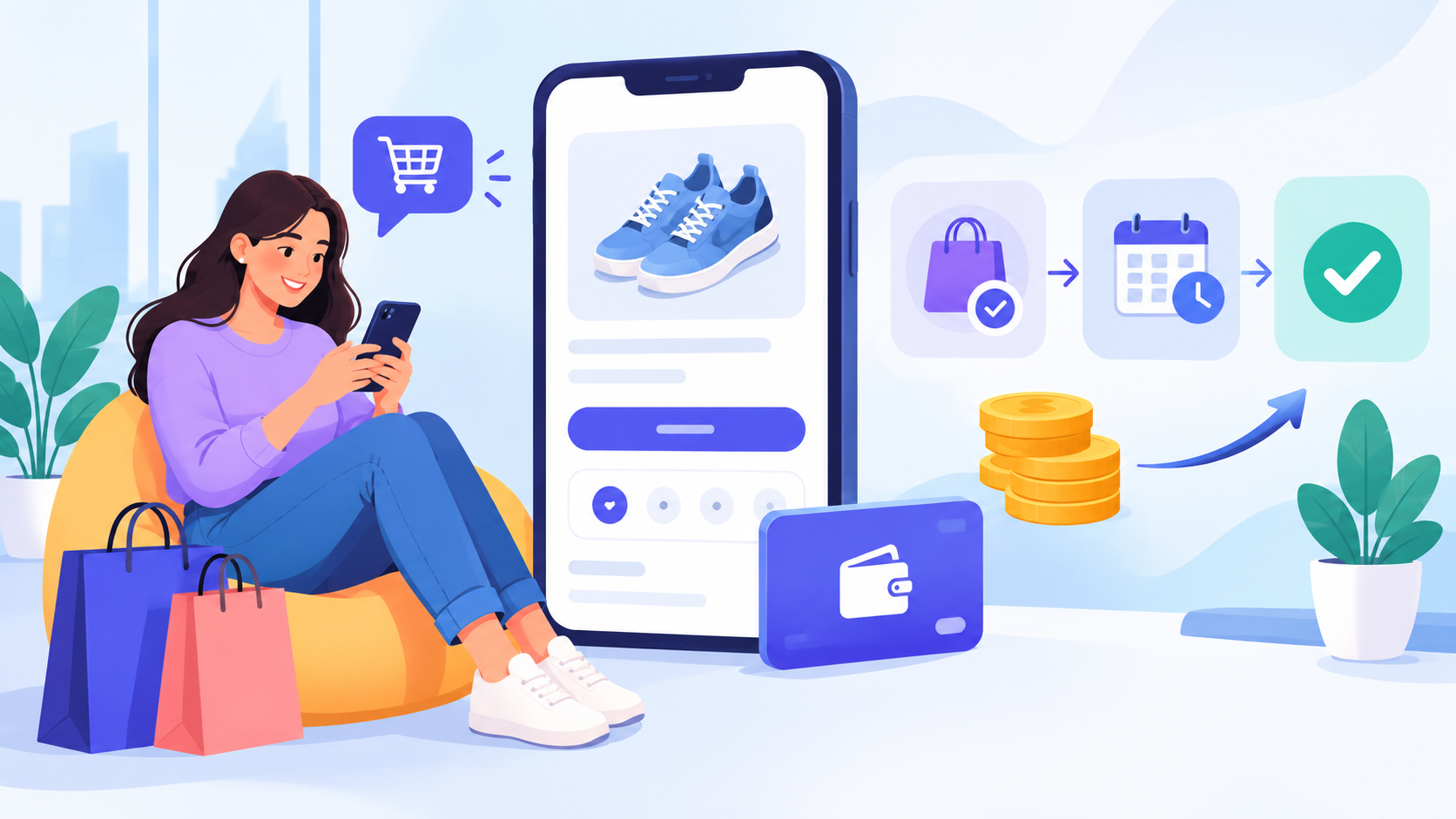
A shopper picks the BNPL option at checkout, and the app runs an instant eligibility check. If approved, the provider pays the merchant upfront, and the customer repays in installments, often four payments over six weeks, with automatic payment reminders.
2. How Customers Benefit From Flexible Payments
BNPL gives shoppers flexibility without a credit card. Capital One Shopping projects 96.3 million Americans will use BNPL in 2026, up about 5% from last year, drawn by simple approvals and clear payment schedules that fit most everyday household budgets.
3. How Merchants Benefit From Offering BNPL
Merchants offer BNPL to lift conversions and order sizes. The same source expects U.S. BNPL purchase volume to reach $127.9 billion in 2026, up 19.1% year over year, showing how quickly checkout habits are changing for online and in-store retailers.
4. How a BNPL Business Makes Money
BNPL providers earn money in a few ways: merchant discount fees on each sale, interest on longer loans, late fees with some providers, and interchange on virtual cards. Balancing revenue against credit losses decides if the whole model stays profitable.
Must-Have Features for a Successful BNPL App
The right features decide if customers trust your BNPL app and keep using it. Speed, clarity, and security matter most.
Here are the six must-have features every successful BNPL app needs, for shoppers, merchants, and your own credit risk team.
1. Instant Onboarding and KYC Verification
Sign-up should take minutes. Let users register with email or phone, then verify identity with ID scans, selfie checks, and address proof.
Fast, smooth KYC meets legal rules and cuts drop-offs before customers reach their first purchase or payment plan.
2. Real-Time Credit Scoring and Instant Approval
Approval must take seconds. Combine credit bureau data, bank transactions, and behavior signals in a scoring engine that sets limits automatically.
Smarter scoring approves more good customers while keeping defaults low, which protects both your margins and your growth plans.
3. Flexible Repayment Plans and Automated Billing
Offer several plans, such as pay in four, monthly installments, and longer terms. Automate billing, reminders, and retries for failed payments.
Clear schedules and easy rescheduling help customers stay on track, which lowers late payments, support requests, and collection costs.
4. Payment Gateway Integration and Multiple Payment Methods
Smooth payment gateway integration lets customers repay with debit cards, bank transfers, and digital wallets.
Connect trusted providers like Stripe, Adyen, or Braintree, and support autopay. Reliable processing means fewer failed charges, faster settlements, and happier merchants and customers alike.
5. Merchant Dashboard and Easy Checkout Integration
Merchants need tools, too. Offer a dashboard for sales, settlements, refunds, and reports, plus plug-ins, APIs, and SDKs for quick checkout setup.
The easier you make integration, the faster retailers add BNPL and send you steady, repeat volume every month.
6. Fraud Detection, Security, and Collections Tools
Lending apps attract fraud. Add device checks, velocity rules, and anomaly alerts, plus encryption and two-factor login.
Build collections tools too, like reminders and hardship plans, so you recover missed payments fairly while protecting customer trust and your loss rates.
Technology Stack for BNPL App Development
A BNPL app is only as strong as the technology underneath it. Speed, security, and scale all depend on your stack. Here are the key layers to choose, from the app frontend to the cloud, with practical picks for each.
1. Web Frontend for Dashboards and Admin Portals
Merchant dashboards and admin portals run in the browser. React and Next.js are popular picks, with Angular and Vue as alternatives.
Choose frameworks with strong libraries and talent pools, so your team ships updates quickly and keeps the design consistent.
2. Backend Languages and Architecture
An experienced fintech app development company will usually pick Node.js, Java, or Python for the backend.
Split the system into microservices for onboarding, scoring, billing, and collections, so each part scales alone and one failure never brings everything else down.
3. Databases and Data Storage
Use PostgreSQL or MySQL for loan records, payments, and ledgers, where accuracy matters most. Add Redis for caching and MongoDB for flexible event data.
Keep strict backups, encryption, and audit trails, because financial records must stay complete and fully traceable.
4. Credit Scoring and AI Tools
Scoring models decide who gets approved. Teams often build them in Python with scikit-learn, XGBoost, or TensorFlow, trained on bureau and transaction data.
Track bias, accuracy, and drift continuously, and keep decisions explainable so regulators and customers can understand them.
5. Third-Party APIs and Integrations
BNPL apps rely on partners. Plug in credit bureaus like Experian, bank data tools like Plaid, KYC providers, and processors like Stripe.
Use well-documented APIs with retries and monitoring, so one provider's outage doesn't freeze approvals or repayments for customers.
6. Cloud Infrastructure and DevOps
Host on AWS, Google Cloud, or Azure with autoscaling, load balancing, and multiple regions. Use Docker, Kubernetes, and CI/CD pipelines to release safely.
Reliable infrastructure keeps checkout fast during sales events, when BNPL traffic can jump suddenly and without warning.
7. Mobile App Frameworks
Strong mobile app development choices shape the customer experience. Native Swift and Kotlin deliver top performance, while Flutter and React Native cut costs with one codebase.
Add biometric login, push notifications, and offline-safe screens for smoother everyday use across devices.
8. Security and Compliance Tooling
Protect data with TLS, encryption at rest, tokenization, and secrets management. Add multi-factor login, role-based access, and logging.
Follow PCI DSS for card data, and run regular penetration tests, because one breach can quickly end customer trust and regulator goodwill.
How to Build a BNPL App: A Step-by-Step Development Process
A BNPL app touches credit, payments, and personal data all at once, so the build order matters. Get the early decisions right, and development moves faster with fewer surprises. Here is how the process unfolds, from first idea to live product.
1. Research the Market and Define Your Model
Study your target customers, competitors, and local rules first. Decide who you will serve, which purchases you will finance, and how you will earn.
A sharp model, such as retail checkout or B2B invoices, guides every technical and business decision.
2. Plan Features and Choose Your Platform
Smart mobile payment app development begins with a scoped feature list. Split features into must-haves for launch and nice-to-haves for later.
Choose iOS, Android, web, or all three, and write clear requirements so designers and engineers share the same picture.
3. Secure Licenses and Legal Foundations
Lending rules vary by country and state. Talk to a fintech lawyer about lending licenses, consumer credit laws, data privacy, and disclosure rules before building.
Settling legal needs early prevents expensive redesigns and delays just before your planned launch date.
4. Design the User Experience
Design for trust and speed. Map the journey from sign-up to first repayment, then build wireframes and clickable prototypes.
Show fees, due dates, and totals plainly, and test with real users, because confusing screens lead to missed payments and complaints.
5. Select the Tech Stack and Architecture
Pick a stack your team can support. Choose a backend language, database, and cloud provider, then design microservices for onboarding, scoring, billing, and collections.
Plan for scale and audit trails now, since changing architecture after launch is slow and costly.
6. Build the Core Lending Engine
Start with the heart of the app: onboarding, KYC, credit scoring, loan creation, repayment schedules, and automated billing.
Develop in short sprints with regular demos, so stakeholders see progress early and can adjust priorities before small gaps become big problems.
7. Integrate Payments, Data Providers, and Merchant Tools
Connect payment processors, credit bureaus, bank data providers, and KYC services through APIs. Then build the merchant dashboard and checkout plug-ins.
Test every integration with sandbox accounts, and add retries and alerts so partner outages never block approvals or repayments.
8. Test Thoroughly and Audit Security
Test features, traffic, and edge cases, like failed payments and partial refunds. Run penetration tests and a third-party security review, and check scoring models for bias and accuracy.
Fix every finding before launch, because money apps rarely forgive serious bugs.
9. Launch in Phases and Learn From Early Users
Release to a small pilot group first. Teams experienced in money transfer app development know to start small: watch approvals, repayments, and support tickets closely, then expand gradually.
Early feedback exposes problems while the cost of fixing them is low.
10. Monitor, Collect, and Improve After Launch
Track approval rates, repayment rates, defaults, and app performance on live dashboards. Retrain scoring models as data changes, tune limits, and ship updates regularly.
Strong post-launch monitoring protects your margins and keeps customers coming back for their very next purchase.
How Much Does it Cost to Build a BNPL App?
Most BNPL apps cost between $7,000 and $60,000 to build, depending on scope. Features, integrations, and compliance work drive the gap. Knowing your fintech app development cost up front helps you set a realistic budget before any real development begins.
|
Development Element |
What It Covers |
Estimated Cost $ |
|
Market Research and Planning |
Competitor review, feature scoping, and project roadmap |
500-600 |
|
Admin Panel and Analytics |
User management, loan tracking, and reporting dashboards |
700-800 |
|
Testing, Deployment, and Launch |
QA, cloud setup, and App Store and Google Play release |
900-1,000 |
|
User Onboarding and KYC |
Sign-up, ID checks, and identity verification flows |
1,200-1,400 |
|
UI/UX Design |
Wireframes, prototypes, and app screens for iOS and Android |
1,800-2,000 |
|
Payment Gateway Integration |
Cards, bank transfers, wallets, and autopay |
2,200-2,500 |
|
Repayment and Billing Engine |
Installment plans, automated billing, and reminders |
3,000-3,500 |
|
Fraud Detection and Security |
Device checks, encryption, and access controls |
4,000-4,500 |
|
Merchant Dashboard and Checkout Plug-ins |
Sales reports, settlements, APIs, and SDKs |
5,000-5,500 |
|
Credit Scoring Engine |
Approval logic, limit setting, and risk models |
6,000-7,000 |
Compliance, Risks, and Best Practices Before You Launch
Launching a lending app without a risk plan is a gamble. Rules differ by state, credit decisions face scrutiny, and one breach can end customer trust.
Smart fintech app development puts compliance, security, and policies in place before launch day.
1. Map Your Licensing Needs by State
There is no national BNPL license. As of mid-2026, only New York and Illinois have dedicated BNPL licensing laws, while other states apply existing lending rules. Map every state you will serve, and confirm needs with a fintech attorney first.
2. Track Federal Rules and Disclosure Duties
The CFPB withdrew its 2024 rule that treated BNPL lenders like credit card issuers, but state regulators are filling the gap. Build clear disclosures and dispute handling anyway, so you stay ahead of future rule changes.
3. Meet Data Privacy and Security Standards
BNPL apps hold identity, bank, and payment data. Follow the Gramm-Leach-Bliley Act safeguards, state privacy laws like CCPA, and PCI DSS for card data.
Encrypt everything, limit access, and keep clear breach response plans ready before any incident ever occurs.
4. Manage Credit and Default Risk
Approving everyone grows volume fast and losses faster. Set conservative starting limits, use bureau and bank data in scoring, and review defaults weekly.
Test models for bias and accuracy, since unfair or unexplainable decisions invite complaints and regulator attention too.
5. Prevent Fraud and Identity Theft
Fraudsters love instant approvals. Combine ID verification, device fingerprinting, velocity checks, and real-time monitoring to catch fake accounts and stolen identities.
Review flagged cases quickly, and keep records, so you can show regulators how you detect and stop abuse early.
6. Protect Customers With Fair, Transparent Practices
Show total cost, due dates, and late fees before the customer taps confirm. Avoid hidden charges, and offer hardship options and easy support.
Fair treatment lowers complaints, reduces defaults, and builds the trust that keeps shoppers returning for repeat purchases.
7. Budget for Compliance From Day One
Compliance work belongs in your budget from day one. Licensing, legal reviews, audits, and monitoring all add to banking software development cost, so include them in early estimates instead of discovering them late in the project, when changes cost more.
8. Test, Document, and Monitor
Run security tests, load tests, and compliance reviews before release. Document policies, model decisions, and incident plans.
After launch, monitor approvals, repayments, complaints, and system health weekly, so you catch problems early and prove good practice during any regulatory audit.
Final Thoughts
Building a BNPL app comes down to a few big decisions made well. Choose a clear business model. Pick features that make approvals fast and repayments easy.
Build on a stack that can grow, and budget honestly for development, compliance, and credit risk.
Cost depends on scope, so start with a lean version and add features once real users show you what matters. Treat compliance and fraud prevention as part of the product, not a last-minute checklist, because rules and risks shift over time.
Teams that plan carefully launch with fewer surprises and earn customer trust faster. Start with one market, one clear use case, and a trusted development partner. Then measure, learn, and improve with every new product release.
FAQ's
A BNPL app lets shoppers split a purchase into smaller installments, often with little or no interest. It checks eligibility instantly, pays the merchant upfront, and collects repayments automatically from the customer on each due date, using saved payment details.
Most earn from merchant fees on each sale, plus interest on longer loans, late fees with some providers, and interchange on virtual cards. Profit depends on keeping credit losses lower than the revenue those streams bring in month after month.
Costs typically range from $7,000 to $60,000, depending on features, integrations, platforms, and security needs. Credit scoring, merchant tools, and fraud detection raise the price most. Licensing, legal, and lending capital are usually separate costs, so budget for them early.
An MVP often takes three to six months, covering onboarding, scoring, billing, and basic merchant tools. A full platform with advanced scoring, multiple integrations, and compliance work can take nine to twelve months or more, depending on your exact scope.
There is no single national BNPL license. As of mid-2026, New York and Illinois have dedicated BNPL laws, and other states may apply lending licenses. Talk to a fintech attorney before launch, since rules keep changing across many states today.
Focus on fast KYC, real-time credit scoring, flexible repayment plans, payment gateway integration, a merchant dashboard, and fraud detection. Clear disclosures and easy support also matter, because customers who understand their payments are more likely to repay fully on time.
They use scoring engines that combine credit bureau data, bank transactions, purchase details, and behavior signals to set a limit in seconds. Good models approve more reliable customers while keeping defaults low, and they stay explainable to regulators and customers.
Combine ID verification, device checks, velocity rules, and real-time monitoring with conservative starting limits that grow with good repayment history. Send reminders before due dates, and offer hardship plans, so customers can recover instead of falling further behind on payments.
Common choices include React and Next.js for web, Swift, Kotlin, or Flutter for mobile, Node.js, Java, or Python for the backend, PostgreSQL for data, and AWS, Google Cloud, or Azure for hosting. Choose what your team can support long term.
White-label platforms launch faster and cost less upfront, but limit customization and branding control. Custom builds take longer and cost more, yet give you full control over scoring, user experience, and data. Choose based on budget, timeline, and long-term goals.

CrinPro
CrinPro Solutions is a leading IT company that helps startups and enterprises build innovative digital products. From intuitive mobile applications and high-performance websites to AI-powered solutions and enterprise software, our team delivers scalable, secure, and user-focused products tailored to unique business needs. With expertise across multiple industries, we transform ideas into digital experiences that drive growth, improve efficiency, and create long-term business value.