Key Takeaways:
- Build a fuel delivery app MVP for $8,000–$18,000, then scale features based on real customer demand.
- App complexity, platform choice, integrations, and compliance have the biggest impact on development cost.
- Flutter helps startups launch faster, while native development suits enterprise apps needing advanced performance.
- Hidden expenses like cloud hosting, APIs, maintenance, and compliance should always be included in your budget.
- Launching with core features first can save $5,000–$25,000+ and reduce costly development rework.
- Fleet-focused fuel delivery apps generate stronger recurring revenue through subscriptions and long-term commercial contracts.
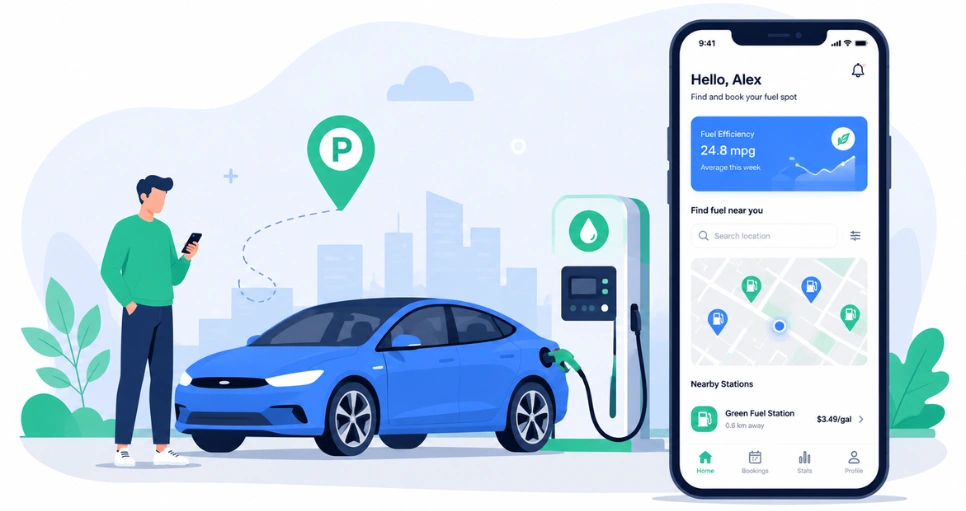
Running out of fuel is frustrating. Building a fuel delivery app without knowing the budget can be even worse. I've seen many startups rush into development, only to realize later that they planned for the wrong costs. That's why understanding the fuel delivery app development cost before writing a single line of code really matters.
Apps like EzFill, CAFU, and Yoshi have shown there's real demand for mobile fuel delivery. But no two apps cost the same. In this guide, you'll learn what affects pricing, how costs break down from $8,000 to $90,000+, which features are worth investing in first, and practical ways to build a scalable app without overspending.
Why Fuel Delivery Apps Are Growing So Fast & Market Overview in 2026
Numbers don't lie, and these ones tell a good story.
The mobile fuel delivery market sat at USD 5.84 billion in 2025, according to Future Market Insights, and it's headed toward USD 11.93 billion by 2035. That's a 7.4% CAGR, steady and not flashy but real growth that keeps building year after year.
Diesel leads the pack here, holding a 62% share, mostly because trucks and heavy equipment can't just roll up to a gas station whenever they feel like it. Trucks themselves make up 70% of the equipment segment. It makes sense once you think about it: fleet operators need fuel where the work is, not the other way around.
Why is this whole space exploding right now? A few real reasons:
- Fleet operators lose money every minute a truck sits idle at a gas station
- Construction and job sites need fuel delivered fast, without stopping work
- Digital payment adoption made ordering fuel as easy as ordering food
- AI-based route planning cuts delivery time and fuel waste for providers
- Businesses want fuel-tracking data, not just a full tank
How Much Does Custom Fuel Delivery App Development Cost in 2026?
Here's the number you came for: custom fuel delivery app development cost runs anywhere from $8,000 for a lean MVP to $90,000+ for a full enterprise build. Let's break down what you get at each stage.
|
App Tier |
Core Features |
Timeline |
Estimated Cost |
|
MVP (Basic) |
User signup, location pin, fuel request form, basic payment, single admin panel |
6–8 weeks |
$8,000 – $18,000 |
|
Standard |
MVP features + driver app, live tracking, push notifications, multiple payment methods |
8–12 weeks |
$18,000 – $35,000 |
|
Advanced App |
Standard features + subscription plans, fleet management, in-app chat, analytics dashboard |
12–16 weeks |
$35,000 – $60,000 |
|
Enterprise |
Growth features + AI demand forecasting, IoT tank sensors, multi-region compliance, custom API integrations |
16–24+ weeks |
$60,000 – $90,000+ |
Detailed Cost Formula: How the Math Actually Works
Let's talk numbers for a second. Not vague ones, real math.
Here's the formula every developer uses behind the scenes:
Total Cost = Total Development Hours × Hourly Rate.
Sounds simple. It is simple. But most agencies never show you this part, so you're left guessing why one quote says $15,000 and another says $60,000 for the same idea.
Hours Breakdown for On-Demand Fuel Delivery App Development Cost
Every phase eats real hours, and every hour shapes your final on demand fuel delivery app development cost, from planning to launch.
1. Discovery & Planning
This is where the real groundwork happens: feature scoping, market research, and mapping out your app's roadmap before a single line of code gets written. Skip this, and you'll pay for it later in rework.
- Competitor research and feature scoping
- User persona mapping
- Technical requirement docs
Cost: $500–1,500 (MVP) | $4,000–8,000 (Enterprise)
2. UI/UX Design
Wireframing and prototyping shape how your app feels in someone's hand. A driver glancing at his phone mid-delivery needs clean screens, not clutter. This phase decides that.
- Low-fidelity wireframes
- Interactive prototypes
- Usability testing rounds
Cost: $800–2,000 (MVP) | $7,000–12,000 (Enterprise)
3. Backend Development
Your database schema, server logic, and API architecture all live here. This is the engine room the part nobody sees, but everything depends on it running clean.
Cost: $1,500–4,000 (MVP) | $15,000–$25,000+ (Enterprise)
4. Frontend (iOS + Android)
This is what users actually touch: buttons, screens, and animations. Whether you go with a native SDK or a cross-platform framework, this phase eats the biggest chunk of hours on the whole build.
Cost: $2,000–5,000 (MVP) | $18,000–30,000+ (Enterprise)
5. Testing & QA
User acceptance testing, bug tracking, and load testing under real traffic this phase catches the stuff that breaks trust fast, like a payment failing mid-order.
- Functional testing
- Load and stress testing
- Security vulnerability checks
Cost: $500–1,500 (MVP) | $5,000–8,000 (Enterprise)
6. Deployment
App store submission, CI/CD pipeline setup, and final cloud hosting configuration happen here. Small phase, but miss a step, and your launch date slips by weeks.
Cost: $250 – $2,000 (MVP) | $750 – $5,000 (Enterprise)
Region-Wise Hourly Rates for Fuel Delivery App Cost Estimation in 2026
Where your developers sit changes everything. Fuel delivery app cost estimation swings hard based on region and rate.
|
Region |
Average Hourly Development Rate |
|
North America |
$80 – $150/hour |
|
Western Europe |
$60 – $110/hour |
|
Eastern Europe |
$35 – $55/hour |
|
India / South Asia |
$20 – $40/hour |
|
Latin America |
$30 – $50/hour |
Let's run the numbers on a real example. Say you're building a Standard-tier app, roughly 350 total hours. Hire a team in India, and you're looking at around $10,500. Go with a North American agency at $120 an hour, and that same project jumps to $42,000.
Same app. Same features. Different price tag entirely just because of where the keyboard sits.
I've seen founders pick the cheapest rate every time, and it bites them later. Communication gaps, time-zone mismatches, rushed QA it adds up in ways a spreadsheet won't show you. When you're comparing overall mobile app development cost, the rate is only half the story. Delivery quality is the other half, and that part doesn't show up in an hourly number.
What Determines the Cost To Build a Fuel Delivery App?
Features, platform, and compliance: are several moving pieces shape the real cost to build a fuel delivery app for your business.
1. App Complexity
More features mean more code, more testing, more time. A simple request-and-pay app costs way less than one with live GPS tracking, subscriptions, and fleet dashboards baked in.
2. Platform Choice: Flutter vs Native
|
Platform |
Best For |
Development Speed |
Performance |
Estimated Cost (MVP–Enterprise) |
|
iOS (Native – Swift) |
Apple-only launch, premium user experience |
Slower (single platform) |
Excellent, smooth GPS and sensor handling |
$6,000 – $45,000 |
|
Android (Native – Kotlin) |
Wider market reach, hardware access |
Slower (single platform) |
Excellent, strong IoT and sensor support |
$6,000 – $45,000 |
|
Cross-Platform (Flutter) |
Fast MVP launch with a single codebase |
Fast (both platforms together) |
Good, with minor lag on heavy sensor tasks |
$8,000 – $55,000 |
|
Cross-Platform (React Native) |
Startups needing quick iteration |
Fast (both platforms together) |
Good, suitable for standard features |
$8,000 – $55,000 |
|
Native (iOS + Android) |
Enterprise-grade apps with advanced IoT and GPS capabilities |
Slowest (two separate builds) |
Best possible performance with full hardware control |
$15,000 – $90,000+ |
3. UI/UX Design Depth
A template-based design is cheap and fast. A custom design, built around how your specific customers actually order fuel, costs more but pays off in retention. I've watched apps with clunky screens lose users in the first week, no matter how good the backend was.
4. Backend Architecture
Real-time tracking, live driver location, secure payment processing this is where the real engineering hours go. It's the part users never see, and it's usually the most expensive.
5. Third-Party Integrations
Payment gateways, Google Maps API, SMS and push notification services – these all come with their own licensing or usage fees. Most cost breakdowns skip this, and then the client gets surprised by a bill later.
Cost: $500 – $3,000 (basic integrations) | $4,000 – $12,000 (multiple gateways, maps, SMS/push combined)
6. Compliance and Safety Regulations
Fuel isn't like food delivery. There are permits, insurance requirements, and safety standards tied to transporting and storing fuel. Skipping this research early costs more later, trust me.
Cost: $500 – $2,000 (basic compliance documentation) | $6,000 – $12,000 (multi-state/region regulatory build-in)
7. AI and IoT Features
Smart tank sensors, demand forecasting, and predictive maintenance are becoming standard for 2026 builds, especially for fleet-focused apps. They're powerful, but they're also the most expensive add-ons on this whole list.
Cost: $3,000 – $8,000 (basic AI demand prediction) | $18,000 – $25,000+ (full IoT sensor network + predictive maintenance)
8. Ongoing Maintenance
Your app isn't done once it launches. Bug fixes, OS updates, server costs this keeps running every month, and a lot of first-time founders forget to budget for it.
Cost: $500 – $1,200/month (MVP-level upkeep) | $2,500 – $5,000/month (enterprise-level upkeep)
Must-Have Features Recommended by a Fuel Delivery App Development Company
Any experienced fuel delivery app development company will tell you these features aren't optional, they're what users expect.
I'm skipping the basics login screens, splash pages, and that stuff barely dents your quote. Here's what actually costs you money, split across the three panels that make this whole ecosystem run.
|
Customer App |
Driver App |
Admin Panel |
|
Geofenced OrderingDetects delivery zones automatically so orders only go where drivers can actually reach. |
Dispatch AlgorithmAuto-assigns the nearest driver based on route optimization, reducing delivery delays. |
Fleet Oversight DashboardTracks every vehicle, driver status, and delivery zone from one central dashboard. |
|
Dynamic Pricing EngineAdjusts fuel costs in real time based on demand, distance, and delivery window. |
Digital Fuel LogsRecords every dispensed gallon for compliance and accurate billing reconciliation. |
Revenue Reporting SuiteGenerates daily, weekly, and monthly transaction reports for business insights. |
|
In-App WalletStores balance and saved cards, allowing repeat customers to complete checkout faster. |
Driver Earnings DashboardDisplays payouts, completed trips, and pending balances without requiring support. |
Role-Based Access ControlRestricts access based on staff roles to protect sensitive business data. |
|
Multi-Vehicle ProfilesAllows users to manage multiple vehicles with different fuel types and tank sizes from one account. |
Offline Mode SyncContinues recording trip data in low-connectivity areas and syncs automatically once online. |
KYC Verification SystemVerifies driver identity and licensing before granting delivery access. |
|
SOS / Emergency ButtonSends instant emergency alerts during accidents or fuel spill incidents. |
Route OptimizationCalculates the fastest routes between multiple delivery stops to save time and fuel. |
Delivery Zone ManagementCreates, edits, and expands service areas without backend development. |
|
Rating & Review SystemCollects customer feedback to build trust and improve repeat orders. |
Fuel Type Selector |
CRM IntegrationConnects customer information with support and sales tools for faster issue resolution. |
Hidden Costs That Affect Fuel Delivery App Development Pricing
Fuel delivery app development pricing also includes hidden costs like APIs, cloud hosting, maintenance, compliance, and third-party integrations.
1. App Store & Play Store Fees
Apple and Google both charge yearly developer account fees, plus a commission cut on in-app purchases and transactions processed through their platforms.
Cost: $99/year (Apple) + $25 one-time (Google) + 15-30% transaction commission
2. Cloud Hosting and Server Scaling
Your backend needs to run somewhere, and as order volume grows, so does your server load. Traffic spikes during peak fuel-demand hours can spike your hosting bill fast.
Cost: $50 – $500/month (MVP) | $1,000 – $6,000+/month (high traffic, enterprise scale)
3. Payment Gateway Transaction Fees
Setting up Stripe or PayPal is one cost. Running transactions through them is another, ongoing one usually a small percentage plus a flat fee per order.
Cost: 2.5% – 3.5% per transaction, plus $0.30 flat fee
4. Data Security and Encryption
Fuel orders involve payment data, location tracking, and personal info. Skimping here isn't just risky, it can violate state-level data protection laws.
Cost: $1,500 – $10,000 (initial setup) | $200 – $1,000/month (ongoing audits)
5. Driver Background Checks and Liability Insurance
Every driver handling fuel needs a clean background check and coverage for accidents or spills. This isn't optional; most states require it before you can legally operate.
Cost: $30 – $80 per driver (background check) | $2,000 – $8,000/year (liability insurance)
6. Customer Support Infrastructure
Live chat tools, helpdesk software, and support staff training all add up once real users start hitting real problems usually within the first month.
Cost: $500 – $3,000/month depending on support volume
7. App Store Optimization and Launch Marketing
Building the app is only half the job. Getting it discovered on the app store, running early ad campaigns, and refining your listing all pull from a separate budget line.
Cost: $1,000 – $10,000 (initial launch push)
Honestly, this list is why so many founders blow past their original quote. Most mobile app development companies won't volunteer these numbers unless you ask directly, not because they're hiding anything, just because the upfront build cost is what closes the deal. Budget for these from day one, and your launch won't come with financial surprises three months in.
How to Reduce Fuel Delivery App Development Cost Without Compromising Quality
Cutting costs doesn't mean cutting corners. There's a real difference, and smart founders know exactly where that line sits.
1. Start With an MVP, Not the Full Vision
Launch with core features only request fuel, track delivery, pay. Skip the extras until real users prove they're worth building.
Savings: $5,000 – $25,000+
2. Use Cross-Platform Frameworks
Flutter or React Native build both iOS and Android from one codebase, cutting duplicate development work almost in half.
Savings: $4,000 – $15,000
3. Hire Offshore or Nearshore Development Teams
Skilled teams in India or Eastern Europe deliver solid quality at a fraction of North American hourly rates, without sacrificing code standards.
Savings: $15,000 – $60,000
4. Reuse Pre-Built Modules and APIs
Payment gateways, maps, and SMS services already exist building these from scratch instead of integrating them just burns the budget for no reason.
Savings: $3,000 – $10,000
5. Delay AI and IoT Features Until Post-Launch
Smart tank sensors and demand forecasting sound great on paper, but most AI development services charge premium rates for this work and push it to phase two once you've got order data to justify it.
Savings: $5,000 – $20,000
6. Choose Agile Development Over Waterfall
Building in short sprints lets you catch design flaws early, instead of discovering a broken flow after the whole app's already built.
Savings: $5,000 – $15,000
7. Test Continuously, Not Just at the End
Catching bugs phase-by-phase costs way less than a full QA overhaul right before launch, when everything's tangled together.
Savings: $2,000 – $8,000
8. Clarify Requirements Before Development Starts
Scope creep adding features mid-build is the single biggest budget killer I've seen. A locked spec sheet upfront avoids this completely.
Savings: $5,000 – $20,000 (in avoided rework)
Is Developing a Fuel Delivery App Worth the Investment in 2026?
Yes, if you build it right and target the right customers.
Here's the thing: fuel delivery isn't a passing trend. Fleet operators, construction sites, and commercial vehicle owners are moving away from gas stations for good. That shift alone creates steady, repeat demand your app can capture month after month.
Is The Fuel Delivery Business Profitable?
yes. Most providers earn through a delivery markup usually $0.30 to $0.75 per gallon above wholesale price plus subscription plans for repeat commercial clients. Fleet-focused apps tend to profit faster than consumer-only models, since one commercial contract can replace dozens of individual orders.
A few reasons this investment holds up:
- Growing demand: businesses want fuel delivered on their schedule, not the station's
- Fleet digitization: companies are replacing paper fuel logs with app-based tracking systems
- Subscription: opportunities recurring fuel plans create predictable, steady monthly income
- Commercial customers: construction, logistics, and agriculture bring higher-volume, loyal accounts
- Long-term scalability: the same app architecture can expand into new cities or fuel types later
Most on-demand app development companies will tell you the same thing I will: don't chase every customer type at launch. Pick one segment, nail the experience, then grow outward.
My honest take, after seeing this space for years the fuel delivery model works when you treat it like a B2B business with a consumer-friendly app on top. Start there, and 2026 is a solid year to build.
Conclusion
Fuel doesn't wait, and neither should your launch timeline. Whether you're eyeing an $8,000 MVP or a $90,000+ enterprise build, the real answer to how much does fuel delivery app development cost comes down to your features, your region, and how disciplined you stay within scope.
Start lean, prove demand, then scale. That's the pattern behind every fuel delivery app that actually made it. 2026's market is ready, the only question left is how fast you move.
FAQ's
A basic MVP costs $8,000–$18,000, while a full-featured enterprise fuel delivery app can cost $60,000–$90,000+.
Most projects take 6–24+ weeks, depending on app complexity, features, integrations, and development approach.
Flutter is ideal for most startups. Native iOS and Android are better for enterprise apps needing advanced performance.
Start with GPS tracking, fuel ordering, secure payments, driver management, push notifications, and an admin dashboard.
Features, platform, UI/UX, backend, APIs, compliance, AI, IoT, and developer location have the biggest impact on cost.
Yes. Launch an MVP first, use Flutter, and add advanced features like AI and IoT after gaining real users.
Yes. Revenue comes from fuel markups, delivery fees, subscriptions, and long-term fleet contracts with recurring orders.
Build an MVP, use cross-platform development, reuse APIs, define requirements early, and add advanced features later.

CrinPro
CrinPro Solutions is a leading IT company that helps startups and enterprises build innovative digital products. From intuitive mobile applications and high-performance websites to AI-powered solutions and enterprise software, our team delivers scalable, secure, and user-focused products tailored to unique business needs. With expertise across multiple industries, we transform ideas into digital experiences that drive growth, improve efficiency, and create long-term business value.