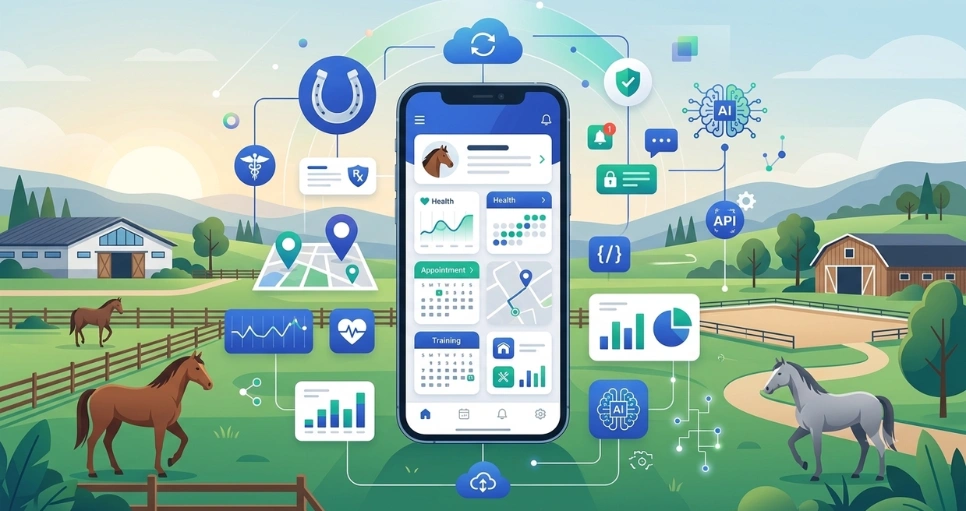
Key Takeaways:
- Equine apps simplify horse care, stable management, and daily operations through one centralised platform.
- Essential features include horse profiles, health records, training tracking, boarding management, and analytics.
- Development costs typically range from $8,000 to $70,000+, depending on project complexity.
- AI, cloud technology, and wearable integrations are shaping the future of equine management solutions.
- A scalable, custom-built app helps equestrian businesses improve efficiency and deliver better care for horses.
The equine industry is rapidly embracing digital technologies to simplify horse care, streamline stable operations, and improve communication between horse owners, trainers, veterinarians, breeders, and riding facilities. Traditional methods of maintaining health records, training schedules, feeding plans, and competition data are increasingly being replaced by intelligent digital solutions.
As a result, equine app development has become an important investment for equestrian businesses, horse owners, breeding farms, riding schools, veterinary clinics, and event organisers. Modern equine applications centralise daily operations, making it easier to monitor horse health, schedule appointments, manage stable activities, track performance, and access important information from any location.
Whether you're planning horse management app development for a private stable or a comprehensive platform serving the wider equestrian community, a well-designed application can improve operational efficiency, enhance horse welfare, and deliver a better experience for every stakeholder.
Why the Equine Industry Is Going Digital
Technology is transforming how equine professionals manage horses and operate their businesses. Mobile and web applications help reduce paperwork, improve communication, and provide real-time access to important information, making daily management significantly more efficient.
Here are some of the major reasons businesses are investing in equestrian app development.
1. Centralized Horse Records
Digital platforms provide a secure location for storing medical history, vaccination records, breeding information, ownership details, training logs, and competition results. Having all records in one place improves accessibility and reduces administrative work.
2. Improved Horse Care
Modern horse care app development solutions help owners and stable managers organise feeding schedules, medication reminders, veterinary appointments, and routine health checkups. This ensures horses receive consistent care while reducing the risk of missed treatments.
3. Better Stable Management
Managing stalls, boarding services, inventory, employee schedules, and maintenance tasks becomes much easier with a centralised digital platform. Automation improves workflow efficiency and helps stable managers focus more on horse welfare.
4. Enhanced Communication
Equine applications enable seamless communication between horse owners, trainers, veterinarians, farriers, and stable staff through messaging, notifications, appointment scheduling, and shared digital records, ensuring everyone stays informed.
5. Data-Driven Decision Making
Real-time analytics provide valuable insights into horse performance, operational costs, customer activity, and stable productivity. These insights help equine businesses make informed decisions, optimise resources, and improve overall operational efficiency.
Essential Features of an Equine Management App
Successful equine applications combine horse management, healthcare, scheduling, communication, and analytics into one centralised platform. Below are the most important equine app features every modern solution should include.
1. Horse Profiles and Digital Records
A comprehensive horse profile serves as the foundation of an equine management app. It should securely store ownership details, pedigree information, medical history, vaccination records, dietary plans, training schedules, insurance documents, breeding records, and competition history.
2. Stable Management
A centralised stable management module helps stable owners and managers efficiently oversee daily operations. It enables them to organise stall assignments, manage boarding records, schedule feeding routines, track maintenance tasks, assign responsibilities to staff, and monitor day-to-day activities from a single dashboard, improving productivity and operational efficiency.
3. Health and Veterinary Management
Modern horse care app development solutions help horse owners and veterinarians manage healthcare more efficiently. Features such as appointment scheduling, treatment tracking, medication reminders, vaccination management, veterinary reports, and emergency health records ensure horses receive timely and well-documented care while maintaining complete medical histories in a centralised system.
4. Training and Performance Tracking
An effective equine app should enable trainers and horse owners to monitor every stage of a horse's development. Users can record daily exercise routines, training sessions, rider notes, competition results, performance metrics, and recovery progress. By maintaining detailed performance records, trainers can identify improvement areas, adjust training programmes, and make data-driven decisions to maximise each horse's health and competitive potential.
5. Event and Competition Management
An integrated event management system allows users to organise horse shows, riding competitions, training events, and tournaments from a single platform. Features such as online registrations, event calendars, participant management, scheduling, and automated notifications help clubs and equestrian organisations streamline event planning while improving coordination for organisers, riders, and horse owners.
6. Boarding and Billing Management
A built-in boarding and billing module helps stable owners manage boarding agreements, generate invoices, process recurring payments, track expenses, and monitor financial records from a single dashboard. Automating these tasks reduces manual paperwork, improves payment accuracy, and streamlines day-to-day business operations.
7. Horse Racing Management
Applications designed for horse racing app development can help trainers, owners, and racing organisations manage race schedules, jockey assignments, horse performance, training progress, race history, and event registrations from a single platform. These features improve coordination, simplify race preparation, and provide valuable insights to support better decision-making.
8. AI-Powered Insights
Many businesses partner with experienced AI app development companies to integrate advanced capabilities such as predictive health monitoring, intelligent scheduling, personalised training recommendations, anomaly detection, and data-driven analytics. These AI-powered features improve decision-making while enhancing horse care and overall operational performance.
Benefits of Equine App Development for Businesses
Investing in equine app development offers long-term advantages for horse owners, breeding farms, riding schools, veterinary clinics, and equestrian organisations. A centralised digital platform streamlines operations, enhances horse care, and improves collaboration among all stakeholders.
1. Improved Operational Efficiency
Automate routine tasks such as stable management, feeding schedules, appointment booking, billing, and record-keeping to reduce manual effort and improve productivity.
2. Better Horse Health Management
Maintain comprehensive medical records, vaccination schedules, treatment histories, and medication reminders in one secure platform, ensuring consistent and proactive horse care.
3. Enhanced Customer Experience
Provide horse owners with real-time access to health records, training progress, boarding updates, invoices, and notifications, improving transparency and customer satisfaction.
4. Data-Driven Decision Making
Leverage dashboards and analytics to monitor horse performance, stable occupancy, revenue, operational costs, and customer engagement, enabling informed business decisions.
5. Increased Revenue Opportunities
Generate additional revenue through online boarding reservations, event registrations, premium subscriptions, training services, veterinary consultations, and digital payment solutions.
6. Future-Ready Scalability
A cloud-based equine management platform can easily scale to support multiple locations, growing customer bases, wearable integrations, AI-powered insights, and advanced reporting as the business expands.
Technology Stack for Equine App Development
Selecting the right technology stack is essential for building a secure, scalable, and high-performance equine management application. The right combination of technologies ensures smooth performance, seamless integrations, robust security, and the flexibility to support future enhancements such as AI-powered analytics, wearable device integration, and cloud-based data management.
Below is a commonly used technology stack for building scalable MVP applications.
|
Technology Layer |
Recommended Technologies |
|
Frontend |
React.js, Next.js, Angular |
|
Mobile App |
Flutter, React Native, Swift (iOS), Kotlin (Android) |
|
Backend |
Node.js, Python (Django/FastAPI), Laravel, .NET |
|
Database |
PostgreSQL, MySQL, MongoDB |
|
Cloud Platform |
AWS, Google Cloud Platform (GCP), Microsoft Azure |
|
Authentication |
Firebase Authentication, OAuth 2.0, JWT |
|
Storage |
Amazon S3, Cloudinary |
|
Notifications |
Firebase Cloud Messaging (FCM), Twilio |
|
Maps & Location |
Google Maps API |
|
Analytics |
Firebase Analytics, Google Analytics |
|
AI & Machine Learning |
OpenAI API, TensorFlow |
|
DevOps |
Docker, Kubernetes, GitHub Actions, Jenkins |
How to Build an Equine Management App
Developing a successful equine application requires careful planning, industry expertise, and the right technology stack. Whether you're creating a solution for horse owners, breeding farms, riding schools, veterinary clinics, or racing organisations, following a structured approach helps ensure your application is scalable, secure, and user-friendly.
1. Identify Your Business Requirements
Start by defining your target audience and business objectives. Determine whether your app will focus on horse care, stable management, training, breeding, event management, or a combination of services. Clearly outlining your goals helps prioritise the features needed for the first release.
2. Plan the Core Features
List the essential functionalities your application should include, such as horse profiles, health records, stable management, appointment scheduling, billing, notifications, and performance tracking. Prioritising core features helps reduce development time while creating a strong foundation for future updates.
3. Design an Intuitive User Experience
A well-designed interface improves usability for horse owners, trainers, veterinarians, and stable managers. Create wireframes and interactive prototypes that simplify navigation and ensure users can quickly access important information from both mobile and web platforms.
4. Develop a Scalable Solution
Build the application using modern frameworks, cloud infrastructure, and secure backend architecture that can support future growth. Businesses investing in custom equine app development services should also ensure the platform can integrate with third-party systems, wearable devices, payment gateways, and veterinary databases.
5. Test and Launch
Before deployment, conduct comprehensive testing to verify functionality, security, performance, compatibility, and user experience. Identifying and resolving issues before launch helps deliver a reliable application across multiple devices and operating systems.
6. Maintain and Scale the Platform
Once the application is live, continuously monitor user feedback, release feature updates, improve performance, and strengthen security. Many businesses partner with experienced mobile app development companies and full-stack development companies to ensure long-term maintenance, seamless scalability, and ongoing technical support.
Equine App Development Cost
The equine app development cost depends on the application's complexity, feature set, technology stack, integrations, and customisation requirements. Businesses should also evaluate the overall software development cost when planning their digital transformation strategy.
Below is an estimated cost breakdown based on the project scope.
|
App Type |
Estimated Cost |
Development Timeline |
|
Basic Horse Management App |
$8,000–$20,000 |
2-3 Months |
|
Standard Equestrian App |
$20,000–$35,000 |
3-5 Months |
|
Advanced Equine Management Platform |
$35,000–$55,000 |
5-7 Months |
|
Enterprise Equine Software Solution |
$55,000–$70,000+ |
7-10 Months |
If the project includes web portals alongside mobile applications, understanding the web app development cost and mobile app development cost helps create a realistic budget.
Similarly, integrating intelligent features may influence the AI app development cost, depending on the complexity of automation and predictive analytics required.
Conclusion
The equine industry is rapidly embracing digital transformation, creating new opportunities for businesses to improve horse care, simplify stable operations, and enhance customer experiences. Investing in equine app development enables equestrian organisations to centralise horse management, automate daily tasks, and make data-driven decisions through a single, scalable platform.
Whether you're planning horse management app development for a stable, breeding farm, veterinary clinic, or riding school, choosing the right technology strategy is essential for long-term success. By incorporating modern features, scalable architecture, and intelligent automation, businesses can build future-ready equine solutions that deliver lasting value to both organisations and horse owners.
FAQ's
Equine app development is the process of creating mobile or web applications that help manage horse care, stable operations, training, veterinary records, breeding, events, and other equestrian activities through a centralised digital platform.
The equine app development cost typically ranges from $8,000 to $70,000+, depending on the application's features, integrations, customisation, and overall complexity.
Important equine app features include horse profiles, health records, stable management, training tracking, boarding management, billing, event scheduling, notifications, analytics, and AI-powered insights.
Most equine applications take 2 to 10 months to develop, depending on the project scope, required features, and customisation level.
Yes. AI can be used for predictive health monitoring, automated scheduling, performance analysis, personalised care recommendations, and intelligent reporting, improving both horse welfare and operational efficiency.
Equine apps are beneficial for horse owners, stable managers, riding schools, veterinary clinics, breeders, trainers, racing organisations, equestrian clubs, and other businesses involved in horse management.

CrinPro
CrinPro Solutions is a leading IT company that helps startups and enterprises build innovative digital products. From intuitive mobile applications and high-performance websites to AI-powered solutions and enterprise software, our team delivers scalable, secure, and user-focused products tailored to unique business needs. With expertise across multiple industries, we transform ideas into digital experiences that drive growth, improve efficiency, and create long-term business value.