Key Takeaways:
- The entertainment app development cost can range from approximately $8,000 to $90,000+, depending on complexity, features, platforms, and integrations.
- Basic entertainment apps may take 2–3 months, while enterprise platforms can require 7–10+ months.
- Important features include content libraries, search, streaming, subscriptions, payments, recommendations, playlists, notifications, and admin management.
- The technology stack can include Flutter, React Native, Node.js, Python, PostgreSQL, cloud platforms, streaming technologies, CDNs, and AI frameworks.
- Streaming infrastructure, content delivery, AI personalization, security, and scalability can significantly increase development expenses.
- Custom development provides greater flexibility for businesses requiring specialized entertainment features and integrations.
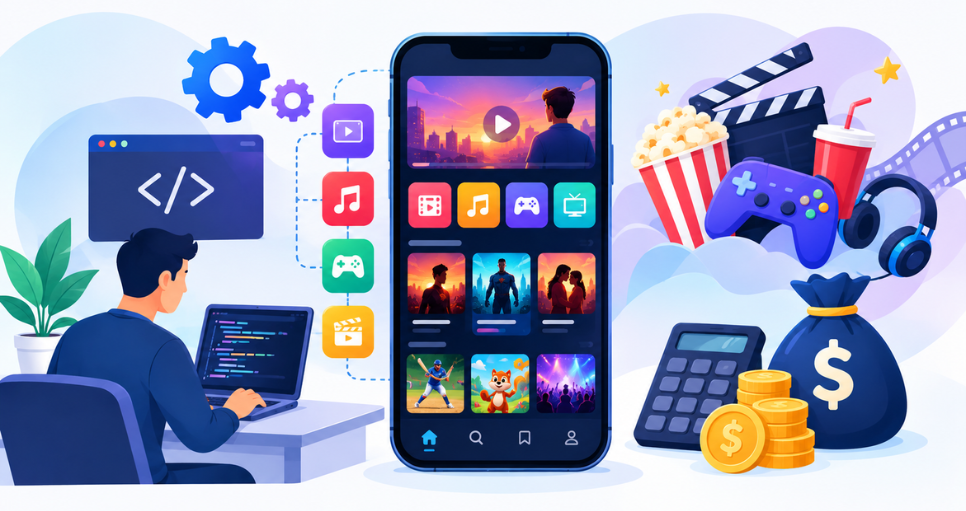
Entertainment apps have become a popular way for users to watch videos, listen to music, discover content, interact with creators, and access digital entertainment from their smartphones. Businesses can use these platforms to reach audiences, deliver personalized experiences, and create new revenue opportunities.
However, developing an entertainment app involves more than building a user-friendly interface. Streaming capabilities, content management, user accounts, payments, recommendations, social features, security, and third-party integrations can significantly influence the overall development effort.
The cost of developing an entertainment app depends on the app's features, technology stack, number of platforms, content type, UI/UX complexity, integrations, scalability requirements, and development approach. This guide explains the major costs, essential features, technology requirements, pricing models, development timelines, and factors that can affect the final budget.
Entertainment App Development Market Statistics in 2026
- The global media and entertainment market size was valued at $2562.08 billion in 2023 and is projected to reach $5279.3 billion by 2032. The market is anticipated to grow considerably with a CAGR of 6.79% during the forecast period, and entertainment apps are a key part of this.
- More than 78% of global users shifted to digital streaming platforms, while 69% increased mobile media consumption and 64% engaged in social media entertainment daily.
- The global entertainment market volume is projected to reach approximately $276.12 billion in 2026, driven heavily by mobile accessibility, video-on-demand, and advertising models
Entertainment App Development Cost: A Quick Pricing Overview
The entertainment app development cost can range from approximately $8,000 to $90,000+, depending on the app's features, content type, technology, number of platforms, integrations, streaming requirements, and level of customization.
|
App Complexity |
Estimated Cost |
Development Timeline |
|
Basic Entertainment App |
$8,000–$20,000 |
2–3 months |
|
Standard Entertainment App |
$20,000–$40,000 |
3–5 months |
|
Advanced Entertainment App |
$40,000–$65,000 |
5–7 months |
|
Enterprise Entertainment Platform |
$65,000–$90,000+ |
7–10+ months |
For businesses planning a streaming-focused platform, the video streaming app development cost can vary depending on streaming quality, content delivery infrastructure, user accounts, subscriptions, video storage, and the number of supported platforms.
Entertainment App Features That Affect Development Cost
The features included in an entertainment application directly influence its development effort and overall budget. Basic content browsing and playback require less development than advanced streaming, personalization, social interaction, and monetization capabilities.
|
Entertainment App Feature |
What It Includes |
Cost Impact |
|
User Registration & Profiles |
Sign-up, login, profiles, preferences, and account management |
Low |
|
Content Library |
Movies, videos, music, shows, categories, and metadata |
Medium |
|
Search & Filters |
Keyword search, categories, genres, languages, and advanced filters |
Low–Medium |
|
Audio & Video Streaming |
Content playback, adaptive streaming, quality controls, and player functionality |
High |
|
Subscriptions & Payments |
Subscription plans, payment gateways, renewals, refunds, and transaction management |
High |
|
Personalized Recommendations |
Content suggestions based on user preferences and behaviour |
High |
|
Playlists & Favourites |
Saved content, watchlists, playlists, and favourites |
Medium |
|
Offline Downloads |
Allows users to download selected content for offline access |
High |
|
Live Streaming |
Real-time video or audio broadcasting and viewer management |
High |
|
Push Notifications |
New releases, recommendations, promotions, and account updates |
Low |
|
Ratings & Reviews |
User ratings, reviews, likes, and content feedback |
Low–Medium |
|
Social Features |
Following, sharing, comments, profiles, and user interactions |
Medium–High |
|
Admin Dashboard |
Content, users, subscriptions, analytics, reports, and platform management |
Medium–High |
1. Video and Audio Streaming
Streaming functionality is one of the most important cost drivers for entertainment applications. Video resolution, adaptive bitrate streaming, content delivery, storage, bandwidth, and the number of concurrent users can increase both development and infrastructure expenses.
Businesses planning music streaming app development may also require playlists, music libraries, artist profiles, recommendations, audio quality controls, and subscription management.
2. AI-Powered Recommendations
AI can analyze viewing or listening behaviour to recommend relevant movies, shows, songs, or other content. Developing personalized recommendation systems can require additional data processing, model development, testing, and infrastructure.
Businesses can consult an experienced AI development company when implementing personalized recommendations, content discovery, and other intelligent entertainment features.
3. Social and Interactive Features
Comments, likes, follows, sharing, user-generated content, live chats, and community features can increase engagement but also add backend, moderation, notification, and security requirements.
4. Monetization Features
Subscription plans, advertising, in-app purchases, premium content, and pay-per-view functionality require additional payment and billing workflows. The complexity of these features can directly influence the overall Entertainment App pricing.
Businesses should prioritize features according to their target audience and revenue model rather than implementing every advanced capability in the first release.
Entertainment App Technology Stack and Estimated Development Cost
The entertainment app technology stack determines how efficiently an application can handle streaming, content delivery, user accounts, payments, recommendations, analytics, and large numbers of concurrent users. The technology choices also influence development and infrastructure costs.
|
Technology Layer |
Recommended Technologies |
Estimated Cost Impact |
|
Mobile App |
Flutter, React Native, Swift, Kotlin |
$3,000–$10,000 |
|
Frontend |
React.js, Next.js |
$2,000–$6,000 |
|
Backend |
Node.js, Python, Django, .NET |
$4,000–$12,000 |
|
Database |
PostgreSQL, MySQL, MongoDB |
$1,500–$5,000 |
|
Video & Audio Streaming |
FFmpeg, HLS, DASH |
$4,000–$15,000+ |
|
Cloud Infrastructure |
AWS, Azure, Google Cloud |
$2,000–$8,000 |
|
CDN & Content Delivery |
CloudFront, Cloudflare, Fastly |
$1,000–$5,000 |
|
Payment Integration |
Stripe, PayPal, Regional Gateways |
$1,000–$4,000 |
|
AI & Recommendations |
TensorFlow, PyTorch, AI APIs |
$3,000–$12,000+ |
|
Real-Time Communication |
WebSockets, Firebase |
$1,000–$4,000 |
|
Analytics & Monitoring |
Firebase Analytics, Google Analytics, Power BI |
$500–$3,000 |
|
Security & DRM |
Encryption, authentication, DRM solutions |
$2,000–$8,000+ |
1. Mobile App Technologies
Flutter and React Native can support cross-platform applications, while Swift and Kotlin are commonly used for native iOS and Android development. The choice depends on the required performance, device support, and project scope.
2. Backend and Database
The backend manages users, content, subscriptions, payments, recommendations, watch history, playlists, and business logic. Databases such as PostgreSQL, MySQL, and MongoDB can store user and content-related information.
3. Streaming Infrastructure
Video and audio applications require specialized streaming technologies to process, encode, store, and deliver media efficiently. HLS and DASH can support adaptive streaming, while CDN services help distribute content to users across different locations.
The music app development cost can increase when the platform requires high-quality audio streaming, offline downloads, personalized recommendations, subscription management, and scalable content delivery.
4. AI and Personalization
AI technologies can analyze viewing or listening behaviour to generate personalized recommendations, automate content discovery, and improve user engagement. These capabilities may increase both development and ongoing infrastructure costs.
5. Cloud, Security, and DRM
Cloud infrastructure provides scalable computing, storage, databases, and monitoring. Entertainment platforms may also require encryption, secure authentication, access controls, and digital rights management to protect premium content.
The technology-level figures are indicative and should not simply be added together to calculate the complete project cost. Actual expenses depend on the selected architecture, feature requirements, media volume, third-party services, and expected user traffic.
Key Factors Affecting Entertainment App Development Cost
Several factors can influence the final budget of an entertainment application. Understanding these elements during the planning stage can help businesses estimate expenses more accurately and prioritize the features that deliver the most value.
|
Cost Factor |
How It Affects Development Cost |
|
Feature Complexity |
Advanced streaming, recommendations, social features, live content, and automation require additional development effort. |
|
Number of Platforms |
Supporting iOS, Android, web, smart TVs, or other devices increases development and testing requirements. |
|
Streaming Requirements |
High-quality video or audio streaming requires media processing, storage, CDN infrastructure, and bandwidth. |
|
Content Management |
Large content libraries, metadata, categories, playlists, and content moderation require more sophisticated systems. |
|
UI/UX Design |
Custom interfaces, animations, interactive media players, and personalized experiences increase design effort. |
|
Third-Party Integrations |
Payment gateways, analytics, social platforms, authentication, cloud services, and media APIs add integration work. |
|
AI & Personalization |
Recommendation engines, predictive analytics, intelligent search, and AI assistants can increase development and infrastructure costs. |
|
Security & DRM |
Encryption, secure authentication, access controls, and digital rights management require specialized implementation. |
|
Scalability |
Supporting large content libraries and high numbers of concurrent users requires stronger backend and cloud infrastructure. |
|
Maintenance |
OS updates, API changes, security patches, infrastructure monitoring, and feature enhancements create ongoing expenses. |
1. Streaming and Content Delivery
Streaming infrastructure is one of the major cost considerations for video and audio platforms. Businesses need to account for media encoding, storage, CDN services, bandwidth consumption, and expected concurrent users.
For businesses exploring social media app development costs, interactive features such as user-generated content, messaging, comments, feeds, moderation, and real-time communication can introduce additional development requirements.
2. Platform and Feature Requirements
Developing for multiple platforms can increase the budget because each platform may require additional development, testing, optimization, and maintenance. Similarly, advanced features such as live streaming, offline downloads, AI recommendations, and personalized content can extend the project scope.
3. Security and Scalability
Entertainment applications may handle large volumes of user accounts, subscriptions, payment information, and licensed content. Strong security and scalable architecture should therefore be considered from the beginning rather than added after launch.
Careful feature prioritization and a phased development approach can help businesses control the initial budget while leaving room for advanced functionality in future releases.
Entertainment App Development Process: From Planning to Launch
A structured development process helps businesses manage the project scope, control costs, and build an entertainment platform that meets user expectations.
Step 1: Define the App Concept
Start by identifying the type of entertainment platform, target audience, content format, business model, and core objectives. This may include video streaming, music, social entertainment, live content, or a combination of formats.
Businesses planning to build an app like Netflix should define their target audience, content model, monetization strategy, and core features before starting development.
Step 2: Conduct Market Research
Analyze competitors, audience preferences, content trends, pricing models, and potential revenue opportunities. This research helps identify the features that should be prioritized in the initial release.
Step 3: Plan UI/UX
Create user flows, wireframes, prototypes, and interface designs for screens such as home, search, content details, media player, subscriptions, profiles, and account management.
Step 4: Select the Technology Stack
Choose appropriate mobile frameworks, backend technologies, databases, cloud infrastructure, streaming technologies, APIs, payment solutions, and security tools based on the project's requirements.
Step 5: Develop the Application
Develop the customer-facing application, backend systems, content management tools, and admin dashboard. Core functionality such as authentication, content browsing, media playback, subscriptions, payments, and notifications is implemented during this stage.
Step 6: Integrate Streaming and Third-Party Services
Connect video or audio streaming infrastructure, CDN services, payment gateways, analytics tools, authentication services, recommendation systems, and other required APIs.
Step 7: Test and Optimize
Conduct functional, performance, security, compatibility, usability, and streaming tests across supported devices. Testing is particularly important for applications expected to handle high concurrent traffic.
Step 8: Deploy and Launch
Configure production infrastructure, publish the application on relevant platforms, monitor system performance, and prepare the platform for users.
Step 9: Maintain and Improve
After launch, businesses should monitor application performance, resolve technical issues, update APIs, improve security, optimize infrastructure, and introduce new features based on user feedback.
Working with an experienced entertainment app development company can help businesses manage the technical requirements, development stages, integrations, and long-term maintenance of the platform.
Entertainment App Pricing by Development Approach: Cost Comparison
The development approach can significantly influence the overall entertainment app pricing. Businesses can choose between building a custom application, using a pre-built solution, or developing the platform in phases based on their budget and long-term objectives.
|
Development Approach |
Estimated Cost |
Best Suited For |
|
Pre-Built Solution |
$8,000–$20,000 |
Businesses seeking a faster and more affordable launch |
|
Custom MVP |
$15,000–$30,000 |
Startups validating an entertainment concept |
|
Standard Custom App |
$30,000–$50,000 |
Growing businesses requiring customized features |
|
Advanced Custom Platform |
$50,000–$70,000 |
Businesses requiring streaming, AI, and advanced integrations |
|
Enterprise Platform |
$70,000–$90,000+ |
Large-scale entertainment and streaming businesses |
1. Custom Development
Custom development provides greater control over the application's design, architecture, features, integrations, and scalability. It can be a better option for businesses with unique entertainment concepts or specialized streaming requirements.
Businesses can work with an experienced mobile app development company to build customized features and integrations according to their specific entertainment platform requirements.
2. Pre-Built Solutions
Pre-built solutions can reduce initial development time because many standard features are already available. However, customization options, scalability, integrations, and long-term flexibility may be more limited.
3. Phased Development
A phased approach allows businesses to launch essential functionality first and introduce advanced features later. For example, a startup could initially launch content browsing and streaming before adding AI recommendations, live streaming, social features, or advanced analytics.
For businesses planning mobile app development costs, comparing development approaches can help determine which option provides the right balance between initial investment, functionality, and long-term scalability.
Ways to Reduce Entertainment App Development Cost and Optimize Your Budget
Businesses can manage their entertainment app budget by prioritizing essential functionality, selecting suitable technologies, and introducing advanced capabilities in phases.
1. Start With an MVP
Launch with core features such as user registration, content browsing, search, media playback, subscriptions, payments, notifications, and an admin dashboard. Advanced features can be introduced after validating the product.
2. Prioritize High-Value Features
Focus the initial budget on features that directly improve user engagement and revenue instead of implementing every advanced capability from the beginning.
3. Choose Cross-Platform Development
Frameworks such as Flutter and React Native can support multiple platforms from a shared codebase, potentially reducing development effort compared with maintaining separate native applications.
4. Use Cloud and Third-Party Services
Ready-made services for authentication, payments, analytics, notifications, storage, and other functionality can reduce the need to develop every component from scratch.
5. Optimize Streaming Infrastructure
Choosing suitable video or audio formats, CDN services, storage solutions, and streaming architecture can help control infrastructure and bandwidth expenses as the platform grows.
6. Add AI in Phases
Businesses can begin with basic content discovery and gradually introduce personalized recommendations, intelligent search, predictive analytics, or AI assistants as user data and business requirements grow.
7. Plan Integrations Early
Identifying payment, analytics, social, streaming, CRM, and other integrations during the planning stage can help avoid costly architectural changes later.
8. Choose the Right Development Partner
Comparing technical expertise, portfolio quality, pricing, communication, scalability, and post-launch support can help businesses select suitable music streaming app development services without compromising essential quality.
Conclusion
Entertainment apps provide businesses with opportunities to deliver video, music, live content, and interactive experiences through convenient digital platforms. However, building a successful application requires careful planning around features, technology, streaming infrastructure, security, scalability, and monetization.
The overall investment can vary significantly depending on whether the business is launching a basic entertainment app or a large-scale streaming platform. Defining the core requirements, prioritizing high-value features and developing advanced capabilities in phases can help control the initial budget while creating a strong foundation for long-term growth.
FAQ's
Entertainment app development can cost around $8,000–$90,000+, depending on features, platforms, integrations, and complexity.
A basic app may take 2–3 months, while an advanced or enterprise platform can take 5–10+ months.
Common features include content streaming, search, subscriptions, payments, recommendations, playlists, notifications, and user profiles.
Yes. AI-powered recommendations, personalization, chatbots, and predictive analytics can increase development and infrastructure costs.
Feature complexity, streaming requirements, number of platforms, security, AI, third-party integrations, scalability, and UI/UX design are major cost factors.
Yes. Businesses typically need an ongoing budget for bug fixes, security updates, API maintenance, infrastructure, performance optimization, and new feature development after launch.

CrinPro
CrinPro Solutions is a leading IT company that helps startups and enterprises build innovative digital products. From intuitive mobile applications and high-performance websites to AI-powered solutions and enterprise software, our team delivers scalable, secure, and user-focused products tailored to unique business needs. With expertise across multiple industries, we transform ideas into digital experiences that drive growth, improve efficiency, and create long-term business value.