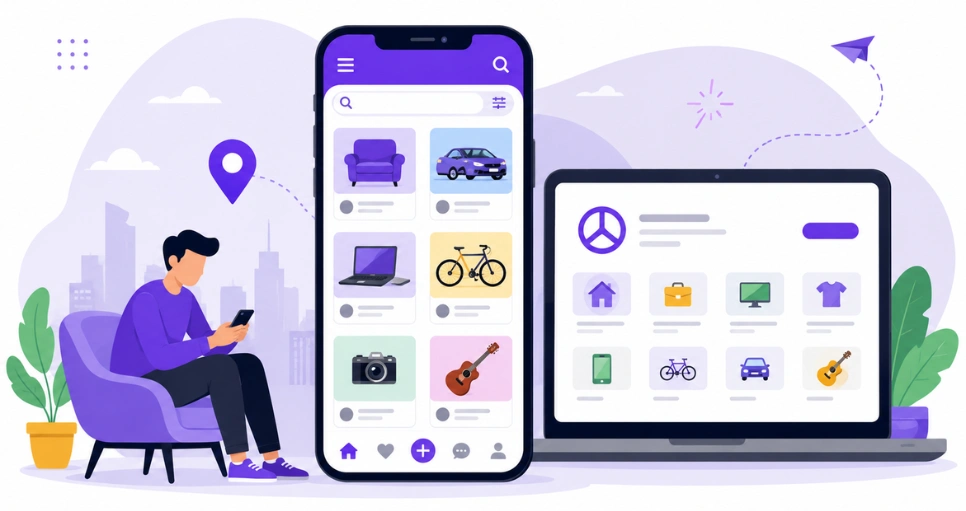
Key Takeaways:
- A Craigslist-like platform can serve general, niche, local, or professional marketplace audiences.
- The core foundation should focus on listings, search, location discovery, seller profiles, messaging, and moderation.
- A phased MVP approach allows businesses to validate demand before investing in advanced marketplace capabilities.
- AI can improve recommendations, listing categorisation, moderation, and fraud detection as the platform scales.
- Craigslist Clone App Development Cost generally ranges from $8,000 to $70,000+, depending on platform complexity and functionality.
Classified marketplaces have a simple proposition: help people find something they need and help someone else sell or offer it. That could be a used phone, a car, a rental property, a local service, furniture, a job opportunity, or almost anything else with a buyer and a seller.
Craigslist became successful by keeping this experience relatively straightforward: users could publish listings, search by location and category, and communicate directly with other users. Its model continues to influence businesses looking to build localised marketplaces where people can exchange products and services without the complexity of a traditional e-commerce store.
Today, entrepreneurs are exploring Craigslist clone app development to create modern classified platforms with better mobile experiences, stronger search, digital payments, location-based discovery, user verification, messaging, and intelligent recommendations.
However, building a successful Craigslist-like platform isn't about copying an existing website. The real opportunity lies in adapting the classified marketplace model to a specific audience, location, or niche while creating a scalable platform that can support buyers, sellers, advertisers, and administrators.
This guide explains how a Craigslist-style marketplace works, the features that matter, different business models, the development process, technology considerations, and the expected Craigslist clone app development cost.
Online Classified Marketplace Market Statistics
The growth of online classifieds shows that the Craigslist-style marketplace model still has significant commercial potential. Increasing smartphone usage, localised discovery, digital transactions, and the growing comfort of buying and selling online are creating opportunities for new classified platforms.
- Global Online Classified Ad Platform Market: The global online classified ad platform market was valued at approximately $40.9 billion in 2024 and is projected to reach $68.4 billion by 2030, representing a CAGR of 8.9% from 2024 to 2030.
- U.S. Market Opportunity: The U.S. online classified ad platform market was estimated at approximately $11.1 billion in 2024, highlighting the size of the market for businesses targeting American buyers and sellers.
- Mobile & Internet Adoption: Technavio estimates that the global online classified ad platform market is expected to grow by approximately $27.86 billion between 2024 and 2028, with increasing internet and smartphone penetration identified as important growth drivers.
- AI & Personalisation: Recent market research identifies AI-driven personalisation, smart ad matching, fraud detection, verification, and premium listing monetisation as important trends shaping the future of online classified platforms.
- Marketplace Monetisation: Online classified platforms can generate revenue through paid listings, featured advertisements, premium placements, advertising services, and communication tools, giving businesses multiple ways to monetise marketplace activity.
Why Craigslist-Like Marketplaces Continue to Attract Users
As the platform expands into multiple categories, businesses may need additional backend systems, admin tools, integrations, and automation. This can increase the overall software development cost, especially when the marketplace evolves from a simple classified platform into a larger multi-category ecosystem.
|
Marketplace Type |
Typical Listings |
Primary Users |
|
General Classifieds |
Furniture, electronics, vehicles, household goods |
Local buyers & sellers |
|
Jobs Marketplace |
Full-time, part-time, freelance roles |
Employers & job seekers |
|
Real Estate Marketplace |
Homes, rentals, commercial properties |
Owners, agents & tenants |
|
Services Marketplace |
Repairs, tutoring, cleaning, consulting |
Service providers & customers |
|
Automotive Marketplace |
Cars, bikes, parts, accessories |
Dealers & private sellers |
|
Niche Marketplace |
Industry-specific products or services |
Specialized communities |
Local Discovery Creates Stronger Connections
Unlike many large eCommerce platforms, classified applications can be built around geography. Users can discover products, services, jobs, or properties close to where they live, making location one of the most valuable parts of the marketplace experience.
This creates opportunities for businesses developing a local marketplace app development solution focused on a particular city, region, or community.
Sellers Get a Low-Barrier Entry Point
A classified platform doesn't require every seller to build a digital shopfront. Users can simply create an account, publish an advertisement, add images and pricing, and wait for interested buyers. This low barrier can help marketplaces grow their listing inventory quickly.
Buyers Get More Variety
Because individual sellers, businesses, dealers, agents, and service providers can all participate, classified platforms can offer a wide range of listings that would be difficult for a single retailer to maintain. A well-designed marketplace app development strategy can further improve discovery through categories, filters, location-based search, saved listings, and personalised recommendations.
The model can expand into specialised marketplaces.
A general classified platform can eventually evolve into focused verticals such as vehicles, property, jobs, services, or local commerce. Businesses can also introduce features inspired by buy-and-sell app development models to create more structured transactions while retaining the flexibility of classified listings.
How a Craigslist-Like Classified Marketplace Works
A classified marketplace connects several groups that interact with the platform differently. Buyers need fast discovery and trustworthy listings; sellers need an easy publishing process, and administrators need enough control to keep the marketplace safe and organised.
|
User Layer |
Main Activities |
Platform Support |
|
Buyers |
Search, compare, save, and contact sellers |
Search, filters, messaging, alerts |
|
Sellers |
Create and manage listings |
Listing tools, pricing, images, analytics |
|
Businesses |
Promote products and services |
Paid listings, advertising, business profiles |
|
Administrators |
Manage the marketplace |
Moderation, users, payments, reporting |
Step 1: A Seller Creates a Listing
The seller selects a category, enters the title and description, uploads images, sets the price, and provides a location. Depending on the marketplace model, additional information such as condition, availability, specifications, or service details can also be included.
Step 2: The platform publishes and organises it.
Once submitted, the listing can go through moderation before appearing publicly. The system organises listings by category, location, keywords, price, and other attributes so users can discover relevant offers quickly.
Step 3: Buyers Discover Relevant Listings
Buyers can browse categories or use search to find specific products and services. Location-based discovery becomes particularly useful for local marketplaces because users can prioritise listings within a convenient distance.
Step 4: Buyers Contact Sellers
Communication can happen through in-app messaging, phone integration, or other approved contact methods. Keeping communication inside the platform can also provide additional moderation and safety opportunities.
Step 5: The Marketplace Generates Revenue
The platform can monetise through featured listings, seller subscriptions, advertising, transaction fees, premium profiles, or category-specific promotions.
As the platform grows, businesses may introduce more structured purchasing capabilities and evolve toward a broader online marketplace app development model without abandoning the original classified marketplace concept.
Features That Give a Classified App Its Competitive Edge
A successful classified platform does not need every possible marketplace feature on day one. The priority should be creating a simple listing and discovery experience while giving administrators enough control to keep the marketplace trustworthy.
Buyer-Side Experience
Buyers should be able to find relevant listings quickly and contact sellers without unnecessary steps.
- Smart Search & Filters: Search should support keywords, categories, location, price range, listing condition, date posted, and other category-specific attributes. Advanced filtering becomes particularly important as the number of listings grows.
- Location-Based Discovery: Users can search for products or services near their current location or within a selected area. Map-based browsing can make local listings easier to discover.
- Saved Listings & Alerts: Users can bookmark interesting listings and receive notifications when prices change, new matching listings appear, or saved advertisements are updated.
- In-App Messaging: A secure messaging system allows buyers and sellers to communicate without immediately exposing personal contact information.
Seller-Side Experience
Publishing a listing should be simple enough that users can complete the process in minutes.
- Quick Listing Creation: Sellers should be able to upload photographs, add descriptions, set prices, select categories, specify locations, and publish advertisements from their smartphones.
- Listing Management: Users can edit, pause, renew, or remove advertisements while monitoring views, enquiries, and responses.
- Seller Profiles: Business and professional sellers can benefit from dedicated profiles containing company information, active listings, ratings, contact options, and verification badges.
- Featured Listings: Paid promotion can allow sellers to move their advertisements higher in search results or highlight them across relevant categories.
Platform-Level Features
The marketplace itself also needs infrastructure that protects users and keeps operations manageable.
|
Feature |
Business Purpose |
|
User Verification |
Helps reduce fake accounts and fraudulent listings |
|
Listing Moderation |
Keeps inappropriate or misleading advertisements off the platform |
|
Ratings & Reviews |
Builds trust between marketplace participants |
|
Push Notifications |
Keeps users informed about messages and listing activity |
|
Payment Integration |
Supports premium listings, subscriptions, or transactions |
|
Admin Dashboard |
Gives administrators control over users, listings, reports, and revenue |
|
Analytics |
Tracks listing performance, user activity, conversions, and marketplace growth |
For businesses adding intelligent discovery, AI app development companies can help implement recommendation engines, automated listing categorisation, fraud detection, image analysis, and personalised search.
Choosing the Right Business Model for a Craigslist-Like App
The classified marketplace model can be adapted to almost any niche. Before development begins, entrepreneurs should decide whether they want a broad platform similar to Craigslist or a focused marketplace serving one specific audience.
1. General Classified Marketplace
A general marketplace allows users to advertise almost anything, from electronics and furniture to vehicles, jobs, rentals, and local services. This model can attract a large audience, but it also requires strong categorisation, moderation, search, and fraud-prevention systems as the number of listings grows.
2. Niche Classified Marketplace
A niche platform focuses on one category or community, such as automobiles, real estate, jobs, rentals, collectibles, or professional services. The narrower audience makes it easier to create specialised marketplace app features and build a stronger value proposition around a particular market.
3. Local Marketplace
A local model concentrates on a city, region, or community. Location-based search becomes the core of the experience, allowing users to discover nearby products, services, and opportunities. This approach is particularly useful for entrepreneurs looking to compete in a specific geographic market rather than trying to launch a nationwide marketplace immediately.
4. Professional or Business Marketplace
Businesses can also use the classified model to connect service providers, dealers, agents, contractors, or other professionals with potential customers. Verified profiles, business subscriptions, lead management, promoted listings, and analytics can become important revenue-generating features.
Building the Platform in Stages
A Craigslist-style marketplace doesn't need to launch with every advanced capability. A phased development strategy can reduce initial investment while allowing the product to evolve based on actual user behaviour.
|
Development Stage |
Core Focus |
Typical Capabilities |
|
Stage 1 — MVP |
Validate the marketplace |
Registration, listings, categories, search, messaging |
|
Stage 2 — Growth |
Improve engagement |
Reviews, saved searches, alerts, seller profiles, analytics |
|
Stage 3 — Monetization |
Generate revenue |
Featured ads, subscriptions, paid promotions, payment integration |
|
Stage 4 — Intelligence |
Improve discovery & safety |
AI recommendations, fraud detection, smart categorization |
|
Stage 5 — Scale |
Expand the ecosystem |
Multiple markets, advanced admin tools, APIs, enterprise integrations |
Starting with a focused MVP also makes it easier to identify which categories attract the most users before expanding into additional marketplace verticals.
Businesses moving from a classified model toward direct purchasing may eventually explore eCommerce app development, while those building a highly customised marketplace can consider custom shopping app development costs when planning future investment.
From Marketplace Idea to Launch
Building a Craigslist-like platform is an iterative process. The first release should prove that users are willing to publish listings, discover relevant offers, and communicate with other marketplace participants. Once that foundation works, more sophisticated capabilities can be introduced.
1. Start With Marketplace Research
Identify the audience, categories, geographic coverage, competitors, pricing model, and problems your platform will solve. A niche marketplace may require completely different functionality from a general classifieds platform.
2. Map the Core User Journeys
Before development begins, map the complete journeys for buyers, sellers, and administrators. This helps define which features are genuinely necessary and prevents unnecessary development during the first release.
3. Build the Marketplace Foundation
The initial product should establish the core infrastructure for user accounts, listings, categories, search, messaging, moderation, notifications, and administration. A capable mobile app development company can then extend this foundation with native or cross-platform applications while maintaining a consistent backend architecture.
4. Introduce Trust & Safety
Trust becomes increasingly important as marketplace activity grows. Identity verification, reporting tools, listing moderation, fraud detection, secure messaging, and seller reputation systems can help create a safer environment.
5. Connect the Supporting Systems
A mature classified platform may eventually connect with payment gateways, maps, analytics platforms, CRM systems, advertising tools, email services, and external marketplace APIs.
Technology Stack for a Classified Marketplace
The technology should support fast search, image-heavy listings, real-time communication, secure accounts, and increasing marketplace activity.
|
Layer |
Suitable Technologies |
Role |
|
Mobile |
Flutter, React Native, Swift, Kotlin |
Buyer and seller applications |
|
Web |
React.js, Next.js |
Marketplace and administration portals |
|
Backend |
Node.js, Python, Java, .NET |
Business logic and APIs |
|
Database |
PostgreSQL, MongoDB |
Users, listings, transactions, and records |
|
Search |
Elasticsearch, OpenSearch |
Fast listing discovery and filtering |
|
Cloud |
AWS, Azure, Google Cloud |
Hosting, scaling, storage, and infrastructure |
|
Real-Time |
WebSockets, Socket. IO |
Messaging and live notifications |
|
AI |
OpenAI APIs, TensorFlow |
Recommendations, moderation, and classification |
Selecting the right architecture early can reduce future redevelopment and infrastructure problems. Businesses should evaluate mobile app development companies based not only on coding capabilities but also on their experience with scalable marketplace architecture, search systems, cloud infrastructure, and post-launch maintenance.
Craigslist Clone App Development Cost
The Craigslist clone app development cost depends less on the basic idea and more on how much marketplace functionality you want to build around it. A simple classified application with listings and messaging is relatively straightforward, while a large marketplace with payments, verification, AI, advanced search, and multiple user roles requires considerably more engineering.
Instead of looking at one fixed price, it is more useful to divide the investment according to the platform's maturity.
|
Product Stage |
What You're Building |
Estimated Investment |
Approx. Timeline |
|
Launch Version |
Listings, categories, search, profiles, messaging |
$8,000–$15,000 |
2–3 months |
|
Growth Marketplace |
Advanced filters, alerts, reviews, seller tools, admin controls |
$15,000–$30,000 |
3–5 months |
|
Revenue-Ready Platform |
Payments, promoted listings, subscriptions, analytics, verification |
$30,000–$50,000 |
5–7 months |
|
Intelligent Marketplace |
AI recommendations, fraud detection, smart search, automation |
$50,000–$70,000+ |
7–10 months |
Where Does the Budget Go?
The development budget is usually distributed across several areas rather than going into one feature
|
Development Area |
Main Work Involved |
|
Product & UX |
User journeys, wireframes, interface design, prototypes |
|
Marketplace Engineering |
Listings, categories, profiles, search, filters, messaging |
|
Backend & APIs |
Authentication, business logic, databases, third-party integrations |
|
Trust & Safety |
Verification, moderation, reporting, fraud prevention |
|
Payments & Monetization |
Premium listings, subscriptions, transaction processing |
|
AI & Automation |
Recommendations, content moderation, listing classification |
|
Testing & Launch |
Security testing, performance testing, deployment, monitoring |
For future expansion, businesses can compare the OLX clone app development cost with Craigslist-style marketplace development to understand how additional commerce, payment, and seller-management capabilities can affect the investment.
Conclusion
A Craigslist-style marketplace remains a flexible business model because it can connect buyers and sellers across almost any category or geographic market. The opportunity is not simply to recreate an existing classified platform but to identify a specific audience and build a more useful experience around its needs.
The strongest platforms combine simple listing creation with fast discovery, reliable communication, trust mechanisms, and scalable infrastructure. Starting with an MVP can help validate the concept, while advanced capabilities can be introduced as the marketplace gains users and revenue.
With the right product strategy and technology foundation, a classified marketplace can evolve from a simple listing platform into a broader digital ecosystem for local commerce, services, and community-based transactions.
FAQ's
Craigslist clone app development involves building a classified marketplace inspired by Craigslist, where users can search for products or services, communicate with other users, and manage advertisements.
The cost generally ranges from $8,000 to $70,000+, depending on features, platforms, integrations, AI capabilities, and customisation requirements.
Important features include user registration, listing creation, categories, advanced search, location-based discovery, messaging, seller profiles, notifications, moderation, reviews, and an admin dashboard.
Yes. A niche marketplace can focus on areas such as automobiles, real estate, jobs, rentals, local services, electronics, or specialised products.
Yes. AI can support personalised recommendations, listing categorisation, content moderation, fraud detection, image analysis, and intelligent search.
Yes. Payment functionality can be added for premium listings, subscriptions, advertising, featured placements, or direct transactions between buyers and sellers.
A basic marketplace may take around 2-3 months, while an advanced platform with AI, payments, verification, and complex integrations can require 7-10 months or longer.

CrinPro
CrinPro Solutions is a leading IT company that helps startups and enterprises build innovative digital products. From intuitive mobile applications and high-performance websites to AI-powered solutions and enterprise software, our team delivers scalable, secure, and user-focused products tailored to unique business needs. With expertise across multiple industries, we transform ideas into digital experiences that drive growth, improve efficiency, and create long-term business value.