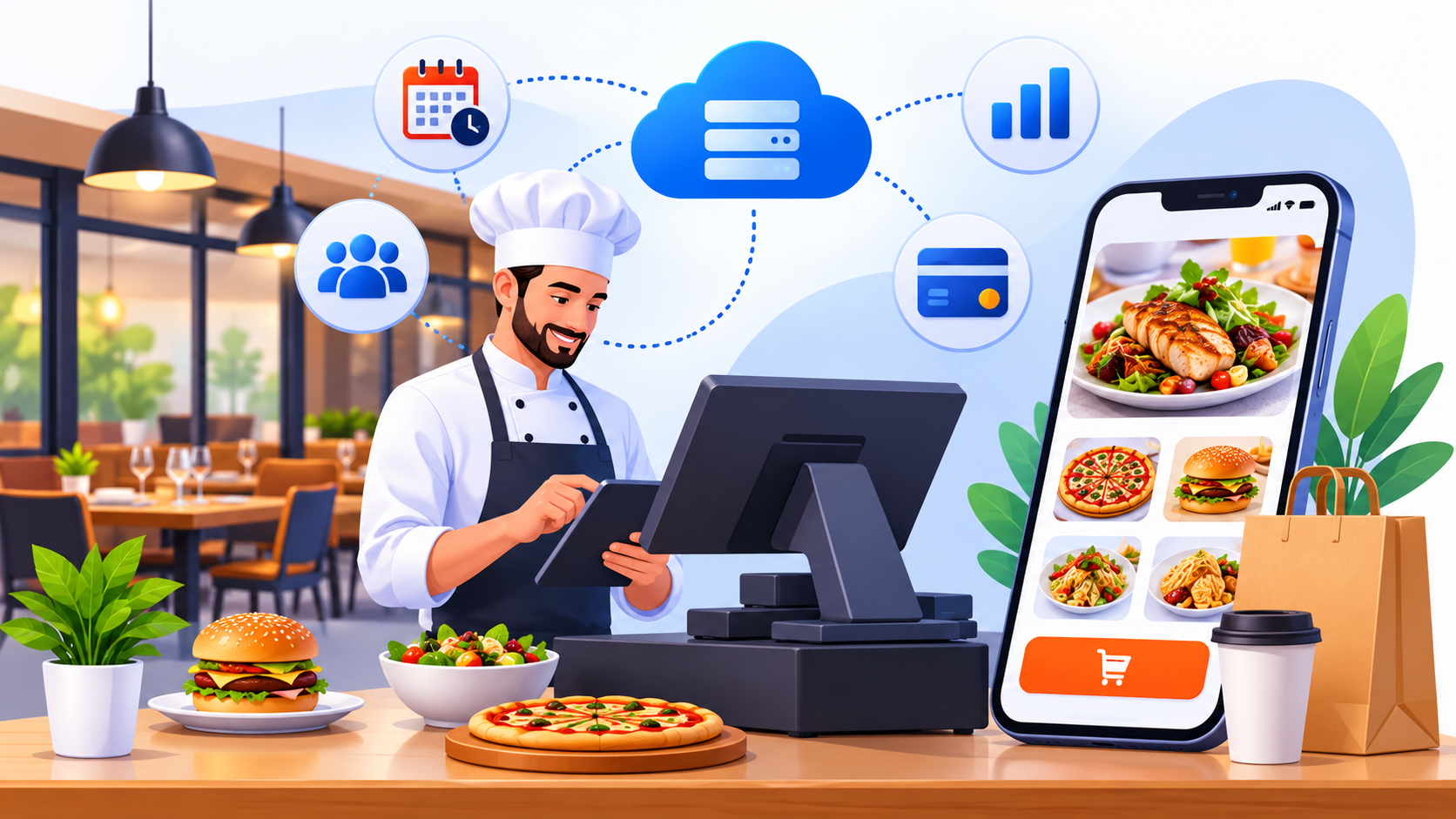
Key Takeaways:
- A Toast-like platform combines POS, online ordering, payments, inventory, and loyalty management.
- Real-time integration helps restaurants streamline orders and daily operations.
- AI can improve demand forecasting, inventory tracking, and customer personalization.
- Restaurant platform development can cost approximately 8,000–100,000+.
- Starting with an MVP allows businesses to launch essential features and scale gradually.
The restaurant industry is increasingly adopting digital platforms to manage orders, payments, customer relationships, and daily operations. Restaurant owners need more than traditional billing systems to handle online orders, in-house dining, delivery, inventory, and loyalty programs from one place. This growing demand has created opportunities for integrated restaurant management platforms like Toast.
Toast combines point-of-sale (POS) technology, online ordering, payment processing, staff management, and customer engagement tools. Its platform helps restaurants coordinate front-of-house and back-of-house activities while providing a connected experience for customers and employees.
Building a similar platform in 2027 requires a clear understanding of restaurant workflows, essential features, technology choices, and development costs. Whether the goal is to serve independent restaurants, multi-location chains, or food service businesses, a well-planned platform can simplify operations and support business growth.
What Is a Restaurant Platform Like Toast, and How Does It Work?
A restaurant platform like Toast is an integrated software solution that helps restaurants manage their daily operations through a centralized system. It combines point-of-sale (POS) functionality, order management, payment processing, online ordering, customer engagement, and business reporting. Instead of using separate tools for every activity, restaurant owners can manage multiple workflows through one connected platform.
The system generally connects three main user groups:
- Restaurant Owners and Managers: They use dashboards to monitor sales, manage menus, track inventory, review employee performance, and access business reports.
- Restaurant Staff: Servers, cashiers, kitchen employees, and delivery teams use POS terminals or mobile devices to receive orders, process payments, and coordinate food preparation.
- Customers: Customers can browse digital menus, place online orders, make payments, track orders, and earn loyalty rewards.
How the Platform Works
A typical restaurant platform follows a connected operational workflow:
- A customer places an order through the restaurant's website, mobile app, kiosk, or in-person POS terminal.
- The system records the order and sends it to the relevant kitchen display or printer.
- Kitchen staff receive the order and update its preparation status.
- The POS system processes payments and records the transaction.
- Inventory levels and sales records update based on completed orders.
- Customers receive order confirmations, receipts, and loyalty points when applicable.
- Restaurant managers access reports to review revenue, popular menu items, and operational performance.
This connected approach reduces manual work and helps restaurants maintain consistent operations across dine-in, takeaway, and delivery channels.
Core Features of a Modern Restaurant Management Platform
A successful restaurant platform needs features that simplify daily operations for restaurant owners, employees, and customers. When building a solution like Toast, the goal should be to connect ordering, payments, kitchen workflows, inventory, and customer engagement in one system.
1. Point-of-Sale (POS) Management
The POS system is the central component of the platform. It allows restaurant staff to create orders, customize menu items, apply discounts, split bills, and process payments. It should also support multiple payment methods and provide real-time transaction records.
2. Online Ordering and Menu Management
Customers should be able to browse menus, select food items, customize orders, and choose pickup or delivery. Restaurant managers need an easy menu management dashboard to update prices, add new dishes, manage availability, and organize categories.
3. Kitchen Display System
A kitchen display system (KDS) sends incoming orders directly to kitchen screens. It helps staff organize preparation queues, prioritize orders, and update order statuses. This reduces communication gaps between the service counter and kitchen team.
4. Payment Processing
The platform should support secure card payments, digital wallets, contactless transactions, and other relevant payment options. Payment integration should also support refunds, tips, transaction records, and reconciliation.
5. Inventory and Ingredient Tracking
Inventory management helps restaurants monitor ingredient quantities, track stock usage, and receive low-stock alerts. More advanced systems can connect ingredient consumption with sales data to support purchasing and reduce food waste.
6. Customer Loyalty and Rewards
Loyalty features encourage repeat purchases through reward points, discounts, memberships, and personalized offers. Customers should be able to view their rewards and redemption history through their accounts.
7. Employee and Staff Management
Staff management tools can support employee profiles, role-based access, shift scheduling, attendance tracking, and performance reports. Permissions should vary according to job responsibilities.
8. Analytics and Reporting Dashboard
Restaurant owners need reports covering sales, revenue, order volume, payment methods, popular menu items, and staff performance. Real-time dashboards help managers identify trends and make operational decisions.
9. Multi-Location Management
Restaurant chains require centralized controls to manage multiple branches. This feature should allow businesses to oversee menus, pricing, inventory, employee access, and performance while supporting location-specific settings.
How Online Ordering, POS, and Loyalty Systems Work Together
Online ordering, point-of-sale systems, and customer loyalty programs are three essential components of a modern restaurant platform. Their integration creates a connected workflow where customer orders, payments, sales records, and rewards are managed through a shared system.
1. Online Ordering and POS Integration
When a customer places an order through a restaurant website, mobile app, or self-service kiosk, the platform automatically sends the order to the POS system. Staff can view the order, confirm payment, and forward preparation details to the kitchen display system.
The integration should support:
- Automatic order synchronization across channels.
- Real-time menu availability and pricing updates.
- Order status tracking for customers and staff.
- Unified sales records for dine-in, takeaway, and delivery.
- Refunds, cancellations, and order modifications.
This reduces manual order entry and helps restaurants avoid errors caused by managing separate ordering channels.
2. POS and Loyalty Program Integration
Connecting loyalty features with the POS system allows restaurants to automatically record eligible purchases and update customer rewards. Customers can earn points, redeem discounts, and receive promotional offers without requiring staff to manage rewards manually.
For example, when a customer completes a purchase, the POS records the transaction and updates their loyalty balance. The system can also identify returning customers and apply available rewards during checkout.
3. Why Integration Matters
A unified platform gives restaurant owners a clearer view of customer activity and business performance. It can help them:
- Reduce duplicate data entry and operational errors.
- Maintain consistent menus and prices across channels.
- Improve checkout speed and customer convenience.
- Track customer purchasing patterns.
- Create targeted promotions based on order history.
- Generate consolidated sales and loyalty reports.
When developing these connected capabilities, businesses should work with a restaurant app development company that understands restaurant workflows, payment integrations, and customer engagement requirements. The platform should also be designed to support future features without disrupting existing operations.
Choosing the Right Technology Stack for Building a Scalable Restaurant Platform
Choosing the right technology stack is important for building a restaurant platform that can handle real-time orders, payment transactions, inventory updates, and customer data. The technology should support multiple devices, secure integrations, and future business expansion.
The following technologies can be considered:
|
Technology Layer |
Recommended Technologies |
Purpose |
|
Frontend Development |
React.js, Next.js |
Web dashboards and admin panels |
|
Mobile App Development |
Flutter, React Native |
Customer and staff mobile applications |
|
Backend Development |
Node.js, Python, Java |
Business logic and API management |
|
Database |
PostgreSQL, MySQL, MongoDB |
Customer, order, and transaction data |
|
Cloud Infrastructure |
AWS, Google Cloud, Azure |
Hosting, storage, and scalability |
|
Payment Integration |
Stripe, Adyen |
Secure payment processing |
|
Real-Time Communication |
WebSockets, Firebase |
Live order and status updates |
|
Analytics |
Power BI, Tableau |
Sales reports and business insights |
|
Security |
OAuth 2.0, SSL/TLS, encryption |
Authentication and data protection |
Step-by-Step Restaurant Platform Development Process
Building a restaurant platform like Toast requires a structured development approach. Each stage should focus on restaurant workflows, system reliability, customer experience, and integration between different operational modules.
1. Conduct Market and Competitor Research
Start by studying restaurant management platforms, including their features, pricing models, target customers, and limitations. Identify whether the solution will serve independent restaurants, restaurant chains, food trucks, or multi-location businesses.
2. Define Business Requirements
Determine the platform's core purpose and business model. Decide whether it will offer POS subscriptions, transaction-based pricing, payment processing, or additional paid modules. Document requirements for customers, restaurant staff, managers, and administrators.
3. Plan Features and System Architecture
Prepare a feature roadmap covering POS, online ordering, menu management, payments, inventory, loyalty, and reporting. Define how these modules will communicate and share data. A modular architecture makes it easier to add new capabilities later.
4. Design UI/UX and Create Prototypes
Create simple interfaces for POS terminals, customer ordering screens, kitchen displays, and management dashboards. Focus on quick navigation, readable layouts, and minimal steps for common restaurant tasks. Test prototypes with potential users before development.
5. Develop the Backend and Frontend
Build the backend to manage orders, payments, menus, users, inventory, and reporting. Use POS Software Development Services to build web dashboards, mobile applications, and POS interfaces. Ensure all modules use consistent data and communicate through secure APIs.
6. Integrate Payments and Third-Party Services
Connect payment gateways, digital wallets, accounting tools, delivery platforms, and notification services. Payment workflows should support transactions, refunds, tips, and reconciliation. Integration testing is important to prevent duplicate orders and payment errors.
7. Implement Testing and Quality Assurance
Test individual features and complete workflows, including order placement, payment processing, kitchen updates, and loyalty redemption. Perform security, performance, usability, and compatibility testing across supported devices.
8. Launch the Platform and Onboard Restaurants
Deploy the platform to production and onboard an initial group of restaurants. Provide staff training, menu setup assistance, payment configuration, and technical support. A limited rollout can help identify operational issues before wider expansion.
9. Monitor Performance and Improve the Platform
Track system uptime, order processing speed, payment failures, customer activity, and feature usage. Collect feedback from restaurant owners and employees to prioritize improvements. Regular updates, security patches, and infrastructure maintenance will help maintain platform reliability.
AI and Automation Opportunities in Restaurant Operations
Artificial intelligence and automation can make restaurant platforms more efficient by reducing repetitive tasks, improving demand forecasting, and creating personalized customer experiences. In 2027, these technologies can become valuable additions to platforms that combine POS, ordering, inventory, and loyalty management.
Key AI and automation opportunities include:
1. AI-Powered Demand Forecasting
Machine learning models can analyze historical sales, seasonal patterns, weather conditions, and customer activity to predict future demand. Restaurants can use these insights to plan inventory, adjust staffing, and reduce food waste.
2. Automated Inventory Management
AI-powered inventory tools can monitor ingredient usage, identify low-stock items, and estimate replenishment requirements. Automated alerts can help managers avoid stock shortages and unnecessary purchases.
3. Personalized Customer Recommendations
AI can analyze previous orders and customer preferences to suggest relevant menu items, meal combinations, and promotions. These recommendations can improve the ordering experience and encourage repeat purchases.
4. AI Chatbots and Order Assistance
Chatbots can answer common questions about menus, restaurant hours, reservations, and order status. With suitable integrations, they can also guide customers through ordering and reduce the workload on support staff.
5. Automated Marketing Campaigns
Restaurant platforms can use customer purchase history and loyalty activity to create targeted promotional campaigns. For example, the system can send special offers to inactive customers or recommend discounts based on ordering patterns.
6. Sales Analysis and Business Insights
AI analytics can identify popular dishes, changing customer preferences, unusual sales patterns, and underperforming menu items. These insights help restaurant owners make better decisions about pricing, promotions, and menu planning.
Businesses investing in AI automation software development should begin with specific operational problems rather than adding AI features without a clear purpose. Integrating useful automation into the POS and ordering workflow can improve efficiency while keeping the platform manageable for restaurant staff.
Restaurant Platform Development Cost in 2027: Pricing Breakdown
The cost of building a restaurant platform like Toast depends on its features, supported devices, integrations, technical complexity, and scalability requirements. A basic POS and ordering solution requires less investment than a complete restaurant management ecosystem with loyalty programs, inventory automation, payment processing, and multi-location controls.
1. Estimated Development Cost
|
Platform Type |
Estimated Cost (USD) |
|
Basic restaurant POS and ordering platform |
8,000–20,000 |
|
Mid-level platform with payments and inventory |
20,000–40,000 |
|
Advanced platform with loyalty and analytics |
40,000–70,000 |
|
Enterprise platform with multi-location management and advanced integrations |
70,000–100,000+ |
These are approximate development estimates. Actual pricing depends on the development team's location, project scope, infrastructure, and integration requirements.
2. Cost Based on Major Development Components
|
Development Component |
Estimated Cost (USD) |
|
UI/UX design and prototyping |
1,500–5,000 |
|
POS and order management |
4,000–12,000 |
|
Online ordering and customer app |
3,000–10,000 |
|
Payment gateway integration |
1,000–4,000 |
|
Inventory and menu management |
2,000–6,000 |
|
Loyalty and rewards system |
2,000–5,000 |
|
Testing and deployment |
2,000–6,000 |
The POS software development cost varies depending on selected features, integrations, and architecture.
3. Estimated Development Timeline
A restaurant platform may take around 3–8 months to develop, depending on its scope.
- Planning and research: 2–3 weeks
- UI/UX design: 2–4 weeks
- Core POS and backend development: 5–8 weeks
- Ordering and payment integrations: 3–5 weeks
- Loyalty and analytics development: 2–4 weeks
- Testing and deployment: 2–4 weeks
A focused MVP can be launched sooner by prioritizing essential POS, ordering, and payment features. Advanced reporting, AI capabilities, and multi-location management can be introduced in later releases.
Factors That Influence Development Cost and Timeline
The overall investment in a restaurant platform depends on more than the number of features. Technical decisions, business requirements, integrations, and future expansion plans can significantly affect both development costs and delivery timelines.
1. Feature Complexity
The retail software development cost and restaurant platform pricing depend on feature complexity, inventory automation, AI recommendations, and multi-location management. Each additional module requires development, testing, and integration.
2. Platform and Device Support
Building only a web-based restaurant dashboard generally requires less effort than supporting web, Android, iOS, tablets, and dedicated POS terminals. Cross-platform development can help manage costs while supporting multiple devices.
3. Third-Party Integrations
Payment gateways, accounting software, delivery platforms, kitchen display systems, and CRM tools require additional integration work. Businesses using specialized hardware or external services may also need custom APIs and compatibility testing.
4. Data Security and Compliance
Restaurant platforms process customer information and payment-related data. Secure authentication, encryption, access controls, payment security requirements, and data protection measures add to the development effort.
5. UI/UX Design Requirements
Restaurant employees often work in fast-paced environments, so interfaces must support quick actions and simple navigation. Custom dashboards, touchscreen-friendly layouts, and accessible customer ordering experiences can increase design and testing costs.
6. Scalability and Infrastructure
A platform designed for a single restaurant has different infrastructure needs from one supporting hundreds of locations. Cloud hosting, database architecture, real-time synchronization, and backup systems should be planned according to expected usage.
7. Development Team and Maintenance
The team's experience, location, technical expertise, and engagement model influence the overall budget. Businesses should also plan for ongoing maintenance, infrastructure expenses, security updates, and feature improvements after launch.
Challenges in Building a Restaurant Platform and Their Solutions
Developing a restaurant platform like Toast involves several technical and operational challenges. Businesses must ensure that ordering, payments, inventory, and restaurant workflows operate reliably while supporting different devices and locations.
|
Development Challenge |
Potential Impact |
Practical Solution |
|
Real-time order synchronization |
Delayed or missed orders across channels |
Use reliable APIs, WebSockets, and centralized order management |
|
Payment processing security |
Transaction failures and data exposure |
Integrate trusted payment gateways and follow applicable payment security standards |
|
Complex third-party integrations |
Data inconsistencies and compatibility issues |
Use standardized APIs and test integrations thoroughly |
|
Inventory accuracy |
Stock shortages and unnecessary waste |
Connect inventory updates with POS transactions and ingredient usage |
|
High transaction volumes |
Slow performance during peak hours |
Use scalable cloud infrastructure and optimize database queries |
|
Multi-location management |
Inconsistent menus, pricing, and reporting |
Implement centralized administration with location-specific controls |
|
User adoption and training |
Staff errors and inefficient workflows |
Design simple interfaces and provide onboarding support |
|
Data privacy and security |
Loss of customer trust and compliance risks |
Apply encryption, role-based access, backups, and regular security testing |
Conclusion
Building a restaurant platform like Toast in 2027 requires a combination of reliable POS technology, online ordering, payment processing, inventory management, and customer loyalty features. Bringing these capabilities together in one system can help restaurants simplify daily operations, improve customer experiences, and gain better visibility into business performance.
The development process should begin with market research and clear business requirements, followed by technology selection, feature development, integration, and testing. Businesses should also consider AI-powered automation, data security, and scalability when planning their platforms.
Although development costs can vary from $8,000 to $100,000 or more, starting with an MVP allows businesses to launch essential features and expand gradually. With the right architecture and development strategy, a restaurant platform can become a scalable solution for independent restaurants and growing restaurant chains.
FAQ's
Development can cost approximately 8,000–100,000+, depending on features, integrations, and platform complexity.
A basic MVP may take 3–4 months, while an advanced platform can require 6–8 months or longer.
Essential features include POS, online ordering, payment processing, inventory management, loyalty programs, and sales reporting.
Yes. Multi-location management allows restaurant chains to control menus, employees, inventory, and sales across different branches.
Common technologies include React.js, Flutter, Node.js, Python, PostgreSQL, AWS, and payment gateway APIs.
Yes. AI can support demand forecasting, inventory management, personalized recommendations, automated marketing, and sales analysis.
POS integration connects orders, payments, kitchen workflows, and sales records, reducing manual work and improving operational accuracy.
Yes. It can integrate with payment gateways, delivery services, accounting software, CRM systems, and other business tools through APIs.

CrinPro
CrinPro Solutions is a leading IT company that helps startups and enterprises build innovative digital products. From intuitive mobile applications and high-performance websites to AI-powered solutions and enterprise software, our team delivers scalable, secure, and user-focused products tailored to unique business needs. With expertise across multiple industries, we transform ideas into digital experiences that drive growth, improve efficiency, and create long-term business value.