Key Takeaways
-
Define the right product scope: Identify your target audience, event categories, and essential networking requirements before starting development.
-
Prioritise core event app features: Registration, attendee profiles, messaging, meeting scheduling, ticketing, and event management form the foundation.
-
Invest in AI matchmaking: Personalised recommendations, compatibility scoring, and smart meeting suggestions can improve attendee engagement.
-
Plan the development budget: Building an event networking app can cost approximately 9,000–100,000+, depending on complexity, integrations, and AI capabilities.
-
Choose a scalable technology stack: Reliable backend infrastructure, secure databases, cloud services, and real-time communication tools support future growth.
Event networking has evolved beyond exchanging business cards and attending scheduled sessions. Businesses, event organisers, and professional communities increasingly rely on digital platforms to connect attendees, arrange meetings, share event information, and build meaningful professional relationships. Platforms like Bizzabo demonstrate how technology can simplify event planning while creating more interactive networking experiences.
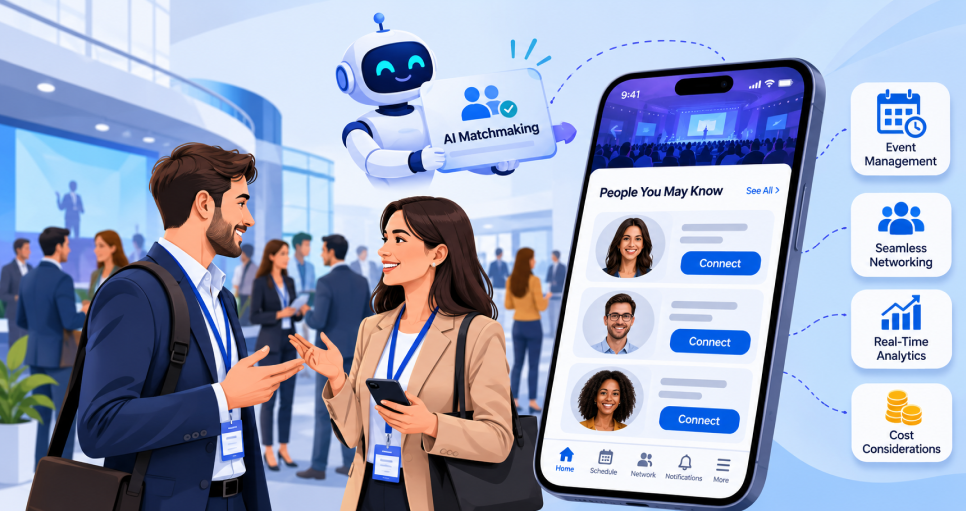
Building an event networking app like Bizzabo in 2027 requires event management capabilities, real-time communication, personalised recommendations, and intelligent networking tools. Features such as attendee profiles, in-app messaging, digital agendas, meeting scheduling, and AI-powered recommendations help users discover relevant connections before, during, and after events.
As AI matchmaking becomes a key part of digital event experiences, businesses can also add intelligent attendee matching, interest-based recommendations, and automated networking suggestions. However, the investment in event networking app development depends on the app's complexity, feature set, AI capabilities, integrations, and technology stack.
This guide explains how to build an AI-powered event networking platform, explores its essential features and development process, and examines the estimated event app development cost in 2027.
Understanding Event Networking Apps Like Bizzabo and How They Work
An event networking app is a digital platform that helps attendees, speakers, sponsors, exhibitors, and organisers interact throughout an event. Instead of relying entirely on physical interactions, users can discover participants, schedule meetings, exchange messages, and access event-related information through a single application.
A platform like Bizzabo combines event management tools with attendee engagement and networking capabilities. It supports organisers in managing event activities while helping participants build professional connections.
The main objective of event networking app development is to create an environment where users can discover relevant people, participate in discussions, and make valuable connections before, during, and after an event.
How Does an Event Networking Platform Work?
A typical event networking application follows a connected workflow:
-
Event Registration: Users register for an event, select tickets, and create their attendee profiles.
-
Profile Creation: Attendees add their professional backgrounds, interests, industries, and networking goals.
-
Attendee Discovery: The platform recommends relevant participants based on shared interests, professional roles, and preferences.
-
AI-Powered Matchmaking: Intelligent algorithms identify potential connections and suggest suitable people to meet.
-
Communication and Meeting Scheduling: Users send messages, request meetings, and coordinate networking sessions.
-
Event Participation: Attendees access schedules, session details, speaker information, and live event updates.
-
Post-Event Engagement: Users continue conversations, exchange resources, and maintain professional relationships after the event.
Who Can Benefit from an Event Networking App?
An event networking platform can serve multiple industries and event formats:
-
Corporate Event Organisers: Manage conferences, business summits, networking sessions, and corporate gatherings.
-
Trade Show and Exhibition Companies: Connect exhibitors with potential customers, partners, and industry professionals.
-
Professional Associations: Help members discover industry contacts and participate in professional communities.
-
Educational Institutions: Facilitate connections between students, recruiters, speakers, and academic professionals.
-
Startup Communities: Bring entrepreneurs, investors, mentors, and business partners together.
For businesses planning an AI app development company, combining event management functionality with intelligent attendee discovery can create a more engaging experience. It also provides organisers with opportunities to improve participation, understand networking activity, and deliver more personalised event experiences.
Market Opportunities and Growth Potential for Event Networking Apps in 2027
The growing adoption of digital event platforms is creating opportunities for businesses to invest in event networking solutions. Organisers increasingly need technology that supports attendee engagement, simplifies event operations, and provides measurable outcomes beyond registrations and ticket sales.
Several developments are shaping the demand for event management app development in 2027.
1. Growing Demand for Hybrid and Virtual Events
Businesses are organising in-person, virtual, and hybrid events to reach audiences across different locations. This creates demand for applications that support live streaming, digital networking, virtual meeting rooms, and real-time event updates.
2. Personalised Attendee Experiences
Attendees increasingly expect event platforms to recommend relevant sessions, speakers, exhibitors, and professional connections. Personalised experiences help users spend less time searching and more time participating in meaningful activities.
3. AI-Powered Networking Opportunities
Traditional networking often depends on chance interactions. AI-powered recommendations can analyse attendee interests, professional backgrounds, industries, and networking goals to suggest relevant connections. This makes AI matchmaking for events a valuable capability for modern event platforms.
4. Increased Focus on Event Engagement Analytics
Organisers want to understand how attendees interact with sessions, exhibitors, speakers, and networking features. Analytics dashboards can provide insights into participation levels, meeting requests, popular sessions, and overall engagement.
5. Demand for All-in-One Event Management Platforms
Managing registrations, ticketing, communication, scheduling, and networking through separate tools can create operational difficulties. Integrated platforms simplify these activities by bringing essential event functions into one application.
6. Expansion of Professional Networking Communities
Industry conferences, startup events, business exhibitions, and professional meetups provide opportunities for people to build long-term connections. Dedicated networking applications can help these communities continue interacting even after an event concludes.
Essential Features to Include in an Event Networking App Like Bizzabo
The success of an event networking platform depends on how effectively it connects attendees while simplifying event participation for organisers. A well-planned set of event app features should support registration, communication, attendee discovery, meeting coordination, and event management.
For businesses planning an event networking app like Bizzabo, features can be divided into three main categories based on user roles.
1. Attendee-Side Features
Attendees need tools that make discovering people, participating in sessions, and managing professional interactions easier.
-
User Registration and Login: Allow users to create accounts through email, phone numbers, or social sign-in options.
-
Professional Profiles: Enable attendees to add their names, job titles, company details, professional interests, and networking objectives.
-
Event Discovery: Help users explore upcoming events based on location, industry, category, and interests.
-
Digital Event Agenda: Display event schedules, speaker sessions, workshops, and personalised activity calendars.
-
Attendee Directory: Allow participants to browse registered attendees and identify relevant professional connections.
-
In-App Messaging: Real-time messaging, group chats, media sharing, read receipts, and secure conversations require a reliable communication infrastructure, which can affect the chat app development cost when these capabilities are integrated into an event networking platform.
-
Meeting Scheduling: Let attendees request meetings, check availability, and coordinate networking appointments.
-
Push Notifications: Send reminders about upcoming sessions, accepted meeting requests, and important event announcements.
-
Feedback and Ratings: Allow users to share their event experiences and provide feedback on sessions.
2. Organiser-Side Features
Organisers require administrative tools to manage event activities, monitor participation, and coordinate attendees.
-
Event Creation and Management: Create events, configure dates, locations, ticket categories, and registration settings.
-
Attendee Management: View registrations, manage attendee information, and organise participant categories.
-
Ticketing and Check-In: Generate digital tickets and QR codes for faster event entry and attendance tracking.
-
Session and Speaker Management: Add speakers, create session schedules, and manage workshop details.
-
Meeting and Networking Management: Monitor meeting requests and provide tools for managing networking activities.
-
Analytics Dashboard: Track registrations, attendance, engagement, and networking interactions.
-
Content and Announcement Management: Publish event updates, important instructions, and schedule changes.
3. Admin-Side Features
The admin panel provides centralised control over the entire event networking ecosystem.
-
User and Role Management: Manage attendees, organisers, speakers, sponsors, and administrative permissions.
-
Event Approval and Monitoring: Review event submissions and monitor platform activities.
-
Payment and Revenue Management: Track ticket transactions, refunds, commissions, and subscription payments.
-
Content Moderation: Review reported profiles, inappropriate messages, and user-generated content.
-
Reports and Performance Tracking: Generate reports on platform usage, event activity, and business performance.
-
Security and Access Controls: Manage permissions, authentication settings, and account security.
AI Matchmaking: The Technology Behind Smarter Event Networking
AI matchmaking is one of the most valuable capabilities businesses can introduce when building a modern event networking platform. Traditional networking relies on attendees manually searching profiles or meeting people by chance.
In AI matchmaking event app development, intelligent algorithms analyse attendee information and recommend connections based on predefined criteria and user behaviour. This helps participants discover relevant people and makes networking more purposeful.
How Does AI Matchmaking Work in Event Apps?
An AI-powered matchmaking system typically follows these steps:
-
Attendee Data Collection: The platform collects information such as job titles, industries, skills, interests, company details, and networking objectives.
-
Profile Analysis: AI algorithms analyse attendee profiles to identify shared interests, professional similarities, and potential collaboration opportunities.
-
Compatibility Scoring: The system assigns relevance scores to potential connections based on selected matching criteria.
-
Personalised Recommendations: Attendees receive suggested connections that align with their professional goals.
-
Continuous Learning: The system can use feedback, accepted meeting requests, and user interactions to improve future recommendations.
Important AI Matchmaking Capabilities
|
AI Capability |
How It Helps |
|
Interest-Based Matching |
Recommends attendees with similar professional interests |
|
Skill-Based Recommendations |
Connects people with complementary skills and expertise |
|
Industry Matching |
Identifies participants from relevant business sectors |
|
Compatibility Scoring |
Ranks potential connections based on selected criteria |
|
Smart Meeting Suggestions |
Recommends suitable people and networking opportunities |
|
Personalised Networking Feed |
Displays relevant attendee and session recommendations |
Advanced AI Features That Can Make an Event Networking App Stand Out
Beyond attendee recommendations, artificial intelligence can improve several aspects of event participation and management. Adding advanced AI capabilities can help businesses create a more intelligent platform that adapts to user preferences and organiser requirements.
Here are some valuable AI features to consider in 2027:
1. AI-Powered Event Recommendations
The application can analyse users' professional interests, industries, previous event participation, and preferred topics to recommend relevant conferences, workshops, and networking opportunities.
2. Smart Networking Assistant
An AI assistant can help attendees identify suitable connections, prepare meeting requests, and discover relevant networking sessions. Users can interact with the assistant through conversational prompts instead of manually searching through multiple profiles.
3. AI Chatbot for Event Support
An integrated chatbot can answer common questions about event schedules, registration, venue details, ticket information, and session availability. This reduces the workload on organisers while providing attendees with quick assistance.
4. Automated Meeting Scheduling
AI can suggest suitable meeting times by considering attendee availability, session schedules, and networking preferences. It can also help organisers manage meeting requests and reduce scheduling conflicts.
5. Intelligent Content Recommendations
The system can recommend sessions, speakers, workshops, and exhibitors based on attendee profiles and interests. These suggestions help participants discover relevant event activities.
6. Predictive Attendee Engagement
AI models can analyse registration patterns and participation data to identify potential engagement trends. Organisers can use these insights to improve event communication, session planning, and attendee experiences.
7. AI-Powered Event Analytics
Advanced analytics can identify popular sessions, networking activity, attendee interests, and participation patterns. Organisers can use these insights to measure event performance and improve future events.
8. Automated Networking Follow-Ups
After an event, AI can help generate personalised follow-up suggestions, meeting summaries, and connection reminders. This encourages attendees to continue professional conversations beyond the event.
These capabilities can make an AI event networking app more useful for both attendees and organisers. However, businesses should prioritise features according to their target audience and product goals instead of implementing every AI capability during the initial release.
Technology Stack Required to Build an Event Networking App
Selecting the right technology stack is essential for developing a reliable event networking platform. The technologies should support real-time communication, attendee management, AI-powered recommendations, secure transactions, and smooth performance during high-traffic events.
|
Development Component |
Recommended Technologies |
Purpose |
|
Android App Development |
Kotlin |
Native Android application development |
|
iOS App Development |
Swift |
Native iOS application development |
|
Cross-Platform Development |
Flutter, React Native |
Building applications for multiple platforms |
|
Frontend Development |
React.js, Next.js |
Web interfaces and organiser dashboards |
|
Backend Development |
Node.js, Python, Laravel |
Business logic, APIs, and application management |
|
Database |
PostgreSQL, MongoDB |
Managing user profiles, event data, and interactions |
|
Real-Time Communication |
WebSockets, Socket.IO |
Instant messaging and live updates |
|
AI and Machine Learning |
Python, TensorFlow, PyTorch |
Matchmaking and personalised recommendations |
|
Cloud Infrastructure |
AWS, Google Cloud, Microsoft Azure |
Hosting, storage, and scalable infrastructure |
|
Push Notifications |
Firebase Cloud Messaging, APNs |
Event reminders and user notifications |
|
Payment Integration |
Stripe, PayPal |
Ticket purchases and payment processing |
|
Analytics |
Google Analytics, Mixpanel |
Tracking user engagement and application performance |
Step-by-Step Process to Develop an Event Networking App Like Bizzabo
Building an event networking platform requires more than implementing attendee profiles and messaging features. The development process must connect event management, communication, AI matchmaking, and administrative operations into one reliable system.
A structured approach helps businesses manage technical requirements, development timelines, and overall investment.
1. Conduct Market Research and Competitor Analysis
Start by researching existing event platforms, including Bizzabo and other networking solutions. Analyse their features, pricing models, target audiences, and user experiences.
Identify gaps in existing applications, such as limited personalisation, complicated meeting scheduling, or poor attendee discovery. This research helps establish a clear product direction.
2. Define the Project Scope and Business Requirements
Determine the target audience, event categories, monetisation strategy, and essential application features. Decide whether the platform will support corporate conferences, trade shows, virtual events, or multiple event formats.
3. Select the Technology Stack and Application Architecture
Choose suitable frontend, backend, database, cloud, and AI technologies. Plan how different components will communicate through APIs and how the platform will handle real-time interactions.
The architecture should also support future expansion without introducing unnecessary complexity during the initial development stage.
4. Design UI/UX and Create Prototypes
Develop wireframes and interactive prototypes for important user journeys, including registration, profile creation, attendee discovery, messaging, and meeting scheduling.
5. Develop the Backend and Frontend
Build the core application infrastructure, including user authentication, event management, attendee profiles, database operations, and administrative controls.
Frontend developers then implement user-facing screens and connect them with backend services. At this stage, businesses can also integrate the essential features required for the initial launch.
6. Implement AI Matchmaking and Personalisation
Develop recommendation algorithms that analyse attendee profiles, professional interests, networking goals, and preferences.
Integrate compatibility scoring and personalised suggestions to help users discover relevant connections. Test recommendations using representative attendee data to evaluate their relevance and accuracy.
7. Integrate Messaging, Payments, and External Services
Connect third-party services for payment processing, notifications, email communication, analytics, and other required operations.
Implement real-time messaging, meeting requests, and scheduling features to support continuous interaction between attendees.
8. Perform Quality Assurance and Security Testing
Test the application across different devices, browsers, and usage conditions. Check registration, ticketing, messaging, matchmaking, payment processing, and notification workflows.
9. Deploy the Application and Monitor Performance
Configure cloud infrastructure, production databases, application monitoring, and backup systems. Release the platform through the appropriate web and mobile distribution channels.
After launch, monitor user activity, system performance, AI recommendation quality, and error reports to identify areas requiring improvement.
10. Maintain and Upgrade the Platform
Provide regular security updates, bug fixes, performance optimisation, and feature enhancements. Use attendee feedback and engagement analytics to improve the networking experience over time.
How Much Does It Cost to Build an Event Networking App Like Bizzabo in 2027?
The estimated event networking app development cost in 2027 can range from $9,000 to $100,000+, depending on the application's complexity, platform requirements, AI capabilities, integrations, and development team.
A basic networking application with event registration and attendee profiles requires a smaller investment. However, a platform like Bizzabo with real-time messaging, advanced event management, personalised recommendations, and AI matchmaking requires more development resources.
Estimated Development Cost by App Complexity
|
Application Type |
Estimated Cost (USD) |
Approximate Timeline |
|
Basic Event Networking App |
Estimated Cost (USD) |
Approximate Timeline |
|
Basic Event Networking App |
9,000–18,000 |
2–3 months |
|
Standard Event Networking App |
18,000–35,000 |
3–4 months |
|
Advanced Event Networking App |
35,000–60,000 |
4–6 months |
|
AI-Powered Event Networking App |
60,000–80,000 |
5–7 months |
|
Enterprise-Level Bizzabo-Like Platform |
80,000–100,000+ |
7–10+ months |
Factors That Affect the Cost of Event Networking App Development
The development budget for an event networking platform depends on several technical and business decisions. Even applications with similar core functionality can have different costs because of variations in design, AI implementation, integrations, and scalability requirements.
Understanding these factors helps businesses estimate the investment more accurately.
1. Number and Complexity of Features
The number of features directly affects development hours and overall project expenses. Basic registration, attendee profiles, and event schedules require less effort than advanced meeting management, real-time communication, and personalised networking tools.
2. AI Matchmaking and Recommendation Complexity
Implementing AI matchmaking for events requires additional resources for data processing, algorithm development, model integration, and testing.
A simple interest-based recommendation engine is generally less expensive than an advanced system using machine learning, semantic profile analysis, and dynamic compatibility scoring.
3. UI/UX Design and Customisation
A standard interface with predefined layouts is more affordable than a fully customised experience. Interactive dashboards, personalised attendee feeds, advanced navigation, and branded event experiences can increase design and development costs.
4. Platform Selection
Building an application for Android, iOS, and the web requires different development resources.
-
Android only: Suitable for businesses initially targeting Android users.
-
iOS only: Appropriate for platforms focused on Apple device users.
-
Cross-platform: Flutter or React Native can reduce duplicated development effort.
-
Web and mobile: Requires additional work to support browser-based access alongside mobile applications.
5. Real-Time Communication Requirements
Features such as instant messaging, live notifications, video meetings, and real-time meeting updates require specialised backend infrastructure. Their cost depends on the number of concurrent users, communication volume, and integration requirements.
6. Third-Party Integrations
Connecting payment gateways, CRM platforms, calendar applications, video conferencing services, email tools, and analytics systems adds development and testing work. Some integrations may also involve recurring subscription or usage fees.
7. Security and Data Privacy
Event networking platforms handle personal profiles, professional information, conversations, and payment details. Implementing encryption, secure authentication, role-based permissions, data backups, and privacy controls increases the initial development effort but helps protect users and business operations.
8. Scalability and Cloud Infrastructure
An application designed for a small professional meetup has different infrastructure requirements from a platform supporting thousands of attendees across multiple conferences. High-traffic applications may require cloud scaling, load balancing, database optimisation, and continuous monitoring.
9. Development Team and Location
Developer experience, team composition, and hiring location also influence the budget. A project involving AI engineers, backend developers, UI/UX designers, mobile developers, and QA specialists generally requires a higher investment than a basic application handled by a smaller team.
Businesses should evaluate these factors together when estimating the event app development cost. Prioritising essential functionality and selecting technologies according to actual requirements can help control expenses without limiting future expansion.
Challenges in Building an AI-Powered Event Networking App and Their Solutions
Developing an event networking platform involves several technical and operational challenges. From managing real-time interactions to delivering relevant AI recommendations, businesses must address potential issues to create a reliable user experience.
The following table highlights common challenges and practical solutions:
|
Development Challenges |
Impact on the Application |
Possible Solutions |
|
AI Matchmaking Accuracy |
Irrelevant recommendations can reduce attendee engagement and networking value. |
Use quality profile data, suitable recommendation algorithms, compatibility scoring, and continuous feedback. |
|
Real-Time Communication |
Message delays and connection failures can interrupt networking activities. |
Implement reliable WebSocket infrastructure, optimise backend services, and monitor communication performance. |
|
High User Traffic |
Large conferences can create sudden traffic spikes and affect application performance. |
Use scalable cloud infrastructure, load balancing, caching, and database optimisation. |
|
Data Privacy and Security |
Exposure of personal profiles, conversations, or payment information can damage user trust. |
Apply encryption, secure authentication, access controls, and regular security testing. |
|
Complex Event Management |
Managing multiple sessions, speakers, attendees, and meeting schedules can create operational difficulties. |
Develop centralised event management tools with automated scheduling and clear administrative workflows. |
|
Third-Party Integration Issues |
Payment, calendar, CRM, and video services may experience compatibility or synchronisation problems. |
Use well-documented APIs, integration testing, monitoring, and fallback mechanisms. |
|
Cross-Platform Compatibility |
Different devices and operating systems may display inconsistent layouts or functionality. |
Conduct device testing and use responsive design or suitable cross-platform development frameworks. |
|
Low Attendee Engagement |
Users may not complete profiles, respond to recommendations, or participate in networking activities. |
Introduce personalised notifications, onboarding guidance, relevant suggestions, and engagement analytics. |
How Can Businesses Manage These Challenges?
A successful development strategy should address these concerns during the planning and architecture stages rather than waiting until the application is launched.
Businesses should prioritise data security, test matchmaking recommendations with representative attendee profiles, and evaluate application performance under realistic traffic conditions. It is also important to provide users with control over their profiles, communication preferences, and networking visibility.
Working with an experienced event management app development company can help businesses manage technical integrations, AI implementation, application security, and long-term scalability more effectively.
Conclusion
Building an event networking app like Bizzabo in 2027 requires more than basic event registration and attendee management. A successful platform should bring together event scheduling, attendee profiles, real-time communication, personalised recommendations, and AI-powered matchmaking to create meaningful networking opportunities.
The development investment can range from $9,000 to $100,000+, depending on the app’s features, AI capabilities, integrations, platforms, and scalability requirements. Starting with an MVP and gradually introducing advanced capabilities can help businesses manage costs while validating their product in the market.
With the right development strategy, technology stack, and ongoing improvements, an event networking app can become a valuable platform for organisers, attendees, and businesses looking to build stronger professional connections.
FAQ's
An event networking app helps attendees connect, schedule meetings, exchange messages, and discover relevant people before, during, and after an event.
The estimated cost ranges from $9,000 to $100,000+, depending on features, AI capabilities, platforms, integrations, and scalability requirements.
A basic app may take 2–3 months, while an advanced enterprise-level platform can require 7–10 months or longer.
Core features include attendee profiles, event registration, ticket booking, attendee search, messaging, meeting scheduling, notifications, and an organiser dashboard.
AI analyses attendee profiles, interests, professional backgrounds, and networking goals to recommend relevant connections and potential meeting opportunities.
Yes. It can include live streaming, virtual meeting rooms, digital agendas, online networking, and tools that connect remote and in-person attendees.
Revenue can come from subscriptions, ticketing commissions, premium networking features, sponsored listings, enterprise plans, and white-label solutions.

CrinPro
CrinPro Solutions is a leading IT company that helps startups and enterprises build innovative digital products. From intuitive mobile applications and high-performance websites to AI-powered solutions and enterprise software, our team delivers scalable, secure, and user-focused products tailored to unique business needs. With expertise across multiple industries, we transform ideas into digital experiences that drive growth, improve efficiency, and create long-term business value.