Key Takeaways:
- AI route optimization uses GPS, traffic, VRP, and business constraints to create efficient delivery routes.
- Core features include dynamic routing, GPS tracking, ETA prediction, re-optimization, and dispatcher controls.
- Development typically costs 8,000–90,000+, depending on features, integrations, AI complexity, and fleet size.
- Successful development requires clean data, system integrations, driver-friendly apps, testing, and real-time monitoring.
- Courier, grocery, e-commerce, field service, freight, waste, and pharma businesses can use route optimization.
Can your delivery team still plan routes when traffic, new orders, and driver schedules change by the hour?
For many U.S. delivery and logistics businesses, manual route planning starts to crack as order volumes grow.
Multiple stops, delivery time windows, vehicle capacity, driver availability, and traffic can quickly turn a simple route into a costly mess.
AI route optimization software development brings these moving parts together through route optimization, real-time GPS and traffic data, predictive ETA, and business constraints.
It can build feasible routes, track them live, and trigger re-optimization when conditions change. This guide explains how the technology works, what it needs, and how to build it.
What Is AI Route Optimization Software? And How Does AI Route Optimization Work?
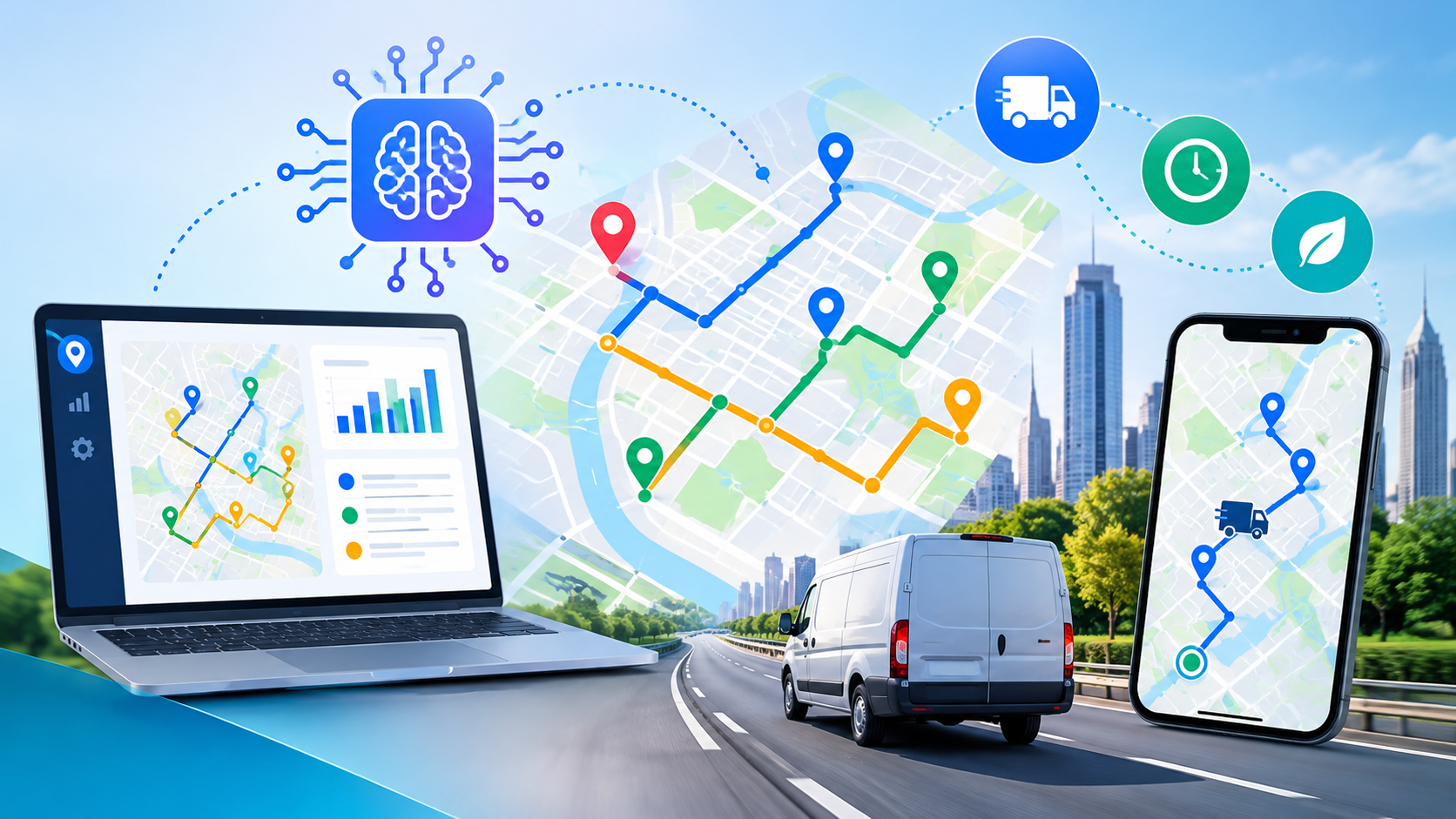
AI route optimization software uses optimization algorithms, real-time data, and predictive intelligence to create efficient delivery routes. It considers traffic, vehicle capacity, driver schedules, delivery windows, order priorities, and fleet constraints to reduce travel time, distance, costs, and delays.
How Does AI Route Optimization Work?
- Orders & Fleet Data: The system collects orders, delivery locations, vehicle capacity, driver availability, schedules, and priority orders.
- Real-Time Data: GPS, traffic, weather, and telematics data provide current conditions that can affect delivery routes and ETAs.
- Business Constraints: The optimization engine applies delivery windows, driver hours, vehicle capacity, road restrictions, and other hard or soft constraints.
- Optimization Engine: Algorithms solve the Vehicle Routing Problem (VRP) and compare possible route combinations based on time, distance, fuel usage, fleet utilization, and delivery requirements.
- Route Generation: The system creates feasible routes and assigns stops to suitable vehicles and drivers. The shortest route may not be selected if another route better meets delivery windows or fleet constraints.
- Dispatcher: Dispatchers can view routes on a live dashboard, monitor fleet activity, and manually adjust assignments when operational needs change.
- Driver: The driver receives the assigned route through a mobile app with stop sequences, directions, delivery details, and updated ETAs.
- Live Tracking: GPS and telematics continuously report vehicle locations and route progress.
- Re-optimization: If traffic worsens, a vehicle breaks down, an order is canceled, or an urgent delivery arrives, the system can recalculate routes and send updated instructions.
Benefits of AI Route Optimization for Delivery and Logistics Businesses
AI route optimization helps delivery teams cut waste, improve routes, and keep drivers and customers better informed.
- Lower Fuel and Operating Costs: Better routes reduce extra miles, fuel use, and daily delivery costs.
- Better Fleet Utilization: Assign the right orders to the right vehicles and avoid unused fleet capacity.
- Faster Delivery Planning: Build multi-stop routes in minutes instead of planning each delivery by hand.
- Fewer Late Deliveries: Use traffic, time windows, and live route data to reduce delays and missed stops.
- More Accurate ETAs: GPS and traffic data help predict arrival times and keep customers updated.
- Higher Driver Productivity: Give drivers clear routes and more balanced workloads so they can complete more stops.
- Better Customer Visibility: Share live delivery updates and ETAs so customers know when to expect their orders.
- Reduced Manual Dispatch Work: Automate route planning and let dispatchers focus on exceptions and urgent orders.
- Easier Scaling of Delivery Operations: Handle more orders and vehicles without adding the same amount of manual work.
Key Features of AI Route Optimization Software
Explore the core features that help AI route optimization software plan, track, adjust, and manage delivery routes more efficiently.
1, Multi-Stop Route Optimization
AI route optimization handles multiple delivery stops by checking distance, traffic, vehicle capacity, and delivery windows. It creates practical stop sequences that help drivers cover more orders with less wasted travel.
2. Real-Time GPS Tracking
Live GPS tracking shows where vehicles are, how routes are progressing, and where delays occur. This gives dispatchers better control and supports reliable delivery updates across a courier delivery app development project.
3. ETA Prediction
AI uses traffic, travel time, historical delivery data, and stop duration to predict ETAs. Better arrival estimates help dispatchers plan ahead and give customers clearer delivery updates.
4. Route Re-Optimization
When a driver gets delayed, an order changes, or a road closes, AI can recalculate the route. AI Development Services can add this decision layer to support fast, data-driven route changes.
5. Dynamic Route Planning
AI-powered route planning can adjust routes as traffic, new orders, or road conditions change. This helps delivery teams respond faster instead of relying on a fixed plan made hours earlier.
6. Dispatcher Dashboard and Manual Override
A live dashboard lets dispatchers monitor vehicles, edit routes, and assign stops. Manual override matters because experienced teams may know local roads or customer needs better than an automated system. A courier app development company can connect this with driver workflows.
AI Route Optimization Software Development Process: Step-by-Step Guide
A practical development process helps turn those requirements into software that works in real delivery conditions.
1. Discovery and Requirements Analysis
Start by understanding how the delivery business works today. Look at order volume, delivery zones, fleet size, driver schedules, time windows, vehicle capacity, and common routing problems.
Talk to dispatchers and drivers too. They often know the small problems that never appear in a requirements document, such as difficult delivery locations, restricted roads, or customers who need special handling.
Define the core requirements around:
- Multi-stop route planning
- Driver and vehicle assignment
- Delivery time windows
- Real-time GPS tracking
- ETA calculation
- Route re-optimization
- Dispatcher controls
- Customer delivery updates
This stage also helps estimate scope and provides a clearer picture of potential logistics software development costs before development begins.
2. Data Assessment and Strategy
AI route optimization needs good data to make useful decisions. Review order history, GPS records, traffic data, customer locations, driver schedules, vehicle details, delivery times, and road network data.
Clean missing or incorrect records before using them. Then decide which data should support route optimization, predictive ETA, demand forecasting, or machine learning. A clear data strategy can prevent expensive problems later.
3. UI/UX Design
The software should make route planning easier, not give dispatchers another complicated screen to manage.
Design the dispatcher dashboard around live fleet tracking, route maps, stop sequences, alerts, ETA updates, and manual route editing. The driver app should keep things simple with turn-by-turn directions, delivery details, status updates, and proof of delivery.
Small UX choices matter here. A dispatcher handling 100+ deliveries does not want to hunt through five screens to change one stop.
4. MVP Development
Build the core version first instead of trying to solve every logistics problem on day one.
An MVP can focus on order import, route planning, vehicle assignment, GPS tracking, ETA, dispatcher monitoring, and basic route editing. The optimization engine can start with established Vehicle Routing Problem (VRP) methods and constraint-based routing.
At this stage, the goal is simple: create a working route optimization workflow that can handle real delivery data.
A smaller MVP also makes it easier to test assumptions before spending heavily on advanced AI features.
5. AI Model Training and Testing
Once the basic routing workflow works, add AI where it can improve actual decisions.
Machine learning can help with travel time prediction, predictive ETA, demand forecasting, delivery duration, and traffic-related predictions. The optimization engine then uses these predictions along with business constraints to create feasible routes.
For example, historical delivery data may show that a particular downtown area takes longer during weekday afternoons. That insight can improve ETA predictions and help the routing system make better planning decisions.
Testing should cover:
- ETA accuracy
- Route quality
- Constraint handling
- Model performance
- Unusual traffic conditions
- High-volume delivery scenarios
Not every part needs machine learning. Traditional optimization algorithms can still handle many routing decisions very well.
6. Integration With Existing Systems
Your route optimization platform rarely works alone. It needs to exchange data with the systems already running the business.
Common integrations include:
|
System |
Purpose |
|
TMS |
Transportation planning and fleet operations |
|
OMS |
Orders, delivery details, and priorities |
|
GPS/Telematics |
Vehicle location and driving data |
|
Maps & Routing APIs |
Directions, traffic, distance, and travel time |
|
WMS |
Warehouse and dispatch information |
|
CRM |
Customer and delivery information |
|
Driver App |
Route instructions, status, and proof of delivery |
7. Pilot Launch and Feedback
Do not launch the complete platform across the entire fleet on day one. Start with a controlled pilot.
Choose a smaller delivery region, fleet group, or order type. Let dispatchers and drivers use the system during normal operations. Then compare its results with the existing planning process.
Track practical KPIs such as:
- On-time delivery rate
- Miles per delivery
- Fuel consumption
- ETA accuracy
- Driver utilization
- Route completion time
- Failed delivery rate
This stage often reveals things the development team could not see in testing. A route may look perfect on a screen but feel impractical to a driver who knows the area. That feedback should go back into the routing rules and product design.
8. Full Deployment, Monitoring, and Improvement
After the pilot performs reliably, roll out the platform to the wider fleet in stages.
Production monitoring should track the optimization engine, API response times, GPS feeds, route calculation errors, application performance, and data quality. Set alerts for failures so the operations team can act before they affect deliveries.
The software should keep improving after launch. New delivery patterns, traffic behavior, fleet changes, and customer expectations create new data that can improve route planning and predictive models.
For businesses planning advanced AI features, ongoing model monitoring is also important. AI app development costs can rise when the product requires continuous model training, real-time inference, large datasets, or specialized infrastructure, so plan these needs early rather than adding them as an afterthought.
AI Route Optimization Software Development Cost
AI route optimization software can cost $8,000 to $90,000+, based on features, AI complexity, integrations, fleet size, and development scope.
|
Software Level |
Estimated Cost |
Timeline |
What You Get |
|
Basic |
8,000–20,000 |
3–4 months |
Route planning, multi-stop optimization, basic dashboard, GPS, simple constraints |
|
Mid-Level |
20,000–45,000 |
4–7 months |
Dynamic routing, ETA prediction, driver app, dispatcher dashboard, APIs, analytics |
|
Advanced |
45,000–70,000 |
6–9 months |
Real-time re-optimization, telematics, ML models, complex constraints, advanced analytics |
|
Enterprise |
70,000–90,000+ |
9–12+ months |
Large-scale fleet support, AI/ML, multiple integrations, custom optimization, security, monitoring |
Industries and Use Cases of AI Route Optimization Software
AI route optimization fits any business where vehicles, drivers, delivery stops, and time matter. Here are the main industries using it to improve daily route planning and fleet operations.
|
Industry |
Use Case |
|
Last-Mile and Courier Delivery |
Plans multi-stop routes, balances driver workloads, and adjusts routes when traffic, delays, or new delivery requests appear. |
|
Food and Grocery Delivery |
Helps assign orders to nearby drivers, manage delivery time windows, and provide accurate ETAs for time-sensitive orders. |
|
E-commerce and Retail |
Optimizes high-volume deliveries from stores, warehouses, and fulfillment centers while reducing unnecessary miles and delivery delays. |
|
Field Service |
Assigns technicians based on location, skills, availability, and appointment windows, helping teams complete more service calls each day. |
|
3PL and Freight |
Helps third-party logistics providers plan vehicle routes, manage multiple customer orders, improve fleet utilization, and handle complex delivery schedules. |
|
Waste Management |
Builds collection routes around service locations, vehicle capacity, pickup schedules, and route restrictions to reduce wasted driving time. |
|
Pharma and Cold Chain |
Supports time-sensitive deliveries by considering delivery windows, vehicle capacity, temperature-sensitive goods, and priority shipments. |
Challenges in AI-Powered Route Optimization and How to Solve Them
AI route optimization can improve delivery planning, but real-world logistics is messy. Data gaps, old systems, driver habits, sudden disruptions, and growing fleet demands can all affect performance.
1. Poor or Insufficient Data Quality
Bad addresses, missing GPS signals, outdated traffic data, or incomplete delivery history can hurt route accuracy. Clean data pipelines, validation rules, geocoding, and reliable telematics feeds create a stronger foundation. See our GPS tracking app development cost guide for planning GPS-based features.
2. Integration With Legacy Systems
Older TMS, ERP, OMS, and fleet systems may use outdated APIs or data formats. Use middleware, secure APIs, data mapping, and staged integration to connect these systems without disrupting daily delivery operations.
3. Driver Adoption
Drivers may resist automated routes if the system ignores local road knowledge or feels hard to use. A simple driver app, clear navigation, manual feedback, and human route overrides can build trust and improve adoption.
4. Handling Unpredictable Real-World Events
Traffic jams, accidents, weather, vehicle breakdowns, road closures, and urgent orders can change a route within minutes. Event-driven re-optimization, live GPS, traffic APIs, and flexible constraints help the system react quickly.
5. Scalability and Cost Control
More vehicles, orders, users, and real-time events increase computing and API usage. Use cloud scaling, caching, efficient optimization engines, monitoring, and usage controls to keep performance stable as the delivery network grows.
Future Trends in AI-Powered Route Planning and Logistics Optimization
See how AI, predictive analytics, EV routing, autonomous vehicles, and real-time optimization may shape future delivery operations.
- Predictive and Autonomous Dispatching: AI will predict demand, traffic, and fleet needs to automate driver and route assignments.
- EV Routing and Sustainability: EV route planning will factor battery range, charging stations, energy use, and carbon reduction.
- Generative AI for Dispatcher Assistance: GenAI can summarize delays, suggest route changes, answer queries, and support dispatch decisions.
- Drone and Autonomous Vehicle Integration: Routing platforms may coordinate drones, autonomous vans, and human drivers for last-mile delivery.
Conclusion
AI route optimization software development can make complex delivery planning faster and more flexible. By combining VRP, GPS, telematics, predictive ETA, traffic data, and business constraints, businesses can build routes that fit real-world needs.
The goal is not to add AI to every feature. It is to use the right technology where it can solve real delivery problems.
With solid integrations, real-time re-optimization, and simple tools for drivers and dispatchers, U.S. logistics businesses can reduce wasted miles, improve fleet use, and handle growing order volumes with less manual work.
FAQ's
It uses optimization algorithms, GPS, traffic data, and AI to create efficient delivery routes based on vehicle capacity, time windows, and fleet constraints.
It analyzes orders, traffic, vehicle capacity, driver schedules, and delivery windows to create feasible routes and re-optimize them when conditions change.
Development can cost around $8,000 to $90,000+, depending on features, AI complexity, integrations, fleet size, mobile apps, and real-time routing needs.
A basic product may take 3–4 months, while advanced platforms with AI, telematics, mobile apps, and enterprise integrations can take 9–12+ months.
Common technologies include machine learning, predictive analytics, optimization algorithms, VRP solvers, constraint programming, and predictive ETA models.
Yes. GPS and telematics integrations can show vehicle locations, route progress, delays, and ETAs while helping dispatchers monitor fleet operations.
Yes. Dynamic routing can trigger route re-optimization when traffic, road closures, urgent orders, cancellations, or vehicle breakdowns affect planned routes.
It can integrate with TMS, OMS, WMS, ERP, CRM, GPS, telematics platforms, mapping APIs, driver apps, and other logistics systems through APIs.

CrinPro
CrinPro Solutions is a leading IT company that helps startups and enterprises build innovative digital products. From intuitive mobile applications and high-performance websites to AI-powered solutions and enterprise software, our team delivers scalable, secure, and user-focused products tailored to unique business needs. With expertise across multiple industries, we transform ideas into digital experiences that drive growth, improve efficiency, and create long-term business value.