Key Takeaways
-
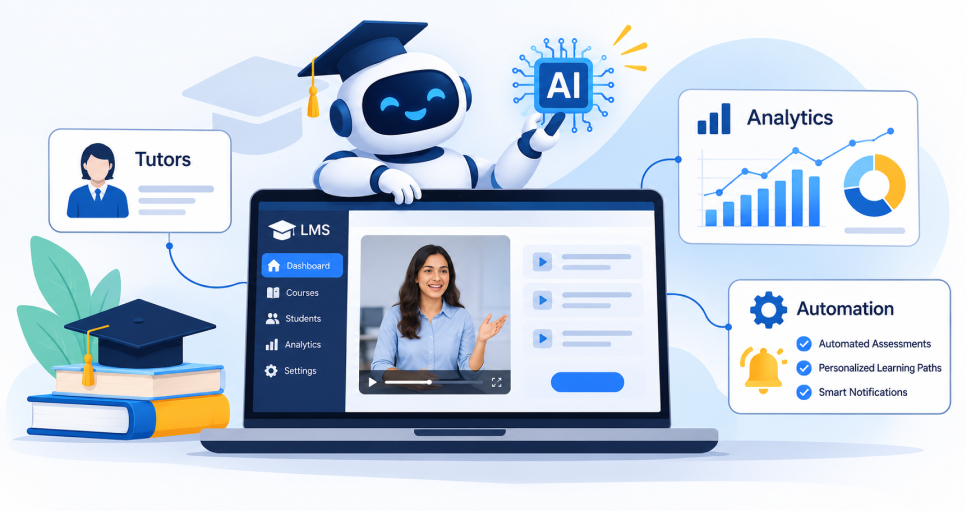
AI LMS development enables personalised learning, intelligent tutoring, and automated educational workflows.
-
AI tutors and chatbots provide real-time guidance, explanations, and practice activities.
-
Learning analytics help educators track progress and identify students who may need additional support.
-
A suitable technology stack and reliable integrations are essential for scalability and performance.
-
AI LMS development costs typically range from $9,000 to $100,000+, depending on features and complexity.
Artificial intelligence is transforming digital education by making learning more personalised, interactive, and data-driven. Traditional learning management systems (LMS) help educators organise courses, deliver content, and track student progress, while AI-powered platforms extend these capabilities through intelligent tutoring, automated assessments, and predictive analytics.
AI learning management system development enables educational institutions, training providers, and businesses to create platforms that adapt to individual learning needs. Features such as AI tutors, personalised recommendations, automated feedback, and conversational assistants can help learners access support when they need it and help educators identify areas requiring attention.
An AI-powered learning management system can also reduce administrative workloads by automating routine tasks, analysing learning activity, and supporting course management. However, its effectiveness depends on reliable educational content, appropriate AI integration, data privacy, and meaningful human oversight.
For organisations planning digital education solutions, understanding AI LMS development, its essential features, and the implementation process is an important first step towards building a scalable learning platform.
Market Statistics
-
The global AI in the learning and development market size is expected to be worth around USD 97 billion. By 2034, it will be USD 9.3 billion, growing at a CAGR of 26.4% during the forecast period from 2025 to 2034.
-
The AI in Education market is projected to grow from USD 2.21 billion in 2024 to USD 5.82 billion by 2030, registering a CAGR of 17.5%.
What Is an AI-Powered Learning Management System and How Does It Work?
An AI-powered learning management system is a digital platform that combines traditional LMS functionality with artificial intelligence to personalise learning, automate educational tasks, and analyse learner performance. Unlike conventional systems that primarily deliver courses and track completion, an AI LMS can adapt content, provide intelligent feedback, and help educators understand individual learning needs.
How an AI LMS Works
An AI LMS typically combines several components to create a more responsive learning experience.
Learner Data Collection: The platform gathers relevant information, such as quiz results, course progress, learning preferences, and assessment performance, subject to appropriate privacy controls.
AI-Powered Analysis: Machine learning models analyse learning patterns to identify knowledge gaps, estimate progress, and recommend suitable learning activities.
Personalised Learning Paths: Based on the available data, the system can suggest lessons, exercises, and resources that align with a learner's needs and goals.
Intelligent Tutoring: AI tutors and chatbots answer questions, explain concepts, provide hints, and guide learners through educational material.
Performance Tracking: Analytics dashboards help students and educators review progress, identify areas for improvement, and make informed decisions about learning strategies.
AI LMS vs Traditional LMS
|
Capability |
Traditional LMS |
AI-Powered LMS |
|
Course delivery |
Structured learning content |
Content with adaptive recommendations |
|
Student support |
Instructor-led or predefined support |
AI tutors and conversational assistance |
|
Assessment |
Standard quizzes and grading |
Automated feedback and AI-assisted assessment |
|
Progress tracking |
Completion and performance reports |
Learning-pattern analysis and predictive insights |
|
Learning paths |
Mostly predefined |
Can adapt to learner progress and needs |
|
Administration |
Many tasks handled manually |
Selected workflows can be automated |
Why AI LMS Development Matters
AI LMS development helps educational institutions and corporate training teams move beyond one-size-fits-all learning experiences. By combining personalised recommendations, intelligent tutoring, and performance analytics, organisations can make learning more responsive to individual needs.
However, AI recommendations should be evaluated for accuracy and fairness, and educators should retain oversight of important learning decisions. The goal is to use AI to support effective teaching and learning rather than replace human instruction.
Key Benefits of AI LMS Development for Students, Tutors, and Educational Institutions
AI LMS development helps educational organisations deliver more personalised learning experiences while simplifying teaching and administrative workflows. By combining intelligent tutoring, automation, and learning analytics, an AI-powered learning management system can support students, educators, and institutions in different ways.
1. Personalised Learning Experiences
AI can recommend lessons, exercises, and learning resources based on a student's progress, preferences, and knowledge gaps. This helps learners focus on areas where additional practice may be useful.
2. Intelligent Tutoring and Instant Support
AI tutors can answer questions, explain concepts, provide hints, and guide students through learning materials. This gives learners access to additional support between instructor-led sessions.
3. Automated Assessment and Feedback
AI can assist with generating quizzes, checking objective answers, and providing feedback on selected assignments. Educators should review AI-generated assessments and use appropriate human oversight for subjective or high-stakes grading.
4. Data-Driven Learning Insights
Learning analytics can help educators identify engagement patterns, track assessment performance, and recognise students who may need additional support. These insights can inform teaching strategies without treating predictions as definitive judgements about individual learners.
5. Reduced Administrative Workload
Automation can assist with enrolment workflows, reminders, routine communications, course administration, and report generation. This can give educators and administrators more time to focus on teaching and student support.
6. Improved Learner Engagement
Interactive AI tutors, personalised recommendations, progress dashboards, and timely feedback can make learning more responsive to individual needs. The effectiveness of these features should be evaluated through learner feedback and measurable outcomes.
7. Scalable Digital Education
An AI-powered learning management system can support growing numbers of learners, courses, and educational programmes when backed by suitable infrastructure and well-designed workflows.
8. Better Support for Corporate Training
Businesses can use AI LMS platforms to deliver employee training, recommend relevant learning materials, monitor course completion, and identify potential skill gaps. Organisations may also connect learning platforms with existing HR and business systems.
Essential Features to Include in an AI-Powered Learning Management System
Building an effective AI-powered learning management system requires more than adding a chatbot to an existing platform. The system should combine core LMS functionality with intelligent tools that support learners, educators, and administrators.
1. Personalised Learning Paths
The platform should recommend lessons, learning resources, and practice activities based on learner progress, assessment results, and learning goals. Users should also be able to access standard course materials when they prefer a structured approach.
2. AI Tutor and Chatbot Integration
An AI tutor can answer questions, explain difficult concepts, provide hints, and guide students through course content. AI tutor chatbot development should include appropriate content sources, response evaluation, and escalation options for questions that require educator input.
3. Course and Content Management
Administrators and educators need tools to create courses, upload learning materials, organise modules, manage enrolments, and update educational content. Content versioning and access permissions can help maintain accuracy and consistency.
4. Automated Assessments and Feedback
Assessment tools can support quiz creation, objective grading, feedback generation, and progress tracking. Educators should retain control over assessment standards and review AI-generated results where necessary.
5. Learning Analytics Dashboard
Dashboards should display relevant information such as course completion, quiz performance, engagement, and progress over time. These insights can help educators identify learning gaps and plan additional support.
6. Student and Educator Portals
Dedicated interfaces allow students to access lessons, submit assignments, view feedback, and track progress. Educators need tools to manage classes, review submissions, communicate with students, and monitor learning outcomes.
7. Notifications and Reminders
Automated notifications can remind students about upcoming assessments, incomplete modules, scheduled sessions, and important course updates. Users should be able to manage notification preferences.
8. Integration With External Systems
APIs can connect the LMS with video conferencing platforms, payment gateways, identity providers, content libraries, and existing student information systems.
9. Security and Role-Based Access
Authentication, permissions, encryption, audit logs, and data-retention controls help protect student information and ensure users access only the information they are authorised to view.
10. Mobile Accessibility
A responsive interface or dedicated mobile application allows learners to access courses, receive reminders, and continue learning across devices. Education mobile app development can extend the platform to students who primarily use smartphones.
How AI Tutors Personalise Learning and Improve Student Engagement
AI tutors are a key component of modern learning platforms, helping students understand difficult concepts, practise skills, and receive feedback at their own pace. Through AI tutor development, educational providers can introduce interactive learning support that complements traditional teaching methods.
Adaptive Learning Based on Student Performance
AI tutors can analyse quiz results, previous responses, and learning progress to identify areas where a student may need additional practice. The system can then recommend relevant lessons or adjust the difficulty of exercises.
Real-Time Explanations and Guidance
Students can ask questions in natural language and receive explanations tailored to the available course material. An AI tutor can break complex topics into smaller steps, provide examples, and offer hints when learners struggle with a problem.
Personalised Practice Activities
AI-powered systems can recommend quizzes, exercises, and revision materials based on a learner's progress. This helps students focus on specific knowledge gaps instead of repeating material they have already mastered.
Continuous Feedback and Progress Tracking
AI tutors can provide immediate feedback on practice activities and help students understand mistakes. Progress dashboards can show completed topics, assessment results, and areas that may require further attention.
Supporting Different Learning Preferences
AI tutors can present information through explanations, examples, summaries, and interactive questions. This flexibility can help accommodate different learning preferences, although the quality of personalisation depends on the platform's design and the accuracy of its content.
Maintaining Educational Quality
AI-generated explanations should be grounded in reliable learning materials and evaluated for accuracy. Educators should be able to review performance, correct unsuitable content, and intervene when students need specialised support.
AI Tutor Chatbot Development for Real-Time Student Support
AI tutor chatbots help students access learning support whenever they need it. Through AI tutor chatbot development, educational platforms can offer conversational assistance that answers questions, explains concepts, and guides learners through course materials without requiring a tutor to be available at every moment.
Instant Answers to Student Questions
An AI chatbot can respond to common questions about lessons, assignments, assessments, and course instructions. When connected to approved educational resources, it can provide answers grounded in the material students are studying.
Conversational Learning Assistance
Students can ask follow-up questions, request simpler explanations, or explore examples of difficult concepts. This interactive approach makes learning support more accessible and helps students clarify misunderstandings as they arise.
Assignment and Assessment Guidance
Chatbots can offer hints, explain relevant concepts, and guide students through problem-solving steps. Rather than automatically completing assignments, the system should encourage independent thinking and help learners understand the reasoning behind an answer.
Integration With LMS Features
An AI chatbot can connect with course content, student progress records, assessment tools, and learning dashboards through secure APIs. This allows it to provide more relevant support based on the student's current course and learning activity, subject to appropriate access permissions.
Escalation to Human Tutors
Not every question can be answered reliably by AI. The chatbot should recognise uncertainty, avoid unsupported claims, and direct students to teachers or human support when a question requires expert judgement or personal attention.
Evaluating Chatbot Effectiveness
Educational providers should monitor answer accuracy, response time, student satisfaction, and escalation rates. Regular testing and educator feedback can help improve the chatbot while reducing the risk of misleading or inappropriate responses.
When carefully designed, AI tutor chatbots can extend learning support beyond scheduled classes while allowing educators to remain responsible for teaching quality and student development.
How Learning Analytics and Predictive AI Improve Educational Outcomes
Learning analytics and predictive AI help educational institutions understand student progress, identify learning gaps, and make informed decisions about teaching strategies. By analysing assessment results, course activity, and engagement patterns, an AI-powered learning management system can turn educational data into actionable insights.
Tracking Student Progress
Learning analytics dashboards can display assessment scores, course completion rates, lesson activity, and learning milestones. These insights help students understand their progress and allow educators to identify topics that may require additional attention.
Identifying Students Who Need Support
Predictive AI can analyse relevant learning patterns to flag students who may be at risk of falling behind. Educators can use these indicators to offer additional resources, personalised guidance, or timely intervention. Predictions should support professional judgement rather than determine student outcomes automatically.
Improving Course Content
Analytics can reveal where learners frequently struggle, abandon lessons, or perform poorly in assessments. Educational teams can use these findings to revise explanations, improve learning activities, and adjust course difficulty.
Enabling Data-Driven Teaching Decisions
Teachers can use learning insights to identify knowledge gaps across a class, compare assessment performance, and plan targeted revision sessions. These capabilities help educators focus their time on areas where students need the most support.
Personalising Learning Recommendations
AI can recommend lessons, practice exercises, and revision materials based on a student's demonstrated progress. Recommendations should remain relevant to the curriculum and be evaluated regularly for accuracy and usefulness.
Protecting Student Data
Learning analytics systems handle sensitive educational information. Platforms should apply appropriate access controls, data minimisation, retention policies, and security measures. Predictive models should also be evaluated for bias to avoid unfairly labelling students.
By combining reliable data with educator oversight, learning analytics and predictive AI can help institutions improve learning experiences, identify support needs earlier, and make more informed decisions about educational delivery.
Automating Administrative Tasks With AI in Learning Management Systems
Administrative tasks such as enrolment management, attendance tracking, assessment coordination, and student communication can consume significant time for educational institutions. Integrating AI and workflow automation into a learning management system can help reduce repetitive work and improve operational efficiency.
Automated Student Enrolment and Onboarding
AI-enabled workflows can assist with registration, course recommendations, onboarding instructions, and account setup. Automated notifications can guide students through the initial steps of accessing their learning materials and completing required activities.
Assessment and Grading Support
AI can automatically score objective assessments, organise results, and provide preliminary feedback on selected written responses. Educators should review AI-generated evaluations when subjective judgement, academic integrity, or complex reasoning is involved.
AI automation software development can support routine LMS workflows such as grading assistance, progress reporting, student notifications, and administrative task management.
Attendance and Engagement Monitoring
An LMS can track attendance records, lesson participation, assignment submissions, and course activity. Automated reports can help educators identify missing submissions or declining engagement and follow up with students when appropriate.
Automated Notifications and Reminders
The platform can send reminders about upcoming deadlines, scheduled classes, assessment dates, and incomplete learning activities. Messages can be triggered by predefined events or relevant changes in a student's progress.
Content and Course Administration
AI can assist administrators and educators with organising learning resources, categorising course materials, generating initial quiz questions, and preparing course summaries. Human review remains important to maintain accuracy and alignment with curriculum requirements.
Reporting and Administrative Insights
Automated dashboards can summarise enrolment trends, assessment results, course completion, and learner engagement. These reports help administrators identify operational bottlenecks and plan improvements using relevant data.
Maintaining Human Oversight
Automation should not remove accountability from educators or administrators. Institutions need clear approval processes for consequential decisions, reliable audit records, and safeguards against inaccurate data or automated actions.
By combining AI capabilities with structured workflows, educational institutions can reduce repetitive administrative effort and dedicate more time to teaching, student support, and improving learning outcomes.
How to Build an AI LMS: A Step-by-Step Development Process
Building an AI learning management system requires a structured approach that combines educational requirements, suitable AI capabilities, reliable infrastructure, and effective user experiences. A clear development process helps businesses prioritise essential features, manage technical complexity, and deliver a platform that can evolve with learners' needs.
Step 1: Define Requirements and Learning Objectives
Identify the target users, educational goals, and problems the platform should solve. Determine whether the system needs personalised learning paths, AI tutors, automated assessments, learning analytics, or administrative automation.
Working with experienced custom software development companies can help organisations define technical requirements, choose a suitable architecture, and plan for future growth.
Step 2: Plan the Core Features
Prioritise essential LMS functionality, including user registration, course management, learning content, assessments, progress tracking, and administrative dashboards. Advanced AI capabilities can be introduced in phases based on user needs and available resources.
Step 3: Design the User Experience
Create intuitive interfaces for students, tutors, and administrators. User research and prototype testing can help ensure that learners can find courses, access AI assistance, complete assessments, and track progress without unnecessary friction.
Step 4: Select the Technology Stack
Choose appropriate frontend frameworks, backend technologies, databases, cloud infrastructure, and AI services. The selection should reflect the platform's expected usage, integration requirements, security needs, and the development team's expertise.
Step 5: Develop and Integrate AI Features
Implement selected capabilities such as AI tutor development, chatbot interactions, content recommendations, and learning analytics. Connect these features to approved educational resources and establish validation mechanisms to improve response quality.
Step 6: Integrate Learning and Business Systems
Connect the LMS with relevant third-party services, such as video conferencing tools, payment gateways, identity providers, content repositories, and student information systems. Secure APIs and clear data permissions help maintain reliable communication between systems.
Step 7: Test Functionality, Security, and AI Accuracy
Conduct functional, usability, performance, and security testing. Evaluate AI responses against representative educational questions, check for inappropriate outputs, and confirm that student data is accessible only to authorised users.
Step 8: Launch a Pilot and Gather Feedback
Release the platform to a limited group of learners and educators. Monitor usability, system performance, AI accuracy, engagement, and support requests before expanding deployment.
Step 9: Monitor and Improve the Platform
After launch, review usage analytics, resolve defects, update educational content, and refine AI features based on measured results. Regular maintenance helps the LMS remain reliable as user expectations and technology change.
Following these steps allows organisations to approach AI LMS development as an ongoing improvement process rather than a one-time software project.
Technology Stack for AI Learning Management System Development
Choosing the right technology stack is essential for building an AI learning management system that supports interactive lessons, personalised learning, AI tutoring, assessments, and learning analytics. The stack should provide reliable performance, secure data handling, and flexibility as the platform grows.
|
Technology Layer |
Common Technologies |
Purpose |
|
Frontend Development |
React.js, Next.js, Angular |
Student dashboards, tutor interfaces, and administration panels |
|
Mobile App Development |
Flutter, React Native, Swift, Kotlin |
Mobile learning experiences across supported devices |
|
Backend Development |
Node.js, Python, Java, .NET |
Business logic, course management, APIs, and learning workflows |
|
Database |
PostgreSQL, MySQL, MongoDB |
Student profiles, course data, assessments, and learning records |
|
AI and Machine Learning |
Python, PyTorch, TensorFlow, and managed AI APIs |
Personalised recommendations, learning analytics, and intelligent automation |
|
Large Language Models |
Hosted LLM APIs, open-source language models |
Conversational tutoring, content assistance, and natural-language interactions |
|
Vector Database and Retrieval |
pgvector, Pinecone, Weaviate |
Retrieving relevant information from approved course materials |
|
Cloud Infrastructure |
AWS, Microsoft Azure, Google Cloud |
Hosting, storage, deployment, and scalability |
|
Video and Content Delivery |
Cloud storage, CDN services, compatible video APIs |
Delivering educational videos and learning resources |
|
Authentication and Security |
OAuth 2.0, OpenID Connect, MFA |
Identity management and secure access |
|
Analytics and Monitoring |
Power BI, Grafana, Prometheus, OpenTelemetry |
Learning insights, application health, and performance monitoring |
Selecting Technologies for Different Requirements
-
For an MVP: Start with core course management, assessments, student accounts, and basic progress tracking. Add AI capabilities once the essential learning workflows are reliable.
-
For AI tutoring: Use an appropriate language model with retrieval from approved educational materials. Evaluate response accuracy and provide escalation options when the system cannot answer confidently.
-
For mobile learning: Consider Flutter or React Native when a shared codebase suits the project. Native development may be appropriate when platform-specific capabilities are essential.
-
For enterprise deployment: Prioritise role-based access, audit logs, integration reliability, backups, and scalable infrastructure.
Why Architecture Matters
The technology stack should match the platform's educational objectives, expected user volume, team expertise, and integration requirements. A modular architecture also makes it easier to upgrade AI models, introduce new learning features, and connect additional educational systems without rebuilding the entire application.
The goal of AI learning management system development is not simply to add AI tools but to combine them with dependable learning workflows, secure data management, and an accessible user experience.
Integrating AI Tutors, Educational Content, and Third-Party Platforms
Integrating AI tutors with educational content and third-party platforms helps create a connected learning environment. Instead of operating as a standalone chatbot, an AI-powered learning management system can combine course materials, student progress, assessments, and external tools to provide more relevant learning support.
Connecting AI Tutors With Course Content
AI tutors should access approved educational materials, including lesson notes, textbooks, FAQs, and course documents. Retrieval-augmented generation (RAG) can help the tutor retrieve relevant content before generating an answer, keeping responses aligned with the available learning resources.
Integrating Assessment and Progress Data
Connecting AI tutors with assessment tools and student progress records can help the system tailor explanations and practice activities to a learner's needs. Access should be limited to the information required for the specific learning task.
Third-Party Learning Tool Integration
An LMS may integrate with video conferencing platforms, digital libraries, online assessment tools, content repositories, and student information systems. APIs and webhooks can support data exchange between these services, while established interoperability standards can simplify connections with compatible learning platforms.
Supporting Content Formats and Learning Resources
Educational platforms often contain videos, PDFs, presentations, quizzes, and interactive exercises. A suitable integration architecture should organise these resources so learners can access them easily and AI features can retrieve relevant information when supported.
Managing Data Synchronisation and Access
Connected systems may update student records, course information, and assessment results at different times. Validation, monitoring, and clear error-handling procedures help maintain data consistency. Authentication and permission checks should also apply whenever an AI tutor accesses external systems.
Testing Integrated Learning Workflows
Testing should cover complete learning scenarios, such as asking a question about a lesson, retrieving relevant content, generating an explanation, and recording progress where appropriate. Teams should also check response accuracy, integration reliability, and the handling of unavailable or outdated information.
A well-planned integration strategy helps educational providers combine AI tutoring with existing learning resources and business systems, creating a more connected and maintainable learning experience.
Data Privacy, Security, and Ethical Considerations in AI LMS Development
An AI learning management system processes student profiles, assessment results, learning activity, and potentially sensitive personal information. Protecting this data is essential for maintaining student trust and supporting responsible AI adoption in education.
Data Privacy and Confidentiality
Collect only the information required to provide learning services and AI features. Apply encryption in transit and at rest, establish clear data-retention policies, and restrict access to authorised users. Students and educators should understand how their information is collected, stored, and used.
Authentication and Access Control
Implement secure authentication and role-based permissions for students, tutors, instructors, and administrators. AI tutors should only access the course materials and student information necessary for their assigned tasks.
AI Accuracy and Educational Safety
AI-generated explanations, summaries, and feedback can contain errors. Ground responses in approved educational resources, test outputs regularly, and provide clear escalation options when the system cannot answer reliably. Educators should retain oversight of important learning decisions.
Bias and Fairness
AI recommendations and predictive models may produce uneven results for different groups of learners. Evaluate model performance across relevant student populations, review potentially unfair outcomes, and avoid using automated predictions as the sole basis for consequential educational decisions.
Academic Integrity and Responsible Use
AI tools should support understanding rather than encourage students to bypass learning activities. Institutions can establish clear guidelines for AI-assisted assignments, automated feedback, and permitted uses of generated content.
Transparency and Human Oversight
Students should know when they are interacting with an AI tutor and understand its limitations. Teachers and administrators should be able to review relevant outputs, correct inaccurate content, and intervene when human support is needed.
Compliance and Ongoing Monitoring
Educational providers should assess applicable privacy, child-safety, accessibility, and data-protection obligations in their operating regions. Regular security testing, access reviews, incident-response procedures, and AI evaluations help maintain the platform after launch.
Responsible AI LMS development requires security and ethical safeguards throughout the product lifecycle. By combining technical controls with transparent policies and educator oversight, institutions can build learning platforms that are more trustworthy, reliable, and appropriate for their students.
AI LMS Development Cost and Estimated Project Timeline
The cost of AI learning management system development depends on the platform's features, AI capabilities, integrations, supported devices, and security requirements. A basic LMS with limited AI functionality generally requires a smaller investment, while an enterprise platform with personalised tutoring, predictive analytics, and complex integrations can cost significantly more.
Estimated AI LMS Development Cost
|
AI LMS Type |
Estimated Development Cost (USD) |
Timeline |
|
Basic AI-Enabled LMS |
9,000–20,000 |
2–3 months |
|
Mid-Level AI LMS |
20,000–40,000 |
3–5 months |
|
Advanced AI-Powered LMS |
40,000–70,000 |
5–7 months |
|
Enterprise AI LMS |
70,000–100,000+ |
7–12+ months |
If the project includes dedicated mobile experiences for learners, tutors, or administrators, assess the business mobile app development cost separately to account for platform requirements, integrations, testing, and maintenance.
Factors That Influence AI LMS Development Cost
-
Feature complexity: Core course management, assessments, and progress tracking typically require less effort than adaptive learning paths, AI tutor chatbots, and predictive analytics.
-
AI tutor development: Conversational tutoring, personalised explanations, and AI-generated feedback may require additional model integration, content retrieval, evaluation, and monitoring.
-
Technology and integrations: Connecting the LMS with student information systems, video platforms, payment gateways, and external learning tools can increase development effort.
-
Security and compliance: Authentication, role-based access, encryption, audit logs, and privacy safeguards are important considerations when handling student data.
-
Platform requirements: Supporting web, iOS, and Android experiences can increase design, development, and testing costs.
-
Ongoing operating expenses: Cloud hosting, AI API usage, content storage, third-party services, maintenance, and future upgrades should be budgeted separately from initial development.
How to Manage the Development Budget
Businesses can control initial costs by launching a focused MVP with essential course management, student dashboards, assessments, and a basic AI tutor. Advanced personalisation, predictive analytics, and extensive integrations can be introduced after the core platform has been tested with real users.
Working with an experienced AI LMS development company can help define the project scope, select suitable technologies, and plan a phased rollout that balances cost, educational value, and long-term scalability.
Common Challenges in AI LMS Development and How to Address Them
Developing an AI learning management system involves technical, educational, and operational challenges. Addressing these issues early helps businesses create reliable platforms that deliver useful learning experiences while controlling costs and maintaining educational quality.
|
Challenge |
Potential Impact |
Practical Solution |
|
AI Accuracy |
Incorrect explanations can confuse students. |
Ground responses in approved course materials and evaluate outputs regularly. |
|
Data Privacy and Security |
Student information may be exposed or misused. |
Apply encryption, access controls, and clear data-retention policies. |
|
Integration Complexity |
Connecting external platforms can create compatibility issues. |
Use documented APIs, validation, monitoring, and structured error handling. |
|
Personalisation Limitations |
Recommendations may not suit every learner. |
Evaluate recommendations against student progress and educator feedback. |
|
High Development Costs |
Advanced AI features can increase the initial budget. |
Prioritise essential features and introduce advanced capabilities in phases. |
|
Performance and Scalability |
High usage may cause slow responses or service interruptions. |
Use scalable infrastructure, load testing, and performance monitoring. |
|
Academic Integrity |
Students may rely on AI to complete work without understanding it. |
Design AI assistance around explanations, hints, and guided practice. |
|
User Adoption |
Students and educators may struggle with unfamiliar workflows. |
Provide intuitive interfaces, onboarding, and user training. |
|
Bias and Fairness |
AI recommendations may disadvantage some learners. |
Test across relevant learner groups and review outcomes regularly. |
Conclusion
AI learning management system development helps educational institutions deliver personalised learning, automate administrative tasks, and improve student engagement. Features such as AI tutors, chatbots, predictive analytics, and automated assessments can make learning platforms more responsive and efficient.
Successful AI LMS development requires the right technology stack, reliable integrations, strong data protection, and continuous evaluation. Businesses should begin with essential features, validate the platform with users, and expand AI capabilities as needs evolve.
Partnering with an experienced AI LMS development company can help organisations build scalable learning solutions that balance innovation, educational quality, and long-term value.
FAQ's
It involves building learning platforms that use AI for tutoring, personalisation, assessments, and learning analytics.
Development can cost 9,000–100,000+, depending on features and complexity.
Typically, 2–12 months or longer, depending on project scope.
Common features include course management, AI tutors, assessments, progress tracking, analytics, and automated notifications.
It provides personalised explanations, practice activities, feedback, and learning guidance.
Common choices include React, Flutter, Python, PostgreSQL, cloud platforms, and AI model APIs.
It can be secure with encryption, access controls, privacy safeguards, and regular security testing.
Yes. APIs can connect it with student information systems, content platforms, and assessment tools.
No. AI can support learning, but educators remain essential for guidance, assessment, and oversight.
Start with an MVP, prioritise essential features, and introduce advanced AI capabilities in phases.

CrinPro
CrinPro Solutions is a leading IT company that helps startups and enterprises build innovative digital products. From intuitive mobile applications and high-performance websites to AI-powered solutions and enterprise software, our team delivers scalable, secure, and user-focused products tailored to unique business needs. With expertise across multiple industries, we transform ideas into digital experiences that drive growth, improve efficiency, and create long-term business value.