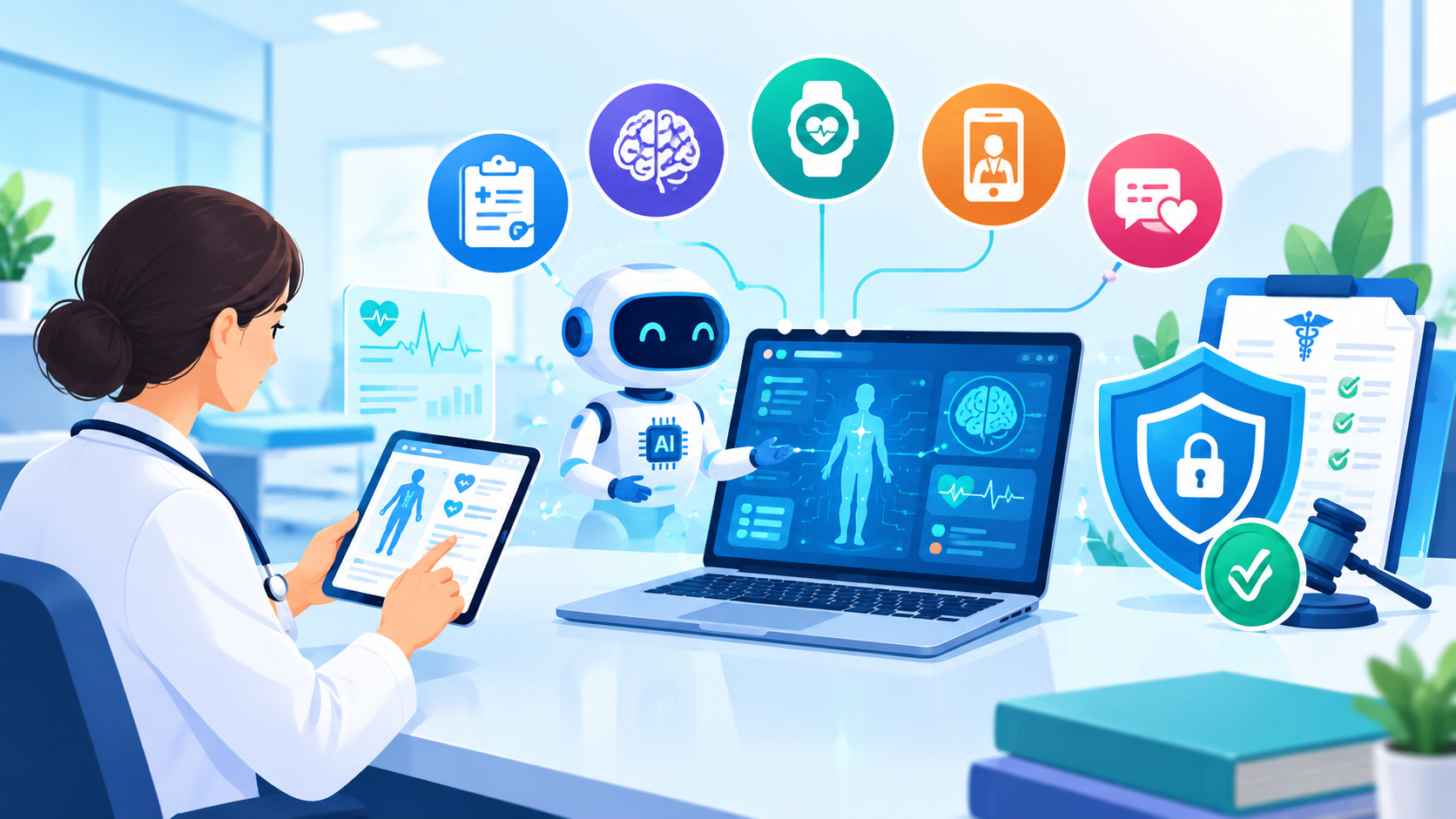
Key Takeaways:
- AI healthcare solutions support diagnostics, patient monitoring, and clinical decision-making.
- Machine learning, NLP, computer vision, and AI agents power healthcare automation.
- Integration with EHR/EMR systems enables more connected healthcare workflows.
- Data privacy, security, clinical validation, and regulatory compliance are essential.
- A phased development approach helps control costs, manage risks, and measure results.
Artificial intelligence is transforming healthcare by helping providers analyse medical data, support clinical decisions, monitor patients, and automate routine administrative tasks. In 2027, healthcare organisations are increasingly exploring AI-driven systems to improve operational efficiency, support earlier disease detection, and deliver more personalised patient experiences.
From medical image analysis and remote patient monitoring to intelligent documentation and workflow automation, AI offers opportunities across the healthcare lifecycle. However, successful implementation requires reliable data, clinical validation, strong privacy safeguards, and compliance with applicable healthcare regulations.
This guide explores the key AI healthcare applications, development process, technology requirements, estimated costs, and challenges businesses should consider before investing in AI-powered healthcare solutions.
AI healthcare solution development market statistics
- The global artificial intelligence (AI) in healthcare market is projected to grow from USD 36.67 billion in 2026 to USD 194.79 billion by 2031, at a CAGR of 39.7% during the forecast period.
- The global artificial intelligence (AI) in healthcare market size is valued at USD 36.96 billion in 2025. It is predicted to increase from USD 51.20 billion in 2026 to approximately USD 744.34 billion by 2035, expanding at a CAGR of 35.02% from 2026 to 2035.
- The global Artificial Intelligence (AI) in healthcare market size was valued at USD 39.34 billion in 2025 and is projected to grow from USD 56.01 billion in 2026 to USD 1,033.27 billion by 2034, exhibiting a CAGR of 43.96% during the forecast period.
What Are AI Healthcare Solutions and How Do They Work?
AI healthcare solutions are software applications that use artificial intelligence to analyse medical information, assist healthcare professionals, monitor patient conditions, and improve clinical or administrative workflows. They can integrate with electronic health records, diagnostic systems, wearable devices, and hospital management platforms.
Common capabilities include:
- AI-assisted diagnostics: Analysing medical images, test results, and clinical data to help identify potential health conditions.
- Patient monitoring: Tracking vital signs and identifying changes that may require clinical attention.
- Clinical documentation: Summarising consultations, organising patient records, and assisting with medical note preparation.
- Workflow automation: Supporting appointment scheduling, billing, patient communication, and administrative processes.
- Predictive analytics: Identifying potential health risks and helping care teams prioritise follow-up.
Modern AI healthcare solutions can support doctors, hospitals, clinics, laboratories, and digital health businesses. However, clinical recommendations and diagnostic outputs require appropriate validation and professional oversight before being used in patient care.
Key Technologies Transforming Healthcare Through Artificial Intelligence
AI healthcare applications combine machine learning, medical data processing, cloud infrastructure, and secure integration technologies. The right technology stack depends on the clinical use case, data sensitivity, system complexity, and deployment environment.
|
Technology |
Healthcare Applications |
|
Machine Learning |
Risk prediction, patient classification, and clinical data analysis |
|
Deep Learning |
Medical image analysis and pattern recognition |
|
Natural Language Processing (NLP) |
Clinical note summarisation, medical document extraction, and patient communication |
|
Generative AI and LLMs |
Clinical documentation assistance, medical information retrieval, and conversational interfaces |
|
Computer Vision |
Analysing radiology images and other medical visual data |
|
Internet of Medical Things (IoMT) |
Collecting vital signs and supporting remote patient monitoring |
|
Cloud Computing |
Hosting AI applications, processing data, and scaling services |
|
APIs and Interoperability Standards |
Connecting AI systems with electronic health records and hospital software |
Integrating AI with Existing Healthcare Systems
AI applications often need to exchange information with electronic health records, laboratory systems, pharmacy platforms, and hospital management software. Standards such as HL7 and FHIR can support healthcare data exchange, depending on the systems involved.
Organisations planning these integrations should also consider the EMR software development cost, particularly when building custom electronic medical record functionality or connecting AI features to existing clinical records.
A modular technology architecture helps healthcare providers introduce new AI capabilities while maintaining data security, interoperability, and reliable system performance.
High-Impact AI Healthcare Use Cases Transforming Modern Medicine
AI can support multiple healthcare functions, from clinical decision support to patient engagement and administrative automation. The most effective applications address specific problems while keeping healthcare professionals involved in important decisions.
1. Medical Image Analysis
AI models can analyse X-rays, CT scans, MRIs, and other medical images to flag patterns that may require further review. These tools can assist radiologists but should be clinically validated and used alongside professional interpretation.
2. Personalised Treatment Support
AI can analyse patient histories, clinical measurements, and other relevant information to help clinicians evaluate potential treatment options. Recommendations must account for clinical guidelines, patient circumstances, and professional judgement.
3. Remote Patient Monitoring
Connected devices can collect information such as heart rate, blood pressure, and glucose levels. AI can identify unusual patterns and alert care teams when follow-up may be necessary.
4. Virtual Health Assistants
AI-powered assistants can answer routine questions, explain care instructions, help patients prepare for appointments, and direct them to appropriate services. They should clearly communicate their limitations and escalate urgent concerns appropriately.
5. Clinical Documentation and Administrative Automation
AI can summarise consultations, draft clinical notes, classify documents, and assist with scheduling or billing workflows. Human review remains important, especially when generated information becomes part of a medical record.
6. Hospital Operations and Resource Planning
Predictive analytics can help healthcare organisations estimate demand, plan staffing, manage resources, and identify operational bottlenecks. Results depend on the quality and relevance of the underlying data.
By selecting use cases with measurable clinical or operational benefits, healthcare organisations can introduce AI incrementally and evaluate its impact before expanding deployment.
How AI Improves Medical Diagnostics and Patient Monitoring
AI can help healthcare professionals interpret clinical information, identify potential warning signs, and monitor patients between appointments. Its value depends on reliable data, clinical validation, and integration into existing care workflows.
1. AI-Assisted Diagnostics
Machine learning and computer vision models can analyse medical images, laboratory results, and clinical records to identify patterns associated with particular conditions. These systems can flag suspicious findings, support prioritisation, and provide additional information for clinicians to review.
AI should complement, not replace, qualified medical professionals. Diagnostic systems require appropriate testing across patient populations to assess accuracy, bias, and clinical suitability.
2. Continuous Patient Monitoring
AI-powered monitoring systems can process data from wearables, connected medical devices, and remote monitoring platforms. They may identify unusual changes in vital signs, detect trends, and generate alerts for clinical review.
3. Early Risk Identification
Predictive models can analyse relevant patient information to estimate risks such as deterioration or hospital readmission. Healthcare teams can use these insights to prioritise assessments and plan follow-up care.
4. Benefits for Healthcare Providers
When properly implemented, AI-assisted diagnostics and monitoring can help clinicians manage information more efficiently, identify cases that need attention, and support more proactive care.
Automating Healthcare Operations with AI Agents for Greater Efficiency
AI agents can help healthcare organisations coordinate multi-step workflows by interpreting requests, retrieving approved information, and using connected tools to complete specific tasks. Unlike basic automation, agent-based systems can adapt their actions to defined goals while operating within established permissions and policies.
Where AI Agents Can Help
- Appointment management: Assist with scheduling, reminders, cancellations, and rescheduling.
- Patient support: Answer routine administrative questions and direct complex concerns to staff.
- Clinical documentation: Retrieve relevant records and prepare draft summaries for professional review.
- Billing and claims: Check submitted information, flag missing details, and route exceptions to administrative teams.
- Care coordination: Help organise follow-ups, referrals, and patient communications.
Building Reliable Agentic Workflows
Agentic AI software development for healthcare requires carefully defined permissions, secure access to approved data, and clear limits on what an agent can do independently. For example, an agent may prepare a referral or draft a clinical note, while a qualified professional approves the action before it is finalised.
Organisations should also implement audit logs, escalation rules, human approval checkpoints, and continuous testing. These controls help prevent unauthorised actions and make AI-assisted workflows easier to monitor.
Key Considerations for Building a Secure and Compliant AI Healthcare System
Healthcare AI systems process sensitive patient information and may influence clinical decisions. Security, privacy, and regulatory compliance must therefore be built into the architecture from the beginning rather than added after development.
1. Protect Patient Data
Use encryption, role-based access controls, secure authentication, and audit logs to restrict access to medical records. Collect only the information required for the intended purpose and establish clear data-retention policies.
2. Meet Applicable Regulations
Compliance requirements depend on the country, intended use, and type of healthcare data processed. In the United States, HIPAA may apply to covered entities and their business associates. In the EU, GDPR and potentially the EU AI Act may be relevant. Medical AI software may also fall under medical-device regulations, depending on its intended function.
3. Validate Clinical Performance
Evaluate AI models using representative datasets and clinically relevant performance measures. Test for bias, false positives, false negatives, and performance differences across patient populations before deployment.
4. Maintain Human Oversight
Define when clinicians must review AI-generated recommendations, approve actions, or handle escalated cases. Clearly document system limitations and provide a way to report errors.
5. Monitor the System Continuously
Track model performance, access events, security incidents, and changes in data quality. Regular reviews help organisations identify problems and respond as clinical requirements or regulations evolve.
Working with an experienced healthcare app development company can help businesses incorporate these safeguards into system design, integration, testing, and ongoing maintenance.
AI Healthcare Solution Development Process: 8 Key Steps
Developing an AI healthcare application requires a structured process that balances technical performance, clinical needs, data security, and regulatory requirements. The following steps help organisations move from an initial concept to a tested, deployable solution.
Step 1: Define the Healthcare Use Case
Identify the problem the application should solve, such as diagnostic assistance, remote monitoring, clinical documentation, or administrative automation. Set measurable objectives and define the intended users.
Step 2: Assess Data Availability
Identify relevant medical records, clinical datasets, device data, and other approved sources. Evaluate data quality, permissions, completeness, and representativeness before using it for model development.
Step 3: Select the AI Approach
Choose an appropriate method, such as machine learning, computer vision, NLP, or a large language model. The selection should reflect the clinical use case, accuracy requirements, and risk level.
Step 4: Design the System Architecture
Plan the frontend, backend, database, AI services, cloud infrastructure, and integration layer. Include access controls, audit logging, and secure data exchange from the beginning.
Step 5: Develop and Integrate the Model
Train or configure the selected model using suitable data, then connect it with the application's workflows and existing healthcare systems.
Step 6: Validate and Test
Evaluate model accuracy, reliability, bias, usability, and security. Clinical applications need validation appropriate to their intended use, with qualified professionals involved in the review.
Step 7: Deploy with Appropriate Safeguards
Release the application in a controlled environment, train users, establish human-review procedures, and confirm that applicable compliance requirements have been addressed.
Step 8: Monitor and Improve
Track model performance, system availability, user feedback, and security events after launch. Update the system when data, clinical workflows, or requirements change.
Technology Stack and Integration Requirements for AI Healthcare Systems
The technology stack for an AI healthcare application should support secure data processing, reliable performance, interoperability, and future expansion. The final selection depends on the application’s purpose, infrastructure, and clinical requirements.
|
Technology Layer |
Common Technologies |
Primary Purpose |
|
Frontend |
React.js, Next.js, Angular |
Patient portals and healthcare dashboards |
|
Mobile Development |
Flutter, React Native, Swift, Kotlin |
Patient and clinician mobile applications |
|
Backend |
Python, Node.js, Java |
APIs, business logic, and AI integration |
|
AI and Machine Learning |
PyTorch, TensorFlow, scikit-learn |
Prediction, classification, and clinical data analysis |
|
LLM Integration |
Model APIs, retrieval-augmented generation (RAG) |
Medical information retrieval and documentation assistance |
|
Database |
PostgreSQL, MongoDB |
Patient records and application data |
|
Cloud Infrastructure |
AWS, Microsoft Azure, Google Cloud |
Hosting, storage, deployment, and scaling |
|
Healthcare Integration |
HL7, FHIR, REST APIs |
Connecting electronic health records and clinical systems |
|
Security and Monitoring |
OAuth 2.0, encryption, audit logs, monitoring tools |
Access control, data protection, and system observability |
AI Healthcare Solution Development Cost in 2027: Key Factors and Estimates
The AI healthcare solution development cost depends on the application's features, model complexity, data requirements, integrations, security controls, and clinical validation needs. A basic AI-enabled healthcare application generally requires less investment than an enterprise platform supporting diagnostics, patient monitoring, and automated clinical workflows.
|
AI Healthcare Solution Type |
Estimated Development Cost |
Estimated Timeline |
|
Basic AI Healthcare App |
8,000–20,000 |
2–3 months |
|
AI Patient Monitoring App |
20,000–40,000 |
3–5 months |
|
AI Diagnostic Support System |
35,000–60,000 |
4–7 months |
|
AI Healthcare Automation Platform |
40,000–70,000 |
5–8 months |
|
Enterprise AI Healthcare Solution |
70,000–90,000+ |
7–12+ months |
These figures are indicative estimates, not fixed market prices. Actual budgets depend on the project scope, development team, AI model requirements, and regulatory obligations.
What Influences the Development Budget?
- AI complexity: Custom model training, clinical validation, and advanced predictive capabilities increase development effort.
- Integration requirements: Connecting EMR systems, medical devices, laboratory platforms, and hospital software adds complexity.
- Security and compliance: Encryption, audit trails, access controls, and regulatory assessments require additional planning and testing.
- Platform selection: Developing web, iOS, Android, and clinician dashboards can increase the overall budget.
- Ongoing expenses: Cloud hosting, model usage, third-party APIs, maintenance, and monitoring add to the total cost of ownership.
Businesses should evaluate the healthcare app development cost separately from AI-specific expenses because patient portals, appointment systems, and record management features may have different requirements.
Implementation Challenges and Risk Management in AI Healthcare Systems
AI healthcare development involves challenges beyond software engineering. Healthcare organisations must ensure that AI systems are reliable, secure, clinically appropriate, and manageable over time.
1. Data Quality and Availability
Incomplete, inconsistent, or biased medical data can reduce model accuracy. Use appropriate data validation, representative datasets, and secure data-governance practices.
2. Clinical Accuracy and Reliability
AI-generated predictions may be incorrect or inconsistent. Validate models against relevant clinical benchmarks and require professional review for high-impact decisions.
3. Privacy and Cybersecurity
Sensitive patient information can be exposed through weak access controls or insecure integrations. Apply encryption, least-privilege access, audit logging, and regular security testing.
4. Integration with Legacy Systems
Older healthcare platforms may use incompatible formats or limited APIs. Assess interoperability early and use standardised interfaces where supported.
5. Regulatory and Compliance Requirements
Requirements vary by location and intended use. Identify applicable privacy, medical-device, and healthcare regulations before deployment.
6. Adoption by Healthcare Professionals
Poorly designed workflows can increase staff workload rather than reduce it. Involve clinicians and administrative teams during design, testing, and rollout.
7. Cost and Scalability
Model usage, infrastructure, validation, and maintenance can increase operating expenses. Start with a focused use case, measure its value, and expand based on results.
What’s Next for AI in Healthcare: Emerging Trends and Innovations
AI healthcare development is moving towards more connected, personalised, and automated care experiences. Several emerging directions may influence how healthcare organisations adopt AI in the coming years.
- More capable AI agents: Healthcare workflows may use agents to coordinate documentation, scheduling, and follow-up tasks under defined permissions and human supervision.
- Personalised healthcare: AI may help clinicians interpret individual patient data to support more tailored care planning.
- Remote and continuous monitoring: Connected devices and predictive models may help care teams identify changes in patient conditions earlier.
- Multimodal AI: Systems combining text, medical images, audio, and structured records may support more comprehensive clinical information analysis.
- Responsible and explainable AI: Greater emphasis on transparency, clinical validation, bias evaluation, and governance will shape adoption.
Progress will depend on evidence of clinical benefit, reliable data, appropriate regulation, and healthcare professionals’ trust. Organisations that prioritise these foundations will be better positioned to adopt emerging AI capabilities responsibly.
Conclusion
AI is creating new opportunities for healthcare organisations to improve diagnostics, patient monitoring, administrative efficiency, and care coordination. However, successful implementation requires more than selecting the right AI models. Healthcare providers must also prioritise data quality, system integration, patient privacy, clinical validation, and regulatory compliance.
A phased development approach allows organisations to begin with specific, high-value use cases, measure outcomes, and expand AI capabilities as their needs evolve. By combining reliable technology with clinical expertise and human oversight, healthcare businesses can build AI-powered systems that support better-informed decisions and more efficient care delivery.
FAQ's
AI healthcare solutions use artificial intelligence to support diagnostics, patient monitoring, clinical decisions, and healthcare operations.
Costs vary by features, integrations, and complexity. A custom solution may cost $8,000 to $90,000 or more.
Development may take around 3–10 months or longer, depending on scope, testing, and compliance requirements.
AI can analyse medical images, patient records, and clinical data to help clinicians identify potential health conditions.
Yes. AI can assist with appointment scheduling, documentation, billing workflows, and patient communication.
It can be secure when designed with encryption, access controls, audit logs, privacy safeguards, and appropriate compliance measures.
Yes. APIs and interoperability standards can connect AI applications with EHR/EMR platforms, laboratories, and other healthcare systems.
No. AI is best used to support healthcare professionals, while clinical judgement and responsibility remain with qualified people.

CrinPro
CrinPro Solutions is a leading IT company that helps startups and enterprises build innovative digital products. From intuitive mobile applications and high-performance websites to AI-powered solutions and enterprise software, our team delivers scalable, secure, and user-focused products tailored to unique business needs. With expertise across multiple industries, we transform ideas into digital experiences that drive growth, improve efficiency, and create long-term business value.