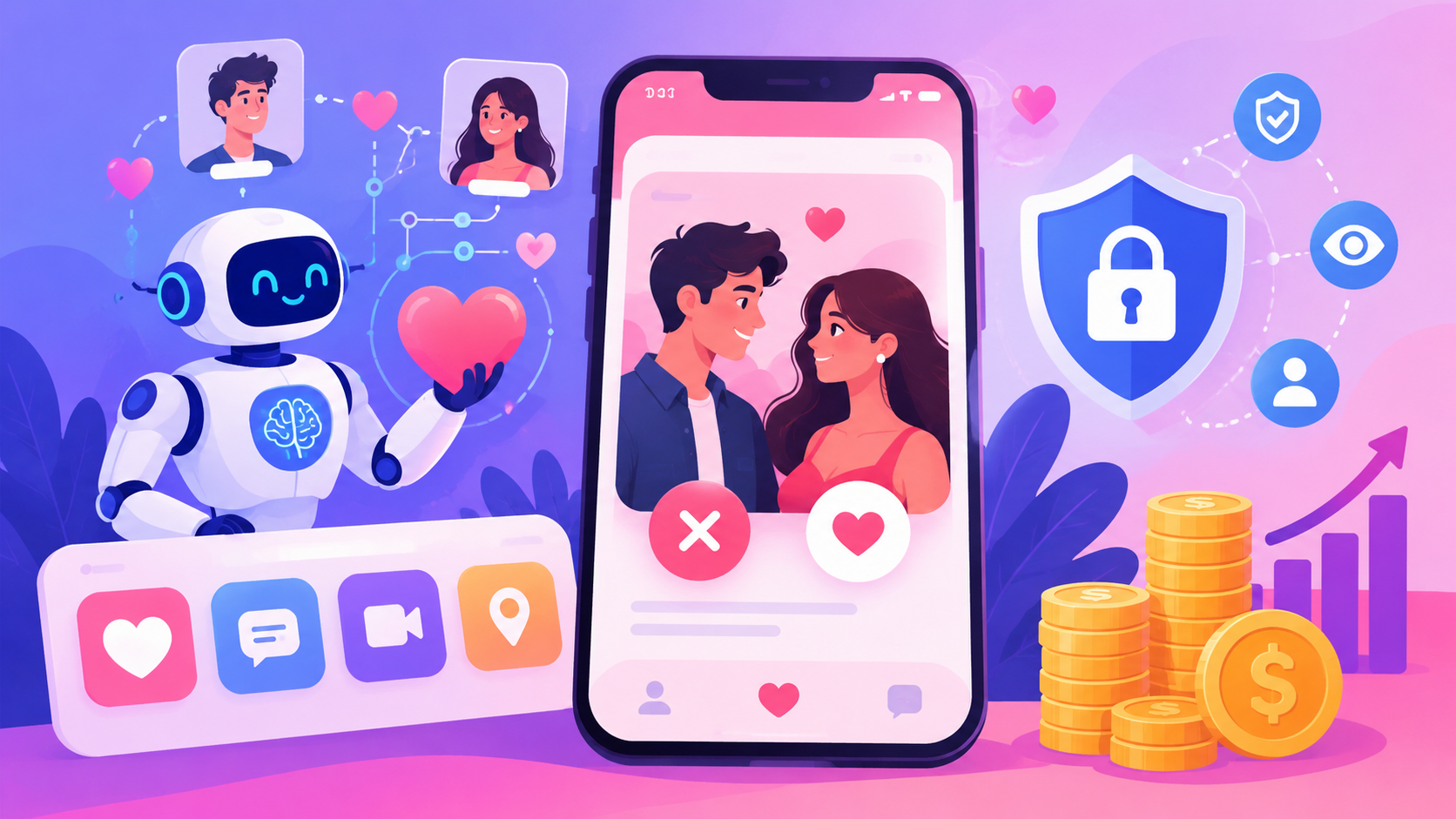
Key Takeaways:
- AI matchmaking uses user preferences, behavior, and relationship goals to suggest compatible partners and improve match quality.
- Essential dating app features include smart matching, selfie verification, in-app messaging, and AI-powered content moderation.
- Identity verification, romance scam detection, biometric data protection, and human moderation help build user trust and safety.
- AI dating app costs range from $8,000 for a basic MVP to $90,000+ for advanced features and integrations.
- Start with a focused MVP, choose a clear dating niche, and plan for privacy compliance, monetization, and ongoing AI model improvements.
Ever matched with someone who turned out to be a bot? It stings. Fake profiles and romance scams push users away fast.
That is the problem behind AI dating app development in 2027. It means building an app that uses machine learning to match people, spot fakes, and verify identity. Skip the safety part, and users leave. Do it well, and trust grows.
Here, we cover benefits, features, safety, verification, privacy, the build process, cost, monetization, challenges, and what comes next.
What Is AI Dating App Development?
AI dating app development is the process of building a dating app that uses machine learning and natural language processing.
It learns user preferences, ranks matches, flags fake profiles, and checks identity, so people meet real and compatible partners safely.
The global online dating market was valued at USD 12.16 billion in 2025 and is projected to reach USD 23.33 billion by 2034, growing at a CAGR of 7.50% during 2026–2034.
What Are the Key Benefits of AI-Based Dating App Development?
AI helps dating apps match people better, block fake accounts, and keep users coming back for the right reasons.
- AI compatibility matching uses behavioral signals and relationship goals to suggest better partners.
- Preference learning improves recommendation accuracy with every swipe, message, and piece of user feedback.
- Fake profile detection and bot detection protect users from romance scams and fraudulent accounts.
- AI content moderation scans messages and images faster than any human team can.
- Conversation starters and profile writing help shy users feel confident and begin real chats.
- Better matches lift user retention, which supports premium subscriptions and long-term revenue.
Top Features to Include in AI Dating Application Development
Great apps mix simple basics with smart AI. Here are seven features, from basic to advanced.
1. Smart Profiles and Onboarding
Good onboarding captures dating preferences, shared interests, and relationship goals in a few taps. Clean data at the start helps every AI model work better later.
2. Location-Based Matching
Users want people nearby. Location-based matching ranks candidates by distance. Add privacy controls so users can hide exact spots. Trust starts with giving people control.
3. In-App Messaging
Chat is where matches become dates. Add read receipts, photo sharing, and report buttons. Planning this early helps you understand the chat app development cost before you commit.
4. AI Compatibility Matching
A hybrid recommendation system blends collaborative filtering and content-based filtering. It scores compatibility and ranks matches by mutual attraction, not just looks.
5. AI Conversation Starters
Many users freeze at "hi". Icebreaker suggestions fix that. Models from OpenAI can draft them. Compare AI APIs for dating app developers for speed, price, and safety.
6. Verification Badges
A selfie check with liveness detection earns a badge. Badges show who is real. In my view, this one feature does more for trust than any design polish.
7. AI Dating Coach and Adaptive Learning
The advanced layer gives profile tips, date ideas, and feedback. It learns from outcomes and improves recommendations over time. Start small, then grow it.
Safety Features Every Dating App Needs
Safety is not a bonus. It is the product. Users stay where they feel protected.
1. AI-Powered Content Moderation
Models screen text, images, voice, and video for nudity, hate, and threats. Risky items go to a review queue. This keeps harmful content away from users fast.
2. Scam, Catfish, and Romance Fraud Detection
Fake profile detection spots stolen photos, copied bios, and odd message patterns. Early warnings reduce romance scams.
3. Harassment and Abusive Behavior Prevention
AI flags insults, threats, and repeat unwanted messages in real time. Warnings, mutes, and bans follow. Clear rules plus quick action build a safer community.
4. In-App Safety Tools
Reporting, blocking, date checks, and a panic button give users control. Make them easy to find. A tool buried in settings does not protect anyone.
5. Protecting Minors and Age Gating
Age assurance blocks underage users. Use ID checks, face age estimates, and strict sign-up rules. This is a legal duty, and the stakes are high.
6. Human Moderation and Escalation Workflows
AI is fast, but it makes mistakes. Trained moderators review hard cases, handle appeals, and suspend accounts fairly. My lesson here is simple. Never leave bans fully to a model.
The Role of Custom AI Dating App Development in Secure User Verification
Real people build real trust. Layer your checks so fakes find it hard to get in.
- Phone number and email verification stop mass sign-ups and offer a quick first filter.
- Selfie verification compares a live photo with profile pictures using facial similarity checks.
- Liveness detection proves a real person is present, not a photo, video, or mask.
- Government ID verification confirms name and age. Providers like Stripe Identity, Jumio, and Entrust offer this.
- Duplicate account detection stops banned users from returning under new names.
- Biometric data protection means encrypting face data and deleting it when no longer needed.
- Verification badges show trust clearly. Follow the NIST Digital Identity Guidelines for identity proofing steps.
How an AI Dating App Ensures Privacy, Data Security, and Compliance
Dating apps hold very personal data. One leak can end a brand, so plan privacy from day one.
1. Handling Sensitive Data
Orientation, location, health, and biometrics need extra care. Use data minimization, user consent, encryption, and clear data retention rules. Collect less, and risk drops.
2. GDPR, CCPA, and Global Privacy Regulations
GDPR and CCPA give users rights to access and delete data. Build these tools early. Strong cybersecurity software development habits keep you ready for audits.
3. Biometric Data Laws
The Illinois Biometric Information Privacy Act, called BIPA, requires written consent before face scans. Fines can be steep. Similar laws exist in other states, so check each one.
4. App Store and Google Play Policies
Both stores have rules for dating apps. They cover age limits, reporting tools, and user-generated content. Break them, and your app can be pulled.
5. Responsible and Transparent AI Practices
Tell users how AI picks their matches. Test models for bias. The NIST AI Risk Management Framework offers a solid guide for this.
Step-by-Step AI Dating App Development Process
This is the heart of the guide. Follow these seven steps in order. Each one saves you money in the next.
1. Market Research and Niche Selection
Do not try to beat Tinder, Bumble, or Hinge at their own game. Pick a niche. Think faith-based, over 40, or hobby-based dating.
Study OkCupid too. It grew by asking smart questions. Talk to 20 target users before writing code.
Hiring a dating app development company can help here. Good partners run product discovery before they quote a price.
2. Defining Your MVP
A dating app MVP should do only a few things well. Keep it tight.
- Sign up and profile creation
- Basic matching with simple AI scoring
- In-app chat
- Selfie verification
- Report and block tools
Leave video dates and AI coaching for version two. You can add them once real users show you what they want.
3. UI/UX Design for Dating Apps
Design should feel warm and fast. Users decide in seconds. Keep swipe or browse screens clean and make safety buttons easy to reach.
Test designs with real people early. A button that makes sense to you may confuse a first-time user. That happens a lot.
4. Building and Training AI Models
Here is where AI shows up. You build or connect models for matching, moderation, and fake profile detection.
Start with a hybrid recommender. Train it on user preference data and behavioral analytics. Use TensorFlow or PyTorch for custom models. Use APIs for faster launches.
If your team lacks ML skills, AI Development Services can fill the gap. Always test models for bias before launch.
Here is a simple tech stack to start with.
|
Layer |
Popular Choices |
Why It Helps |
|
Mobile app |
Flutter, React Native |
One codebase for iOS and Android |
|
Backend |
Node.js, Python |
Fast APIs and easy AI integration |
|
Database |
PostgreSQL |
Reliable and good for user data |
|
AI and ML |
TensorFlow, PyTorch, OpenAI |
Matching, moderation, and chat help |
|
Cloud |
AWS, Google Cloud, Azure |
Scaling and secure hosting |
|
Verification |
Stripe Identity, Jumio, Entrust |
Selfie, liveness, and ID checks |
5. Development, QA, and Security Testing
Build in small sprints. Test every release. Quality assurance should cover bugs, speed, and model accuracy.
Run penetration tests before launch. Check how the app handles fake accounts, spam, and stolen data. Fix gaps now, not after the news story.
6. Launch Strategy and Cold Start Problem Solutions
An empty dating app feels dead. This is the cold start problem. Launch in one city or one campus first.
Invite a balanced mix of men and women. Use waitlists and referral rewards. A smaller, active pool beats a big, empty one every time.
7. Post-Launch Iteration and Model Improvement
Launch is day one, not the finish line. Track match rates, message replies, reports, and churn.
Retrain models with fresh data each month. Read user feedback weekly. The best apps keep improving, and users notice.
AI Dating App Development Cost in 2027
Dating app development cost depends on features, AI depth, and team location. These are rough estimates, so get quotes before you plan.
|
Build Level |
Estimated Cost |
Timeline |
Best For |
|
Basic MVP |
$8,000 to $20,000 |
3 to 4 months |
Startups testing one niche |
|
Mid-level AI app |
$20,000 to $45,000 |
4 to 6 months |
Growing apps with smart matching |
|
Advanced AI app |
$45,000 to $90,000+ |
6 to 10 months |
Large apps with video, coaching, and moderation |
How Artificial Intelligence Dating App Development Creates New Revenue Opportunities
Money should follow trust. Charge for value, not for fear.
- Freemium subscriptions give basic matching for free and unlock extra filters and likes for paying users.
- Premium plans can add priority matches, read receipts, and advanced AI compatibility reports.
- In-app purchases let users buy profile boosts, super likes, or extra messages.
- AI dating coach add-ons can charge for profile reviews, date ideas, and chat tips.
- Verified member tiers can offer safer, ID-checked communities for a small monthly fee.
- Partner offers, like date night deals, can bring extra income if they fit your brand.
Common Challenges in AI Dating Platform Development and How to Overcome Them
Every AI dating app team faces these hurdles. Plan for each one early, and your launch gets much smoother.
1. Cold Start Problem
Challenge: A new app has few users, so match recommendations feel weak. People leave before the AI can learn their preferences.
Solution: Launch in one city first. Use simple rules for candidate ranking, then add preference learning as user feedback grows.
2. Fake Profiles and Romance Scams
Challenge: Bots and fraudulent accounts copy photos and target lonely users. Romance scams erode trust and drive users away fast.
Solution: Combine selfie matching, liveness detection, and AI scam alerts. Send flagged accounts to human moderators for review.
3. Biased Matching Results
Challenge: Recommendation models can repeat old patterns. Some groups may see fewer matches because of skewed training data.
Solution: Audit match ranking by group and retrain on balanced data. Follow the NIST AI Risk Management Framework for guidance.
4. Privacy and Compliance Risks
Challenge: GDPR, CCPA, and BIPA rules are strict. One mistake with biometric data or user consent can mean heavy fines.
Solution: Practise data minimization, get clear consent, and use encryption. Have a legal expert review every launch and update.
5. Rising AI and Cloud Costs
Challenge: Third-party API fees and cloud hosting bills climb quickly. Scaling to more users can strain your maintenance budget.
Solution: Cache results, use smaller models where possible, and track cost per active user each month. Review vendor fees often.
Future of AI Dating Apps Beyond 2027
The next wave feels more personal. Apps will act less like catalogs and more like helpers.
1. AI Companions and Virtual Date Assistants
Virtual assistants may plan dates, remind you to check in, and coach your chats. The key is consent and clear limits. Users must know when they talk to AI.
2. AR/VR and Immersive Dating
Imagine a first date in a virtual cafe before meeting in person. AR and VR can lower risk and ease nerves. Cost and comfort will decide how fast this grows.
3. Voice-First and Video-First Matching
People trust voices and faces more than text. Voice intros and short video profiles will help users spot real people. Add liveness checks to keep it safe.
Conclusion
AI Dating App Development in 2027 is about more than clever matching. It is about trust. Strong compatibility scoring, scam detection, identity verification, and privacy rules work together.
Start with a tight MVP, choose a clear niche, and test every model. Budget for safety and maintenance, not just launch.
Follow NIST guidance, respect GDPR, CCPA, and BIPA, and keep humans in the loop. Do that, and your app earns real trust.
FAQ's
A basic MVP may cost 8,000–20,000, while advanced platforms can exceed $90,000, depending on features and complexity.
A basic app may take 3–4 months, while feature-rich platforms can take 6–10 months or longer.
AI analyzes user preferences, interests, relationship goals, and feedback to recommend potentially compatible partners.
Start with smart matching, profile recommendations, chat, scam detection, selfie verification, and content moderation.
They can analyze suspicious behavior, duplicate photos, unusual messages, and account activity to flag potentially fraudulent profiles.
They can use phone checks, selfie matching, liveness detection, and government ID verification through trusted providers.
Common choices include Flutter, React Native, Python, PostgreSQL, cloud platforms, and machine learning frameworks such as PyTorch.
Revenue can come from premium subscriptions, profile boosts, paid filters, AI coaching, and optional in-app purchases.

CrinPro
CrinPro Solutions is a leading IT company that helps startups and enterprises build innovative digital products. From intuitive mobile applications and high-performance websites to AI-powered solutions and enterprise software, our team delivers scalable, secure, and user-focused products tailored to unique business needs. With expertise across multiple industries, we transform ideas into digital experiences that drive growth, improve efficiency, and create long-term business value.